
There is something extraordinarily revealing about the art a person chooses to live with. Not the art they display for others, to impress or signal taste, but the art that hangs in private rooms, the images that become part of the daily backdrop of a life. The painting you look at every morning. The photograph framed on a wall you pass a hundred times a day without consciously registering it. These choices are rarely random. They are expressions of an inner world, of what a person finds beautiful, necessary, or true.
When police entered Apartment 213 on the night of July 22, 1991, they catalogued everything. Among the evidence was something that most accounts treat as peripheral detail — the art on Jeffrey Dahmer’s walls. But those walls, and what hung on them, tell a story that is worth examining carefully.
The Living Room
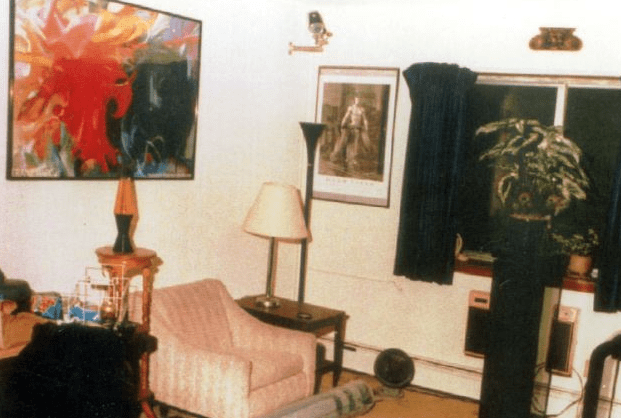
Brian Masters, in The Shrine of Jeffrey Dahmer, describes the living room that Officers Mueller and Rauth first encountered as “small but pleasantly furnished” — an oriental rug, blue curtains, a healthy pot-plant on a tall pedestal, a large comfortable armchair. And then, quietly noted: “some fine pictures on the wall, and one framed picture of a naked male model.”
The word “fine” is significant. Masters is a precise writer, and he is not using the word carelessly. The pictures were not crude or squalid. They were fine — chosen with something like care, something like taste. This was not a bare or neglected space. It was a room in which someone had made deliberate aesthetic decisions.
Fighting Forms — Franz Marc, 1914
The most significant work in Jeffrey Dahmer’s apartment was a reproduction of Fighting Forms, painted by the German Expressionist Franz Marc in 1914.
Marc was a founding member of Der Blaue Reiter — The Blue Rider — a group of artists who believed that colour and form could express the spiritual world more truthfully than representation ever could. He had a deep, almost religious reverence for animals, seeing in them an innocence and purity that humanity had lost. He developed a precise and personal theory of colour symbolism: blue for the spiritual and masculine, yellow for the feminine and joyful, red for violence and passion.
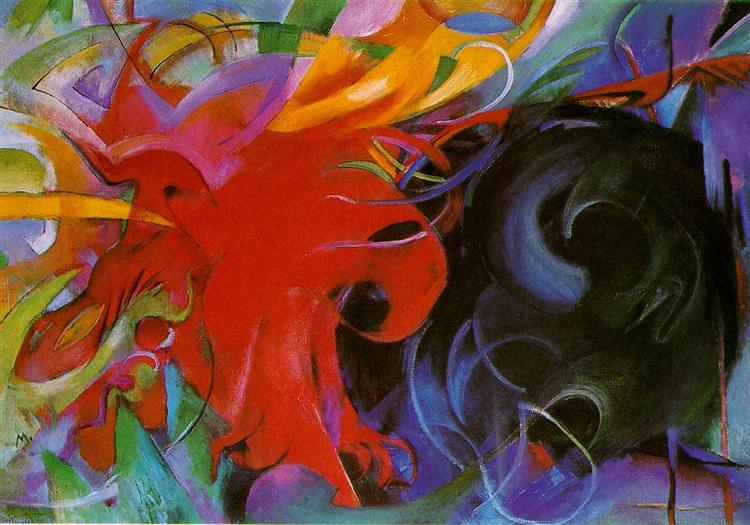
Fighting Forms was painted in the final months before the First World War. It is one of the most abstract works Marc ever produced — two opposing forces, one dominated by violent, churning red, the other by deep, absorptive black, locked in a collision that has no resolution and no clear victor. There are no animals, no recognisable figures. There is only the pure language of colour and form, expressing what Marc called “the spiritual essence of things.” It is one of a series of four works he painted that year — Playing Forms, Forms in Combat, Cheerful Forms (now destroyed), and Fighting Forms. Three months after completing them, Marc enlisted in the German Army. He was killed at the Battle of Verdun on March 4, 1916, before orders could reach him to withdraw from the front.
That Jeffrey Dahmer owned a reproduction of this painting — that he looked at it every day — is not a trivial detail.
Fighting Forms is a painting about two irreconcilable forces. About the impossibility of harmony between opposing natures. About something that cannot be stopped, something that moves toward its end with the logic of a natural force, indifferent to the damage it causes. Marc painted it on the edge of a war he could feel coming but not prevent. He painted it as a man who had run out of animals to use as symbols for the duality he felt in the world, and had moved instead to pure abstraction — to the forces themselves, stripped of any mediating form.
Jeffrey Dahmer stood before this painting in his living room. He lived with it. Whatever drew him to it, whatever he saw in those two churning, colliding masses of red and black, was something he felt the need to look at every day.
Behind the Door — Archaeological Reminiscence of Millet’s Angelus
The third work identified from Apartment 213 hung in the least public place of all — the back of the front door itself. A print of Archaeological Reminiscence of Millet’s Angelus, painted by Salvador Dalí in 1933–35.

Dalí built the piece around Jean-François Millet’s The Angelus (1857–59), a quiet painting of two peasants pausing at dusk to pray over a basket between them. Dalí became privately convinced the painting wasn’t really about a harvest at all — that Millet had originally painted a child’s coffin between the two figures and painted over it. He was, eventually, proven right: an X-ray of Millet’s canvas later revealed a rectangular, coffin-like form beneath the visible basket. Dalí spent years reworking the image obsessively, and in this version the two humble peasants become towering, hollowed-out ruins — stone monuments eroded by time, facing each other across an empty plain, with actual architectural wreckage crumbling at their feet.
That this was the image chosen for the door — not the living room, not the bedroom, but the threshold itself, the last thing seen leaving and the first thing seen coming home — is difficult to read as accidental. Whether or not Jeffrey knew the painting’s buried history, he lived daily with a reworking of a scene about grief hidden beneath a scene of quiet ritual. Two monumental figures, worn down to their structure, facing each other over a landscape of ruins.
The Photographs
In the bedroom and hallway, the art took a different form. Masters documents “framed photographs and posters of male nudes taken in ‘artistic’ poses and clearly intended to be attractive to a homosexual man.” These were not the Polaroids — those were hidden. These were displayed. Framed. Hung. Chosen for the walls in the way anyone might choose art for the walls of their home.
The distinction matters. Jeffrey Dahmer was a man who separated, with care, what was private from what was visible. The framed photographs of male nudes in artistic poses were not hidden. They were part of the apartment’s decoration — the legitimate, curated face of his aesthetic world.
We know from Brian Masters’ account of his adolescence that from a young age Jeffrey was drawn to the male form with a specific intensity: the chest, the abdomen, the smooth musculature of the body without its personhood. The magazines he sought out as a teenager were those showing “photographs of muscular torsos and hairless chests.” The fantasy that formed in those years was not of relationship, but of possession — of being close to something beautiful and keeping it. The photographs on his walls were the legal, visible expression of the same impulse. The male body as aesthetic object. Beautiful and arrested.
Three specific works have been identified among the photographs displayed in Apartment 213:
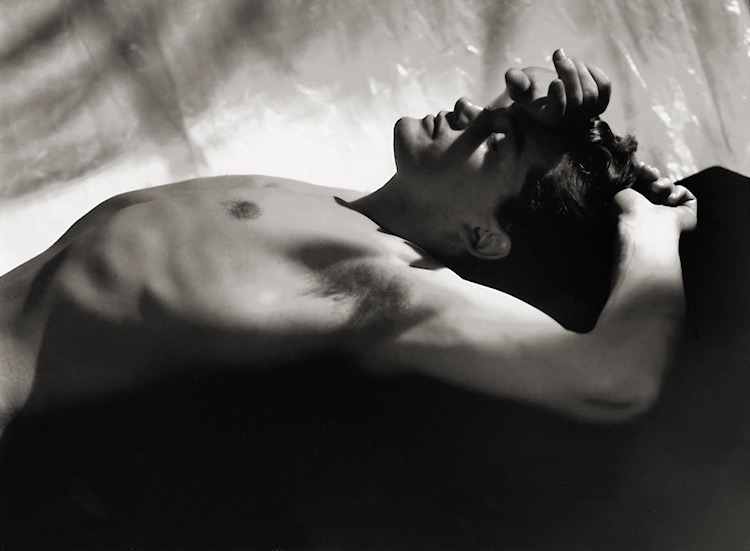
Jean Marais — Raymond Voinquel, 1938. A black and white fine art photograph of French actor and cultural icon Jean Marais, shot by one of France’s foremost portrait photographers. Marais reclines, bare-chested, in dramatic chiaroscuro light — the image has the quality of classical painting, the body rendered with the same reverence one might give to sculpture.
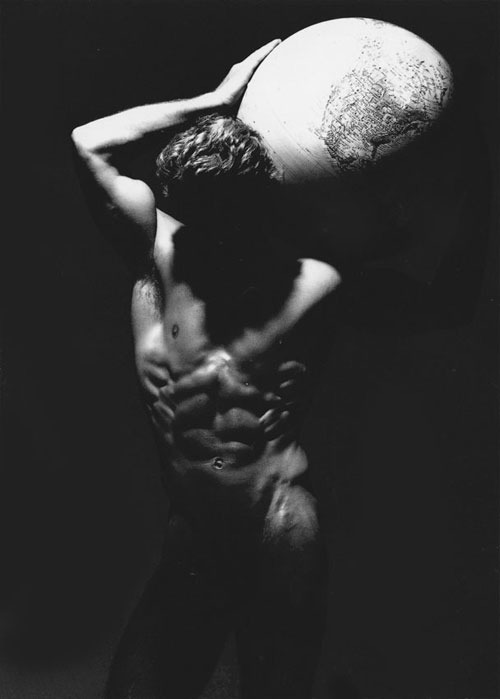
LA Nude — Victor Skrebneski, 1984. Skrebneski was a Chicago-based master of black and white photography known for his classical, sculptural approach to the body. In this image, a nude male figure carries a globe on his shoulders in the pose of Atlas — shot from below, the musculature lit dramatically against deep black. The body as architecture. The body as myth.
Fred with Tires — Herb Ritts, 1984. One of the most iconic images in twentieth century photography, and the photograph widely credited with launching Ritts’ career. A nude male figure leans against a stack of tyres, the industrial setting in stark contrast with the classical beauty of the body. Ritts — along with Robert Mapplethorpe and Bruce Weber — provoked a radical change in how the nude was depicted in the 1980s.

The Altar That Was Never Built
There was a third layer to Jeffrey Dahmer’s visual world — one that existed only in drawings and notes found in the apartment. He had been planning what he called a shrine: a precisely designed aesthetic space, hand-drawn in plans that specified colours and materials. Black carpet. Black plush chair. Windows covered with black shower curtains. A black table. Fluorescent eyes set into a wall plaque. And along the table — painted skulls, arranged in a composition.
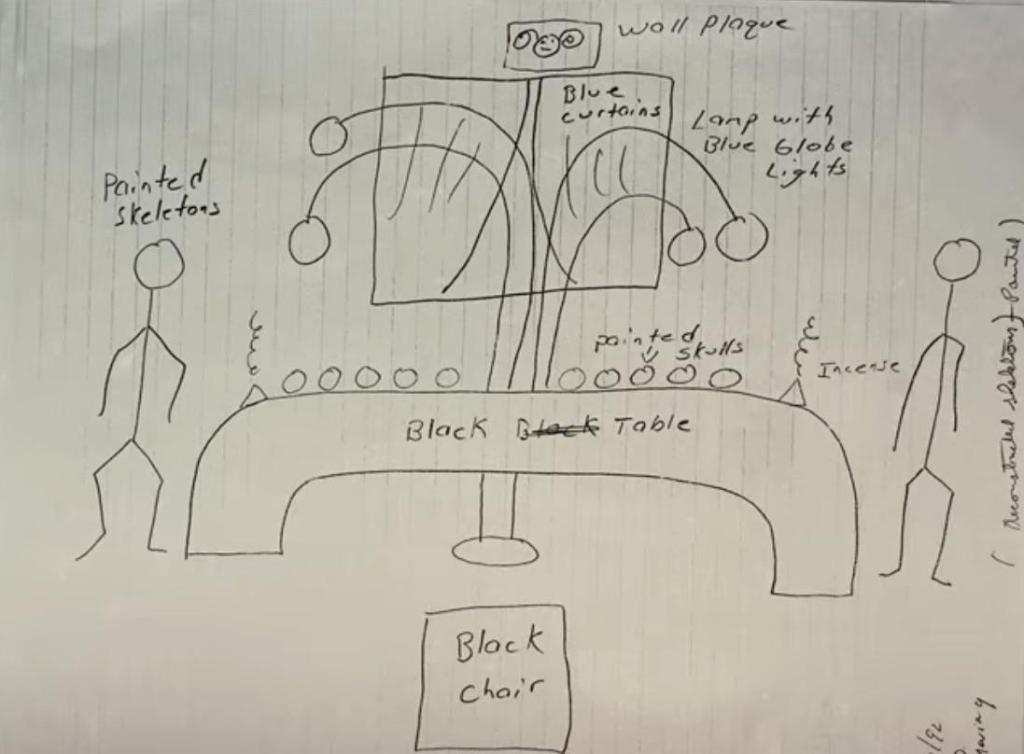
He wanted to build something. He wanted to create an environment, an interior world made entirely to his own specifications, expressing the aesthetic of his deepest and most damaged desires. The shrine was never completed. But its plans reveal something important: Jeffrey Dahmer thought in visual terms. He composed. He arranged. He had a sense of what things should look like, of the emotional effect of colour and placement and form. He was, in the saddest and most terrible sense, an artist of a kind — one whose medium had become irredeemable.
The Drawings
In prison, Jeffrey received letters. Many of them. And to some of those who wrote, he wrote back — and drew.
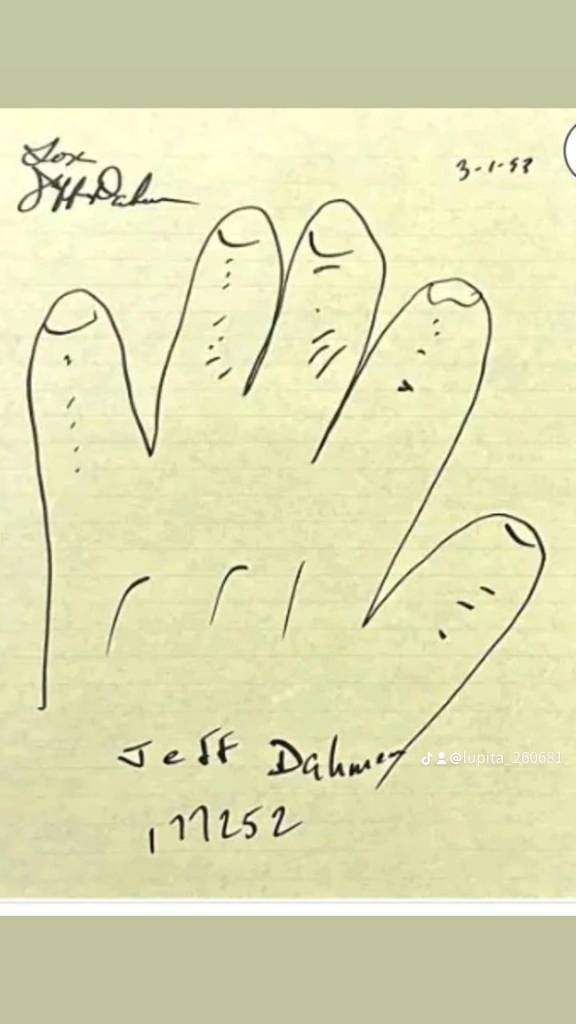
What survives in circulation are small, intimate things. A hand tracing on lined paper, dated March 1, 1993 — his signature above it, J.H. Dahmer, and below the outline of his fingers: Jeff Dahmer. 177252. His name and his number. He placed his hand flat on the paper, traced around it, and sent it to a stranger. There is something almost unbearably human about that gesture — the oldest mark a person can make, the first thing children do with a piece of paper and a pen.
And then there is the sketch labelled in his own handwriting: my leg and foot. A pencil drawing, careful and observational, of his own body. He looked at himself and drew what he saw. Not a fantasy, not an abstraction — just his leg, his foot, rendered with quiet attention.
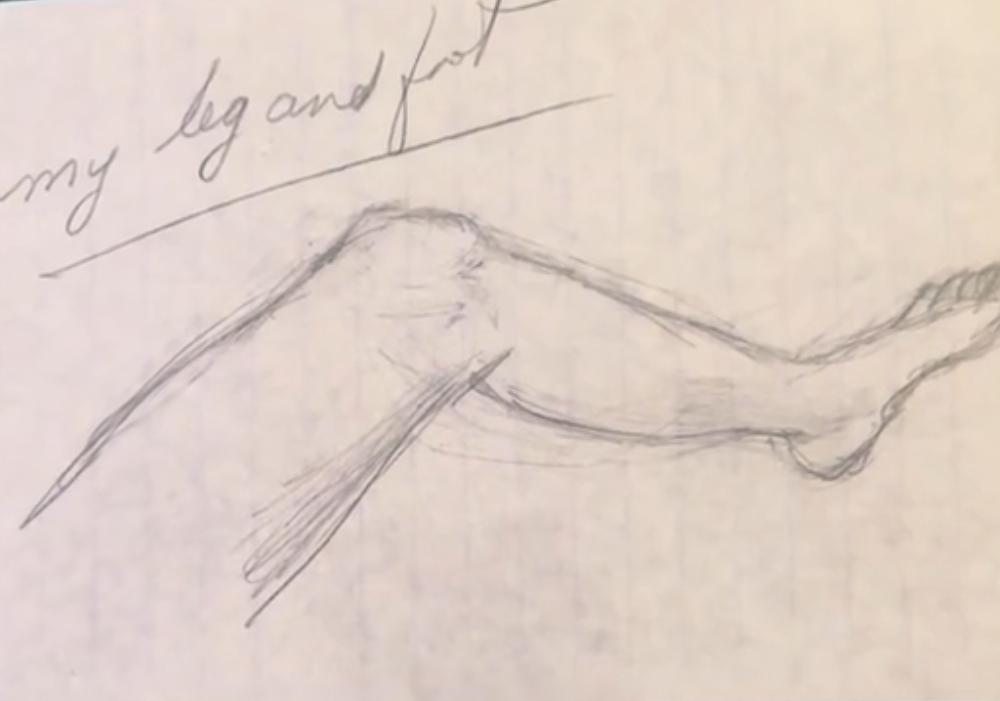
These drawings belong in any serious examination of Jeffrey Dahmer’s visual world. They are not the work of a man who had stopped seeing. He was still looking — at his hand, at his body, at the world around him — and still finding it worth recording. The same impulse that hung Fighting Forms on his living room wall, that sketched plans for a shrine he would never build, was still alive in cell 177252. Diminished, constrained, reaching through a pen and a piece of lined paper — but alive.
What the Art Tells Us
There is a version of Jeffrey Dahmer’s story that presents him as simply monstrous — a man without inner life, without feeling, without the kind of interior world that makes a person legible as human. The art on his walls pushes back against that version.
A man who chooses Fighting Forms to live with is a man who feels the conflict in himself — the red and the black, the two forces that cannot be reconciled — and who finds in abstraction a language for something he cannot otherwise name.
A man who frames a 1938 vintage photograph by one of France’s greatest portrait photographers, alongside two of the defining works of 1980s art photography — Skrebneski and Herb Ritts — is not a man without aesthetic knowledge or taste. He had a curated collection. He chose with intention.
A man who draws detailed plans for a shrine — who specifies fluorescent eyes and painted skulls and the precise quality of black he wants — is a man with an interior aesthetic world that is coherent, structured, and deeply felt.
And a man who traces his own hand on a piece of lined paper and sends it to a stranger — who sketches his leg and labels it in his own handwriting — is a man who was still present. Still here. Still marking his existence in the only ways left available to him.
None of this excuses anything. It does not soften the crimes or their consequences. But it is part of the truth of who Jeffrey Dahmer was. And this memorial exists to hold the full truth, however uncomfortable — to see the human being behind the name, however much the world has decided that is not worth doing.
The art on his walls was part of his inner life. It deserves to be seen as such.
Sources: Brian Masters, The Shrine of Jeffrey Dahmer (1992); Milwaukee Police Department inventory, July 1991; Franz Marc, Fighting Forms (1914), Bayerische Staatsgemäldesammlungen, Munich; Raymond Voinquel, Jean Marais (1938); Victor Skrebneski, LA Nude (1984); Herb Ritts, Fred with Tires (1984).


