In The Woman Who Drove Away, we used the case of Karen Greenlee to argue that Jeffrey was not a preferential necrophile. This piece asks the same question about the word most often attached to his name: cannibal. The Milwaukee Cannibal. It is in the headlines, the documentary titles, the true-crime thumbnails.
The answer is not a denial. Jeffrey ate parts of some of his victims, and he said so himself. The real question is what cannibalism was for him. Was it the centre of his pathology, or something at its edges? To answer that, it helps to look at a man for whom it was unmistakably the centre.
Renée
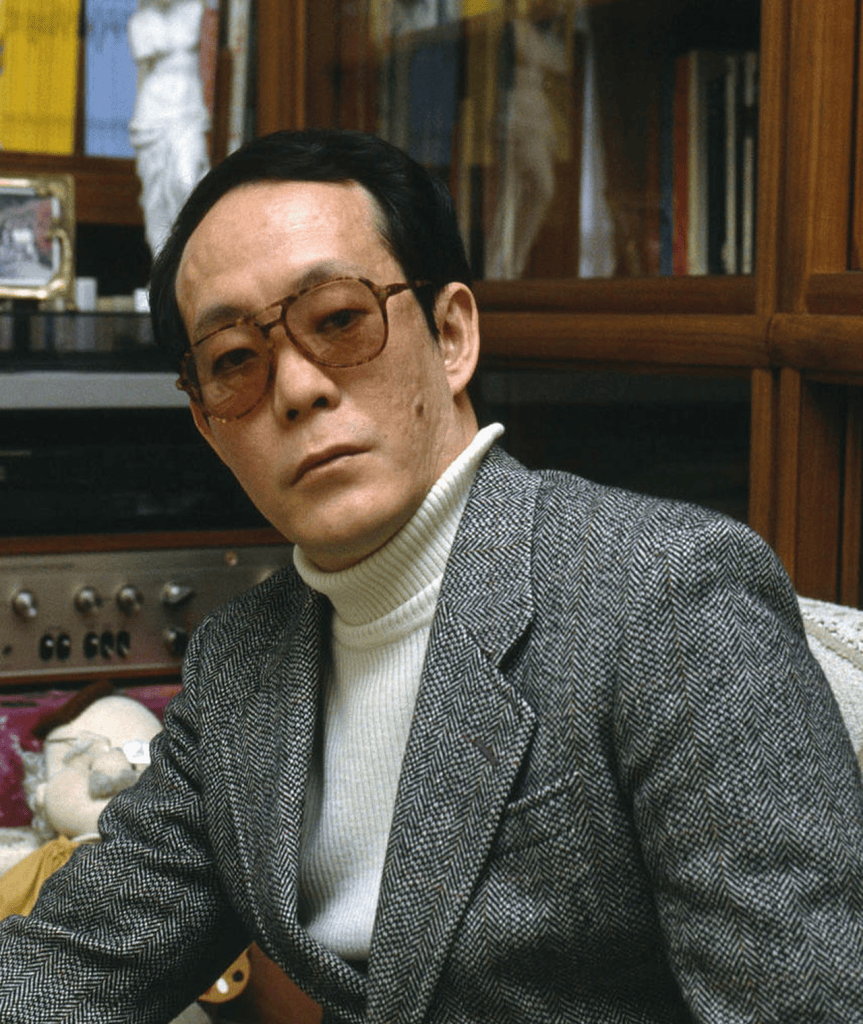
Her name comes first. Renée Hartevelt, born in 1955, was a Dutch student of French literature at the Sorbonne. She was 25. On 11 June 1981, her classmate Issei Sagawa, then 32, invited her to his apartment at 10 Rue Erlanger under the pretext of translating poetry for a school assignment. While she read at a desk with her back to him, he shot her in the neck with a rifle.
Over the following days he violated her body and ate parts of it. He then tried to dispose of her remains in the Bois de Boulogne, where he was arrested. Her name is far less known than his. On this site, we try to keep that order right.
A desire that came first
What makes Sagawa’s case so clarifying is how openly the act was the fantasy. He traced his cannibalistic desires back to the first grade. Years before Paris, in Japan, he tried to take flesh from a sleeping woman, but she woke and fought him off; he was charged with attempted rape and never revealed his real intention to the authorities.
He chose Renée, by his own account, because of the health and beauty he believed he lacked, describing a wish to absorb her energy. Decades later, he told an interviewer that his ultimate intention had been to eat her, not necessarily to kill her. Speaking to Vice, he described how “My desire to eat a woman had changed into an obligation.”
For Sagawa, killing was the means. Eating was the end. The fantasy began with the mouth and ended there.
What Jeffrey said
Jeffrey’s own words point somewhere else entirely.
In his supplementary report of 24 July 1991, Detective Patrick Kennedy recorded Jeffrey’s account of his motive. He said he would have preferred his victims to stay alive, but that “it was better to have them with him dead than to have them leave.” When he sensed someone was about to go, that was when he decided to kill.
The same report records his explanation of the cannibalism: eating parts of a victim was “his way of keeping them with him even longer and making his victims part of himself.” He said much the same to Dr Judith Becker, telling her that it made him feel as though they were “even more a part of me,” as quoted in Brian Masters’ The Shrine of Jeffrey Dahmer.
When FBI profiler Robert Ressler asked what lay at the root of his fantasies, Jeffrey answered that it all revolved around “having complete control.” Asked what had aroused him after the death of Steven Hicks, he replied: “By the captivity.”
Masters, who had access to Dr Kenneth Smail’s interviews, notes that the cannibalism was a fairly late development in Jeffrey’s offending and did not apply to all of his victims. It was not where the story began.
The shape of each fantasy
Put the two men side by side and the difference is structural.
In Sagawa’s case, the object of desire was the act of eating itself. It was lifelong, it came first, and everything else, including the killing, served it.
In Jeffrey’s case, the object of desire was a companion who could not leave. The killing served that wish. So did the keeping: the photographs, the skulls, the planned temple, the failed attempts to create a living “zombie” who would stay. The cannibalism was one more expression of the same impossible wish, arriving late and appearing only sometimes. He ate in the way he did everything else: to hold on to someone.
This is the same distinction we drew with Karen Greenlee. Greenlee’s desire was directed at the dead as such. Jeffrey’s was directed at a person he could not keep alive and would not let go. Both the necrophilia and the cannibalism were terrible consequences of that loneliness, not its source.
None of this makes what he did less horrifying. It makes it more precise.
Two reckonings
The cases diverge again in what came after.
French medical experts deemed Sagawa unfit for trial in 1983, and he was held in a psychiatric institution before being deported to Japan the following year. Japanese authorities ruled him sane, but could not obtain his case files because the French case had been closed, and so he walked free. He checked himself out of Matsuzawa Hospital on 12 August 1986 and remained free until his death.
He then built a career from what he had done. He wrote a memoir, In the Fog, detailing the murder, appeared in adult films, and sold paintings of naked women. He also wrote about other crimes, including a book on the 1997 Kobe child murders. Throughout his life, he showed no remorse. He died of pneumonia on 24 November 2022, aged 73, with a funeral attended only by relatives. He was never tried for Renée’s death.
Jeffrey waived his right to a lawyer during interrogation and confessed in exhaustive detail. He pleaded guilty but insane, was found sane by a jury in February 1992, and received fifteen consecutive life sentences in Wisconsin, followed by another in Ohio. He told the court he did not want to be free. He never profited from his crimes, and he was killed in prison in November 1994.
We are not ranking these men against each other. We are noting that one sought an audience, and the other sought an ending.
Why the word matters
“Cannibal” does a lot of work in the public image of Jeffrey Dahmer. It turns him into a creature of appetite, something from a horror film. That image is easier to live with than the truth, which is that his crimes grew from something recognisably human: a terror of being left, pushed to a monstrous extreme.
Sagawa is what the word actually describes. Jeffrey is something else, and understanding that difference is part of seeing both him and his victims clearly.
Sources
Det. Patrick Kennedy, Milwaukee Police Department supplementary report, 24 July 1991
Robert K. Ressler, I Have Lived in the Monster (1997), interview with Jeffrey Dahmer
Brian Masters, The Shrine of Jeffrey Dahmer (1993)
AFP, “Japanese cannibal who walked free dies age 73,” December 2022
Newsweek, “Issei Sagawa Dead: Why Notorious Cannibal Killer Never Saw Jail,” December 2022
A personal essay on the post-attack photograph of Jeffrey Dahmer that circulates online — why its treatment breaks with how we protect the dead, and how it has been used as a weapon against the living who write about him.
I am not going to describe it to you. If you are reading this, you almost certainly already know which photograph I mean — it has been circulated so widely, for so long, with so little resistance, that description has become unnecessary. That is itself the problem I want to write about.
On 28 November 1994, Jeffrey was attacked in the Columbia Correctional Institution and died the next day. In the interval between the attack and his death, a photograph was taken of him — injured, restrained by medical equipment, alive but only barely. That photograph exists. It should never have left the room it was taken in. It has been circulating for decades regardless, appearing in slideshows, forum posts, “documentary” video essays, and — for those of us who run spaces like this one — occasionally in our own inboxes, sent to us by strangers who know exactly what they are doing.
What We Don’t Do With the Dead
Every serious newsroom and every serious archive operates under a shared, mostly unwritten rule: you do not publish autopsy photographs. You do not publish crime scene photographs of a victim’s body. You do not publish a person’s final, most vulnerable moment for an audience to consume. This isn’t a legal requirement in most cases — it’s an ethical one, built over a long time, for a simple reason: a person’s suffering does not become public property just because the public is curious about it. Families are protected from this. Victims are protected from this. It is one of the few places where our culture still draws a hard line around dignity.
Jeffrey’s photograph sits outside that line. It circulates freely, captioned, reposted, used as a punchline or a piece of “closure” content, entirely unprotected by the norm that would shield almost anyone else’s worst moment from public consumption. And the reason is not subtle. It is that the people trading it have decided, somewhere along the way, that he forfeited the right to that protection — that what he did in life means his death is fair game, his suffering is entertainment, his most helpless moment is something other people are entitled to see.
I want to be completely clear, because this memorial has never once asked anyone to look away from what he did: seventeen people are dead because of him. That fact does not move, and nothing in this essay is asking it to. But the dignity of a corpse and the guilt of the person who once inhabited it are two separate questions, and our culture has quietly decided — through the sheer fact of how freely this image travels — that in his case, only one of those questions still matters.
The Photograph as Weapon
I did not go looking for this image. It found me, the way it finds most people connected to this work — sent by a stranger, unprompted, into a DM, timed for whatever moment would make it land hardest. It is used deliberately. Not to inform, not to document, but to hurt: to hurt anyone who has ever expressed sympathy for him, to hurt anyone doing the kind of careful, difficult work this memorial does, to hurt me specifically, for daring to hold both truths — that he did something unforgivable and that he was also a person whose ending deserved something better than becoming a weapon.
That is the part I need people to sit with. A photograph of a dying man’s face has become ammunition. Every time it’s sent, forwarded, reposted with a gloating caption, someone is using another human being’s final hours as a tool to punish the living. It does not punish him. He is not here to be hurt by it. It only ever lands on the people who are.
Why I’m Not Looking Away From This
I write often about difficult things on this site, and I try to write about them with rigor rather than sentiment. This piece is different, and I want to say so honestly: it is personal. Seeing that image, even unwillingly, even for the fraction of a second it takes to block and report the person who sent it, does something to me that doesn’t fully go away. I don’t think I’m alone in that, among the people who do work like this.
But I don’t think the answer is to stop saying so. Part of what this memorial exists to argue is that dignity isn’t conditional on innocence, and that the way we treat the dead says something true about us regardless of what the dead once did. A photograph like this one — traded like a trophy, weaponised against the living, stripped of every protection we’d extend automatically to almost anyone else — is not a neutral historical document. It is a small, ongoing act of disrespect, repeated every time someone shares it for the reaction rather than the record.
I’m not asking anyone to forget what happened in that apartment. I am asking whether a dying man’s face was ever supposed to be public property, and why so few people have thought to ask that question before now.
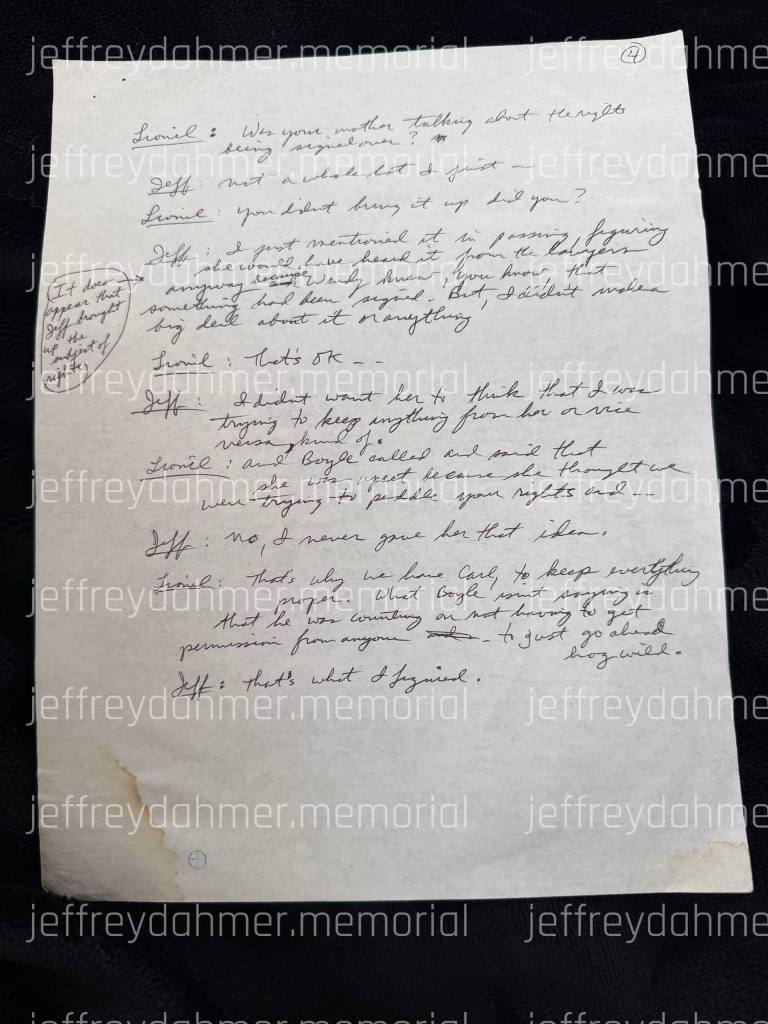
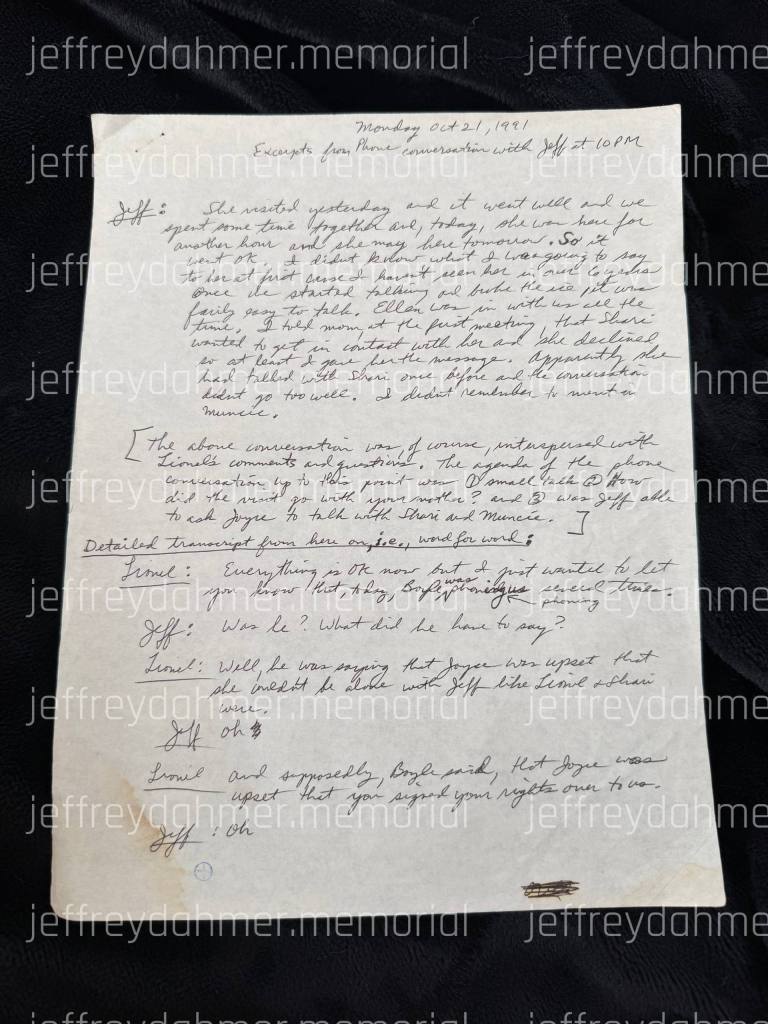
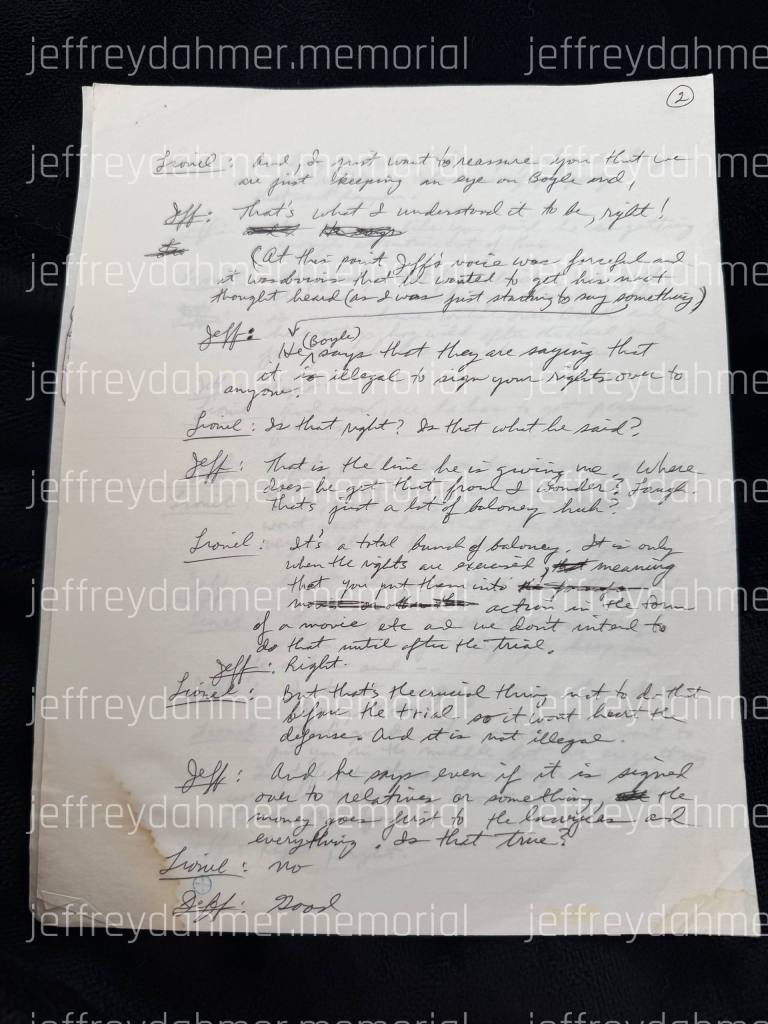
There is a moment on the first page of this document where a father stops summarising his son and starts transcribing him. It happens mid-page, marked by a single underlined sentence: Detailed transcript from here on, i.e., word for word.
Everything before that line is paraphrase. Everything after it is preserved exactly. And what falls on either side of that boundary tells us more about the Dahmer family in the autumn of 1991 than almost any other document we have seen.
The Document
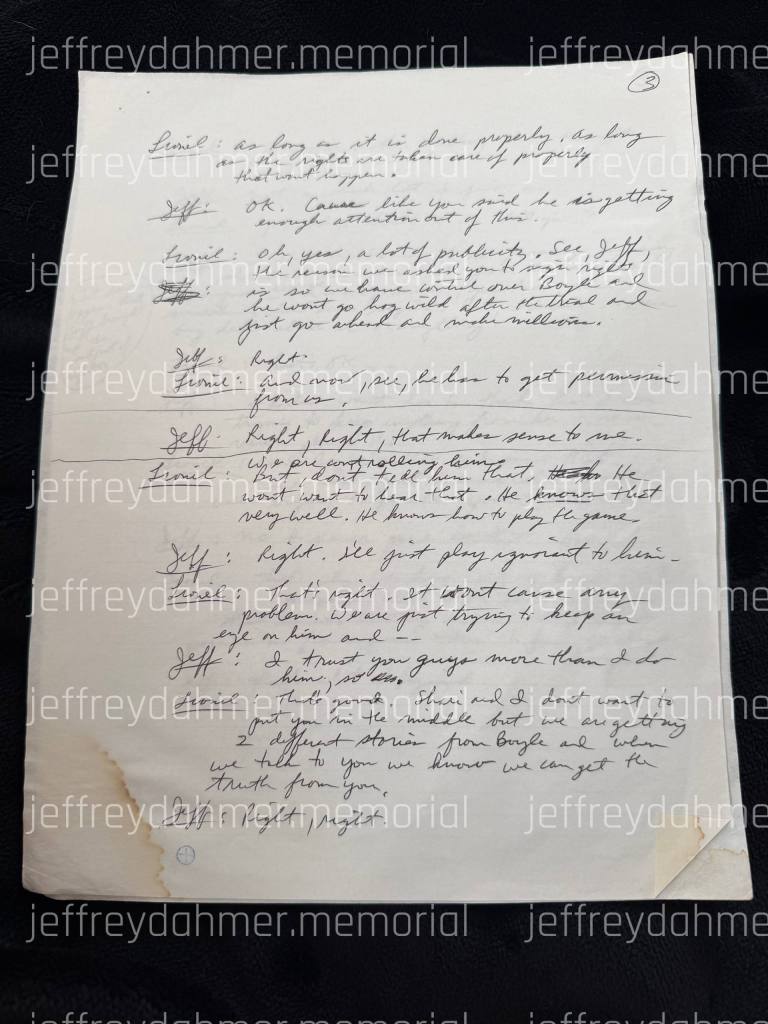
The pages consist of Lionel Dahmer’s handwritten record of a telephone call with his son, headed Monday, Oct 21, 1991 — Excerpts from Phone conversation with Jeff at 10 PM. The sheets are numbered in the upper right; the memorial holds pages three and four alongside the opening page.
The date places it precisely. Jeffrey had been arrested on 22 July 1991, three months earlier. His trial would begin at the end of January 1992, three months later. This is the middle of that winter — the period when the family was absorbing what had happened and, simultaneously, discovering that what had happened was now an asset that other people wanted.
A note on provenance, in keeping with this memorial’s practice: these pages came to us through a private contributor. Each bears a small registration mark at the lower left, indicating they are reproductions from a copied or archived set rather than original leaves. We have not been able to independently authenticate the hand against a verified exemplar, and we present them as what they appear to be rather than as what we can prove. Readers should weigh them accordingly. What follows is analysis of the text as it stands, with brief quotation only.
The Line Down the Middle
The call opens with Jeffrey talking about his mother.
Joyce had visited him. She had come the previous day, stayed a while; she came again that day for another hour; she might come again tomorrow. Jeffrey says he had not known what he was going to say to her at first, because he had not seen her in over six years. Once she started talking, he says, the ice broke and it became fairly easy.
Consider what is contained in those few sentences. A man of thirty-one, three months into permanent incarceration, sitting across from a mother he had not seen since his mid-twenties, not knowing how to begin. The ice breaking. An hour, then perhaps another tomorrow.
Lionel summarises it in a short paragraph.
He then adds a bracketed editorial note explaining that his own comments and questions have been omitted, and lays out the agenda of the call in numbered points: small talk; how the visit with Jeffrey’s mother went; and whether Jeffrey had been able to ask Joyce to speak with Shari and with Muncie.
And then, underlined: Detailed transcript from here on, i.e., word for word.
What follows, recorded exactly, is a conversation about publicity rights.
We do not think Lionel did this cruelly, and we will return to that. But the boundary is real and it is his. Faced with a call containing both his son’s first contact with his mother in six years and a dispute over legal control of the family’s story, he judged one worth compressing and the other worth preserving syllable by syllable. He was not keeping a record of his son. He was keeping a record of a negotiation.
“I’ll Just Play Ignorant to Him”
The transcribed portion begins with Lionel reporting that Gerald Boyle — Jeffrey’s own defence attorney — had telephoned the family several times that day. Boyle relayed that Joyce was upset she could not be alone with Jeffrey the way Lionel and Shari could, and upset that Jeffrey had signed his rights over to them.
Jeffrey’s response, twice, is a single syllable. Oh.
Lionel then explains the reasoning behind the signing. The purpose, he tells his son, was to have control over Boyle, so that after the trial he could not go — the phrase is Lionel’s — hog wild and make millions. Now, he points out, Boyle has to get permission from them.
Jeffrey agrees. Right, right, that makes sense to me.
Then comes the passage that should stop any reader.
Lionel begins to say that they are controlling Boyle, crosses it out mid-sentence, and instead instructs his son not to tell him — Boyle would not want to hear it, though he knows very well how the game is played.
Jeffrey answers: Right. I’ll just play ignorant to him.
Eleven weeks before a trial at which Gerald Boyle would stand up and argue for his life, Jeffrey Dahmer was asked by his father to conceal something from that attorney, and agreed within a single line. He then went further than he was asked, volunteering that he trusted his father and stepmother more than he trusted his own lawyer.
There is no resistance anywhere in the exchange. No question, no hesitation, no why. Whatever was put in front of him, he agreed with.
This is the trait Brian Masters spent a book circling and Dr Judith Becker described from the stand — the near-total absence of a stable position of his own, the reflexive accommodation of whoever happened to be in the room. What makes this document different from those accounts is that it is not reconstruction. It is not a psychiatrist’s summary or a biographer’s inference or a memory recovered years later. It is the behaviour itself, caught live on a Monday night in October, written down by the person he was accommodating.
The Same War, Thirteen Years On
Underneath the argument about rights is an older argument.
Boyle is carrying messages from Joyce to Lionel and Shari. Lionel is relaying them to Jeffrey. Joyce is upset about the visits; Joyce is upset about the signing; Joyce, according to Boyle, believes they are trying to peddle her son’s rights. Lionel asks whether she raised it. He asks — and the question has an edge — whether Jeffrey brought it up himself.
Jeffrey says he mentioned it in passing, assuming she would hear it from the lawyers anyway, and offers a reason that is the most human line in the document: he did not want her to think he was keeping anything from her.
Lionel does not respond to that. He returns to Boyle.
And in the margin beside it, in his own hand, he has written a note to himself: that it does appear Jeffrey brought up the subject of rights.
He is annotating his son. Checking the account against itself, flagging the discrepancy for later reference, in the margin of a record of a phone call with a man in a cell.
Then he offers the reassurance that gives the game away — that he and Shari do not want to put Jeffrey in the middle, but they are getting two different stories from Boyle, and when they talk to Jeffrey they know they can get the truth.
They do not want to put him in the middle. So they have placed him in the middle and told him it is because he is the honest one.
Jeffrey’s parents divorced in 1978, in a house where he was the remaining child and the only available conduit. Thirteen years later, from opposite sides of a criminal trial, they were doing it again — and he was still doing what he had learned to do, which was to make himself agreeable to whoever was on the line.
In Defence of Lionel Dahmer
It would be easy to read this document as an indictment, and that reading is available. We do not think it is the correct one.
Consider what October 1991 was for this man. His son had been revealed as the perpetrator of crimes that the country could not stop looking at. Reporters were on his lawn. Publishers were circling. A defence attorney with a growing public profile was, in Lionel’s understanding, positioned to profit enormously from the destruction of his family, and there was no law and no authority that would stop him — only paperwork. So Lionel did the one thing available to a frightened, methodical man trained as a chemist: he secured the paperwork, brought in his own attorney to keep it proper, and started keeping records.
He was not transcribing the call because he valued the rights conversation over his son. He was transcribing it because he was terrified he would need it later, and the reunion with Joyce was not evidence of anything.
And there is this. Three years after this call, Lionel Dahmer published A Father’s Story, a book in which he turned the same forensic attention onto himself and did not spare what he found — his blindness, his absences, his willingness not to see. Very few parents in his position have ever done anything comparable. The man in this transcript, managing his son’s asset portfolio at ten o’clock at night, is the same man who would later write that he had failed to look at his own child.
Both things are true. That is usually how it goes.
What the Document Leaves Us
Three sheets of lined paper, a fountain pen, and a father’s careful hand.
On one side of a line: a son describing the first time he had seen his mother in six years, compressed into a paragraph.
On the other: every word of a conversation about who would own the story.
Nobody in this transcript is a monster. A frightened father is protecting what he can. A mother, absent from the pages and represented only by other people’s reports of her distress, is being talked about rather than to. An attorney is playing the game he knows. And in the middle of it, agreeing with everyone, holding no position of his own, is a man who by then had already done everything he would ever be known for.
Right, right, that makes sense to me.
He said it to his father about a legal strategy he did not understand, and it is, in the end, the sentence he said to everyone. It is worth sitting with the possibility that no one ever asked him what he actually thought — not because they were cruel, but because there was always something more urgent to settle first.
(Original source of the document: Lyra, 2026)
A note on provenance, in keeping with this memorial’s practice: these pages came to us through a private contributor. Each bears a small registration mark at the lower left, indicating they are reproductions from a copied or archived set rather than original leaves. We have not been able to independently authenticate the hand against a verified exemplar, and we present them as what they appear to be rather than as what we can prove. Readers should weigh them accordingly. What follows is analysis of the text as it stands, with brief quotation only
Source: handwritten record by Lionel Dahmer, “Excerpts from Phone conversation with Jeff at 10 PM,” dated Monday 21 October 1991; pages 3 and 4 with opening page, held by the memorial. Contextual sources: Brian Masters, The Shrine of Jeffrey Dahmer (1993); Lionel Dahmer, A Father’s Story (1994); trial testimony of Dr Judith Becker (1992).
Names appearing in the document that we have not conclusively identified — including Ellen, Carl, and Muncie — are left unglossed rather than guessed at. Readers with documented information are invited to contact us.
Karen Greenlee is one of the best-documented preferential necrophiles in American history. She never killed anyone. Placing her case beside Jeffrey Dahmer’s shows why the label so often attached to him points in exactly the wrong direction.
The word “necrophile” has been attached to Jeffrey Dahmer’s name for over three decades, usually without much thought about what it actually means. It appears in headlines, documentaries, and casual conversation as though it were self-evident. But forensic psychology draws real distinctions within that word, and those distinctions matter — not to excuse anything, but to understand it. The clearest way to see what Jeffrey was not is to look closely at someone who genuinely was. Her name is Karen Greenlee, and her case is one of the best-documented examples of preferential necrophilia in American history.
Sacramento, December 1979
On 17 December 1979, Greenlee was working as an apprentice embalmer at Sacramento Memorial Lawn in California. Her task that morning was simple: drive a 1975 Cadillac hearse carrying the body of John Mercure, a 33-year-old man who had died a week earlier, to his burial. His family was waiting at the cemetery, dressed in black.
The hearse approached the entrance — and then turned around and sped away. Greenlee had absconded with both the vehicle and the body.
She was found two days later near Alleghany, a remote community in Sierra County, having attempted suicide with an overdose of Tylenol and codeine. She survived. What she left behind was a four-and-a-half-page confession letter in which she admitted to sexual contact with somewhere between twenty and forty deceased men over the course of her time in the funeral industry.
Then came the detail that made the case famous: necrophilia was not a crime in California in 1979. There was simply no law against it. Greenlee could only be charged with stealing the hearse and interfering with a burial. She pleaded guilty and received eleven days in jail, a $255 fine, and probation with mandatory therapy. Mercure’s mother, Marian Gonzales, later sued Greenlee and the mortuary for severe emotional distress — a reminder, before anything else is said, that these acts were not victimless. A grieving family stood at a cemetery gate and watched their son’s body be driven away by the person entrusted with it.
The Unrepentant Necrophile
In 1987, Greenlee gave a long interview to writer Jim Morton, published under the title “The Unrepentant Necrophile” in Adam Parfrey’s anthology Apocalypse Culture. It remains one of the only extended first-person accounts of necrophilia ever recorded, and it is remarkable for its complete lack of evasion.
Greenlee described her attraction as exactly that — an attraction. She spoke about a preference for the bodies of young men. She described the sensory experience of the morgue in the language other people use for perfume or music, stating plainly that she found “the odor of death very erotic”. She called herself a “morgue rat”. She framed her necrophilia not as a compulsion she fought, but as something closer to an orientation: this was what she wanted, in itself, for its own sake.
That last part is the key to everything that follows. For Greenlee, the corpse was the object of desire. Death was not an obstacle, a by-product, or a price. It was the point.
And here is the fact that must be stated plainly, because the comparison ahead is meaningless without it: Karen Greenlee never killed anyone. She never assaulted a living person, never abducted one, never threatened one. Across the twenty to forty encounters she described, and across her entire working life in the funeral industry, not one living human being was harmed by her hands. She did not need to hurt anyone, because hurting people was never any part of what she wanted. She went to work at a mortuary, and the dead arrived on their own.
She did cause harm — real harm, of a kind this memorial will not minimise. John Mercure’s family were left standing at a graveside; his mother suffered enough that she sued for severe emotional distress; and the dead men themselves could not consent to what was done to them. But the harm was grief and violation, not violence. There is no body count. There was never a danger to the living public, and after her arrest she completed therapy, left the funeral trade, and lived out an ordinary private life.
That is what a preferential necrophile looks like when the paraphilia stands alone, uncoupled from any impulse to kill: transgressive, distressing to the bereaved, illegal in most jurisdictions today — and not lethal.
The Object of Desire
Now place Jeffrey Dahmer beside her, and the picture inverts.
Let it be said clearly, because this memorial does not flinch from the record: Jeffrey committed sexual acts with the bodies of his victims, and he admitted this in his confessions. Nothing in this article disputes that. The question is not whether those acts occurred, but what they meant — what he was actually seeking.
And on this point, the record is unusually consistent. In his confessions to Milwaukee police, in his conversations with psychologists, and in Dr. Judith Becker’s trial testimony, the same theme returns again and again: what Jeffrey wanted was a companion who would not leave. A living person, present, compliant, permanently his. He told investigators that he killed because his victims wanted to go — that the killing itself was, in his own framing, a means to an end, and the part of the process he found hardest.
A preferential necrophile does not describe killing as the hardest part. A preferential necrophile does not need to kill at all — as Greenlee’s entire history demonstrates. Her desire was fully satisfied by bodies that were already dead, arriving by natural means, in a building designed to receive them. Seventeen people are dead because of Jeffrey Dahmer. Nobody is dead because of Karen Greenlee. If death itself had been the thing Jeffrey wanted, he had the same option she had, and every reason to take it: morgues, mortuaries, cemeteries, the whole quiet infrastructure of the already-dead. He did not go there. He went to bars and bus stops, looking for people who were alive.
The Experiments That Settle the Question
If any single piece of evidence resolves this, it is the one that is hardest to write about: the drilling experiments.
In the final period of his crimes, Jeffrey attempted to create what he called a compliant, “zombie-like” companion by drilling into the skulls of drugged, living victims and injecting acid or boiling water — attempts which caused unimaginable suffering and death. Dr. Becker’s testimony explored these attempts in detail at trial.
Strip away the horror for one clinical moment and look at what the act reveals about desire. These were attempts to keep a person alive. Damaged, will-less, catastrophically harmed — but alive. A man whose actual attraction was to corpses would have no conceivable reason to attempt this. The experiments only make sense as the actions of someone for whom death was the problem, not the goal — someone trying, in the most monstrous way imaginable, to stop his companions from crossing the line into death, because on the other side of that line they were no longer what he wanted, only what he could keep.
Greenlee drove a body away from its burial because the body was what she desired. Jeffrey drilled into living skulls because the living person was what he desired. These are not two examples of the same paraphilia. They are close to opposites.
What the Classifications Say
Forensic taxonomy supports the distinction. Anil Aggrawal’s widely used classification of necrophilia separates, among other categories, the regular or preferential necrophile — whose primary erotic interest is the dead body itself — from the homicidal necrophile, who kills and whose contact with the dead follows from the killing. Greenlee is a textbook example of the first category. Jeffrey, to the extent the label applies at all, falls into the second — and even there, his own accounts complicate it, because his stated desire was never for the dead but for the permanently present.
Brian Masters reached a similar conclusion in The Shrine of Jeffrey Dahmer: the engine underneath everything was a terror of abandonment and a hunger for total possession. The post-mortem acts were the wreckage of that hunger, not its fulfilment.
Why Precision Matters
None of this is exculpatory, and it should not be read as an attempt to soften the record. Seventeen men and boys are dead. What was done to them, before and after death, was done. A diagnostic distinction does not move a single gram of that weight.
But this memorial exists on the premise that understanding is not the same as excusing, and that lazy labels obstruct understanding. “Necrophile”, applied to Jeffrey as a primary description, points investigators of the human condition in exactly the wrong direction. It suggests a man drawn to death, when every serious piece of evidence describes a man in flight from it — from departure, from abandonment, from the empty apartment. Karen Greenlee shows us what genuine preferential necrophilia looks like: unambiguous, self-described, oriented toward death itself — and, crucially, harming no living person. The paraphilia by itself does not produce corpses. Something else has to be present for that, and in Jeffrey’s case that something else was not a love of the dead. Jeffrey Dahmer, held against that mirror, does not match. He was something else — arguably something lonelier, and in its consequences, something infinitely worse.
Sources: Jim Morton, “The Unrepentant Necrophile”, in Adam Parfrey (ed.), Apocalypse Culture (1987); contemporary press coverage of the 1979 Sacramento case; Milwaukee Police Department confession records; trial testimony of Dr. Judith Becker (1992); Brian Masters, The Shrine of Jeffrey Dahmer (1993); Anil Aggrawal, Necrophilia: Forensic and Medico-Legal Aspects (2011).
A building razed, a household buried in an unmarked landfill, and thirty years of grass at 924 North 25th Street: what Milwaukee’s great erasure accomplished, and what it could not.
A building razed, a household buried in an unmarked landfill, and thirty years of grass at 924 North 25th Street: what Milwaukee’s great erasure accomplished, and what it could not.
I. Fifteen Months
The Oxford Apartments outlived their most famous tenant’s freedom by only fifteen months.
The building at 924 North 25th Street was a 49-unit complex in Milwaukee’s Avenues West, and there was nothing about it that asked to be remembered. Jeffrey moved into Apartment 213 in May 1990, coming from his grandmother’s house in West Allis, and lived there for fourteen months. Twelve men died in that small second-floor unit. Neighbours complained to the building manager, Sopa Princewill, about the smells and the sounds; Jeffrey offered his excuses — a broken freezer, dead tropical fish — and the complaints never travelled further. Then came 22 July 1991, and the building became the most notorious address in America.
It never recovered, and nobody expected it to. By August 1992 only around fifteen of the forty-nine units were still occupied. The Campus Circle Project — a neighbourhood redevelopment initiative affiliated with Marquette University — bought the property for $325,000, offered the remaining tenants relocation help, and brought in the wrecking crews. Demolition began on 16 November 1992. The project’s leaders framed the building as a standing symbol of pain and violence, and its removal as an act of healing for the neighbourhood. Grass and flowers were planted where the foundations had been.
That was the plan in its entirety: remove, plant grass, heal. It is worth sitting with how much faith that sequence places in absence.
II. Thirty Years of Grass
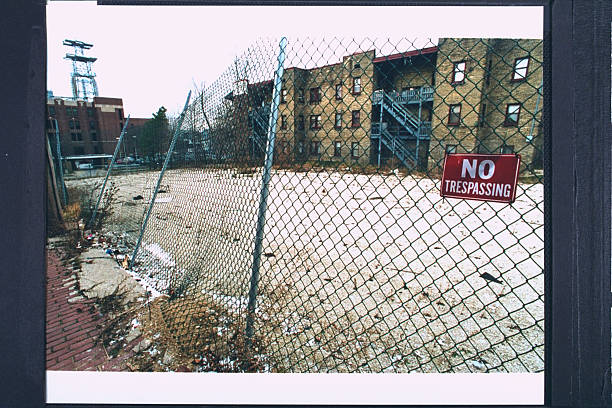
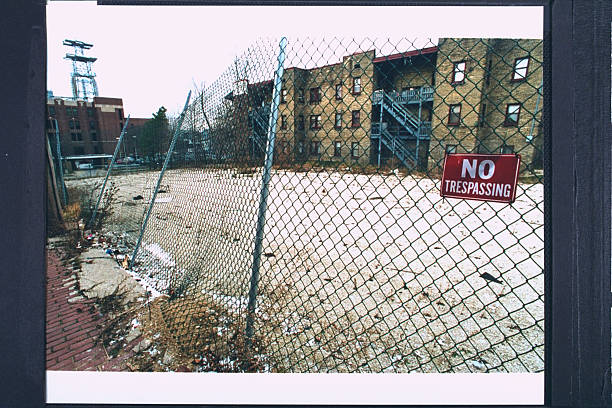
Here is what stands at 924 North 25th Street today: grass, a few trees, and a black iron fence. No building. No plaque. No marker of any kind.
In the three decades since the demolition, every proposal for the site has failed. A memorial garden. A playground. New housing. Even, at the other extreme, a museum. None advanced past conversation. A Marquette official admitted as early as 1998 that no one was willing to take the parcel on — its history made ownership itself feel like contamination. So the lot has simply persisted, mown and fenced, a hole in the street grid that everyone understands and no one names.
The demolition was supposed to be an act of healing, and perhaps for the immediate neighbourhood, in 1992, it was. But look at what the erasure actually erased. The building is gone — and with it went the only physical place where Anthony Sears, Raymond Smith, Ernest Miller, David Thomas, Curtis Straughter, Errol Lindsey, Tony Hughes, Konerak Sinthasomphone, Matt Turner, Jeremiah Weinberger, Oliver Lacy and Joseph Bradehoft could have been remembered where they died. Milwaukee did not replace the site of the crimes with a site of mourning. It replaced it with nothing. Thirty years on, the men whose lives ended there have no marker on that ground, because giving them one would require the city to acknowledge the ground at all.
This is the “monster” logic we have written about many times, expressed in urban planning. The word monster exists to end thought; the empty lot exists to end memory. Both offer the same bargain: you will never have to look at this again, and the price is that you will never have to think about it again either — including the parts that deserved thought. The victims were part of what got bulldozed into silence.
The selectiveness of the erasure is its own tell. The childhood house in Bath, Ohio — where Steven Hicks died in 1978 — still stands, has been lived in for decades, and surfaces on the property market from time to time like any other house. His grandmother’s home in West Allis still stands. Even the Ambrosia Chocolate factory where Jeffrey worked was demolished for ordinary commercial reasons, its site now occupied by a basketball arena. Only the Oxford Apartments were removed as an act of meaning. The erasure was never really about the buildings. It was about which memories a city could bear to have addresses.
III. The Landfill
What the demolition did to the place, the summer of 1996 did to the things.
(Photo by Steve Kagan/Getty Images)
After Jeffrey’s death, his estate passed to the families of eleven of his victims, who had won civil judgments against him. In 1996 a court ordered his assets liquidated for their benefit, and Thomas Jacobson, the lawyer representing most of the families, announced an auction. He set the ambition at a million dollars, pointing to the staggering sums the Jacqueline Kennedy Onassis auction had just fetched in New York — if Camelot could command that market, he reasoned publicly, the interest in this estate was undeniable. The inventory was a study in the case’s terrible ordinariness: a refrigerator, a Sears freezer, the 57-gallon drum, two sets of handcuffs, tools, a lava lamp.
Milwaukee recoiled. A civic group — Milwaukee Civic Pride, anchored by the real-estate developer Joseph Zilber, who put in $100,000 of his own — raised a pledge of $407,225 to buy the entire estate and keep it off the market. Zilber’s stated purpose was blunt: the “tools of death” should be destroyed, not sold to collectors and preserved in museums. The families accepted the offer in what was reported as a very close vote — a detail worth pausing on, because it means this was genuinely contested even among the people with the greatest standing to decide. Each of the eleven families received roughly $32,000 once the lawyers were paid.
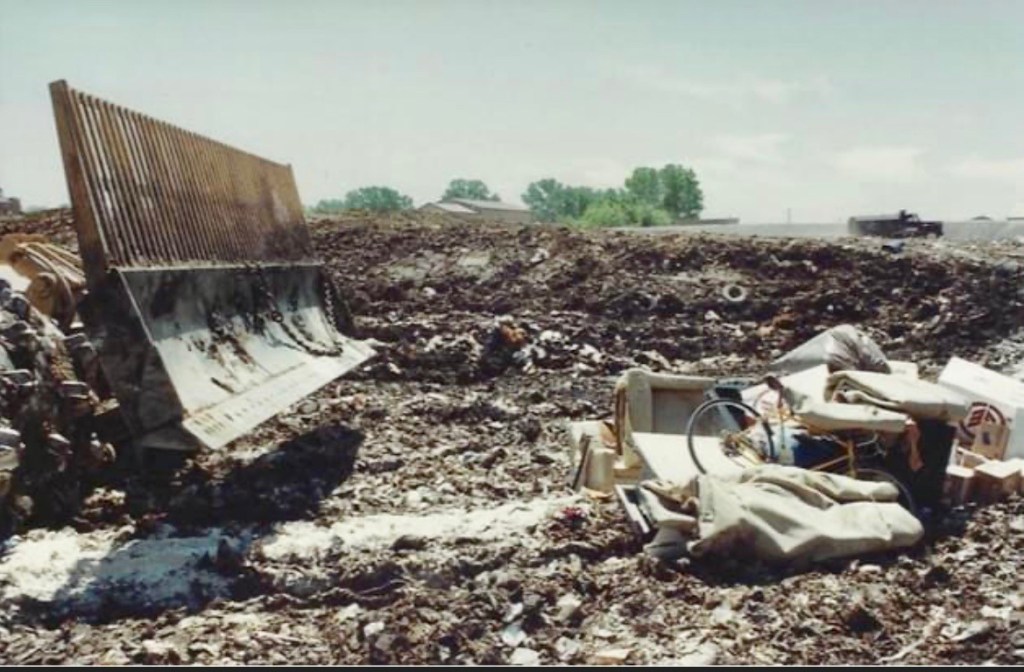
And then, in June 1996, everything Jeffrey Dahmer had owned was hauled to an undisclosed landfill in Illinois and buried.
Let us be fair to everyone in that story, because fairness is the point of this site. The families’ vote deserves respect either way it had gone; there is no correct answer to the question they were asked. Zilber’s motive was decency — he wanted to spare the families the spectacle of a bidding war over the instruments of their grief, and to strangle the collectors’ market before it could feed. Nothing in this article should read as contempt for any of them.
But notice the form the solution took, because it is remarkable. The objects were not merely destroyed — they were buried in secret, in another state, at a location deliberately kept from the public. That is not disposal; disposal does not require secrecy. It is the inverse of a relic. Medieval cultures enshrined fragments of their saints so that presence could radiate from a known place; Milwaukee interred the possessions of its great sinner so that presence could radiate from nowhere. The unmarked landfill and the unmarked lot are the same gesture at different scales: the belief that meaning is a property of objects and coordinates, and that if you scatter the coordinates, the meaning dies too.
Thirty years of true-crime saturation, a Netflix series watched by hundreds of millions, and the steady traffic to sites like this one have delivered the verdict on that belief.
IV. What We Hold
This memorial keeps objects. Among them are things salvaged from Lionel Dahmer’s estate: photographs, a shirt, a red Bible whose pages carry fingerprints that appear under ultraviolet light. Given everything above, we owe our readers a straight answer to the obvious question: how is this different from the collectors’ market that Joseph Zilber spent $407,225 to prevent?
The honest answer is that the difference is not in the objects. It is in what is done with them. The murderabilia trade that Zilber feared treats objects as trophies — their value rises with the body count, and they are held privately, as proximity to infamy. What this memorial does with its objects is closer to what an archive does: they are studied, contextualised, written about, and used as evidence in work that treats every person in this story, victims included, as fully human. A fingerprint on a Bible is not a thrill here. It is a document — of a father’s grief, of a son’s strange late-life faith that we examined in the baptism article, of the fact that these were people whose hands touched things, which is precisely what both the landfill and the word monster were designed to make unthinkable.
We would also say, carefully, that the 1996 burial and the empty lot have not aged as their architects hoped. The erasure did not end the remembering; it only ended the city’s participation in it. The remembering moved elsewhere — into documentaries, streaming series, forums, and the collectors’ market that grew anyway around whatever objects escaped the landfill. By refusing to build anything at 924 North 25th Street, Milwaukee did not close the story. It abdicated its voice in the story, and left the telling to whoever showed up. Thirty years of grass behind a black fence, and still no memorial to the twelve men who died there: that is not healing. That is a city holding its breath.
Somewhere in Illinois, under unrecorded ground, there is a refrigerator, a freezer, a drum, a lava lamp. Somewhere in Milwaukee there is a rectangle of lawn where a building used to be. Both are supposed to mean nothing, by design. And both, by that very design, have become the most eloquent monuments the case has: monuments to the idea that if you cannot bear to think about something, you can bury it — and to the thirty years of evidence that you cannot.
Sources and notes
Milwaukee Journal Sentinel reporting on the Oxford Apartments’ purchase by the Campus Circle Project ($325,000), the November 1992 demolition, and the lot’s continued vacancy.
Contemporary reporting (Washington Post, Associated Press, Deseret News, May–June 1996) on the court-ordered liquidation of the estate, Thomas Jacobson’s planned auction, Milwaukee Civic Pride’s $407,225 pledge, Joseph Zilber’s role, the families’ close vote, and the June 1996 burial of the items in an undisclosed Illinois landfill.
Reporting on failed redevelopment proposals for 924 North 25th Street and Marquette University statements (1998) on the parcel’s unwanted status.
Reporting on the Bath, Ohio childhood home’s continued private ownership and periodic sale listings, and on the Ambrosia Chocolate factory site’s redevelopment.
Christopher Scarver, the applause that followed 28 November 1994, and the victims the cheering required everyone to forget.
Christopher Scarver, the applause that followed 28 November 1994, and the victims the cheering required everyone to forget.
I. The Applause
This article does not begin with a metal bar in a prison gymnasium. It begins with what happened afterwards, in living rooms and newsrooms and radio call-in shows across America, when the news broke that Jeffrey Dahmer was dead.
There was satisfaction. There was open celebration. There were jokes within hours. Commentators reached, again and again, for the same formulation: that someone had finally done what the justice system would not. The man who swung the bar was transformed, almost instantly, into a folk hero — an instrument of cosmic correction. Thirty years later, the sentiment survives intact. Spend five minutes in the comments beneath any video about the killing and you will find it, thumbs-up counts in the thousands: he did the world a favour. Give that man a medal.
This article is not primarily about Christopher Scarver. It is about that applause — what it required people to forget, whom it required people to erase, and what it reveals about the moral logic of the audience. Because the hero narrative only functions if you never look too closely at it. Look closely, and it comes apart in your hands.
II. Steve Lohman
The first thing the hero narrative requires you to forget is a man named Steve Lohman.
In 1990, Lohman worked at a Wisconsin Conservation Corps job-training programme office in Milwaukee — an ordinary employee of a programme that existed to give young people trade skills and a path into work. On the morning of 1 June 1990, Christopher Scarver, a former trainee carpenter in that programme, returned to the office with a pistol. Scarver had been promised a full-time position by a supervisor named Edward Patts; when Patts was dismissed, the job evaporated, and Scarver’s grievance did not.
He held Lohman at gunpoint and demanded money. Handed only fifteen dollars, Scarver shot Lohman in the head, killing him — and then shot his body twice more. Site manager John Feyen, the other man in the office, wrote Scarver a cheque for three thousand dollars and fled for his life. Scarver was arrested within hours, still in possession of the gun, the cash, and the cheque.
Fifteen dollars. That is what Steve Lohman’s life was traded against — a man who, by every available account, had done nothing to Scarver at all. He was simply present, in an office, on a Friday morning, doing a job.
When the world made Christopher Scarver a hero four years later, it made a hero of the man who did this. And in doing so, it erased Steve Lohman a second time. His name appears in almost none of the celebratory retellings. There is no folk mythology about him, no comment sections demanding he be remembered. The avenging-angel story has no room for the inconvenient fact that the angel’s first killing was of an innocent man, over pocket money and a job that fell through.
Any honest account of 28 November 1994 has to begin here, because this is who was standing in that gymnasium. Not an instrument of justice. A man who had already demonstrated, in the most final way possible, what he was capable of doing to a person who had wronged no one.
III. The Man Himself
The second thing the hero narrative cannot survive is an honest look at Scarver’s mind — and here this memorial must hold itself to its own standard. We have argued, across many articles, that “monster” is a word people use when they want permission to stop thinking. That principle does not bend for convenience. It applies to Christopher Scarver too.
By his own account and by contemporaneous reporting, Scarver’s life had been coming apart well before June 1990. A high-school dropout, put out of his mother’s home over his drinking, he descended into heavy alcohol use after the promised job collapsed — and began hearing a voice that told him he was “the chosen one.” He was subsequently diagnosed with schizophrenia. He would later say that God had directed his actions; his sense of divine selection and special purpose persisted through his incarceration. After the 1994 killings he was evaluated at a federal medical centre for prisoners, and in 2001 a federal judge ordered him relocated, alongside roughly three dozen other seriously mentally ill inmates, out of Wisconsin’s supermax facility — a court effectively certifying what had been evident for a decade.
This was the man the public canonised: not a righteous everyman pushed to a breaking point, but a psychotic, profoundly unwell prisoner whose delusions had already cost one innocent man his life. The people cheering for him were not cheering for justice. They were cheering for the output of an untreated mental illness, because on this one occasion its violence happened to land on someone they hated.
There is a genuine tragedy in Scarver’s story, and it deserves to be named without strategy or irony: a young man’s psychosis went unaddressed at every stage where intervention might have changed the outcome, and three people died. That is not heroism. It is systemic failure wearing the costume of fate.
IV. 28 November
The facts of that morning are brief, and their brevity is part of the indictment.
At Columbia Correctional Institution in Portage, Wisconsin, three inmates were assigned to a cleaning detail in the prison gymnasium area: Christopher Scarver, Jeffrey Dahmer, and Jesse Anderson. The guards left. For roughly twenty minutes, the three men — one of them the most publicly hated prisoner in America, one of them a diagnosed schizophrenic serving life for homicide — were unsupervised. In that window, Scarver took a metal bar from the exercise equipment and beat both men about the head. Jeffrey died that morning, 28 November 1994. Anderson died of his injuries two days later, on 30 November.
Scarver himself has claimed the arrangement was no accident — that officials knew his feelings and wanted the outcome they got. That specific claim is his alone and unproven. But it points at a question that does not require his testimony to stand: how does an institution whose singular job is custody leave that particular combination of men alone with gym equipment? Whatever the answer — negligence, indifference, or something worse — the institution’s failure is a load-bearing part of this story, and the hero narrative papers over it completely. If Scarver is an avenging angel, no one has to ask why the state’s most scrutinised prisoner was unprotected in the state’s care.
And then there is Jesse Anderson — the second man killed that morning, and the great inconvenient absence in every celebratory retelling. Anderson was serving life for stabbing his wife Barbara to death in 1992 and then wounding himself and telling police that two Black men had attacked them — a lie that sent Milwaukee’s police searching for phantom Black assailants in a city still raw from the Dahmer case’s own racial wounds. Anderson was, by any measure, a despicable man. He is also entirely missing from the hero story, because his death cannot be dressed up as righteous vengeance on behalf of anyone’s victims. He simply doesn’t fit the script — so the script forgets him. A “hero” narrative that has to quietly delete one third of the morning’s dead in order to function was never a description of events. It was always a story people wanted.
V. The Myth-Making
In 2015, Scarver gave an extended interview to the New York Post — his fullest public account, and a masterclass in how mythology gets built after the fact.
In it, Scarver said that Dahmer had taunted other inmates by shaping prison food into the forms of severed limbs and dressing them with ketchup as blood. He described confronting Dahmer with a newspaper clipping about his crimes in the moments before the attack, demanding to know whether the reports were true. He presented the killings as a considered act with a moral architecture around it.
The ketchup story has since been repeated in thousands of articles, videos, and documentaries as established fact. It is nothing of the sort. It is a single uncorroborated claim, made two decades after the event, by the one person with the strongest possible interest in making the killing look deserved. No guard, no chaplain, no fellow inmate has verified it, and it sits uneasily beside the accounts of those who actually spent time with Jeffrey in his final years — Reverend Roy Ratcliff among them, who baptised him and visited him weekly, and who described a subdued, remorseful man preoccupied with the question of his own guilt, not a taunting provocateur.
Why did an unverifiable claim become canon overnight? Because the audience needed it. The celebration of 1994 had always carried a small, unexamined discomfort — a defenceless man beaten to death in state custody is an ugly thing to cheer — and the ketchup story dissolved that discomfort on contact. See, he was taunting them. He brought it on himself. The myth is not evidence about Jeffrey Dahmer. It is evidence about what the cheering public required in order to keep cheering.
VI. What the Cheering Means
Strip away the mythology and this is what remains: a mentally ill man who had murdered an innocent stranger over fifteen dollars beat two prisoners to death with a metal bar while the institution charged with keeping all three of them alive looked elsewhere. For this, he was celebrated across the nation — and is celebrated still.
Sit with the logic of that celebration for a moment, because it is the entire subject of this article. The public’s case against Jeffrey Dahmer was that killing human beings is an absolute wrong — so absolute that his own documented mental illness, his confession, his cooperation, and his expressed remorse could not mitigate it one degree. We do not dispute that his acts were terrible; this memorial has never disputed it. But the same public then applauded a killing — unlawful, unsanctioned, carried out on a defenceless man — and called it justice. The principle held for exactly as long as it took to find a victim nobody would mourn.
That is not a principle. It is bloodlust with a permission slip.
The cheering asked nothing of anyone. It did not ask who Christopher Scarver was, or who Steve Lohman was, or why Jesse Anderson vanished from the story, or how a state prison came to function as an execution chamber by inattention. It asked only that everyone agree the victim deserved it — and on that agreement, a triple murderer became a folk hero, an innocent man’s death became a footnote, and an institutional failure became fate.
Christopher Scarver was not a monster. This site does not deal in that word, and his story — the untreated psychosis, the system that failed him at every turn before failing everyone through him — deserves the same unsentimental honesty we extend to Jeffrey’s. But he was no hero either. The heroism was manufactured afterwards, by an audience that wanted its hatred sanctified, and the manufacturing had costs: Steve Lohman erased, Jesse Anderson deleted, the state absolved, and the comfortable fiction installed that what happened in that gymnasium was justice rather than the last, entirely preventable failure in a story that had been full of them.
The monstrous thing was never any one man in that room. It was the applause outside it.
Sources and notes
Contemporary reporting on the murder of Steve Lohman (1 June 1990) and Scarver’s conviction and life sentence (1992).
Reporting on the events of 28 November 1994 at Columbia Correctional Institution, including the unsupervised work detail and the deaths of Jeffrey Dahmer (28 November) and Jesse Anderson (30 November).
Christopher Scarver interview, New York Post, April 2015 — treated throughout as an uncorroborated primary account, not established fact.
Roy Ratcliff, Dark Journey, Deep Grace, for the counter-portrait of Dahmer’s demeanour in his final years.
Court records and reporting on Jesse Anderson’s 1992 conviction for the murder of Barbara Anderson.
2001 federal court order relocating seriously mentally ill inmates, including Scarver, from the Wisconsin Secure Program Facility.
There are two records of Jeffrey Dahmer’s time in the Army, and they do not describe the same man.
The first was assembled by Brian Masters in the early nineties, from Dahmer’s own account and from the soldiers who served alongside him. It describes a young man so withdrawn that almost nothing about him registered — quiet, moody, permanently half-drunk, remembered by his colleagues mainly as someone who was there.
The second emerged much later, from two men who came forward long after his arrest. It describes a predator who was already operating.
Both records concern the same twenty-one months at the same small base in the Rhineland-Palatinate. Reconciling them is the work of this article, and it cannot be done cleanly.
The base
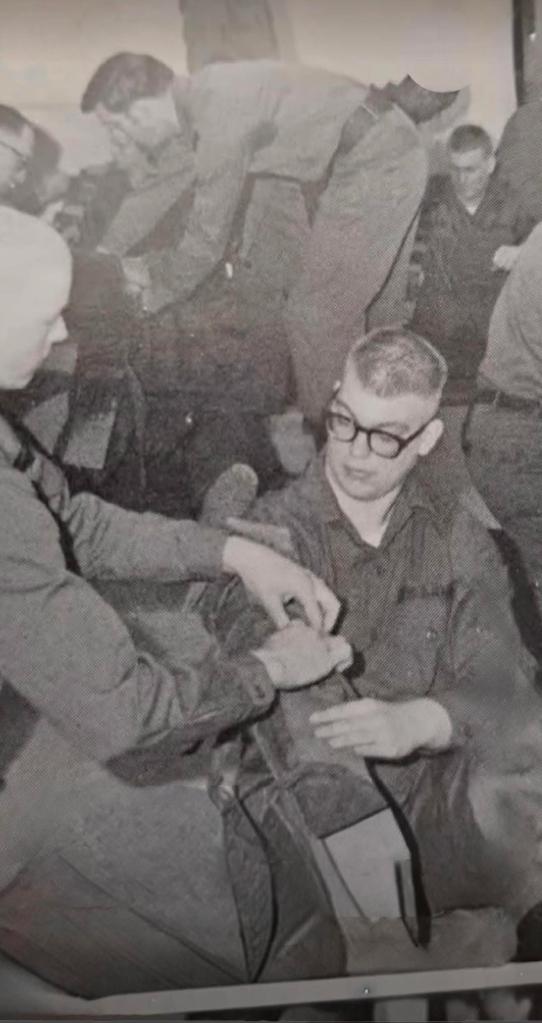
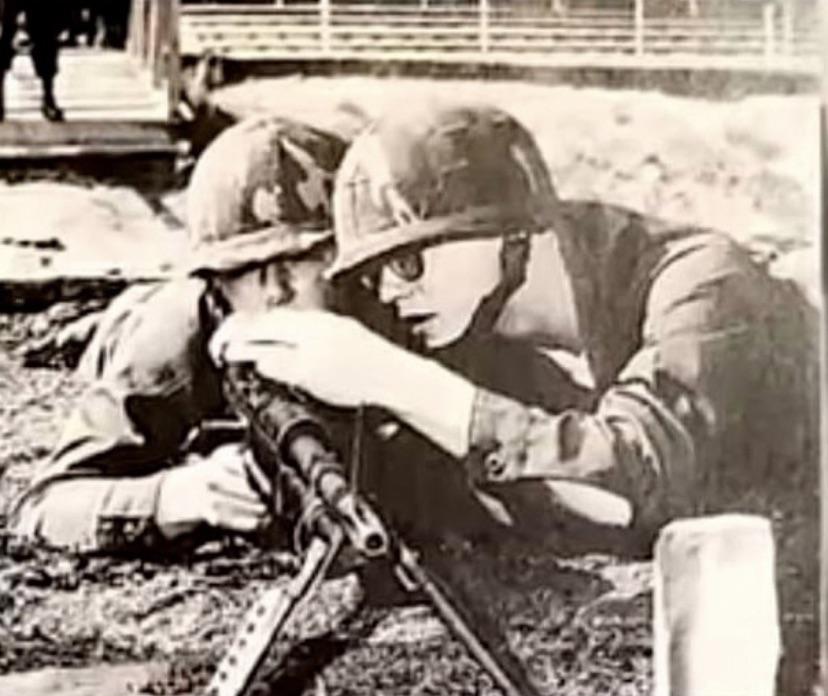
He enlisted in January 1979, six months after killing Steven Hicks, at his father’s urging and as an alternative to the semester he had already drunk his way out of at Ohio State. He trained as a medical specialist at Fort Sam Houston in Texas. In mid-1979 he was assigned to the 2nd Battalion, 68th Armored Regiment, 8th Infantry Division, at Baumholder in West Germany, and joined the squad at the Battalion Aid Station as a combat medic.
He would be there until March 1981. His service reports describe him as an average to slightly above average soldier.
What almost nobody noticed
Masters makes an observation about this period that is worth quoting in substance, because it frames everything else. For a man who spent nearly two years in one place, remarkably little is known about his life there or the impression he made — and Masters reads that absence as evidence in itself. Dahmer ate with people, went to restaurants with them, made small talk. He made no effort to know anyone or to be known, and so his privacy went unexamined.
What his colleagues did notice was that he was sexually innocent, and it became something of a project. Taken aback that he had no girlfriend and had never kissed a girl, a group of them brought him to a brothel at Vogelweh. Two soldiers his own age walked him inside and introduced him to one of the women. When they regrouped, he had slipped out without doing anything. They put it down to shyness until he told them he had never wanted to go and did not need a girl.
One of the older men formed a private theory that he was homosexual — not because of the brothel, and not because of anything obviously effeminate, but because he always seemed to be hiding something. Masters calls this astute, and it is difficult to disagree.
By his own account he had no sexual contact of any kind in Germany. He found the gay bookshops in Frankfurt and bought pornography. He understood by then that what he wanted was, in the terms available to him, inadmissible — and he concluded that further isolation was the only safe course. That is not a small thing to note. He knew what he was capable of, and his solution was to be alone.
His pleasures were solitary. He walked in the countryside. He described, years later and with real animation, watching a family of wild boars come down a snowy hillside at a distance and mistaking them at first for boulders. He liked target shooting and thought about taking it up properly after the Army. And soldiers could buy liquor at half price, of which he took full advantage — the drinking that would eventually end his service.
On at least one occasion the drink brought Steven Hicks back, and he broke down sobbing. Masters is careful about what that means, and so should we be: by then the remorse had given way to self-pity, grief less for what he had done to Hicks than for the burden it had placed on himself.
One further contemporaneous account is worth setting alongside the rest. David Rodriguez, then eighteen, shared a room with Dahmer and six other men for close to a year in 1979, and the two trained together in the same Army medical unit. When reporters reached him in July 1991 he described someone who drank gin constantly and struck him as a weakling — a man he found incapable of what was then being reported from Milwaukee. He also remarked, and this is the detail that lingers, that Dahmer had never shown any particular interest in their anatomy classes.
It cuts against a tidy reading. In the one setting where the human body was formally on the timetable, the man who would later be defined by what he did to bodies was, by his roommate’s account, bored.
Thanksgiving, 1979
One night from this period is documented in detail, and it is the strangest thing in the record.
For Thanksgiving 1979, Carlos Cruz — who served in the same squad at the Aid Station — invited some of the younger soldiers to dinner at his home. Dahmer was among them, as was a soldier named Preston Davis. Heavy snow began to fall, and Cruz suggested everyone stay the night.
Dahmer and Davis fell into an argument. Davis told him to get back to Baumholder. At half past ten, Dahmer walked out of the door into the snow.
Baumholder was around eight miles away, around a mountain, in sub-zero temperatures. Cruz went out to look for him for fifteen minutes, came back for heavier clothing, searched another half hour, then gave up and assumed he had found a taxi.
Four hours later Dahmer was at the door. Davis called out that the orphan was back and they brought him inside. He was confused and vague, his mind elsewhere. He had lost his glasses. His jacket was not as cold as it should have been after four hours outdoors, and neither was he. Cruz took him to the kitchen, where he washed his hands energetically, and thought he saw what looked like blood on his clothing. Dahmer sat and stared at the table. He said he could not remember where he had been or what he had done, but assumed it must have been something bad.
A few days later Cruz asked him what was wrong. He could not or would not say. But he offered one remark, and it has hung over the whole episode ever since:
Sometimes the best thing for the soul is to confess.
Masters treats the night with appropriate restraint. The blood was something Cruz thought he noticed, not something established. The likeliest explanation, he suggests, is that Dahmer found somewhere to sit out of the wind and stayed there with his thoughts.
This matters because the episode has hardened, in retelling, into something the source does not support. The version that circulates online — and which appears in later true-crime writing, including Willis Morgan’s Frustrated Witness — has him returning covered in blood. Masters has a host who thought he noticed something on a jacket in a kitchen at two in the morning. Those are not the same claim, and the distance between them is roughly the distance between an observation and a story.
But nor is it nothing. A man walked into a blizzard, lost four hours he could not account for, and came back saying he assumed he had done something bad.
What came out later
Neither Preston Davis nor Billy Joe Capshaw appears in the 1993 account as anything other than a fellow soldier. Both came forward afterwards, and what they described changes the shape of the period entirely.
Davis, a twenty-year-old Black medic, was tasked with training Dahmer when he arrived. He has said Dahmer was openly racist and became obnoxious when drinking, and that he would boast, drunk, about having killed someone in Ohio — a claim nobody had reason to take seriously at the time, and which was true.
In a written account published by the veterans’ advocacy organisation Protect Our Defenders, Davis describes a field exercise in the autumn of 1979 during which their vehicle broke down and the two men were left isolated together for three or four days. He states that during that period he was sexually assaulted, that the assault included penetration, and that he believes he was drugged, because he lost time and has gaps in his memory. He has said he thinks the only reason Dahmer did not kill him was that Dahmer had no way of getting back to base alone.
Davis left the unit shortly afterwards. His record, previously strong, deteriorated. He has described the decades that followed — drinking, drug use, a marriage that ended, contact lost with his sons, and surgery for the injuries.
Capshaw arrived after Davis left. He was seventeen, and became Dahmer’s roommate. He has said the abuse ran for something close to seventeen months: that he was tied to the bunk with rope from the motor pool, that his clothing was taken from him, that he was beaten before or after being raped, and that he cannot say with certainty how many times it happened. He reported it. He underwent a rape examination. He has said he learned roughly a decade later that the kit had been discarded.
After his own discharge he returned to Arkansas and, by his account, did not leave his room for five years. He did not speak about any of it until after his father died.
How to hold this
These accounts were never tested in a courtroom. Dahmer was never charged with either assault, and he has been dead for over thirty years, so they never will be. That is a real limitation and it should be stated rather than glossed over.
What can be said is this. Both men are named, both have spoken publicly and at length, and their accounts are independent of one another and separated in time. Neither had anything obvious to gain. And the method Davis describes — drugging, memory loss, hours he cannot account for — is precisely the method Dahmer used, provably and repeatedly, a decade later in Milwaukee.
Nor do the accounts of the men who noticed nothing count against them. Rodriguez shared a room with Dahmer for a year and saw a harmless drunk; Capshaw shared a room with him and describes being tied to a bunk. Both can be true, and the fact that they are is the most disturbing thing about the whole period. Whatever he was doing, he was doing it in a barracks full of people, and it was visible to precisely those he chose and to nobody else.
There is also the matter of the honourable discharge. He was released in March 1981, six months before his expected date, on grounds of alcohol abuse. Nothing in his file records a sexual assault. Capshaw’s report went nowhere and his examination kit was destroyed. Whatever else that tells us, it tells us the Army’s paperwork is not a record of what happened at Baumholder — it is a record of what the Army processed.
The site has argued this before in a different context. When the institutions around a man decline to look, the resulting silence in the file gets mistaken for evidence of nothing happening.
The German investigations
One further thread needs handling carefully, because it is routinely misrepresented.
Four days after his arrest, on 26 July 1991, police across Germany reopened files on unsolved murders and disappearances from his time in the country. Five unsolved murders at Baumholder were re-examined. Federal authorities also reviewed all cases of unidentified male victims and missing men from that window. One case that drew attention was that of Erika Hansthuh, twenty-two, found stabbed and strangled in the snow some fifty miles from Baumholder on 30 November 1980, days after hitchhiking from Heidelberg.
Nothing came of any of it.
A federal police spokeswoman said at the time that no links to Dahmer had been made. Four of the five murder victims were women, which does not match his pattern in any respect. He was never charged with an offence in Germany. He denied, through his attorney, any killings beyond those he had admitted, and on this point there has never been evidence to contradict him.
It is worth saying plainly, because the internet has spent thirty years implying otherwise: there is no evidence Jeffrey Dahmer killed anyone in Germany. The investigations were a reasonable thing for German police to do and they found nothing. Treating an opened and closed file as a shadow of guilt is exactly the kind of reasoning this site exists to refuse.
What Baumholder was
The temptation is to pick one of the two records. Either the isolated depressive drinking himself out of a career, or the predator hiding in plain sight.
The evidence supports both, and the discomfort of holding them together is the honest position.
He was withdrawn to the point of invisibility, and he assaulted at least two men. He was so unremarkable that a biographer could find almost nothing about twenty-one months of his life, and one of the men living in that blank space was being tied to a bunk. A roommate remembered a wimp who drank gin and could not have done any of it. He told a colleague that confession is good for the soul, and confessed nothing for another twelve years.
What Germany demonstrates is that the interval between Steven Hicks in 1978 and Steven Tuomi in 1987 was not the pause it is usually described as. Something was operating throughout. It simply did not produce a body, and so it produced no record — until two men decided, decades on, to supply one.
Sources: Brian Masters, The Shrine of Jeffrey Dahmer (1993); Associated Press, 26 July 1991; United Press International, 28 July 1991; Deseret News, 28 July 1991 (David Rodriguez interviews); Preston Davis’s published account for Protect Our Defenders; Billy Joe Capshaw’s public interviews and statements; U.S. Army service records as reported. Allegations of assault are the accounts of the men who made them and were never adjudicated.
Between his discharge from the Army in March and his arrival at his grandmother’s house that December, Jeffrey Dahmer spent roughly six months in Miami Beach, Florida. It is the least documented period of his adult life. There were no arrests. No employment records have surfaced. No psychiatric contact, no probation officer, no family in the same state. For half a year, the only account of where he was and what he was doing comes from Jeffrey himself, told afterwards, and from a father hearing it down a telephone line from a thousand miles away.
That is precisely why it is worth writing about.
Leaving
On 24 March 1981 he was sent to Fort Jackson, South Carolina, for debriefing, and given a travel voucher good for anywhere in the United States. He chose Florida. The reasoning, as he later described it, was straightforward and almost hopeful: he did not want to go back to the cold, and he thought the sun and the ocean might do something for him.
Before he flew, he did something worth noting. He packed his trunk — fatigues, jacket, trousers, everything he owned in the Army, along with his government correspondence — and sent it home to 4480 West Bath Road. Into that trunk he also put the German pornographic magazines he had bought in Europe, rather than carry them to Florida. Masters reads this as an attempt to start clean, and it is hard to read it any other way. He was posting his past to Ohio and getting on a plane without it.
There is a detail in that shipment which matters. His father did not know he had left the Army. The trunk arrived unannounced, with no note and nothing to say where Jeffrey had gone. The discharge papers followed a few days later. It was another month before the telephone rang.
He had, in the most literal sense, disappeared from the view of everyone who knew him.
Sunshine Subs
What he found in Miami Beach was a motel room and a job at a sandwich shop called the Sunshine Sub Shop, half a mile down the road. He worked seven days a week. By his own later account, he spent essentially all of what he earned on drink.
Two things about this period are striking, and both cut against the story people expect.
The first is that he made no attempt to find the gay bars or bathhouses of a city that had plenty of both. Miami Beach in 1981 was not a difficult place to find that scene. He did not look. Whatever he had gone south to escape, he was not chasing it there.
The second is Julie.
She was an English girl working at the sub shop, in the country on a visitor’s visa and working illegally. She and Jeffrey became friends — the only female friend, Masters records, that he would have until after his arrest a decade later. She wanted to legitimise her status and eventually asked him to marry her so she could stay. He liked her. He discouraged her, and declined.
It is a small, ordinary episode, and there is almost nothing else like it anywhere in his life. Two people working the same counter, one asking the other for a serious favour, the other saying no but staying friendly. She telephoned him in Ohio a few times afterwards, just to see how he was getting on. That is the entire recorded content of the friendship, and it is more than he managed with anyone else for ten years.
The beach
When the money ran out and he could no longer pay for the motel, he took what he owned and slept on the beach. He went there from work at the end of a shift and slept under the sky.
The image has a certain romance to it, which is worth resisting. He was twenty-one, working seven days a week at a sandwich counter, drinking the proceeds, and homeless. The sun and the ocean he had flown south for had not done what he hoped. Masters records the conclusion he reached there, and it is the reason this period matters: the thoughts he had gone to Florida to escape had come with him. They had not been left in the trunk.
What he took from that, in Masters’ account, was not that he needed help. It was that the thoughts needed to be starved — that there must be nothing left to think about.
That is the sentence to sit with. He had run three thousand miles, changed his climate, taken a job, made a friend, slept on sand under stars, and the conclusion he drew from its failure was not I should tell someone. It was that escape does not work and something else would have to.
Where the sources disagree
The record of this period is thin enough that its two main sources contradict each other, and the honest thing is to say so rather than to pick the more convenient version.
Masters, working from Jeffrey’s own account, has him running out of money, leaving the motel, and camping on the beach until he called his father for the fare home.
Lionel’s memoir tells it differently. In one of those phone calls, he writes, Jeffrey said he was living with a woman — an illegal alien who had offered him money to marry her. Lionel and Shari advised him against it.
The two versions can be partly reconciled: Julie is plainly the woman in both accounts, though the direction of the offer differs, and it is possible Jeffrey stayed with her for a period before or after the beach. But it is equally possible that he simply told his father something more respectable than the truth. A young man sleeping rough and calling home has reasons to improve the story.
The endings differ too. Masters has Lionel sending the fare. Lionel records that Shari refused to send money at all, and instead left a plane ticket waiting at the airport — she would bring him home, but she would not fund him where he was.
We cannot resolve these, and we are not going to pretend to. What both accounts agree on is the shape: he ran out of everything, and he called Ohio.
Coming back
Lionel went to Cleveland airport expecting a downtrodden son. From a distance, Jeffrey was smiling and looked cheerful. Up close, his father realised he was drunk — that the cheerfulness was the drink. He was filthy, his clothes stained and unwashed, a scraggly untended moustache, a cigarette hanging from his mouth. He apologised for having had a few too many on the plane.
Within days he had brightened. He chopped wood, helped take down a tree, gathered branches, made himself as useful as he possibly could. Lionel’s reading was that the Army had at least left him a work ethic.
Then, with winter coming, they decided to insulate the water pipes. Jeffrey helped in the attic. But when it came to the crawl space beneath the house, he was emphatic that his father should not go down there. He would do it himself.
Lionel watched him work on his back, wrapping the copper lines and tying the insulation with braided twine. He came out dusty and enthusiastic, ready for the next job.
The crawl space was where the remains of Steven Hicks had been stored three years earlier.
And within that same period at Bath — while his father and Shari were at work — he went out to the drainage pipe, retrieved the bags of bones he had hidden there, carried them to the woods beyond the property, and smashed them with a rock until they were splinters. The skull he pulverised. He scattered the fragments across the trees by hand.
I had to, he said of it later.
What the silence contains
Two weeks after coming home he was arrested at the Ramada Inn for drinking vodka straight from the bottle in the lounge, refusing to leave, and swearing at the officers who came. Disorderly conduct and resisting arrest. It went no further than a municipal citation, but it settled the question of whether he could stay in Bath. In December, Lionel and Shari sent him to Catherine’s house in West Allis.
Which brings this period into focus. Miami Beach sits between two structures — the Army, which had held him for two years and then expelled him, and his grandmother’s house, which would hold him for six. In between there is a gap where nothing held him at all.
It is tempting to treat that gap as empty because so little is recorded in it. But something happened in those six months, and the evidence for it is what he did immediately afterwards. He came back to Ohio and destroyed the last physical trace of Steven Hicks, thoroughly, with his hands. That is not the act of a man who had put it behind him. It is the act of a man who had spent half a year discovering that he could not.
The beach is not the interesting part. What is interesting is that he went there to become someone else, and came back knowing it could not be done.
Sources: Brian Masters, The Shrine of Jeffrey Dahmer (1993); Lionel Dahmer, A Father’s Story (1994). Where the two accounts conflict, both are given.
Everything on this site is written about Jeffrey Dahmer. Third person, past tense, sources at the bottom. That grammar is not incidental — it is the distance that makes the work possible. You can examine a man in the third person. You can hold him at arm’s length and still look closely.
A song does not have to obey that rule, and this one does not.
“Dahmer,” from the forthcoming Shyster, is written in the second person. It talks to him. It exists on the record in two versions: the original, classic hip-hop built on piano and scratches, and a heavier industrial rework by GoH Mr. Whatever, with different words layered around the same core. Together they make an argument with itself, and the disagreement between them is more interesting than either version alone.
The original: a defence
The first version opens on an image of fit:
I got the key, you got the lock
Two objects that are useless apart and mean nothing separately. The verse that follows makes the same claim in a different figure — I’ve got a half, you’ve got the other — and then names it outright: my brother.
Everything else in the track is organised against a “they.” They look through you. They make their voodoo. They lose their minds. They have weapons, and they will abuse you and accuse you. The song’s world contains exactly two parties: a you and an I who fit together, and a hostile everyone-else who understands neither.
And at its centre is the line the whole version turns on:
they call you a monster you’re not
This is a defence. Not an examination, not a reckoning — a defence, delivered directly to him, in the voice of someone who has taken a side.
It is worth being honest about what that means, because this site’s method is to be honest about difficult things rather than to arrange them flatteringly. There are no victims in the original version of this song. Seventeen men and boys do not appear in it. The “they” who accuse and abuse are the press, the public, the machinery of spectacle — and framed that way, the accusation looks like persecution rather than the consequence of what he did.
The track also refuses to promise anything. None of us here is gonna win is not triumphant. It is a song that takes his side and expects nothing to come of it.
The remix: a redistribution
Mr. Whatever’s version keeps the original verses intact and builds new material around them. What that new material does is not soften the song. It complicates it, and in one specific place it contradicts it.
It opens somewhere the original never goes:
Cold room, dead eyes, fluorescent light
An institutional image, and then immediately a psychological one — you wanted a friend, you wanted control — which is a two-clause summary of the whole case, and a fairer one than most books manage. The wanting is real. The method was annihilation.
Then the line that changes the song:
But the monster had a heartbeat just like me
Set that against they call you a monster you’re not and you have two incompatible claims sitting on the same record. The original denies the category. The remix accepts it and then does something much more unsettling with it — it puts the speaker inside it. Not he isn’t a monster, but the monster was a person, and so am I.
That is a harder position to hold, and a more defensible one.
The remix also restores what the original leaves out:
You wanted connection, but you couldn’t stay So you turned every heartbeat into something to take A body is a memory, a memory fades
There they are. Not named, but present — heartbeats and bodies, people who were taken rather than an abstraction called accusation. The remix will not let the song be only about him.
And it adds a target the original doesn’t have. The chorus turns outward, at the audience:
Everybody wants to know your name Everybody wants to watch the flame
That is a different “they” from the original’s. Not persecutors — spectators. The people consuming him. Which is a sharper and more accurate charge, and one that implicates anyone listening, including anyone reading this.
The keyhole
The remix ends by picking up the original’s first image and turning it inside out.
The song began with a key and a lock: fit, belonging, two things made for each other. It closes at the same door from the other side.
Look through the keyhole, what do you see? A monster in the darkness or a piece of me?
The keyhole is now something you look through — the same verb the original used for the hostile “they,” who look through you. The listener has been moved into that position. And the question it asks is the one the memorial has been circling since it began: whether what you find in him is entirely alien, or partly familiar.
Some names become legends Some names become stains
Then: Dahmer… 213. The apartment number, which is also the name of the project that made the record. The song signs itself with the address.
Why both versions belong on the album
There is an argument for keeping only the second one. It is the more complete piece of writing, it is the one that acknowledges the dead, and it is the one that can be defended without qualification.
But keeping both is the more honest choice, because the two versions are a record of an actual movement in thinking, and flattening that would be its own kind of dishonesty. The first is what it feels like from the inside — the pull toward defending someone the world has flattened into a symbol, the sense of a fit that nobody else can see. The second is what happens when that impulse is examined rather than simply obeyed.
Neither cancels the other. They sit next to each other on the record and disagree, which is roughly the condition of anyone who has spent serious time with this material.
None of us here is gonna win survives into the second version unchanged. It is still the truest line either version contains.
“Dahmer” and “Dahmer (remix)” appear on Shyster. Original lyrics and vocals by Door213; remix, additional lyrics and production by GoH Mr. Whatever.
Every account of Jeffrey Dahmer eventually arrives at the same question, and almost always phrases it the same way: how did he get away with it for so long?
The question contains an assumption worth examining. It assumes the answer lies in him — in his cunning, his ordinariness, his ability to pass. It assumes that the obstacle he had to overcome was a city looking for him.
Milwaukee was not looking for him. To understand the thirteen years between Steven Hicks and Tracy Edwards, you have to understand the place, and the place was not a neutral backdrop against which one man operated. It was a city with a specific economy, a specific geography of race, a specific police department, and a specific set of assumptions about whose disappearance constituted an emergency. He did not slip through the gaps. He moved through a structure that was already built.
The brutal decade
The Milwaukee of the 1980s was a city coming apart economically, and the numbers are stark. Between 1979 and 1983, some fifty thousand manufacturing jobs left the city. Across the decade as a whole, the metropolitan area lost roughly a fifth of its industrial employment — a rate about three times the national average. Schlitz shut its Milwaukee brewery in 1981. Allis-Chalmers, once the largest industrial employer in Wisconsin, went bankrupt in 1987.
This was the city that had called itself the machine shop of the world. By 1986, service work had overtaken manufacturing for the first time. The economist Marc Levine’s summary of the period is blunt: the 1980s were the brutal decade in Milwaukee.
Two consequences matter for this history.
The first is personal. This is the labour market in which Jeffrey Dahmer worked the third shift at the Ambrosia Chocolate Factory — eleven at night to seven in the morning, six nights a week. The nocturnal, marginal, replaceable work he did was not incidental to how he lived. It set his hours, and his hours were the city’s empty ones.
The second is structural, and far more important. Deindustrialisation did not fall evenly. Nearly half of Black male workers in Milwaukee held manufacturing jobs, and the plants that closed were concentrated on the north side, where Black Milwaukee lived. The collapse landed hardest on precisely the neighbourhoods that already had the least, and it produced a population of young men with irregular work, unstable housing and every reason to accept fifty or a hundred dollars from a stranger who wanted to take photographs.
Dahmer’s offer was not exotic. It was an offer that made sense in that economy.
The most segregated city in America
Milwaukee has been ranked, decade after decade, among the most racially segregated metropolitan areas in the United States. It still is. The pattern was built deliberately over the twentieth century through redlining, restrictive covenants that barred Black residents from most of the city, and suburban zoning that priced them out of everywhere else. Black Milwaukee was confined to the near north side, and stayed there.
This is not background colour. It is the operative fact of the case.
Segregation determined who lived in the neighbourhood around the Oxford Apartments. It determined that a white man in that building was unusual. It determined which parts of the city the police patrolled as territory to be contained rather than served. And it determined, decisively, whose reports were believed.
Milwaukee’s police department had been shaped for twenty years by Chief Harold Breier, who ran it from 1964 to 1984 and whose relationship with the city’s Black population was one of open hostility. He was gone by the time Dahmer moved to 25th Street, but a department does not change its habits in five years. When the Dahmer case broke, Black and gay leaders in the city argued that the force still operated on Breier’s assumptions. The evidence suggests they were right.
Walker’s Point
The other Milwaukee that matters here is a few blocks of Walker’s Point, south of downtown, where the city’s gay bars were concentrated.
Club 219, at 219 South 2nd Street, opened in early 1981 out of a short-lived predecessor called Trash. It became one of the central spaces in Milwaukee’s gay life — bright, loud, a dance bar with drag shows, eclipsed in scale by La Cage Aux Folles after 1984 but never displaced in affection. It stayed open until 2005. The building is still there, under another name.
Dahmer met Steven Tuomi there in September 1987. He met Raymond Smith and Richard Guerrero there. In May 1991 he met Tony Hughes there, and because Hughes was deaf, he wrote his offer down on a piece of paper. He met Jamie Doxtator at a bus stop outside it.
It matters how this is told. Club 219 was not a hunting ground that happened to have people in it. It was a community’s living room, in a city that gave that community very few places to exist, and it was full of people who knew each other. Eric Wynn, one of the few Black drag performers regularly working the club in the eighties, has described building a small following of young Black men who came to his shows because they saw someone like themselves on stage. Tony Hughes was one of them; he taught Wynn to fingerspell the alphabet.
Then some of them stopped coming.
Nineteen funerals
Set against this is the fact that makes the whole period legible: these were the worst years of the AIDS epidemic.
By 1987, when Dahmer began killing regularly in Milwaukee, more than half a million people in the United States were living with HIV. A bartender at Club 219 during those years, Scott Gunkle — who served Dahmer and found him entirely unremarkable — has described a year in which he attended nineteen funerals, someone dying every fortnight.
Consider what that does to the meaning of an absence.
In a community losing men constantly, a familiar face vanishing from the bar was not a mystery. It was the ordinary shape of the era. He got sick. He went home to family. He was too ill to come out. He died and nobody was told. There was no gap where an alarm should have sounded, because the alarm had been sounding continuously for years and everyone had learned to live inside it.
This is the single most under-examined element of the case. AIDS did not merely coincide with Dahmer’s most active period. It supplied the cover.
Who gets looked for
The families reported them. This needs saying plainly, because the standard account leaves the impression that these men vanished unnoticed.
Richard Guerrero’s father reported him missing two days after he disappeared in March 1988, and paid for notices with his son’s photograph in the local press. Jamie Doxtator’s mother reported him the day after he failed to come home. Reports were filed, again and again, by families who knew immediately that something was wrong.
Nothing came of them.
There is no single decision to point to — no officer who looked at a file and dismissed it. That is what makes it a structural failure rather than an individual one. A missing persons report on a young Black or Latino or Native man from the north side, in a city that had spent decades treating those neighbourhoods as a containment problem, simply did not generate urgency. It went into a system that had already decided what it was worth.
Seventeen men and boys died. The overwhelming majority were Black, Latino, Asian or Native American. That is not a coincidence of who happened to be in the bars. It is a description of whose disappearance a city was prepared to tolerate.
27 May 1991
Everything above converges on one night, and if the article has a centre, this is it.
Fourteen-year-old Konerak Sinthasomphone escaped from Apartment 213, drugged and bleeding, while Dahmer was out buying alcohol. He was found in the street by Sandra Smith and Nicole Childress, two young Black women, who called 911. Glenda Cleveland, Smith’s mother and Childress’s aunt, called as well.
Three officers responded: John Balcerzak, Joseph Gabrish and Richard Porubcan. Dahmer returned and told them the boy was his nineteen-year-old boyfriend, drunk after an argument. He gave a name that was not Konerak’s.
The officers believed the white man. They walked the boy back up to Apartment 213 — where the body of Tony Hughes was lying — and left. The entire investigation took sixteen minutes. A later review found they had violated departmental rules fifteen times, including failing to run any records check on Dahmer, which would have shown he was a convicted child sex offender then on probation.
Roughly ten minutes after they left, Glenda Cleveland telephoned again. She spoke to Balcerzak. She was told the matter was handled, and he declined to take the names of the two witnesses. She called again in the following days, after seeing the missing boy’s photograph in the paper. She called the FBI. Nobody acted.
Konerak was killed within the hour of the officers’ departure. Dahmer went on to kill four more men.
And there is a detail that turns the whole thing from failure into something closer to indictment. Konerak was the younger brother of Somsack Sinthasomphone — the boy Dahmer had assaulted in 1988, the offence for which he was on probation that very night. The same family, twice, by the same man. The record connecting them was one records check away.
The audio of the officers’ radio traffic later became public. They can be heard joking about reuniting the lovers, and about needing to be deloused after their time in the apartment.
What the city did afterwards
The response was immediate and furious. There were marches, vigils and sit-ins through August 1991. Jesse Jackson came to Milwaukee. The family of Oliver Lacy filed a federal suit against the city, arguing that the police had discriminated by failing to respond properly to complaints from minority citizens — and that Lacy and three other men would be alive had Dahmer been arrested on 27 May. The community activist Queen Hyler put the case bluntly: this is a very racist city.
Chief Philip Arreola — the first Milwaukee chief in modern times appointed from outside the department, brought in as a community-policing reformer — suspended the three officers.
His own force turned on him. In a survey of 1,339 officers, ninety-eight per cent said the suspensions were wrong and around ninety-three per cent declared no confidence in his leadership.
Balcerzak and Gabrish were eventually dismissed after a lengthy hearing process. They appealed, were reinstated with back pay, and returned to the department. Balcerzak later served as president of the Milwaukee Police Association.
That sequence is the whole story in miniature. The city was told exactly what had gone wrong, in public, with recordings. And the institution absorbed it and continued.
The empty lot
The Oxford Apartments were bought in 1992 by the Campus Circle Project, a redevelopment initiative connected to Marquette University, for $325,000. The forty-nine-unit building was demolished that November, fifteen months after the arrest, at the urging of victims’ families. The chocolate factory came down the following year; the Milwaukee Bucks’ arena stands on part of that ground now.
The lot at 924 North 25th Street is still empty. Grass and a chain-link fence.
There were proposals over the years — a playground, a park, a missing persons centre, a memorial to the seventeen. None was built. The objection, then and now, is that a memorial would draw the wrong kind of visitor. The current alderman for the area has called the idea a terrible one. Some of the victims’ relatives agree; others have wanted a memorial for thirty years.
(Photo by Steve Kagan/Getty Images)
So the site of the most notorious crimes in the city’s history is a fenced rectangle of nothing, and the seventeen men and boys have no marker anywhere in Milwaukee.
The point of asking about the city
None of this diminishes what Jeffrey Dahmer did or shifts the responsibility for it. He chose every one of those men. He is answerable for all of it.
But “how did he get away with it” has an answer, and the answer is not that he was brilliant. He was arrested twice for sexual offences during the killing years and served neither a serious sentence nor a serious assessment. He was on probation while killing. He was caught, in effect, by three officers who then handed his victim back to him. He was not hard to see. He was simply not looked at.
What let him continue was a city where a certain kind of man could vanish without consequence — because the plants had closed on his side of town, because the police had spent decades treating his neighbourhood as hostile territory, because his community was burying men every fortnight anyway, and because when his mother or father filed a report, the report went nowhere.
Dahmer did not create those conditions. He found them, and used them for thirteen years.
That is the part that should be uncomfortable, and it is the reason this article exists. A man like him is rare. A city like that was not.
Sources: Encyclopedia of Milwaukee (UW-Milwaukee); Marc Levine, UWM Center for Economic Development; Brown University Diversity and Disparities Project; Wisconsin LGBT History Project; WUWM Milwaukee Public Radio; Associated Press and UPI contemporaneous reporting, 1991–92; Christian Science Monitor, August 1991; Milwaukee Journal Sentinel; Milwaukee Fire and Police Commission findings.