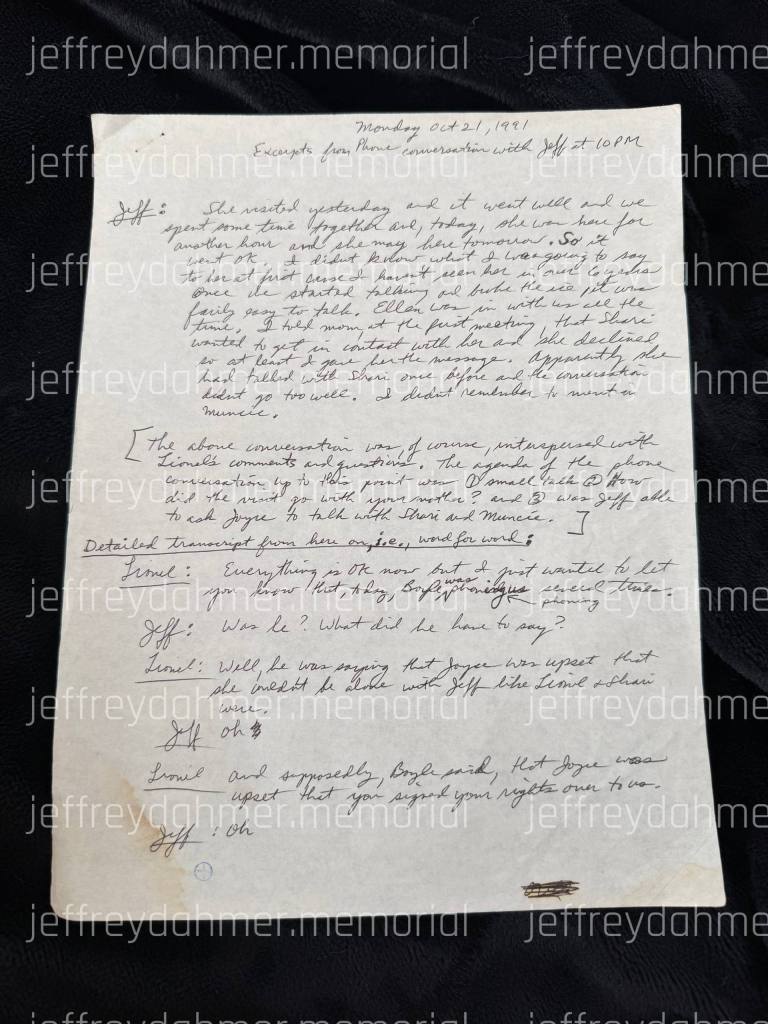
There is a moment on the first page of this document where a father stops summarising his son and starts transcribing him. It happens mid-page, marked by a single underlined sentence: Detailed transcript from here on, i.e., word for word.
Everything before that line is paraphrase. Everything after it is preserved exactly. And what falls on either side of that boundary tells us more about the Dahmer family in the autumn of 1991 than almost any other document we have seen.
The Document
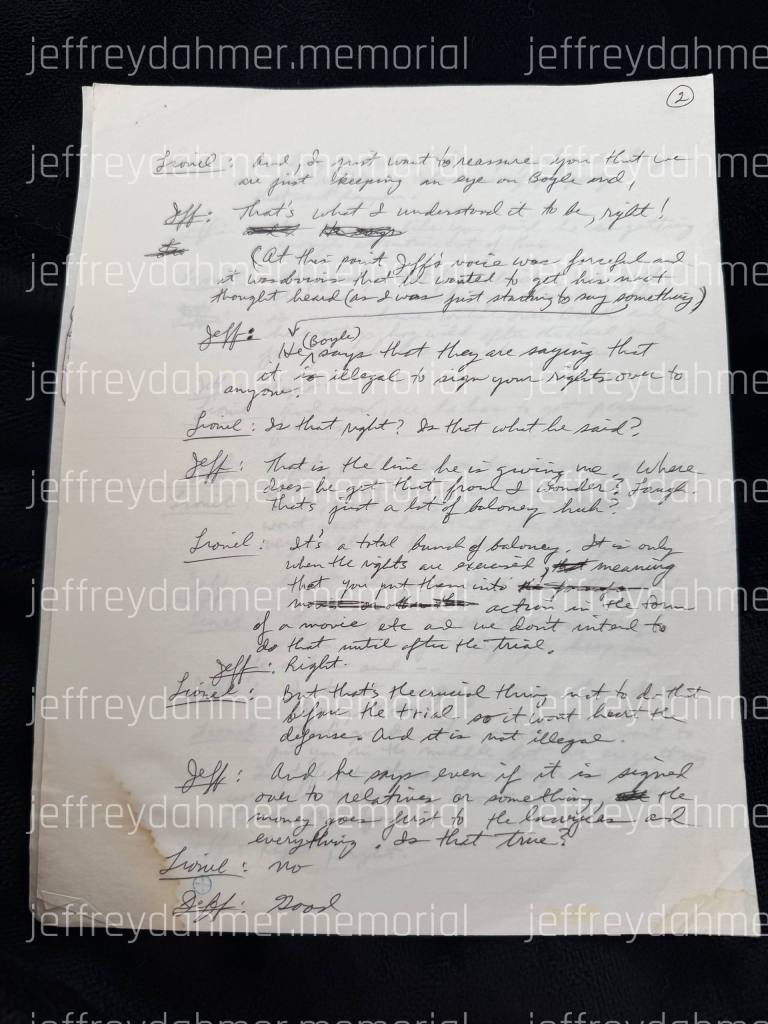
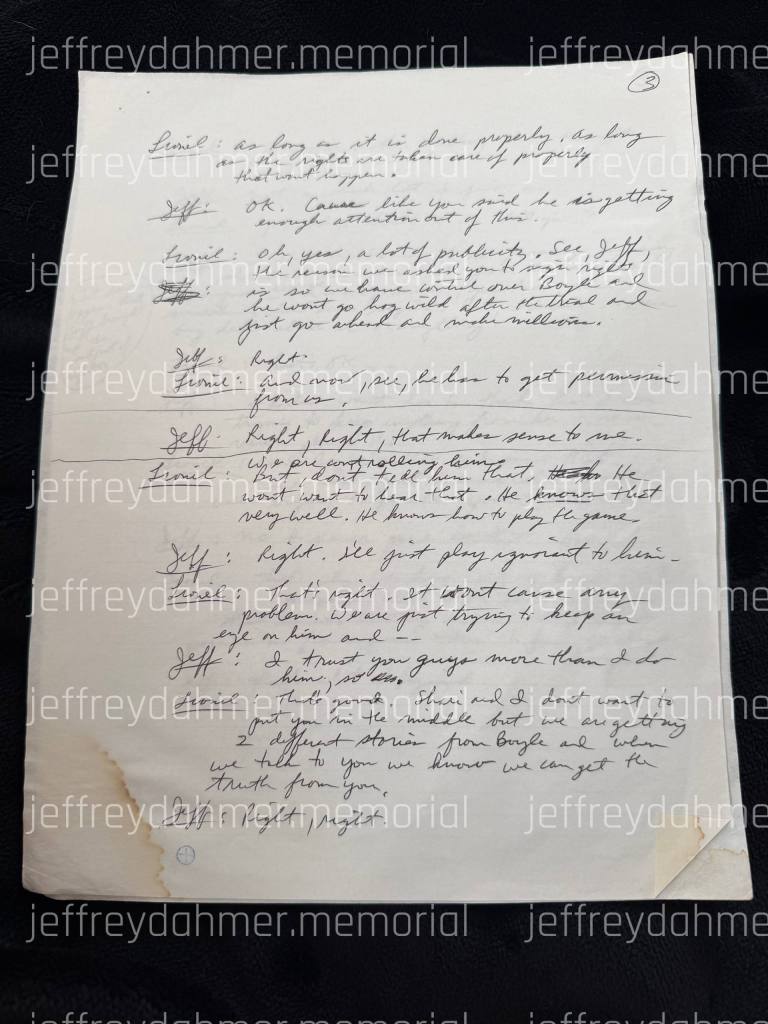
The pages consist of Lionel Dahmer’s handwritten record of a telephone call with his son, headed Monday, Oct 21, 1991 — Excerpts from Phone conversation with Jeff at 10 PM. The sheets are numbered in the upper right; the memorial holds pages three and four alongside the opening page.
The date places it precisely. Jeffrey had been arrested on 22 July 1991, three months earlier. His trial would begin at the end of January 1992, three months later. This is the middle of that winter — the period when the family was absorbing what had happened and, simultaneously, discovering that what had happened was now an asset that other people wanted.
A note on provenance, in keeping with this memorial’s practice: these pages came to us through a private contributor. Each bears a small registration mark at the lower left, indicating they are reproductions from a copied or archived set rather than original leaves. We have not been able to independently authenticate the hand against a verified exemplar, and we present them as what they appear to be rather than as what we can prove. Readers should weigh them accordingly. What follows is analysis of the text as it stands, with brief quotation only.
The Line Down the Middle
The call opens with Jeffrey talking about his mother.
Joyce had visited him. She had come the previous day, stayed a while; she came again that day for another hour; she might come again tomorrow. Jeffrey says he had not known what he was going to say to her at first, because he had not seen her in over six years. Once she started talking, he says, the ice broke and it became fairly easy.
Consider what is contained in those few sentences. A man of thirty-one, three months into permanent incarceration, sitting across from a mother he had not seen since his mid-twenties, not knowing how to begin. The ice breaking. An hour, then perhaps another tomorrow.
Lionel summarises it in a short paragraph.
He then adds a bracketed editorial note explaining that his own comments and questions have been omitted, and lays out the agenda of the call in numbered points: small talk; how the visit with Jeffrey’s mother went; and whether Jeffrey had been able to ask Joyce to speak with Shari and with Muncie.
And then, underlined: Detailed transcript from here on, i.e., word for word.
What follows, recorded exactly, is a conversation about publicity rights.
We do not think Lionel did this cruelly, and we will return to that. But the boundary is real and it is his. Faced with a call containing both his son’s first contact with his mother in six years and a dispute over legal control of the family’s story, he judged one worth compressing and the other worth preserving syllable by syllable. He was not keeping a record of his son. He was keeping a record of a negotiation.
“I’ll Just Play Ignorant to Him”
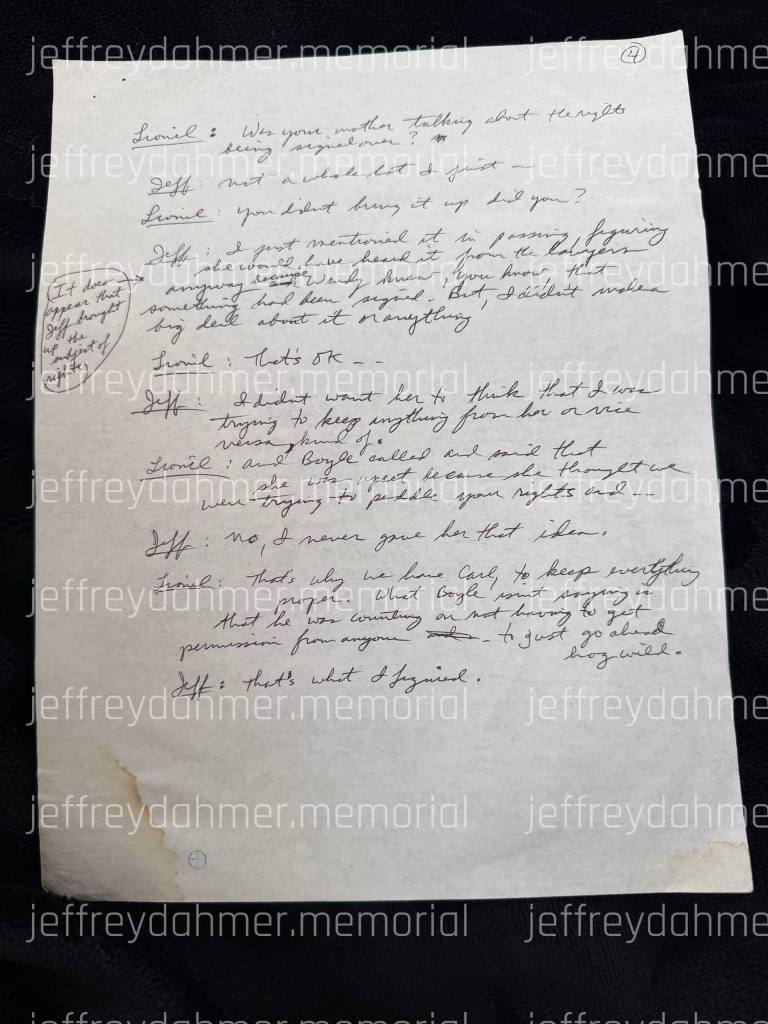
The transcribed portion begins with Lionel reporting that Gerald Boyle — Jeffrey’s own defence attorney — had telephoned the family several times that day. Boyle relayed that Joyce was upset she could not be alone with Jeffrey the way Lionel and Shari could, and upset that Jeffrey had signed his rights over to them.
Jeffrey’s response, twice, is a single syllable. Oh.
Lionel then explains the reasoning behind the signing. The purpose, he tells his son, was to have control over Boyle, so that after the trial he could not go — the phrase is Lionel’s — hog wild and make millions. Now, he points out, Boyle has to get permission from them.
Jeffrey agrees. Right, right, that makes sense to me.
Then comes the passage that should stop any reader.
Lionel begins to say that they are controlling Boyle, crosses it out mid-sentence, and instead instructs his son not to tell him — Boyle would not want to hear it, though he knows very well how the game is played.
Jeffrey answers: Right. I’ll just play ignorant to him.
Eleven weeks before a trial at which Gerald Boyle would stand up and argue for his life, Jeffrey Dahmer was asked by his father to conceal something from that attorney, and agreed within a single line. He then went further than he was asked, volunteering that he trusted his father and stepmother more than he trusted his own lawyer.
There is no resistance anywhere in the exchange. No question, no hesitation, no why. Whatever was put in front of him, he agreed with.
This is the trait Brian Masters spent a book circling and Dr Judith Becker described from the stand — the near-total absence of a stable position of his own, the reflexive accommodation of whoever happened to be in the room. What makes this document different from those accounts is that it is not reconstruction. It is not a psychiatrist’s summary or a biographer’s inference or a memory recovered years later. It is the behaviour itself, caught live on a Monday night in October, written down by the person he was accommodating.
The Same War, Thirteen Years On
Underneath the argument about rights is an older argument.
Boyle is carrying messages from Joyce to Lionel and Shari. Lionel is relaying them to Jeffrey. Joyce is upset about the visits; Joyce is upset about the signing; Joyce, according to Boyle, believes they are trying to peddle her son’s rights. Lionel asks whether she raised it. He asks — and the question has an edge — whether Jeffrey brought it up himself.
Jeffrey says he mentioned it in passing, assuming she would hear it from the lawyers anyway, and offers a reason that is the most human line in the document: he did not want her to think he was keeping anything from her.
Lionel does not respond to that. He returns to Boyle.
And in the margin beside it, in his own hand, he has written a note to himself: that it does appear Jeffrey brought up the subject of rights.
He is annotating his son. Checking the account against itself, flagging the discrepancy for later reference, in the margin of a record of a phone call with a man in a cell.
Then he offers the reassurance that gives the game away — that he and Shari do not want to put Jeffrey in the middle, but they are getting two different stories from Boyle, and when they talk to Jeffrey they know they can get the truth.
They do not want to put him in the middle. So they have placed him in the middle and told him it is because he is the honest one.
Jeffrey’s parents divorced in 1978, in a house where he was the remaining child and the only available conduit. Thirteen years later, from opposite sides of a criminal trial, they were doing it again — and he was still doing what he had learned to do, which was to make himself agreeable to whoever was on the line.
In Defence of Lionel Dahmer
It would be easy to read this document as an indictment, and that reading is available. We do not think it is the correct one.
Consider what October 1991 was for this man. His son had been revealed as the perpetrator of crimes that the country could not stop looking at. Reporters were on his lawn. Publishers were circling. A defence attorney with a growing public profile was, in Lionel’s understanding, positioned to profit enormously from the destruction of his family, and there was no law and no authority that would stop him — only paperwork. So Lionel did the one thing available to a frightened, methodical man trained as a chemist: he secured the paperwork, brought in his own attorney to keep it proper, and started keeping records.
He was not transcribing the call because he valued the rights conversation over his son. He was transcribing it because he was terrified he would need it later, and the reunion with Joyce was not evidence of anything.
And there is this. Three years after this call, Lionel Dahmer published A Father’s Story, a book in which he turned the same forensic attention onto himself and did not spare what he found — his blindness, his absences, his willingness not to see. Very few parents in his position have ever done anything comparable. The man in this transcript, managing his son’s asset portfolio at ten o’clock at night, is the same man who would later write that he had failed to look at his own child.
Both things are true. That is usually how it goes.
What the Document Leaves Us
Three sheets of lined paper, a fountain pen, and a father’s careful hand.
On one side of a line: a son describing the first time he had seen his mother in six years, compressed into a paragraph.
On the other: every word of a conversation about who would own the story.
Nobody in this transcript is a monster. A frightened father is protecting what he can. A mother, absent from the pages and represented only by other people’s reports of her distress, is being talked about rather than to. An attorney is playing the game he knows. And in the middle of it, agreeing with everyone, holding no position of his own, is a man who by then had already done everything he would ever be known for.
Right, right, that makes sense to me.
He said it to his father about a legal strategy he did not understand, and it is, in the end, the sentence he said to everyone. It is worth sitting with the possibility that no one ever asked him what he actually thought — not because they were cruel, but because there was always something more urgent to settle first.
(Original source of the document: Lyra, 2026)
A note on provenance, in keeping with this memorial’s practice: these pages came to us through a private contributor. Each bears a small registration mark at the lower left, indicating they are reproductions from a copied or archived set rather than original leaves. We have not been able to independently authenticate the hand against a verified exemplar, and we present them as what they appear to be rather than as what we can prove. Readers should weigh them accordingly. What follows is analysis of the text as it stands, with brief quotation only
Source: handwritten record by Lionel Dahmer, “Excerpts from Phone conversation with Jeff at 10 PM,” dated Monday 21 October 1991; pages 3 and 4 with opening page, held by the memorial. Contextual sources: Brian Masters, The Shrine of Jeffrey Dahmer (1993); Lionel Dahmer, A Father’s Story (1994); trial testimony of Dr Judith Becker (1992).
Names appearing in the document that we have not conclusively identified — including Ellen, Carl, and Muncie — are left unglossed rather than guessed at. Readers with documented information are invited to contact us.