Two Ways of Saying His Name: The “Dahmer” Track and Its Remix

Everything on this site is written about Jeffrey Dahmer. Third person, past tense, sources at the bottom. That grammar is not incidental — it is the distance that makes the work possible. You can examine a man in the third person. You can hold him at arm’s length and still look closely.

A song does not have to obey that rule, and this one does not.

“Dahmer,” from the forthcoming Shyster, is written in the second person. It talks to him. It exists on the record in two versions: the original, classic hip-hop built on piano and scratches, and a heavier industrial rework by GoH Mr. Whatever, with different words layered around the same core. Together they make an argument with itself, and the disagreement between them is more interesting than either version alone.

The original: a defence

The first version opens on an image of fit:

I got the key, you got the lock

Two objects that are useless apart and mean nothing separately. The verse that follows makes the same claim in a different figure — I’ve got a half, you’ve got the other — and then names it outright: my brother.

Everything else in the track is organised against a “they.” They look through you. They make their voodoo. They lose their minds. They have weapons, and they will abuse you and accuse you. The song’s world contains exactly two parties: a you and an I who fit together, and a hostile everyone-else who understands neither.

And at its centre is the line the whole version turns on:

they call you a monster you’re not

This is a defence. Not an examination, not a reckoning — a defence, delivered directly to him, in the voice of someone who has taken a side.

It is worth being honest about what that means, because this site’s method is to be honest about difficult things rather than to arrange them flatteringly. There are no victims in the original version of this song. Seventeen men and boys do not appear in it. The “they” who accuse and abuse are the press, the public, the machinery of spectacle — and framed that way, the accusation looks like persecution rather than the consequence of what he did.

The track also refuses to promise anything. None of us here is gonna win is not triumphant. It is a song that takes his side and expects nothing to come of it.

The remix: a redistribution

Mr. Whatever’s version keeps the original verses intact and builds new material around them. What that new material does is not soften the song. It complicates it, and in one specific place it contradicts it.

It opens somewhere the original never goes:

Cold room, dead eyes, fluorescent light

An institutional image, and then immediately a psychological one — you wanted a friend, you wanted control — which is a two-clause summary of the whole case, and a fairer one than most books manage. The wanting is real. The method was annihilation.

Then the line that changes the song:

But the monster had a heartbeat just like me

Set that against they call you a monster you’re not and you have two incompatible claims sitting on the same record. The original denies the category. The remix accepts it and then does something much more unsettling with it — it puts the speaker inside it. Not he isn’t a monster, but the monster was a person, and so am I.

That is a harder position to hold, and a more defensible one.

The remix also restores what the original leaves out:

You wanted connection, but you couldn’t stay
So you turned every heartbeat into something to take
A body is a memory, a memory fades

There they are. Not named, but present — heartbeats and bodies, people who were taken rather than an abstraction called accusation. The remix will not let the song be only about him.

And it adds a target the original doesn’t have. The chorus turns outward, at the audience:

Everybody wants to know your name
Everybody wants to watch the flame

That is a different “they” from the original’s. Not persecutors — spectators. The people consuming him. Which is a sharper and more accurate charge, and one that implicates anyone listening, including anyone reading this.

The keyhole

The remix ends by picking up the original’s first image and turning it inside out.

The song began with a key and a lock: fit, belonging, two things made for each other. It closes at the same door from the other side.

Look through the keyhole, what do you see?
A monster in the darkness or a piece of me?

The keyhole is now something you look through — the same verb the original used for the hostile “they,” who look through you. The listener has been moved into that position. And the question it asks is the one the memorial has been circling since it began: whether what you find in him is entirely alien, or partly familiar.

Some names become legends
Some names become stains

Then: Dahmer… 213. The apartment number, which is also the name of the project that made the record. The song signs itself with the address.

Why both versions belong on the album

There is an argument for keeping only the second one. It is the more complete piece of writing, it is the one that acknowledges the dead, and it is the one that can be defended without qualification.

But keeping both is the more honest choice, because the two versions are a record of an actual movement in thinking, and flattening that would be its own kind of dishonesty. The first is what it feels like from the inside — the pull toward defending someone the world has flattened into a symbol, the sense of a fit that nobody else can see. The second is what happens when that impulse is examined rather than simply obeyed.

Neither cancels the other. They sit next to each other on the record and disagree, which is roughly the condition of anyone who has spent serious time with this material.

None of us here is gonna win survives into the second version unchanged. It is still the truest line either version contains.


“Dahmer” and “Dahmer (remix)” appear on Shyster. Original lyrics and vocals by Door213; remix, additional lyrics and production by GoH Mr. Whatever.

The Temple: Infinity Land Rebuilt

We have written before about Infinity Land, the game Jeffrey Dahmer invented at nine years old — fleshless stick figures moving across a drawn landscape, annihilated if they came too close to one another, surrounded by spirals descending toward a black hole at the centre. That article argued the game never really ended; that it scaled up.

This is about what it scaled into.

What he was building

In the summer of 1988, Jeffrey bought a long black table and two statues of griffins. He was twenty-eight and still living in his grandmother’s house in West Allis. The purchase was not decorative. He had been turning an idea over since the previous year, and these were its first physical components: the table would be the altar, and the griffins — eagle-headed, lion-bodied, traditionally guardians of treasure — would protect it.

The design, as he described it after his arrest, called for skulls arranged along the table and two complete skeletons standing at either end. Incense. Blue lighting. He would sit in front of it.

He never finished it. When the apartment was searched in July 1991 police recovered the table, the griffins, eleven assorted heads and skulls, and the two skeletons — one from Ernest Miller, one from Oliver Lacy, whom he had defleshed specifically for the purpose. He had also looked into buying a freeze-drying machine, wanting to preserve bodies whole rather than reduce them to bone, and abandoned the idea when he found one large enough would cost around thirty thousand dollars.

The griffins were damaged before the end. One of the men he attacked fought back hard enough to knock the table and send them over. He kept the broken statues anyway.

Why it is the same object

Set the temple beside the game and the correspondence is close enough to be uncomfortable.

Infinity Land was populated by figures stripped of flesh — not people with contours, but bone. The temple was to be built from skulls and skeletons: the same reduction, carried out on real bodies.

In the game, the figures were arranged across a landscape and destroyed if they came too close. In the temple, the skulls were to be placed along a table at fixed intervals, permanently positioned, permanently apart. The proximity rule survives intact — it simply becomes a seating plan.

The game had a black hole at its centre, and Jeffrey described that nothingness to a prison therapist as soothing rather than frightening. The temple had a black table at its centre, and he described what he wanted from it in almost the same register. He called it a place where he could feel at home.

And in both, the essential feature is authorship. The nine-year-old drew the borders and decided the physics of his world. The adult was constructing a room in which he set the arrangement, the lighting, the rules, and the population — a space where nothing could arrive unannounced, change its mind, or leave.

The child made a world he controlled because he could not control the one he lived in. The adult was still making one. He was simply using different materials.

What the court could not decide

The temple became one of the strangest disputes of the 1992 trial, and the disagreement was not really about the facts.

For the defence, Dr Carl Wahlstrom pointed to it as evidence of a mind operating outside reality, citing Jeffrey’s intention to build a power-bestowing shrine alongside his attempts to create compliant companions as reaching psychotic proportions.

For the prosecution, Dr Park Dietz argued that it demonstrated nothing of the kind. Jeffrey did not truly believe the shrine would give him power, only that it might put him in contact with some spiritual force — which made it superstition rather than delusion, and superstition is not madness.

Dr George Palermo went further and simply declined to believe the temple existed as a plan at all, saying Jeffrey had mentioned it to him in passing and that he had reason to doubt it.

Brian Masters draws the distinction more usefully than any of them. A false idea is one that is factually wrong. A delusional idea is one that wrongly assigns power. The shrine was not a false idea — the table was real, the griffins were real, the skulls and the skeletons were real, and they were all found in the apartment. What was delusional was the expectation that sitting before them would confer anything at all.

He also places it in a longer tradition, and the comparison is bracing rather than flippant: churches across Europe have been built around body parts. Reliquaries hold bones. The faithful pin representations of damaged limbs to shrines in the belief that proximity to holy remains transmits power. The impulse to arrange the dead and draw strength from the arrangement is not, historically, a rare one.

What separates Jeffrey’s version is not the logic. It is that he supplied the relics himself.

Why a table

There is a further reading of the temple that belongs to Brian Masters, and it should be introduced as what it is: an interpretation, not a documented fact. We think it is worth stating anyway, because it asks a question nobody else thought to ask.

Why a table?

An altar, if you were designing one, would not obviously be a table. It might be lower. It might be smaller, or ornate, or raised. Jeffrey chose a long, flat, waist-height surface — and the reason that matters is what he actually used it for before any skull was ever placed on it. He draped the bodies of the men he killed across it. He arranged them on it and photographed their chests, abdomens and genitals. He made the first incision on it, before the dismemberment moved to the bathroom.

It was, functionally, an operating table.

On 19 March 1964, at the age of four, Jeffrey underwent a double hernia operation. We have written elsewhere about the psychology of early surgical trauma — that children under six suffer disproportionately because they cannot understand what is being done to them, that they become objects in the hands of strangers, that their emerging sense of autonomy is abruptly cancelled and nobody explains why. Afterwards, in pain that would have felt exactly like it, he asked his mother whether his penis had been removed. He told Dr Judith Becker about that question nearly thirty years later.

Masters’ argument is that control was taken from Jeffrey on an operating table at four and that he spent his adult life trying to take it back — that with his victims he was finally the surgeon rather than the passive child, handling their insides as his had been handled, cutting where he had been cut. On that reading, the black table is not an incidental piece of furniture. It is the operating table, rebuilt and owned, with him standing on the other side of it.

We flag the obvious limit: this is an interpretive claim, and Masters himself concedes it cannot be generalised — a great many children have hernia repairs and become nothing in particular. It explains rather more than a coincidence should, which is a reason to take it seriously and also a reason to be careful with it.

What is documented is narrower and stranger. At the 1992 trial, Dr Becker raised two things that had never been publicly examined: the hernia operation, and a childhood game called Infinity Land. Gerald Boyle prompted her gently on both. Neither was pursued.

Two keys, offered in open court, and nobody turned either one.

The thing worth saying plainly

There is a reading of the temple that treats it as the final proof of monstrousness — the horror-film altar, the serial killer’s trophy room. That reading is available and it is not entirely wrong.

But it misses what the Infinity Land parallel makes visible. The temple was not conceived as a display of what he had done. It was conceived as a place to sit. He described wanting to be in front of it, in the light and the incense, in the company of the dead — the only people, as he saw it, who had known him as he actually was.

A child who cannot find safety in the world builds a small one he can govern. That is ordinary. Nearly every frightened child does some version of it, and the ones who do are not marked for anything.

What is not ordinary is continuing to build it at thirty-one, out of people.

The continuity is the disturbing part, and it is also the part that resists any comfortable conclusion. The same need runs from the drawn spirals to the black table. The need itself was never the problem. What he was willing to do to satisfy it was.


Sources: Brian Masters, The Shrine of Jeffrey Dahmer (1993); Lionel Dahmer, A Father’s Story (1994); trial testimony, Milwaukee County Circuit Court, 1992; Milwaukee Police Department inventory of Apartment 213.

Codex Ballads: The New Door213 Album Is Out

Codex Ballads, the new full-length album by Door213, is out now on Enough Records.

The title is the key to the whole record. A codex is a book that must be deciphered — and these are ballads written the same way, songs with a hidden double meaning folded inside them. On the surface, they are love songs. Read again, they are rebellion songs — songs set against a system that is unforgiving, that decides who is beyond saving and closes the book on them. Every track holds both meanings at once, and neither cancels the other.

The album carries an openly Christian tone. Its themes are God, forgiveness, divine presence, and the strength it takes to seek redemption — told through the visual and lyrical language of one specific life: Jeffrey Dahmer, who in his final years repented of his life of crime and violence, delivered his soul to God, was baptised, and did what little a man in his position could to make amends with the past. The album reflects on why that mattered — and extends the same possibility outward, to everyone who has repented of pain they caused and wonders whether the door is still open. The record’s answer is that it is.

The sound is a mix of hip-hop ballad and medieval hints — strong beats underneath, choir-like textures above, deep poetry throughout. The lyrics are God-seeking; to some listeners they may land as prayers. It is music built for the space between the club and the chapel.

Two of the album’s strongest tracks — Don’t Forsake Me (Jeff Version) and Swallow Me Whole (Jeff Version) — were made in collaboration with Jeff Knapp, aka GoH | Mr. Whatever, a German multidisciplinary artist and musician. His voice against Necro’s gives the album’s message its clearest expression, in both sound and visual art. Don’t Forsake Me already has an official video, a prayer crossing time and space:

Alongside the album, the two artists also produced a separate single, Feels Like Coming — a song about love and about arriving where we long to be, with the one we desire to love, no matter the distance, and no matter whether they are living or dead. It belongs to the same universe as Codex Ballads and is best listened to together with it. Its video is also out:

Tracklist:

  1. Heaven Complete
  2. Don’t Forsake Me (Jeff Version)
  3. I’ll Do It All For You
  4. Love Is Eternal
  5. The Beast Is Hiding Among Your Friends
  6. Meat Grinder
  7. Reborn
  8. Don’t Forsake Me
  9. If I Die Before I Wake
  10. A God That IS Good
  11. Swallow Me Whole (Jeff Version)
  12. Swallow Me Whole

Codex Ballads is available now — listen on Spotify, Deezer, Apple Music, Amazon Music, Etc, with wider streaming platforms to follow.

Door213 is the project of Necro (they/them), Portuguese multidisciplinary artist and founder of this memorial. GoH | Mr. Whatever is the project of Jeff Knapp (he/him), German multidisciplinary artist and musician.

Feels Like Coming: On Arrival, and What It Costs to Get There

The title will stop some people in their tracks. That’s intentional.

Feels Like Coming is the new single from Door213 — a collaboration between Necro (Portugal) and Jeff Knapp (Germany) — and it carries a double meaning that is worth sitting with rather than dismissing. Yes, the obvious reading is there. But the one that drives the music, the one that drives the video, is something else entirely: I feel like I’m arriving to where you are.

The video makes this literal. Through fields, forests, highways at night — Necro runs. Not metaphorically. The whole visual structure is a journey toward someone, across distance, across time, across whatever separates the living from the dead. It is the same impulse that drives the memorial itself: the refusal to accept that a wall exists between the present and 1994, between the world and the man the world discarded.

The provocative title is the point of entry. What you find inside is the journey.

Feels Like Coming will be available on all major streaming platforms on July the 1st.

Don’t Forsake Me: A Music Video About Prayer, Grace and What Crosses Time

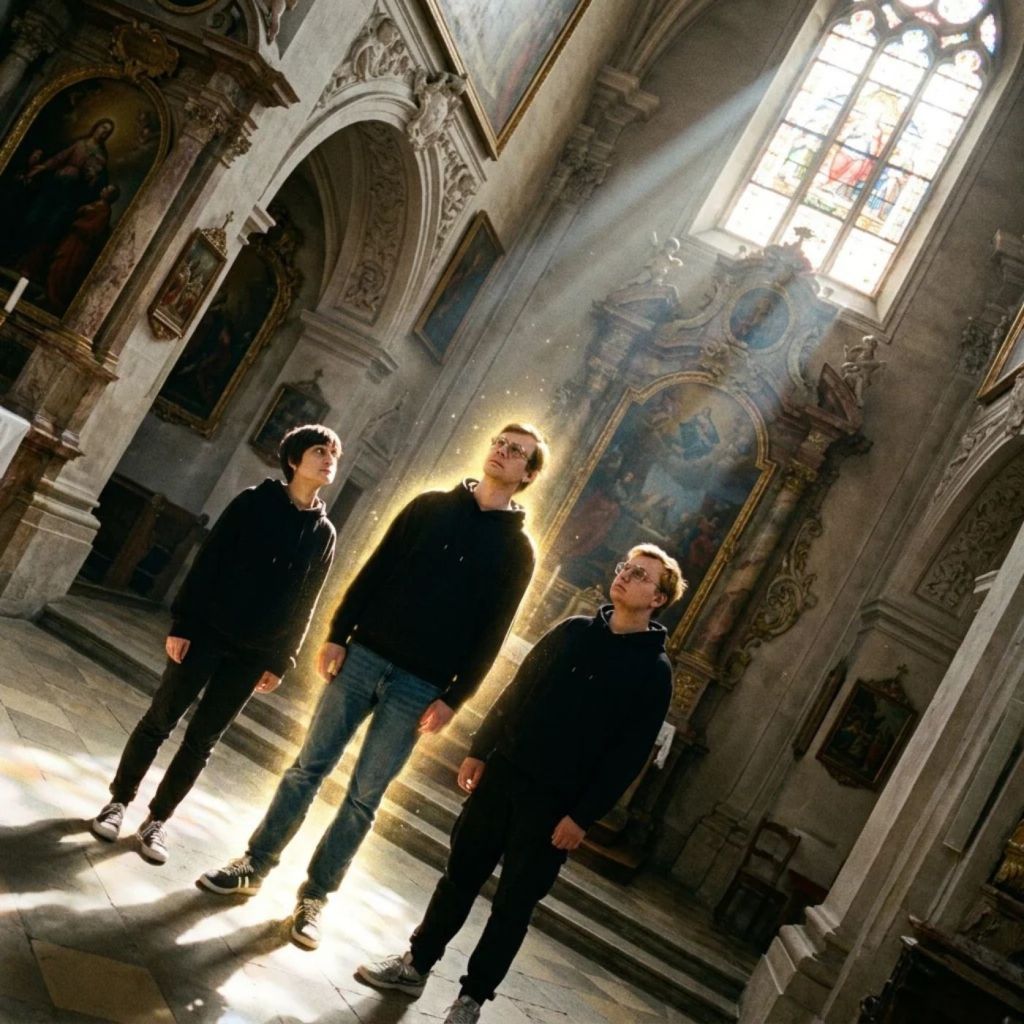
Door213 and GoH | Mr. Whatever have released the official music video for Don’t Forsake Me (Jeff Version), a collaborative alternative and hip-hop ballad written, composed, produced and performed by both Vânia Netas and Jeffrey Knapp.

The song was written as a prayer — a plea not to be abandoned in the dark. The video extends that prayer into image.

What the Video Shows

The visual structure takes place across two spaces that exist in different dimensions of time.

In the first, two figures — Vânia and Jeff — pray separately, each in their own sacred space. They are not together. They do not know each other is there. But the intention is the same: to reach through darkness toward something or someone who needs light.

In the second, Jeffrey Dahmer sleeps in a simple bedroom. He wakes slowly, as though something has reached him across the distance. He moves to the window. Light begins to spiral around him, lifting him — not dramatically, but gently, the way grace tends to arrive.

The two spaces are connected by prayer. The video makes that visible.

What It Is About

Don’t Forsake Me is about forgiveness, redemption, and faith — not as abstract concepts but as things people actually do, reach toward, and sometimes find. It is about the idea that genuine intention can cross time and space, that a prayer offered sincerely does not simply disappear.

It is also about the memorial’s central conviction: that Jeffrey Dahmer was a human being, that he suffered, that he sought grace in the final months of his life, and that the people who believe in holding his full humanity are not wrong to do so.

The video does not argue. It prays.

The Collaboration

Don’t Forsake Me (Jeff Version) is a joint work between Door213 (Vânia Netas, Portugal) and GoH | Mr. Whatever (Jeffrey Knapp, Germany). Both artists wrote, composed, produced and sang the track. Both voices are present throughout.

The video was generated and edited by the artists themselves.


Don’t Forsake Me (Jeff Version) is available now.

Milwaukee Rain: A Journey Through Space, Time, and Shared Streets

Milwaukee Rain is a music video collaboration between Door213 (Vânia Netas, Portugal) and GoH Mr. Whatever (Jeffrey Knapp, Germany) that traces the invisible threads connecting two artists who have never met, bound together by their shared understanding of Jeffrey Dahmer’s humanity.

The video follows Vânia and Jeff as they walk the same Milwaukee streets Jeffrey once walked, separated by geography and time yet unified in their connection to his story. Through flashbacks, we see Jeffrey himself—in record shops, moving through the city that would become inseparable from his name. The three figures converge in scenes of collaboration, playing together as a band across the boundaries of time and space.

At its core, Milwaukee Rain explores what it means to be connected to someone you’ve never physically met—both Jeffrey Dahmer himself, and the collaborator on the other side of Europe who shares your understanding of him. Vânia, based in Portugal, and Jeff, based in Germany, have never stood in the same room, yet they create together, walk the same streets in different moments, and find themselves entangled in the same story.

The video asks: what does it mean to walk where someone walked? To stand where they stood? To feel connected across time to a person you never knew, and across distance to a person you’ve never touched?

Milwaukee becomes more than a location—it becomes the intersection point of three lives, three timelines, three understandings of loneliness, creativity, and the human need for connection.

OXOXO Love Jeffrey, Art and Forgiveness

I’m Vany, known in the JD Community as Necroartsy. I was born in Portugal in 1988 and have journeyed from video editing and music to AI art, culminating in the creation of my store, The Slice, in this year of 2024. My work blends traditional techniques with AI, crafting stories that challenge societal norms.

The OXOXO Love Jeffrey collection shows Jeffrey Dahmer’s complex legacy, not to glorify his crimes but to explore repentance, forgiveness, and humanity’s multifaceted nature. It humanizes Dahmer, presenting him in imaginative scenarios that challenge perceptions of good and evil. Pieces like serene portraits and whimsical depictions, such as Dahmer in Jedi robes, invite viewers to reflect on morality and redemption.

Jedi Robes 2024

The mission of “OXOXO Love Jeffrey” is to advocate for empathy and understanding. I believe in the power of forgiveness, extending it to everyone. By presenting controversial subjects, I encourage discussions about redemption and change. Forgiveness is central to the collection, urging viewers to consider nuanced understandings of humanity and the potential for redemption.

The Slice, my platform, fosters these discussions through art. The store’s design, review system, and blog provide space for immersive engagement with each collection’s stories. My holistic approach blends aesthetics with profound social commentary, making The Slice a unique destination.

OXOXO Love Jeffrey Pin Buttons 2024

In “OXOXO Love Jeffrey,” AI and traditional techniques create thought-provoking and visually stunning pieces. Each artwork is a testament to the transformative power of art. By humanizing Dahmer and advocating for forgiveness, I push conventional art boundaries and invite viewers to a larger conversation about humanity, morality, and redemption.

Visit The Slice to explore “OXOXO Love Jeffrey,” discover a collection that challenges, provokes, and inspires. Engage with the art, read the stories, and join the conversation about forgiveness, empathy, and the complexity of the human condition.

Depeche Mode — I Am You

this song makes me think of jeff so much. it really does. it must have been what he felt when he desired for a person to become a permanent part of him.

I had to ask. “Jeff, why did you wear this guy’s face?”

Dahmer continued to smoke as he answered. “Pat, I already told you that I wanted to keep these guys with me. I didn’t want them to leave. I loved them. That’s why I killed them. That’s why I saved their body parts. That’s why I ate them—so they could become one with me. I thought if I could preserve this guy’s skin, I could wrap myself in him. His outer shell would surround me. I would actually be in him. We would be one.”

The room fell silent. Patrickus wrote in her notepad, and Murphy and I sat without a word, letting Dahmer’s heartfelt explanation sink in.

— Grilling Dahmer: The Interrogation Of “The Milwaukee Cannibal” by Patrick Kennedy, Robyn Maharaj

if only he’d expressed this in a healthier way, with the consent of the other person, then maybe it would have gone more like this song portrays. 💔 but i wonder if this is what he was longing for — a connection so irreversibly deep and profound, two souls blended together fully, to the point where he was them and they were him.

it’s sad to know he was never able to find this consensual arrangement with a partner, instead feeling like he had to completely dominate them in order to have anything at all that wasn’t just a fuck-and-dump. perhaps in the next life, he will be — or already is — healthier, and he can have this intensely deep and unbreakable bond with someone who feels the same way.

You have bound my heart with subtle chains
So much pleasure that it feels like pain
So entwined, now that we can’t shake free
I am you and you are me

No escaping from the mess we’re in
So much pleasure that it must be sin
I must live with this reality
I am yours eternally

There’s no turning back
We’re in this trap
No denying the facts, no, no, no
No excuses to give
I’m the one you’re with
We’ve no alternative, no, no, no

Dark obsession in the name of love
This addiction that we’re both part of
Leads us deeper into mystery
Keeps us craving endlessly

Strange compulsions that I can’t control
Pure possession of my heart and soul
I must live with this reality

I am you and you are me

There’s no turning back
We’re in this trap
No denying the facts, no, no, no
No excuses to give
I’m the one you’re with
We’ve no alternative, no, no, no

Jeffrey Falling Asleep (2023)

One of my first portraits using a Trained Model of Jeffrey’s face.

https://instagram.com/new_necroartsy/

I used Stable Diffusion and Photoshop. This was a different experience, it is the first time I am using a model that I trained, mixed with my usual prompt. It has resulted in a very dreamy portrait that I’m so excited to share here.

Please visit my Instagram for more portraits of Jeffrey!

Signing off,

Necro

Transforming through Beauty and Other Thoughts

I believe art can help souls; I started to produce portraits of Jeffrey with the intention of helping his soul transform and transcend through beauty and art, where Jeffrey can be put into a context where he can exist peacefully, where he can love and be loved, experience desire without hurt and, ultimately, be happy.

I do not use any AI Model trained to produce Jeffrey’s face, I do use Img2Img in some more classical and obvious forms of portraits but, for the most part, Jeffrey’s image appears through to my outputs in a supernatural fashion, where no photo of him is used, nor any reference to his name. I make use of Photoshop to correct some body features that do not come out well enough through my AI machine, however, his face is, very rarely, corrected or modified.

Untitled with Glasses (2023) – A spontaneous output, unmodified.

I do have a very deep connection with Jeffrey’s soul; I believe my mission is to help him, as he has been, to me, a guiding soul, since my childhood years. I believe his soul is Good and that he has repented in a deep and honest way, choosing to become Light.

It has been very hard for me, and for the community that supports this belief, to experience so much hatred and intolerance, in places that shout words of freedom, in a very selective way that does not give any space to real things in this world, like: forgiveness to those who really need it.

[I am currently without Instagram or any other platform, because our mission is unwelcome and my accounts keep being taken down.]

Stay blessed, everyone. Signing off,

Necro