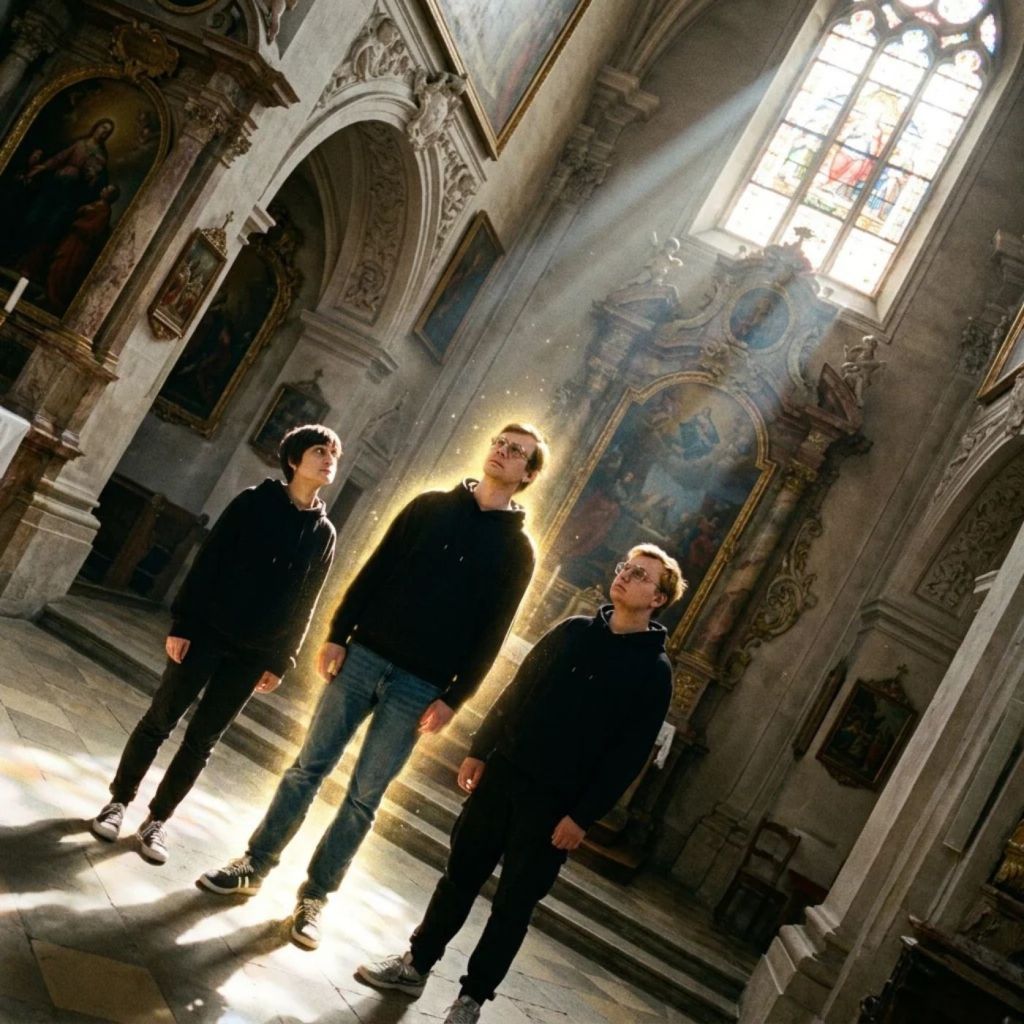
Door213 and GoH | Mr. Whatever have released the official music video for Don’t Forsake Me (Jeff Version), a collaborative alternative and hip-hop ballad written, composed, produced and performed by both Vânia Netas and Jeffrey Knapp.
The song was written as a prayer — a plea not to be abandoned in the dark. The video extends that prayer into image.
What the Video Shows
The visual structure takes place across two spaces that exist in different dimensions of time.
In the first, two figures — Vânia and Jeff — pray separately, each in their own sacred space. They are not together. They do not know each other is there. But the intention is the same: to reach through darkness toward something or someone who needs light.
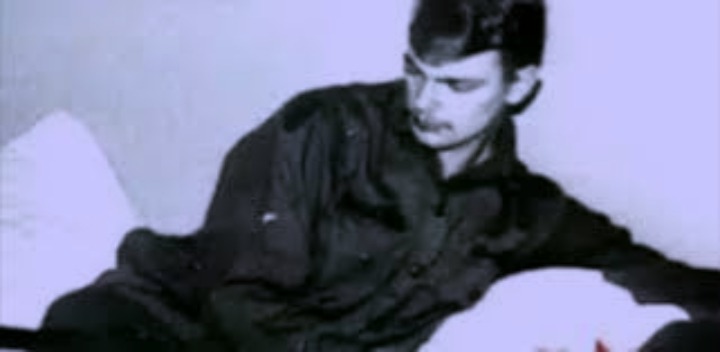
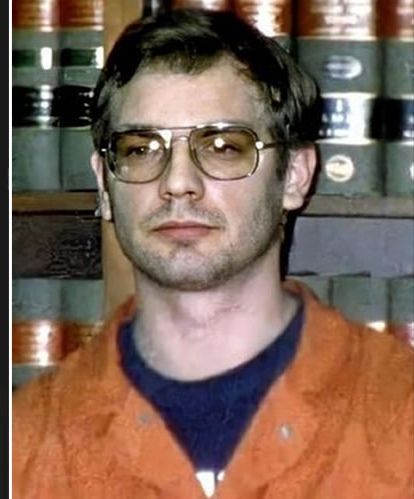
In the second, Jeffrey Dahmer sleeps in a simple bedroom. He wakes slowly, as though something has reached him across the distance. He moves to the window. Light begins to spiral around him, lifting him — not dramatically, but gently, the way grace tends to arrive.
The two spaces are connected by prayer. The video makes that visible.
What It Is About
Don’t Forsake Me is about forgiveness, redemption, and faith — not as abstract concepts but as things people actually do, reach toward, and sometimes find. It is about the idea that genuine intention can cross time and space, that a prayer offered sincerely does not simply disappear.
It is also about the memorial’s central conviction: that Jeffrey Dahmer was a human being, that he suffered, that he sought grace in the final months of his life, and that the people who believe in holding his full humanity are not wrong to do so.
The video does not argue. It prays.
The Collaboration
Don’t Forsake Me (Jeff Version) is a joint work between Door213 (Vânia Netas, Portugal) and GoH | Mr. Whatever (Jeffrey Knapp, Germany). Both artists wrote, composed, produced and sang the track. Both voices are present throughout.
The video was generated and edited by the artists themselves.
I’ve been studying Jeff since 2022.
Not in the way people often assume.
Not out of admiration, and never to justify anything.
But because something about it made me stop… and look closer.
I’ve always been drawn to the things that don’t have simple answers.
To the quiet spaces between what is visible and what is hidden.
To the parts of human nature that most people turn away from, because they are too uncomfortable, too heavy, or too complex to hold for long.
What draws me in isn’t what he did.
It’s everything surrounding it.
The psychology.
The loneliness.
The contradictions that can exist within one person — how someone can be both deeply human and deeply broken at the same time.
I don’t believe that understanding equals excusing.
And I don’t believe that looking closer means losing your sense of right and wrong.
To me, it means the opposite.
It means being willing to sit with something difficult, without immediately reducing it to something simple just to feel safe again.
I’ve never seen the world in black and white.
There are always layers. Always reasons. Always something beneath the surface, even if we don’t like what we might find there.
And maybe that’s why I’m here.
Not to defend.
Not to glorify.
But to understand.
Because sometimes, understanding is the only honest way I know to look at things.
This is a part of me.
Quiet, complex, and real.
And I’m not here to hide it.
There is a moment in almost every childhood where the world becomes too large and too unpredictable to bear. The adults are fighting. The house is moving again. Nobody is explaining anything. And so a child does what children do when the outside offers no safety — they build something on the inside. A private world with its own rules, its own logic, its own borders. A place that belongs entirely to them.
Jeffrey Dahmer built his at around the age of nine. He called it Infinity Land.
What It Was
The game was drawn on paper. Stick figures — fleshless, bone-only, stripped of flesh entirely — moved across a landscape governed by a single absolute rule: if they came too close to one another, they were annihilated. Surrounding them were spirals, tightly wound, intensely imagined, pulling downward toward a black hole at the centre of everything.
He shared it with his friend David Borsvold — a quiet, rock-collecting, dinosaur-studying boy who was perhaps the closest thing Jeffrey had to a genuine companion during those years. Together they played out these annihilations, moving their little armies across a world where closeness meant destruction and the only destination was oblivion.
Brian Masters, in The Shrine of Jeffrey Dahmer, described the game with the care it deserves. The stick figures were not conceived with the full contours of people. They were bone. Their danger lay in proximity. And the spirals descended, always, toward the black hole of infinity.
He called it Infinity Land. He was nine years old.
What It Meant
Here is what I believe, having lived with Jeffrey in my thoughts for so long: Infinity Land was not a symptom. It was a solution.
By the time Jeffrey drew those first spirals, his life was already shaped by things a child has no language for and no power over. His mother Joyce’s mental health crises — the seizures, the medication, the hospitalizations, the rages. His father Lionel’s long absences, buried in his chemistry PhD. A family in near-constant motion, address after address, the ground never quite solid underfoot. A boy who had become, very early, extremely alert to instability — watching the room, reading the atmosphere, waiting for the next thing to shift.
He could not control any of that. But in Infinity Land, he controlled everything.
He made the rules. He decided the physics. He drew the borders of the world and determined what happened inside them. The stick figures obeyed laws he invented. The spirals descended at his direction. The black hole waited at the centre, patient and absolute, because he had placed it there.
This is what children do with anxiety they cannot name. They build containers for it. Games with highly defined rules — and Lionel Dahmer himself noted that Jeffrey always preferred games with exactly that: defined rules, repetitious actions, nothing left to chance or confrontation. The structure was the comfort. The rules were the shelter.
Infinity Land was Jeffrey’s most complete version of that shelter.
The Symbology of the Spiral
A spiral is not simply a shape. It is a direction. It implies movement — inward, downward, tightening — toward a centre that cannot be reached or escaped. Every civilisation that has ever drawn a spiral has understood, on some level, that it means something about time, about fate, about the way certain forces pull you regardless of your will.
Jeffrey drew spirals at nine years old and gave them a destination: a black hole. Infinity. Nothingness that was not frightening but — as he would say decades later in prison, when a therapist asked him about the game — soothing. Nice. Like a child asking for a warm blanket.
That detail stops me every time I return to it.
The nothingness at the centre of Infinity Land was not a threat. It was a comfort. For a boy who lived in a house full of noise and volatility and unpredictability, the absolute stillness of the void was something to move toward rather than away from. It was the one thing that could not suddenly change its mind, raise its voice, or disappear.
It was reliable. In its way, it was safe.
The Annihilation Rule
The stick figures were annihilated if they came too close.
Masters read this as a sign of Jeffrey’s relationship with intimacy — the danger of closeness, the way contact meant destruction. And he was right. But I think there is something else in it too.
When you are a child and the people closest to you are also the sources of the most unpredictability — when the arrival of a parent means tension rather than relief, when love comes wrapped in volatility — you learn, very early, that proximity is risk. You learn to keep a careful distance. You learn that the safest position is adjacent, not close.
Jeffrey encoded that knowledge into his game at nine years old without knowing that’s what he was doing. He made a world where the rule he was already living by — don’t get too close, it ends badly — was written into the physics of the universe itself. Not as a wound but as a law. Clean, legible, certain.
In Infinity Land, you always knew exactly what would happen if someone came too close. There were no surprises.
The Game That Didn’t Stay a Game
Brian Masters returned to Infinity Land again and again throughout The Shrine of Jeffrey Dahmer — not as a curiosity but as a key. He described Jeffrey’s adult descent as “descending with frightening rapidity down one of his own spirals into Infinity Land.” He described Jeffrey’s panic attacks in prison as spiralling “to the pit of despair, parodying his imaginary descents into Infinity Land as a child.”
The game, in Masters’ reading, never ended. It simply scaled up.
The spirals became real. The annihilation became real. The black hole at the centre — the nothingness Jeffrey had called soothing as a child — became the “deep, clawing depression” and the sense of “total, final hopelessness” that he described in prison as feeling “a bit like what hell is like.”
What had been shelter became structure. What had been comfort became compulsion. The rules of Infinity Land — closeness destroys, the spiral descends, the void awaits — did not stay on paper.
This is not to say the game caused what happened later. That would be too simple, and Jeffrey’s story resists simplicity at every turn. But it is to say that the interior world Jeffrey built at nine years old to make sense of a life he couldn’t control became, over the following decades, the template through which he understood everything. The logic of Infinity Land was the logic of his mind. He never entirely left it.
The Trial, and the Silence
In 1992, during Jeffrey’s trial, the defence psychologist Dr Judith Becker mentioned Infinity Land in her testimony. She described it gently, on gentle prompting from defence attorney Gerald Boyle. And then nobody pursued it.
Masters found this extraordinary, and so do I. Here was a window into the interior world of a man whose crimes the trial was trying to explain — a childhood game that encoded, with startling precision, his deepest beliefs about closeness, destruction, and the pull of the void. And it was left in limbo, as Masters put it. A curiosity not to be tampered with.
Perhaps it was too strange. Perhaps the courtroom had no framework for it. Perhaps nobody present understood what they were looking at.
We do.
A Child Who Built His Own World
Jeffrey Dahmer was a boy who needed safety and couldn’t find it in the world around him. So he made one. He drew it on paper with fleshless figures and tight spirals and a black hole at the centre, and he played it with his friend, and for a little while it was enough.
That is the most human thing in this entire story.
The boy who built Infinity Land was not building toward horror. He was building away from pain. He was doing what every frightened child does — reaching for some small corner of existence that he could control, that had rules he understood, that would not suddenly change.
He called it Infinity Land. He was nine years old. He was just trying to feel safe.
Sources: Brian Masters, The Shrine of Jeffrey Dahmer (1993); Lionel Dahmer, A Father’s Story (1994); Trial testimony of Dr Judith Becker, Milwaukee, 1992.
There is a comfortable version of forgiveness that most people practice without difficulty. Forgiving someone who apologised sincerely for something relatively minor. Forgiving a friend who let you down. Forgiving yourself for a mistake that cost you something but hurt no one else irreparably.
And then there is the other kind. The kind that costs something. The kind that the entire weight of Christian theology points toward and very few people are actually willing to extend.
Jeffrey Dahmer is a test case for that second kind. And most people fail it.
The Man Nobody Wants to Mention
Before he was the Apostle Paul — before he wrote half the New Testament, before he became one of the most important figures in the history of Christianity, before he was martyred for his faith in Rome — he was Saul of Tarsus.
Saul was a persecutor of Christians. Not metaphorically. Not bureaucratically. He was present at the stoning of Saint Stephen, the first Christian martyr — holding the cloaks of the men who threw the stones, giving his approval to the killing. He went house to house in Jerusalem dragging Christians out and throwing them in prison. He obtained letters authorising him to travel to Damascus to arrest believers there and bring them back in chains. He described himself later as having been, in his own words, a blasphemer, a persecutor, and a violent man.
He caused suffering. He caused death. He did it with conviction and with the full support of the religious establishment of his time.
And then, on the road to Damascus, everything changed.
The Road to Damascus
The conversion of Saul is one of the most dramatic moments in the entire New Testament. A blinding light. A voice asking “Saul, Saul, why do you persecute me?” Three days of blindness. And then — transformation so complete that the man who had been hunting Christians became Christianity’s greatest evangelist.
What is theologically significant about this moment is not just that Saul changed. It is what the Church did with that change.
It did not erase his past. It did not pretend the stoning of Stephen hadn’t happened or that the families of those he had imprisoned hadn’t suffered. Paul himself never pretended otherwise — he called himself the foremost of sinners, the least of the apostles, one not even deserving to be called an apostle because he had persecuted the Church of God.
The Church held both truths simultaneously: this man caused real harm to real people, and this man was genuinely transformed by grace. Both things were true. Neither cancelled the other.
That is the radical heart of Christian forgiveness. And it is what most people refuse to apply to Jeffrey Dahmer.
Jeffrey’s Damascus
Jeffrey Dahmer’s conversion was quieter than Saul’s but no less genuine according to those who witnessed it.
It began with a Bible his father sent him in prison. It deepened through a correspondence course. It culminated in the spring of 1994 when Reverend Roy Ratcliff — a minister of the Church of Christ who had agreed to meet with him after Jeffrey expressed interest in baptism — submerged him in the prison whirlpool at Columbia Correctional Institution.
Ratcliff later wrote about Jeffrey with a clarity that cuts through the noise. He described a man who was sincere, who asked real questions, who struggled genuinely with what he had done and what it meant before God. He noted that Jeffrey’s questions were not the questions of someone performing remorse for an audience. They were the questions of someone who was genuinely trying to understand whether redemption was possible for a person like him.
Jeffrey himself said: “I hope God has forgiven me. I know society will never be able to forgive me.”
He met with Ratcliff every week from his baptism in May 1994 until five days before his death in November. Their last session together covered the Book of Revelation — its subjects, death, punishment for sins, and what comes after. He was not coasting. He was working.
What the Thief on the Cross Tells Us
If the story of Saint Paul isn’t enough, consider the thief on the cross.
In the Gospel of Luke, one of the two criminals crucified alongside Jesus turns to him and says simply: “Remember me when you come into your kingdom.” And Jesus replies: “Truly I tell you, today you will be with me in paradise.”
No lengthy process of rehabilitation. No years of demonstrating changed behaviour. No committee deciding whether the repentance was sincere enough. A dying man, in his final hours, asking to be remembered — and the answer being yes.
The thief had presumably done enough to warrant execution by Roman standards. We don’t know what he did. We know that in his last moments he turned, and that turning was enough.
The theology here is explicit and radical: the reach of grace has no floor. There is no depth from which it cannot lift someone. There is no crime that places a person permanently beyond its reach.
The Prodigal Son
Jesus told a story about a son who took his inheritance early — essentially wishing his father dead — went to a foreign country and wasted everything on reckless living, and then came home in desperation, planning to beg to be taken on as a servant.
The father sees him coming from a long way off. He runs to meet him. He calls for a robe and a ring and a feast. He says: “This son of mine was dead and is alive again; he was lost and is found.”
The older son — the good one, the one who stayed, the one who did everything right — is furious. And the father’s answer to him is the heart of the parable: “We had to celebrate and be glad, because this brother of yours was dead and is alive again; he was lost and is found.”
The story is not about whether the prodigal deserved the feast. It is about the nature of the father. It is about what grace looks like when it is genuinely operating.
The people who insist Jeffrey Dahmer cannot be forgiven are, in the parable’s terms, standing outside the feast refusing to come in. That is their right. But it does not change what is happening inside.
Why People Refuse
The resistance to extending forgiveness to Jeffrey is understandable on a human level. His crimes were of a type that the mind struggles to hold. The nature of what he did — the intimacy of it, the specific choices involved — creates a revulsion that is visceral and real.
But Christian forgiveness was never designed for easy cases. It was designed precisely for the cases where human instinct says no. The entire point of the theology is that grace operates where human moral accounting breaks down — that it covers what we cannot cover ourselves, reaches where we cannot reach, holds what we cannot hold.
If forgiveness only extends to the people we find it easy to forgive, it is not forgiveness in the Christian sense. It is just social approval.
Paul understood this. He wrote in his first letter to Timothy: “Christ Jesus came into the world to save sinners — of whom I am the worst. But for that very reason I was shown mercy so that in me, the worst of sinners, Christ Jesus might display his immense patience.”
The worst of sinners. Shown mercy. So that the display of that mercy might mean something to everyone else.
What Jeffrey Said
At his sentencing in 1992, Jeffrey Dahmer spoke in court. He said:
“I know my time in prison will be terrible, but I deserve whatever I get because of what I have done. Thank God there will be no more victims and no more suffering. I believe I was completely out of my mind. I hated no one. I knew I was sick or evil, or both. I know that you cannot forgive me for what I have done. I ask for no consideration.”
He asked for no consideration. He said he deserved whatever he got. He acknowledged his illness. He expressed relief that there would be no more victims.
And then, two years later, he was baptised.
And then, six months after that, he was dead.
The arc of his last years was not the arc of a man performing for parole or reputation. He had no parole to seek. He had said himself he expected to die in prison. He was working through something privately, seriously, with a minister who had no reason to lie about what he witnessed.
The Question
If Saint Paul deserves to be called a saint — if the Church can hold together the man who approved the stoning of Stephen and the man who wrote “love is patient, love is kind” — then the question must be asked honestly:
Why not Jeffrey?
Not because what he did wasn’t devastating. Not because the families of his victims are required to forgive him — they are not, and their pain is not ours to adjudicate. But because the theology either means what it says or it doesn’t. Because grace either has no ceiling or it has one, and if it has one, Christianity needs to say so plainly.
Jeffrey Dahmer repented. He was baptised. He studied. He questioned. He asked whether God could forgive him and he was told yes. Reverend Ratcliff believed it. The minister who spent months with him, who had no reason to be deceived, believed it.
The thief on the cross asked to be remembered. He was told: today.
“I hope God has forgiven me.”
The theology says: yes.
Sources: The New Testament — Acts of the Apostles, Luke 23, 1 Timothy 1, Luke 15; Reverend Roy Ratcliff, Dark Journey Deep Grace (2008); Jeffrey Dahmer sentencing statement, Milwaukee, 1992.
There is a version of Jeffrey Dahmer that true crime coverage almost never reaches. Not the crimes, not the psychology, not the diagnosis — but the small, private, ordinary things. The colour he loved. The roses he planted. The fish he tended. The films he watched on a Tuesday night. The ice cream sodas he shared with his father on Saturday afternoons.
These details do not diminish what he did. But they are part of who he was, and the memorial exists precisely to hold that whole picture — the human being alongside the horror.
Yellow
Jeffrey’s favourite colour was yellow. Not tentatively, not occasionally — yellow was a running thread through his life. Yellow roses in his grandmother’s garden in West Allis, which Lionel would later mention during a prison visit: “The roses look good, the ones you planted. The yellow ones and the red ones.” A yellow toothbrush. A yellow bike. The colour of something warm and specific in a life that was otherwise deeply dark.
It is such a small and human detail. Jeffrey Dahmer had a favourite colour, and it was yellow.
Flannel
Jeffrey had a fondness for flannel long before it became a cultural statement. His neighbour Vernell Bass recalled often seeing him in flannel shirts, and he can be seen wearing flannel in several photographs from his adult years. It was comfortable, unpretentious, practical — the kind of clothing that asks nothing of the world and expects nothing back. Very Jeffrey.
The Blue Topaz Ring
Jeffrey admired jewellery, especially rings. In the summer of 1987 he bought a blue topaz ring for $1,500 — a significant sum for a man working the night shift at a chocolate factory. He wore it for about a year before pawning it when he was short on cash. The detail is quietly touching: a man who rarely spent money on himself, who kept a spare and functional apartment, who bought a beautiful ring and wore it until necessity took it away.
The Garden
Jeffrey genuinely enjoyed gardening. Lionel mentions it among the things he suggested as possible career paths, noting that Jeff “seemed to enjoy it, at least so far as I had observed him when he worked in the yard around my house.” At his grandmother Catherine’s house in West Allis, he tended the garden himself — those yellow and red roses were his. The man who worked the night shift at a chocolate factory and came home to an apartment that police would later describe as a slaughterhouse also knelt in the dirt and planted flowers.
The Fish
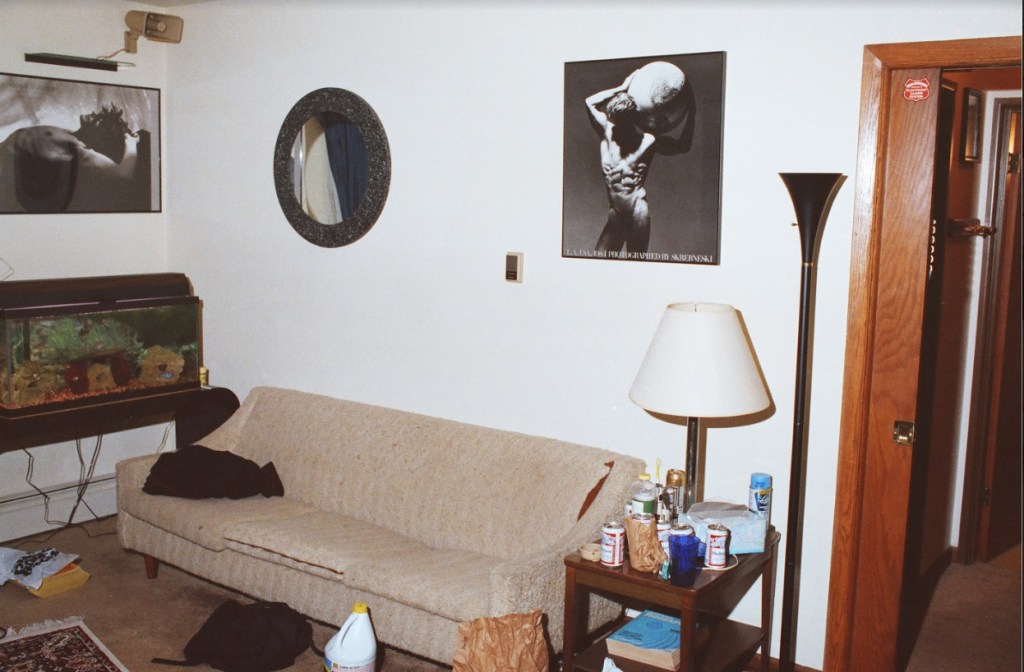
The aquarium in Apartment 213 was not decorative. Jeffrey was genuinely interested in tropical fish — four books on their care were found in his apartment, and during a visit to the House of Correction before his murders resumed, he talked to Lionel with real animation about his “new-found interest in aquarium fish.” He fed them. He read about them. The fish were alive and tended in that apartment while other things were happening there that no one should know about.
Jodi
Catherine’s cat was named Jodi — an orange female tabby. During a visit to his grandmother’s house filmed on Lionel’s video camera, Jeffrey got down on the floor and played with her. He knew exactly how she liked to be brushed. “She’s always trying to be brushed,” Lionel said during a prison visit. “You know how she likes that.” And Jeffrey did. He remembered.
And at West Allis, neighbours recalled a quietly tender relationship with animals more broadly. One neighbour remembered Jeffrey standing near the trash container in the backyard with a beer, surrounded by cats. Not a couple. A lot. Following him all over the place.
Sundays
Jeffrey vacuumed his apartment on Sundays. He generally kept both his home and his person very neat and tidy — the apartment that police described as orderly when they first entered it was not an accident. It was maintained. The oriental rug, the fish tank, the incense. He took care of his space.
When he was depressed, however, this changed completely. He would stop shaving, stop bathing, go days without taking care of himself, and the apartment would fill with empty beer bottles. The tidiness was a signal of his interior state. When it collapsed, so had he.
Budweiser
Jeffrey’s favourite beer was Budweiser — “the king” of beers, in his opinion. The police inventory confirmed it: Budweiser cans among the bottles of rum and other beers. He had a brand loyalty, an opinion about it. In the midst of everything, he had a favourite beer and a reason for it.
McDonald’s
Jeffrey described himself as practically living off McDonald’s at various points in his life — a detail captured in a Thanksgiving home video recorded by his father, where he mentioned it casually. He also took refuge at the nearest McDonald’s during his senior prom — having attended for reasons that remain unclear, he slipped away during the evening and spent time at the fast food restaurant before returning. The image of him sitting alone at McDonald’s during his own prom is one of the loneliest small facts in the entire story.
Chocolate Ice Cream Sodas
Every Saturday afternoon, during the years the family lived in Ohio, Lionel and Jeffrey drove to nearby Barberton for their regular chocolate ice cream sodas — a habit they had carried over from their earlier years in Ames, Iowa. Two people in a car, a standing tradition, a flavour they both liked. Lionel describes it with the casualness of someone who couldn’t know how precious it would later seem.
He Took German
Jeffrey took German in high school. Given his German and Welsh ancestry on his father’s side, and the two years he would later spend stationed in Baumholder, West Germany, it was perhaps not a coincidental choice. A language that connected him to something. He also kept a Latin learning kit in his apartment years later — a man who quietly, privately, kept trying to learn things.
Drag Queens
Jeffrey enjoyed camp and the theatricality of drag queens. The performance, the artifice, the deliberate construction of an identity for public display — it is easy to see why someone who spent his entire life performing a version of himself for the world around him might find something genuinely appealing in an art form built on exactly that. The drag queen knows she is performing. The audience knows it too. There is an honesty in the artifice that Jeffrey’s own performances never had.
The Films
The police inventory of Apartment 213 found several videotapes. Among them were Blade Runner, Star Wars, and Exorcist III. The presence of Exorcist III is interesting — it is not the famous original but the third instalment, a quieter and more philosophical film about a detective confronting evil and the existence of God. Blade Runner is perhaps the most telling: a film about beings manufactured to feel but not permitted to live, about the question of what makes something human, about a man hunting creatures who simply want more life.
According to accounts from one of his surviving victims, Jeffrey was seen watching one of the Exorcist films repeatedly, in a trance-like state. Also among the tapes: a recorded episode of The Bill Cosby Show — just a TV programme he wanted to keep.
The Music
When Milwaukee Police searched Apartment 213, they found a specific and revealing cassette collection. The confirmed tapes included Mötley Crüe and Def Leppard’s Hysteria — but the full picture of his musical world goes further than the inventory alone.
Jeffrey was a genuine fan of Black Sabbath and Iron Maiden — the dark, dystopian weight of those bands was a constant in his isolated life. In Germany, stationed at Baumholder, he decorated his barracks room with an Iron Maiden poster. A young man far from home, putting something on the wall that was his.
Alongside the heavy metal sat classical music and opera, which he played at high volumes inside the apartment — documented by neighbours and investigators alike. And perhaps most surprisingly, among the cassettes recovered were New Age and nature sound recordings — relaxation tapes, ambient sounds, the kind of thing sold for meditation and sleep. The contrast is almost unbearable to sit with: the same person, the same apartment, the same shelf.
Also worth noting — for the record — is what was not there. Despite persistent internet rumours, Jeffrey was not a KISS fan. No significant collection of their music was ever documented in his possession. The myth appears to have no basis in the evidence.
The Bible study cassettes and Creation Science tapes sat on the same shelf as the metal and the ambient sounds. The contradictions were absolute and apparently untroubling to him. He listened to what he liked.
Hated Sticking People With Needles
Jeffrey briefly worked as a phlebotomist at the Milwaukee Blood Plasma Center in the early 1980s, drawing blood from donors. He disliked the job because he hated sticking people with needles. The irony is extraordinary — and the detail deepens when you learn that at some point during this period, he took a vial of blood up to the roof and drank it out of curiosity. He spat it out. He didn’t like the taste. A man who would later do things of incomprehensible violence had no appetite for blood and couldn’t bear to cause the minor discomfort of a needle. The compartmentalisation that defined his psychology ran in all directions.
The Army and the Cigarettes
Jeffrey started smoking in the army and came home smoking a pack a day. He had also, by then, acquired a broken eardrum — the result of a severe beating by several fellow soldiers, leaving him bloody and his hearing damaged. He suffered periodic bouts of earache from it for years afterward. The army was supposed to be a fresh start, urged on him by his father. It became, instead, two years of escalating alcohol abuse, violence visited upon him by the men he lived with, and a discharge for being unfit for service.
Lambs, Tennis and Saturday Science Fiction
Among the books found in his room as a teenager were science fiction novels and Alfred Hitchcock’s Horror Stories for Children. He played intramural tennis for three years at Revere High School. He was on the school newspaper for one year. He participated in 4H for two years with his father — raising lambs, building fences, planting gardens, hiking in the metropolitan parks around Bath. Jeffrey Dahmer raised lambs.
He liked, according to Lionel, games with highly defined rules and repetitious actions — nothing confrontational, nothing that required improvisation. He preferred hide-and-seek, kick the can, ghost in the graveyard. The structure of rules was always important to him.
Infinity Land
When Jeffrey was around nine years old, he invented a private game he called Infinity Land. He drew stick figures — deliberately fleshless, just bone — and gave them one rule: if they came too close to one another, they were annihilated. The spirals he drew alongside them descended toward a black hole. He shared the game with his friend David Borsvold, who also collected rocks and studied dinosaurs with him.
Brian Masters, in The Shrine of Jeffrey Dahmer, saw Infinity Land as a key that unlocked the whole interior world — the fleshless figures, the danger of intimacy, the pull of oblivion. He returned to it throughout the book as a recurring image for Jeffrey’s descent. It even came up at the 1992 trial, mentioned by Dr Judith Becker, and then passed over without anyone pursuing what it might mean.
We will return to this game in a dedicated article. It deserves its own space.
The Apartment Itself
When police catalogued the contents of Apartment 213 after the arrest, the inventory ran to sixty-nine separate sheets. Among the horror there was also a life. Ornamental driftwood. Artificial peacock feathers. Two plastic griffins. An incense burner with incense sticks. A computer and a guide to learning DOS. A Latin learning kit. Bible study tapes and Creation Science cassettes alongside Numerology and the Divine Triangle. Fish food. An aquarium full of living fish.
He was working out — Anabolic Fuel, Vita, Yerba Prima supplements alongside Doritos and Ruffles chips. He had an Oral-B toothbrush and a contact lens cleaning kit and a tube of acne lotion. He had envelopes from Woolworth’s and a library card with his name on it. There was no air conditioning. When neighbours complained about smells coming from his apartment, he explained that his freezer had broken and meat had spoiled. He placed air fresheners throughout. The neighbours, for the most part, accepted this.
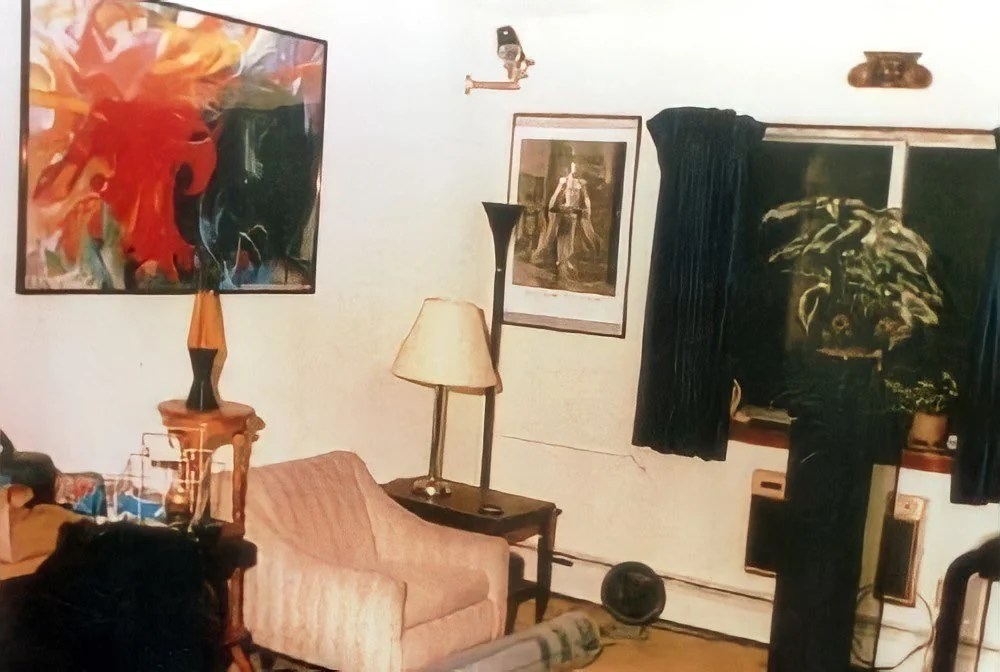
The floor plan below — reconstructed from police documentation — shows exactly how Jeffrey’s world was arranged. The aquarium sat in the living room, close to the couch where he spent his evenings. The upright freezer and refrigerator occupied the kitchen area. The bedroom was separate, modest. Everything in its place in a space that was, outwardly, unremarkable.
At some point Jeffrey wrote down two sentences, side by side:
“When my father came home I was happy.”
“When my mother came home, I was watching TV.”
That is the entirety of it. No elaboration. The contrast is so precise and so devastating that it requires nothing else.
“She’s Lived in That House a Long Time”
When asked, at some point, whether he loved his grandmother, Jeffrey replied: “Yes, she’s lived in that house a long time.”
It is one of the strangest answers imaginable to that question. Not warmth, not a memory, not an expression of feeling — just the duration of her presence in a place. And yet it was clearly meant as an affirmation. He said yes. He just couldn’t, or didn’t, translate it into the emotional register that the question expected. His grandmother was part of the permanent furniture of his world. That was love, in his language.
“Much, Much Better”
Late in his prison years, Jeffrey said: “It would have been better if I’d just stuck to the mannequins. Much much better.”
It is as close as he ever came, in a single sentence, to expressing regret for the shape his life had taken. The mannequins — which he had been fixated on since adolescence, visiting department stores to be near them — represented the version of his compulsion that could have existed without victims, without horror, without the destruction of seventeen lives. Much much better. The repetition is not rhetorical flourish. It sounds like someone saying it to themselves, quietly, in the dark.
What It Means
The point of gathering these details is not to soften the reality of what Jeffrey did. It is to resist the simplification that makes monsters of people we don’t want to understand. Jeffrey Dahmer had a favourite colour and planted roses and read science fiction and raised lambs and vacuumed on Sundays and drove to get chocolate ice cream sodas with his father and got down on the floor to play with Jodi the cat and watched Blade Runner alone at night in his apartment with no air conditioning.
All of this was true at the same time as everything else was true.
That is the hardest thing to hold. And it is the most important.
Sources: Lionel Dahmer, A Father’s Story (1994); Brian Masters, The Shrine of Jeffrey Dahmer (1993); Milwaukee Police Department Inventory, July 1991; IMDB.
There is a word for what happens when a society decides that a person no longer deserves the basic protections extended to other human beings. That word is dehumanisation. It is not a metaphor. It is a documented psychological process with a name, a mechanism, and a history — and it happened to Jeffrey Dahmer both while he was alive and continues, with remarkable consistency, after his death.
This article is about that process. About what was done to him, why it was done, and what it reveals about the people who did it.
What Was Done to Him
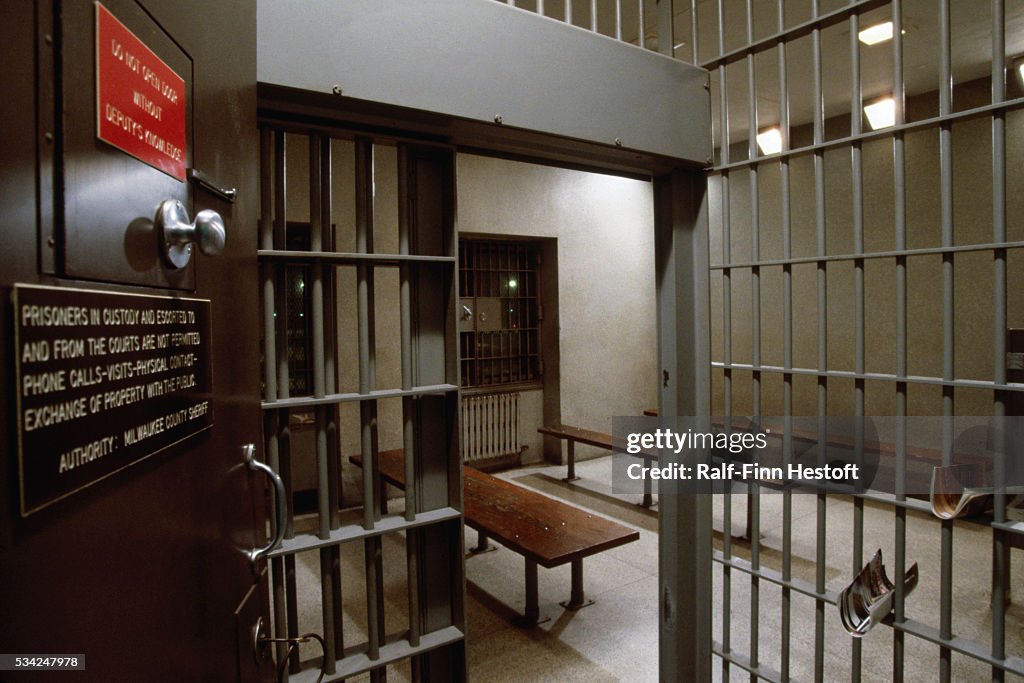
When Jeffrey arrived at Columbia Correctional Institution in Portage, Wisconsin in February 1992, he was placed in a cell and subjected to hours of relentless taunting from the surrounding cell block. Questions shouted through bars. Threats. Mockery. The noise escalated, got louder, cruder, more specific. Jeffrey said nothing. For hours, nothing at all. He sat in Cell 1 and waited.
This was not the worst of it.
Reports from that period describe Jeffrey being made to sleep naked on the floor of his cell during his first days at the institution. He was denied basic privacy. He was displayed, essentially, as a spectacle — the worst thing that had happened in Wisconsin in living memory, now contained and available for inspection.
During his trial in 1992, he sat behind eight feet of bulletproof glass, separated from the courtroom — not for any genuine security reason, but because his presence was considered too dangerous to exist in the same physical space as ordinary proceedings. He was tried, in a real sense, as something other than a man.
And then there were the shackles. Each day of his trial, Jeffrey was escorted to court handcuffed in a wheelchair — because the leg irons placed on him were so heavy that they made walking impossible. A 6’1” man, unable to bear the weight of his own restraints, wheeled through courthouse corridors like freight.
One day, as he was being wheeled toward the courtroom, a woman passing in the hallway recognised him and let out a bloodcurdling scream. Jeffrey, unperturbed, muttered quietly: “I guess I should’ve shaved.”
In a wheelchair. In shackles so heavy he could not walk. Being wheeled through a public building while a stranger screamed at the sight of him. And his response was a dry, quiet joke about not having shaved. That is not the response of a monster. That is the response of a person — exhausted, dignified in the only way left available to him, and still, somehow, human.
The Psychology of Dehumanisation
Psychologists have studied dehumanisation extensively, particularly in the context of how ordinary people become capable of cruelty toward other human beings. The mechanism is consistent: first, you remove someone’s humanity in your own mind. You assign them to a category — monster, animal, thing — that exists outside the circle of moral concern. Once that categorisation is complete, cruelty becomes not only possible but, for many people, feels righteous.
Jeffrey Dahmer was an almost perfect candidate for this process. His crimes were so extreme, so far outside anything most people could comprehend or contextualise, that the leap to monster felt not only natural but necessary. To acknowledge his humanity would be to sit with something deeply uncomfortable — that a person, a recognisable human being, had done these things. That the distance between him and everyone else was perhaps not as vast as we need it to be.
It is easier, and psychologically safer, to make him into something else entirely.
The inmates who taunted him on his first night in prison were not psychopaths. They were ordinary people who had been given permission — by the media, by the trial, by the collective verdict of society — to treat this particular human being as less than human. The guards who allowed Jeffrey to be made to sleep on the floor were not monsters. They were people acting within a system that had already decided Jeffrey was beyond the protections that system normally provides.
He Dealt With It in Silence
What is striking, in every account of Jeffrey’s time in prison, is how he responded to this treatment. Not with rage. Not with breakdown. With a kind of quiet, contained dignity that the people around him seemed entirely unprepared for.
When the taunting on his first night reached its peak — Did the male parts taste good? Do you prefer dark meat or white meat? — Jeffrey said nothing for hours. He waited. And then, when one inmate shouted Hey Jeff, how’s the corpse?, he answered, after a pause, with three words: Chunky. Delicious and tasty.
The ward went quiet.
It was not aggression. It was not a breakdown. It was a man refusing, in the only way available to him, to be entirely erased. He turned the taunting back on itself with a precision that silenced the room. Whatever you think of him, whatever he did — that moment was human. That was a person navigating something impossible with the tools he had.
Detective Dennis Murphy, who spent sixty hours taking his confession, said Jeffrey was cooperative, frank, and without guile. Reverend Roy Ratcliff, who baptised him in prison and visited him regularly until his death, described a man who was sincere, reflective, and genuinely spiritually searching. The FBI agents who interviewed him found him completely credible.
These were people who actually sat with him. Who treated him as a human being capable of communication and reflection. And what they found, consistently, was exactly that.
What Happens Today
Jeffrey Dahmer has been dead for thirty years. And the dehumanisation has not stopped.
His death photographs circulate freely on blogs and social media. His face — split open, unrecognisable, the result of a brutal beating by a fellow inmate — is shared, reposted, used as profile pictures by people who consider this an act of justice or entertainment. The images are not difficult to find. They are treated as public property, as a spectacle to be consumed.
Compare this to how the photographs of his victims are treated. The families of those seventeen men have fought for decades to keep graphic images of their loved ones private. Society, broadly, respects this. The victims are afforded the dignity of death. Jeffrey is not.
This double standard is not justice. It is not about the victims. If it were about the victims, their families’ pain would be the centre of the conversation — and most of the people sharing Jeffrey’s death photographs have no particular investment in those families at all.
It is about something else. It is about the satisfaction of seeing a specific person degraded, even in death. It is about the continuation of a process that began the moment he was arrested — the process of making him into something that does not deserve what the rest of us are given automatically.
That is not justice. That is cruelty with permission.
Disputed Even in Death: The Brain
Jeffrey had left clear instructions in his will: he wished to be cremated. No services. No headstone. Nothing. He wanted to be gone cleanly, on his own terms.
What happened instead was that before his body was cremated in September 1995, doctors removed his brain and preserved it in formaldehyde. His parents — long divorced — then fought a public legal battle over what to do with it. His mother Joyce wanted it donated to science, hoping researchers might find a biological explanation for what he did. His father Lionel wanted it cremated, in line with Jeffrey’s stated wishes.
The case went to court. A judge ultimately ordered the brain cremated in December 1995 — more than a year after Jeffrey’s death — without any scientific study being conducted.
Whatever one thinks of the arguments on either side, the basic fact remains: Jeffrey had expressed a clear wish about what should happen to his remains, and that wish was overridden — his body becoming, even after death, a matter for courts and public dispute rather than quiet, private dignity.
The Tapes He Didn’t Know Were Being Kept
In 2023, a four-part documentary series titled My Son Jeffrey: The Dahmer Family Tapes was released on Fox Nation. It features audio recordings of private conversations between Jeffrey and his father Lionel, made during prison visits and phone calls — conversations that Jeffrey had no reason to believe would ever be made public.
Lionel, by all accounts, recorded these conversations out of a genuine desire to understand his son — a father grappling with something incomprehensible, reaching for any thread of explanation. That impulse is human and understandable. But the decision to release those recordings to a documentary production, to broadcast them on television for public consumption, raises a question that nobody in the coverage seemed particularly interested in asking: would Jeffrey have wanted this?
Jeffrey, who confessed everything willingly to investigators, who spoke openly with Roy Ratcliff and with the detectives who interviewed him — Jeffrey who asked for no consideration at his sentencing and accepted whatever came — nevertheless had a private interior life. He had conversations with his father that existed in the space between two people, not for the world.
Thirty years after his death, those conversations were packaged and broadcast. His voice, his words, his private reaching toward his father in a prison cell — turned into content. The dehumanisation does not require malice. Sometimes it simply requires treating a person’s private life as raw material, available to anyone who wants it.
The Comparison That Nobody Makes
Ted Bundy confessed to nothing voluntarily. He manipulated, performed, charmed, and deflected until the very end — defending himself in court, flirting with the press, using every tool available to him to avoid accountability. He was a diagnosed psychopath with no genuine remorse. He died having never fully owned what he did.
Jeffrey Dahmer confessed to everything. He cooperated completely. He expressed genuine remorse in terms that those closest to him found credible. He repented. He was baptised. He spent his final years in quiet reflection with a prison chaplain.
Bundy is a cultural icon. Jeffrey is a target.
The difference is not the severity of the crimes — Bundy killed more people. The difference is that Jeffrey’s crimes were of a type that made dehumanisation easier. The cannibalism, the necrophilia — these are the elements that push him beyond the boundary of what people can hold as human. And once beyond that boundary, anything becomes permissible.
Why It Matters
We are not asking anyone to forget what Jeffrey did. We are not asking for sympathy that erases the suffering of seventeen families. Those two things can exist simultaneously — grief for the victims and the recognition that a human being deserves to be treated as one, even after death, even in prison, even in the face of crimes that are almost impossible to comprehend.
The people who post his death photographs are not more moral than the people who don’t. They are not more protective of the victims. They are simply people who have found a target that society has declared acceptable — and they are doing what people always do when a target is declared acceptable.
Jeffrey Dahmer was a human being. He was a deeply traumatised, profoundly ill, ultimately destroyed human being who caused incalculable harm. He was also a man who planted yellow roses, who got down on the floor to play with a cat named Jodi, who said much much better quietly to himself in the dark.
Both of these things were true. They will always have been true.
The dehumanisation does not change that. It only tells us something about ourselves.
Sources: Anonymous inmate memoir; Reverend Roy Ratcliff, Dark Journey Deep Grace (2008); Detective Dennis Murphy, various interviews; Brian Masters, The Shrine of Jeffrey Dahmer (1993); The Washington Post; Fox Nation, My Son Jeffrey: The Dahmer Family Tapes (2023); Psychology research on dehumanisation.