The Topaz Ring

In the summer of 1987, Jeffrey walked into Bailey, Banks & Biddle at Northridge Mall in Milwaukee and paid roughly $1,500 for a ring — a large blue topaz set in gold. Asked about it later, his explanation was almost disarmingly ordinary: he had “always had an interest in jewelry and especially rings,” and the size of the stone appealed to him.

A year later, in the summer of 1988, he pawned it. Not at a jeweler this time, but at a gold-and-silver exchange on Bluemound Road, where he bargained the clerk up to $189 for a ring he’d paid nearly eight times that for. His own stated reason was blunt: his drinking had left him short on cash.

That gap — $1,500 down to $189 — is not, on its own, remarkable. People pawn jewelry for a hundred reasons that have nothing to do with anything sinister. What makes this exchange worth examining is what came next.

The question that was actually being asked

The document containing this account is not a jewelry appraisal. It’s a police report, compiled after Jeffrey’s arrest, following a tip from the Brookfield Police Department that he had pawned a ring in their city. Investigators weren’t interested in the ring as a ring. They were asking a direct question: did this come from one of his victims?

His answer was immediate and flat — no, and he “again denied selling any of the jewelry which he obtained from any of his victims.” Then, without being pressed further on the point, he added something no one had asked for: that if there was any jewelry taken from victims, “he simply threw it out in the trash, along with body parts.”

That sentence is doing an enormous amount of work in very little space. It is, technically, a hypothetical — if there was jewelry, here’s what would have happened to it. But it’s delivered with the same flat tone as everything else in his account, sliding a detail about disposing of human remains into what started as a question about a pawn ticket.

Setting this against what trophy-taking actually looks like

Criminologists who study sexual homicide offenders have a specific term for what Jeffrey is being asked about here: trophy-taking — retaining an item connected to a victim, not for its resale value, but for what it does psychologically. The research is consistent on this point: items are kept “not for monetary reasons but to serve the offender psychologically,” allowing the offender to revisit and relive the experience privately. The most commonly documented trophies across offender studies are body parts, photographs of the crime scene, and — specifically — jewelry or clothing taken from the victim.

Jeffrey is a documented case of exactly this behavior, just not with jewelry. Skulls, Polaroid photographs, and other remains were recovered from his apartment — trophies in the fullest sense the research describes. Which makes his specific denial here worth sitting with rather than passing over. He is not claiming he kept nothing. He is drawing a very precise line: photographs, yes; skulls, yes; a victim’s ring, no — that would have gone in the trash.

Whether that line is true is not something this record can settle. It’s possible jewelry genuinely held no significance to him the way other remains did — trophy-taking research does note that offenders are selective, not indiscriminate collectors, and what becomes meaningful to one offender may hold no charge for another. It’s also possible this was simply the safer thing to say to an investigator, a way to admit to the pattern in general terms — “if there was jewelry” — while denying the one form of it that would have been easiest to trace back to a named victim through a pawn shop record, exactly as this one was traced.

A small object, honestly

There is no way to resolve that ambiguity from this document alone, and this piece isn’t going to pretend otherwise. What’s certain is narrower: a ring bought for $1,500 out of an ordinary, almost sweet fondness for jewelry, pawned a year later for a fraction of that as his drinking worsened, and finally surfacing again after his arrest as the subject of a question about whether it had ever belonged to someone he killed. An object that started as a small personal indulgence ended its documented life sitting inside an interrogation about trophies and trash.


Sources cited

  1. Police report excerpt, Brookfield Police Department tip regarding Jeffrey Dahmer pawn transaction, released records.
  2. Sage Reference, Encyclopedia of Murder and Violent Crime — “Trophy Taking.” https://sk.sagepub.com/ency/edvol/violentcrime/chpt/trophy-taking
  3. Walter, N. et al. (2024). “Trophy, souvenir, or simple theft? Taking items from the victim in sexual homicide.” Behavioral Sciences & the Law. https://onlinelibrary.wiley.com/doi/full/10.1002/bsl.2660
  4. “The collectors: Serial sexual offenders who preserve evidence of their crimes.” ResearchGate. https://www.researchgate.net/publication/259158356_The_collectors_Serial_sexual_offenders_who_preserve_evidence_of_their_crimes

Jeffrey Dahmer and the Jokes He Left Behind

Humour is not a word anyone expects to find near this story. But it is there, threaded through the record in two very different forms — the jokes a horrified public told about him, and the small, dark moments of levity that actually happened around him, inside the jail cells and interrogation rooms where his story was still unfolding in real time. Both are worth looking at honestly. Neither is comfortable.

The jokes that swept the country

Within two weeks of Jeffrey’s arrest, jokes about him were already circulating nationally. On August 6, 1991, The New York Times ran an editorial addressing the phenomenon directly, arguing that the jokes existed because “there is a need for people to distance themselves from the horror.”

That explanation is a reasonable one, and it was echoed by people who had no choice but to sit with the horror professionally. Anne Schwartz, the reporter who broke the story and covered the trial from the front row, later wrote that many of her fellow journalists told jokes throughout the proceedings specifically “in order to keep their sanity.”

But distance may not be the whole story. Within months, a publisher named Hart Fisher had turned Jeffrey’s crimes into a comic book through his company, Boneyard Press, and described the appeal to television cameras without any apparent discomfort: “It’s something you can’t get anywhere else — if you like the truth, if you like something a little bit more fresh, a little bit more bloody, we’ve got the meat.” That is not the language of someone trying to create distance. It is the language of someone selling proximity.

The joke cycle sat inside a larger pattern that scholars have since traced through the entire “serial killer” media boom of the early 1990s — the same years that gave the culture Hannibal Lecter as a sanitised, almost lovable version of the same figure. Anthony Hopkins later recalled being approached by twelve-year-old children asking him to perform Lecter’s “fava bean” line for their entertainment. Somewhere between the Times editorial and the comic book and the children asking a fictional cannibal to do a bit, the line between “processing horror” and “consuming it as entertainment” gets difficult to locate.

Jeffrey was not insulated from any of this. Letters reached him in prison keeping him “up-to-date on the latest ‘Jeffrey Dahmer’ jokes,” according to his father’s own account, and reporting from inside the jail described him as “visibly perturbed” by the jokes that followed him even among fellow inmates. Whatever function the jokes served for the public telling them, for the man they were about, they were simply one more form of the notoriety he could not escape.

The humour that actually happened around him

Separate from the joke cycle is something stranger: a handful of genuinely dark, unplanned moments of humour that occurred in the actual rooms where his case was being handled — not jokes told about him from a distance, but small human moments that happened to be, in a bleak way, funny.

The most widely cited is also the earliest. Minutes after Tracy Edwards escaped Apartment 213 and police discovered what was inside, one of the responding officers radioed dispatch: “The intoxicated Asian naked male [laughter heard in background] was returned to sober boyfriend.” A second officer, informed he’d be heading back to the station, added: “My partner’s gonna get deloused at the station” — followed by more laughter on the recording. This is gallows humour in its purest form: officers who had no idea yet what they’d just walked into, laughing at a domestic-dispute call minutes before it became one of the most notorious crime scenes in American history.

Inside the jail itself, the record shows a mix of hostility and small, incongruous moments of connection. Guards placed Jeffrey under 24-hour suicide watch — a light kept permanently on, flashlights turned on his face as he tried to sleep, three guards watching him urinate “and laughing as well,” according to Brian Masters’ account. He once sharpened his toothbrush in protest of what he considered unfair treatment, a small act of defiance that cost him a night sleeping on the concrete floor in his underwear. And yet amid the hostility, Masters records one genuinely tender moment: a guard, stepping away from his post for fifteen minutes overnight, told him simply, “Now don’t do anything stupid, Jeff.” Masters calls it “a tiny moment of connection” — and it is hard to disagree.

Jeffrey’s own complaints about jail carry a dry, almost absurd quality of their own. Asked what the days were like, he described having “nothing to do but watch the ants crawl around on the floor,” and described the bed bugs at night as something you could feel “jumping on your eyelids and nose.” A former inmate told the Milwaukee Sentinel that the guard posted outside his cell “reads him the paper, and talks to him about what he did to people and things” — offered as evidence of favourable treatment, but reading, out of context, almost like a description of an unlikely daily routine between two people stuck in a small space together.

Even the investigators had their own strange footnote. Detective Patrick Kennedy, who spent hours across the interrogation table extracting Jeffrey’s confession, moonlighted off duty as McGruff the Crime Dog, touring Milwaukee schools in a furry costume to teach children about the dangers of drugs. The man who sat with Jeffrey through some of the most disturbing testimony in American criminal history spent his weekends in a dog suit warning eight-year-olds about strangers.

Why this belongs in the record

None of this softens what happened. The jokes, the comic books, the gallows humour on a police radio — none of it changes the seventeen lives that were taken, and this memorial has never tried to weigh one against the other. But humour is also one of the most honest windows into how a society actually processes something it cannot fully absorb, and how the people closest to a case — reporters, guards, detectives — survive proximity to it day after day. The jokes told about Jeffrey say more about the country’s appetite for monsters than they do about the man himself. The small, dark moments that happened around him say something quieter: that even inside the most controlled, hostile environment imaginable, ordinary human behaviour — boredom, dry humour, a guard’s offhand kindness — kept finding its way through.


Sources cited

  1. Schwartz, Anne E. Monster: The True Story of the Jeffrey Dahmer Murders.
  2. Masters, Brian. The Shrine of Jeffrey Dahmer.
  3. Dahmer, Lionel. A Father’s Story.
  4. Kennedy, Patrick, and Robyn Maharaj. Grilling Dahmer: The Interrogation of the Milwaukee Cannibal.
  5. The New York Times, editorial on serial killer jokes, August 6, 1991.
  6. Academic discussion of the joke cycle, comic book publication, and Hannibal Lecter comparison drawn from a scholarly text on Dahmer and the construction of the serial killer figure in media.

In His Own Hand: What Jeffrey Dahmer’s Letters Reveal — and What They Don’t

Almost everything ever written about Jeffrey Dahmer was written by someone else. The trial transcripts, the psychiatric evaluations, the books, the documentaries — all of it filtered through other people’s frameworks and other people’s words. What has rarely been examined with any care is the small body of text he produced himself: the letters, cards, and documents in his own hand.

The memorial has gathered four such documents, spanning 1989 to 1994 — from his life before arrest to the final weeks before his death. This article looks at them through the lens of psycholinguistics: the scientific study of how language use reflects psychological states. It is, as far as we know, the first attempt to do so.

We want to be clear from the outset about what this is and is not. This is an exploratory reading of a very small sample, informed by published research — not a clinical analysis, and not a diagnosis. Where the science supports an observation, we cite it. Where we are simply describing what is on the page, we say so.

The Science, Briefly

The research foundation for this kind of reading comes largely from the work of psychologist James Pennebaker and colleagues, whose studies of “function words” — pronouns, articles, prepositions — have shown that the small, unnoticed words in a person’s writing correlate with psychological states more reliably than the dramatic ones. A few findings matter for what follows:

First-person singular pronouns. Elevated use of “I,” “me,” and “my” is one of the most replicated linguistic markers of self-focused attention, and correlates with psychological distress and depression across many studies.

Absolutist words. Research by Al-Mosaiwi and Johnstone (2018) found that words like “always,” “never,” and “completely” appear at significantly higher rates in the writing of people experiencing depression and suicidal ideation.

Politeness strategies. Linguists Brown and Levinson documented how people manage requests and social risk through “negative politeness” — hedging, apologising for imposing, softening. The degree and style of this management reflects how a writer perceives social relationships.

Concrete sensory detail. Genuine, present-focused writing tends to contain specific sensory observation; detached or dissociated writing tends toward abstraction and flatness.

With that foundation, here is what the documents show.

1989: The Letter to Judge Gardner

The earliest document is also the only one from Jeffrey’s life before the arrest — a written request to Judge William Gardner for sentence modification, following his 1988 conviction.

The surviving fragment reads: “This is why, Judge Gardner, I am requesting from you, a sentence modification. So that I may be allowed to continue my life as a productive member of our society. Respectfully Yours, Jeff Dahmer.”

Three things stand out.

First, the register. This is careful, formal, institutional English — “requesting,” “sentence modification,” “a productive member of our society.” He is writing in the language of the system he is addressing, mirroring its vocabulary back to it. This is a documented social-linguistic skill called register matching, and it shows an acute awareness of audience.

Second, the self-focus. In two sentences: “I am requesting,” “that I may be allowed,” “my life.” This is entirely natural in a plea letter — the genre demands it — but it is worth noting because of how sharply it contrasts with the last document in this collection, five years later.

Third, the handwriting itself. Unlike the later letters, this one is printed rather than cursive — deliberate, separated letterforms, the writing of someone taking visible care to be legible and correct before authority. We note this as a physical description only. Graphology — the claimed reading of personality from letter shapes — performs no better than chance in controlled studies, and the memorial will not lean on it. What we can say without pseudoscience is simply that the document is neat, effortful, and controlled, which is consistent with everything witnesses documented about his self-presentation.

There is a painful irony in this letter that needs naming: at the time he wrote these words about continuing life as a productive member of society, the worst years were still ahead. Whether the letter was cynical performance or something he believed in the moment he wrote it is unknowable. The competency evaluation we published previously documents that he resisted the therapy ordered alongside that sentence — so the record suggests, at minimum, that the words and the follow-through did not match.

April 1993: The Penpal Letter

The second document is a full letter to a correspondent, dated 4-24-93, written from Columbia Correctional Institution.

It opens: “Hi how are you? I hope that this letter finds you healthy and in good spirits. Over here in Wisconsin all of the snow has melted, the birds sing during the day, and the frogs sing at night. It feels like Spring is finally here.”

For a man so often described as affectless, this passage deserves attention. It contains layered, specific, sensory observation — snow melting, birds by day, frogs by night — organised into a small, almost literary parallel structure. This is not flat writing. Whatever else was true of Jeffrey Dahmer in April 1993, he was noticing the world through a prison window and translating it into warm, conventional, socially fluent prose. Research associates this kind of concrete present-tense sensory detail with genuine engagement rather than detachment; his conversational writing, at least here, does not read as dissociated.

The letter then moves to practical matters, and here the politeness patterns are striking. Asking his correspondent for money — twenty-five dollars, in a letter that explains he earns twenty dollars a month and spends it on cigarettes — he writes: “I hate to ask this of you, but could you please send over a check or money order…” This is textbook negative politeness: acknowledging the imposition, softening the request, apologising in advance. He manages the social risk of asking with the same care he applies to his handwriting.

And then there is the smallest and perhaps most telling detail in the whole collection. Mid-letter, he misspells a word, crosses it out, and writes above it: “sp?”

He is flagging his own spelling error, in a casual letter to a penpal, with a proofreader’s annotation. This is self-monitoring — a live record of a mind checking its own output for correctness even in low-stakes writing. It is one visible data point of the carefulness that runs through everything: the neat letterforms, the managed politeness, the register control. The competency evaluation documented a man of high measured intelligence with obsessive-compulsive behavioural features; this little “sp?” is what that looks like on paper.

December 1993: The Hand

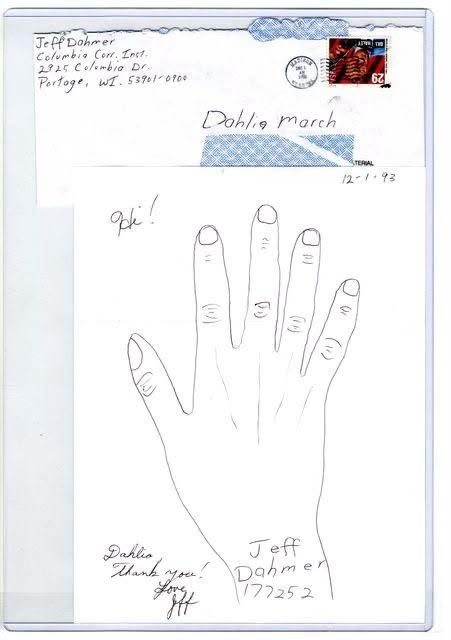
The third document is not primarily text at all. Sent to a correspondent named Dahlia in December 1993, it is a traced outline of his own hand, signed with his name and his inmate number, 177252, written on the palm.

The accompanying words are minimal — a greeting, “Thank you!”, “Love, Jeff.” There is little language to analyse here, and we will not overreach. But the artefact itself says something the letters cannot: asked to give something of himself to a stranger, he gave the outline of his own hand — the most literal self-portrait available to a man with no possessions. He labelled it with the two identifiers the world had left him: his name, and his number.

We offer no psychological claim about this. We simply note that people across every culture trace their hands as a way of saying I was here, this is me — children do it in school, prisoners have done it for as long as there have been prisons. It is among the most human gestures there is.

November 1994: The Thanksgiving Card

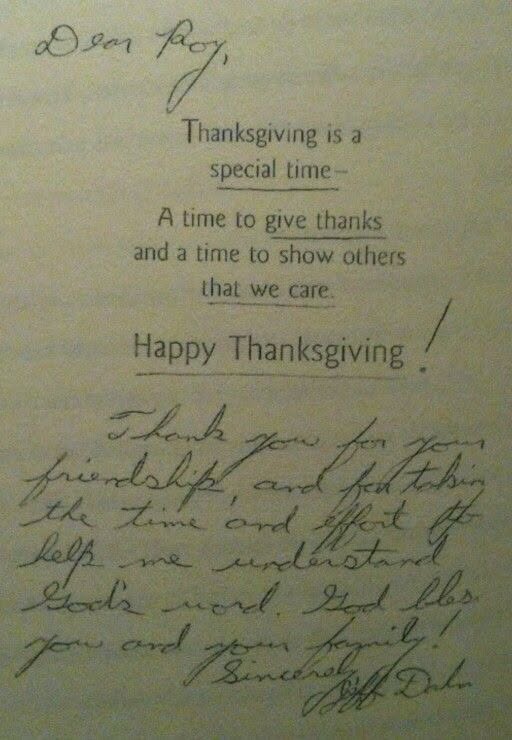
The final document is the card he sent to Roy Ratcliff, the minister who baptised him, in the last weeks of his life. Ratcliff described it in Dark Journey Deep Grace as one of his most treasured possessions.

The handwritten message reads: “Thank you for your friendship, and for taking the time and effort to help me understand God’s word. God bless you and your family! Sincerely, Jeff Dahmer.”

Set beside the 1989 Gardner letter, the shift in linguistic orientation is unmistakable. The 1989 letter is built around the self: I am requesting, that I may be allowed, my life. The 1994 card is built almost entirely around the other person: your friendship, your time and effort, you and your family. The only self-reference — “help me understand” — casts himself as a learner receiving something, not an agent demanding something.

The research on pronoun orientation is relevant here: outward-directed, other-focused language is associated with connection and gratitude; inward-directed language with distress and self-focus. On a sample of two short documents we cannot claim a measured trajectory — we want to be honest about that. But the direction of the shift matches, exactly, what every witness to his final years described: Ratcliff’s account of a man surprised that anyone would keep visiting him, the Thanksgiving card itself, the documented seriousness of the spiritual turn. The language on the page and the testimony about the man point the same way.

What This Does and Does Not Show

Read together, the four documents give us a consistent portrait in some respects and an honest limit in others.

What is consistent: carefulness. Across five years, two facilities, three genres, and audiences ranging from a judge to a penpal to a pastor, every document shows the same controlled, effortful, correctness-monitoring writer — neat letterforms, managed register, softened requests, a spelling annotation in a casual letter. The linguistic record matches the behavioural one: the politeness noted by detectives, the precision about the baptismal words, the methodical habits documented everywhere.

What is suggestive but not provable: the shift from the self-focused instrumental language of 1989 to the other-focused gratitude of 1994. It aligns with the documented biography of his final years. It is also two short texts, in different genres, and we will not pretend that is a dataset.

What is absent: the markers one might expect. In this small sample there is little of the absolutist vocabulary associated with depressive writing, no flattened affect in the conversational prose — the spring passage is the opposite of flat — and no linguistic strangeness at all. And perhaps that is the finding. The man whose inner life contained what his did wrote letters that are, linguistically, almost aggressively ordinary: polite, careful, warm within convention, worried about spelling. The gap between the interior documented in the clinical record and the surface of these pages is the same gap everyone who met him described — and here it is, preserved in ink.

This article is part of an ongoing series examining primary sources. See also: “A New Primary Source: The 1992 Competency Evaluation” and “The Mind That Wouldn’t Stay: Jeffrey Dahmer’s Dissociative Episodes and What They Tell Us.”

Documents: letter to Judge William Gardner (1989, court record); letter to a correspondent, April 24, 1993; hand tracing sent to Dahlia March, December 1, 1993; Thanksgiving card to Roy Ratcliff, November 1994 (reproduced in Ratcliff, Dark Journey Deep Grace, 2006). Research references: Pennebaker, The Secret Life of Pronouns (2011); Al-Mosaiwi & Johnstone, Clinical Psychological Science (2018); Brown & Levinson, Politeness: Some Universals in Language Usage (1987).

Why We Are Here: Voices from the Memorial Community

The jeffreydahmer.memorial was built on a conviction: that Jeffrey Dahmer deserves to be understood as a full human being, not reduced to the worst of what he did. Over time, a community has gathered here — researchers, writers, people with lived experience of loneliness, people with faith questions, people who simply couldn’t stop reading once they started. They come from different countries, different generations, different frameworks entirely.

We asked some of them five questions. What follows are their answers, in their own words.


How did you first hear about Jeffrey?

Some came to his story through the shock of the original news cycle. Others found him decades later, through a film, a novel, or a Netflix series watched during an ordinary evening.

Debbie, 66, found herself watching the news in 1991 by accident, immediately after serving on a jury in an unrelated murder trial — her first experience of the justice system. She came home exhausted from testimony about things she had never wanted to see, turned on the television, and heard a reporter describing body parts and drilled skulls. She lunged for the remote. For decades she kept it that way. Then, last December, recovering from a hip replacement, she flipped through Netflix and saw Dahmer: Monster. “Hey, I remember that dude,” she thought. She watched it. She started researching. “It hit me like a ton of bricks out of left field,” she says. “It’s definitely not something I was looking for or wanted. But here I am.”

Sylli, 46, heard about Jeffrey in 1991 when she was twelve years old and the story made headlines around the world. As a child, she couldn’t fully understand the complexity of what had happened. She only knew it was a story that stayed in her mind long after the news coverage faded. It wasn’t until 2022, when the Netflix series was released, that her interest was truly reignited. What started as renewed curiosity soon became something much deeper.

Gray, 22, came to Jeffrey the way many of her generation did — through the Netflix series, which led her immediately to the real case. “I found that the show does not come close to what actually happened,” she says. She went far past it.

Yarrow, 37, heard about Jeffrey in 2016 and found in his story something that would become personally significant in unexpected ways.

Eden G. encountered the name through a friend who loved film — a passing mention of My Friend Dahmer that lodged and eventually became something much more.

Lucy first came across Jeffrey through Poppy Z. Brite’s novel Exquisite Corpse, which quoted from his 1994 autopsy report. “His feet were still shackled because people were that afraid of him,” she recalls. “I found this to be weird then and even weirder now, especially considering that not only was Jeff deceased but had been rather placid in prison.” Years later, the Netflix series drew her back. She went looking for the real case.

Frisky, 40, saw him for the first time as a teenager, in a television interview. “Something inside me stirred feelings I had never experienced before,” she says. “He felt close and familiar, as if at some point in life I would come across something of his again, or get to know him more deeply.” She has never forgotten the feeling.


What called your attention to his story?

The answers to this question fall into patterns — but the patterns are wider and more varied than one might expect.

For many it was his honesty. Gray was struck by what she describes as the rarity of it: “Other serial killers, like Ted Bundy, don’t even come close to the level of self-reflection Jeffrey had done. He never once tried to lie his way out of the consequences of his actions, he knew what he had done.” She points to something he said in his confessions — that if nobody had caught him, he would have kept going — as evidence of a self-knowledge that moved her. “He knew himself and his compulsions so well that even he agreed that his getting caught was ‘better’ for everybody else and humanity in general.”

Lucy was struck by the same quality. “I think that his openness and honesty about his life and crimes makes it easier to connect with him. If he’d lied constantly or made excuses for his behaviour, this would have been difficult.”

For Sylli, it was the complexity that drew her deeper. “The more I learned, the more I realized that there were no simple answers. I became interested in understanding the person behind the headlines — the loneliness, the isolation, the psychology, and the many contradictions that existed within him. His story challenged me to look beyond black-and-white thinking.”

Frisky was drawn immediately to the human being behind the headlines. “What struck me most about his story was, quite literally, his loneliness and his complete lack of self-worth. I found myself wondering how such a handsome man could be so utterly alone. It was heartbreaking.”


How do you define your connection with him?

This is the hardest question, and the answers here are the most personal. They range widely — and that range is honest.

Gray describes a connection that is grounded in recognition. “Jeff, except of course for the gruesome killings, has a lot in common with me character-wise and mental health-wise. His coping mechanisms reminded me a lot of my own. The fact that he was heavily misunderstood and so extremely lonely that he had difficulties even forming normal human relationships also reminded me a lot of myself.” She is careful to locate the connection precisely: it is not spiritual, but human. It is the experience of seeing something of yourself in someone else’s story.

Sylli describes Jeffrey as “a quiet presence that accompanies me through my thoughts, my writing, and my creative work.” She thinks of him often in terms of nostalgia — not for the events of his life, but for a feeling she cannot easily name. “He is a source of inspiration, curiosity, and imagination.”

Lucy notes that the connection changed her social world as much as her inner one. “I have met quite a few friendly, like-minded people due to our common interest in Jeff. Being part of the online community who study and discuss Dahmer has definitely made a positive impact on my life.”

Yarrow speaks from a different framework entirely. A practicing druid, they describe Jeffrey as a constant presence and an ally — someone who, over time, has become part of their spiritual practice. For them, his story was also the beginning of a journey toward self-understanding: “Jeff having to accept himself as a gay man led me to accept myself as primarily attracted to men.”

Eden G. describes an experience that arrived unbidden and stayed. They see Jeffrey in dreams. Once, when their cat died and they were drifting toward sleep, they heard a voice they recognised as his. “I guess as a guide and a friendly soul that’s just floating around, paying attention to similar energy out and about the world.” For them, the connection is not chosen. It was received.

Frisky describes Jeffrey as her emotional anchor. She is in his presence every day — in her thoughts, in her prayers. Seeing his face, reading about him, learning something new about him lifts her spirits when she is low. She knows how that sounds. She offers it anyway, because it is true.

Debbie describes herself simply as hyperfixated, in the way her neurodivergent autistic brain hyperfixates on things. “It hit me like a ton of bricks out of left field.” She finds him handsome. She is sixty-six years old and completely unashamed. There is something refreshing in that.


Has this connection changed you?

Almost universally: yes.

Sylli describes the most unexpected transformation. Creativity had always been part of her, she says, but it remained in the background. Through her engagement with Jeffrey’s story, something dormant came back to life. She is now writing a novel. “In many ways, studying Jeffrey’s case led me back to myself. It helped me recognize abilities and creative instincts that I had overlooked for years.”

Gray found in his story a mirror for her own mental health experience, and through that mirror, a way to understand herself better. “Something about that honesty made me feel understood.”

Yarrow found self-acceptance. Through Jeffrey’s story — through the difficulty of his own reckoning with his sexuality in a time and place that offered no path forward — Yarrow was able to reckon with their own.

Eden G. says they might have gone down a different, darker path without it. They describe this as a kind of redirection, a steadying presence during difficult moments.

Frisky says simply: she is not the same person she was before. “I see everything differently now, even in my daily life. Something inside me has changed forever, but I can say with certainty that this change has been positive and empowering.”


What would you say to people who refuse to forgive or understand?

The responses to this question are the most carefully worded. All of them, in different ways, resist telling people how to feel.

Gray makes a distinction she considers essential. “Too many people treat forgiveness and forgetting as if they are the same thing, but they are not. Forgiveness does not mean excusing, justifying, or being okay with what someone has done. It means acknowledging the harm for what it is.” She adds: “Whether you choose to forgive is entirely your decision.”

Sylli takes the same position from a different angle. “I understand why many people struggle with forgiveness, and I would never tell anyone how they should feel. Understanding and excusing are two very different things. Seeking to understand someone’s psychology, struggles, or motivations does not mean approving of their actions.”

Lucy directs her response toward the specific problem of misinformation. “It does frustrate me to see people basing their opinions about the Jeffrey Dahmer case on what they’ve seen in the Netflix show when so much of it was fictionalised. I would encourage people to watch Jeff’s interviews, or footage of his father, Pat Kennedy, or Pamela Bass, to get a clearer picture of who he was as a person outside of his criminal activity.”

Frisky draws on her faith. “If the Lord is willing to forgive, then who are we as human beings to judge? In truth, no one has that right, not when compared to the immense love of our Heavenly Father.”

Eden G. is direct: “He did the crimes, and when he was alive he admitted to every single one of them. That alone is rare in serial killer cases. Not boasting — just admitting to it. That’s about as good as a criminal can do when it comes to responsibility.”


A Note from the Memorial

These seven voices represent something the memorial has always believed: that the people drawn to Jeffrey Dahmer’s story are not a monolith. They are researchers and writers, people in recovery and people in grief, people of faith and people of none, people who found self-acceptance here and people who simply couldn’t look away. They come from different countries, different decades of their lives, different ways of understanding the world.

What they share is a refusal to look away — and the conviction that looking away never helped anyone understand anything.

The memorial is grateful to everyone who shared their story here.

The Record: Myths About Jeffrey Dahmer That Need to Stop

Thirty years of true crime content have layered fiction on top of fact until the two are nearly indistinguishable. This article addresses the most persistent claims circulating about Jeffrey Dahmer that are either false, unverified, or significantly misrepresented.


He killed and mutilated a dog as a teenager.

False. Jeffrey Dahmer denied this throughout his life. What is documented is that he collected and dissected animal carcasses he found already dead, driven by a fascination with anatomy and the interior of living things. That is meaningfully different from harming a living animal. No evidence has ever been produced to support the claim that he killed a pet. He was, by multiple accounts, fond of animals.


He made terrorising phone calls to victims’ families.

Unverified. Some families of missing persons received anonymous calls from an unidentified man in the period before Jeffrey’s arrest. The attribution of those calls to Jeffrey has never been conclusively established. There are no recordings, no phone records, and no confession. Jeffrey denied making them. The claim is frequently presented as established fact. It is not.


He killed a fellow inmate in prison.

False. Jeffrey Dahmer did not kill anyone in prison. He was killed on November 28, 1994, by Christopher Scarver, alongside fellow inmate Jesse Anderson, while on a cleaning detail at Columbia Correctional Institution. This is fully documented. The rumour that he committed a prison murder appears to exist because people assume he must have continued killing. He did not.


He was a cannibal who consumed his victims.

Misleading. Jeffrey did consume parts of some victims — he was honest about this. But the word “cannibal,” as it is used in headlines and true crime content, implies predatory contempt. What Jeffrey described was the opposite: a desperate need for the person not to leave, to remain part of him permanently. It was a catastrophically distorted expression of attachment, not hatred or hunger. The framing matters. The popular framing is wrong.


He targeted Black men because he hated Black people.

Oversimplified and contradicted by the record. The majority of Jeffrey’s victims were men of colour, and that fact deserves honest acknowledgment. However, the conclusion that this was motivated by racial hatred is not supported by Jeffrey’s own extensive accounts of his crimes, his attraction to his victims, or the testimony of those who knew him. The men who attacked and killed him in prison believed they were punishing a racist who had hunted Black men as prey. That belief was built on the same flattened mythology, not on the documented record. The reality is more complex, and complexity is not the same as excuse.


His father Lionel abused him.

False, and directly contradicted by Jeffrey himself. This claim circulates widely, particularly in the wake of dramatised portrayals of the Dahmer family. Jeffrey consistently and clearly stated throughout his confessions, interviews, and correspondence that he was not abused by his parents or by anyone else in his life. He described his parents as caring people who loved him. He did not use his childhood as a mitigating narrative, and he had every reason to do so had it been true. Attributing his crimes to parental abuse is not only factually unsupported — it also removes Jeffrey’s own voice from the record and replaces it with a convenient fiction.


He gave his neighbour a sandwich made with human meat.

False. This scene was invented for the 2022 Netflix dramatisation Monster: The Jeffrey Dahmer Story and has no basis in documented fact. It did not happen. It was not reported by any neighbour, referenced in any police record, or mentioned in any credible source. It is screenwriting, not history. The scene has since circulated as if it were real, which is a precise example of how dramatisation manufactures myth.


He contaminated the chocolate at the Ambrosia factory.

False. During his trial, Jeffrey was asked repeatedly whether he had ever contaminated the chocolate mixture at the Milwaukee Ambrosia Chocolate Factory, where he worked as a mixer on the night shift. The suspicion was understandable given the circumstances, but it was entirely unfounded. Jeffrey denied it each time, reportedly responding: “What kind of monster do you think I am?” No evidence of any kind — no contamination reports, no complaints, no corroborating testimony — was ever produced. The claim does not appear in any credible source. It circulates as dark rumour, nothing more.


A note on sources.

Jeffrey Dahmer was, by all accounts of those who interviewed and worked with him, unusually honest. He confessed to everything. He cooperated with investigators, researchers, and journalists at length. He did not minimise. He actively tried to help people understand what had happened and why. The persistence of fabrications and exaggerations about him is not a reflection of who he was. It is a reflection of what true crime does to people it decides are monsters.


Sources: Trial and confession records, 1991–1992; Stone Phillips interview, Dateline NBC, 1994; Brian Masters, The Shrine of Jeffrey Dahmer, 1993; Lionel Dahmer, A Father’s Story, 1994.

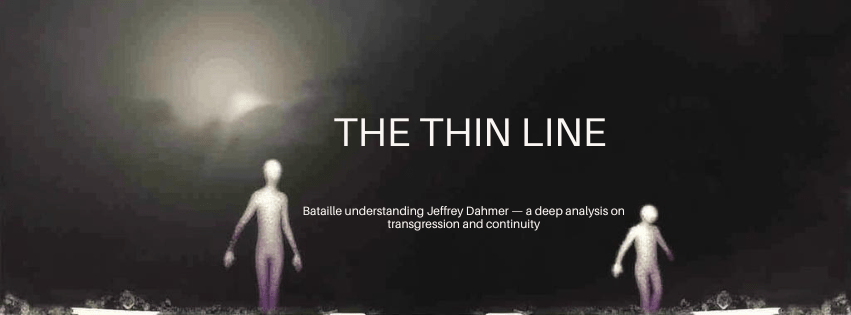
The Thin Line: Jeffrey Dahmer Through the Eyes of Georges Bataille

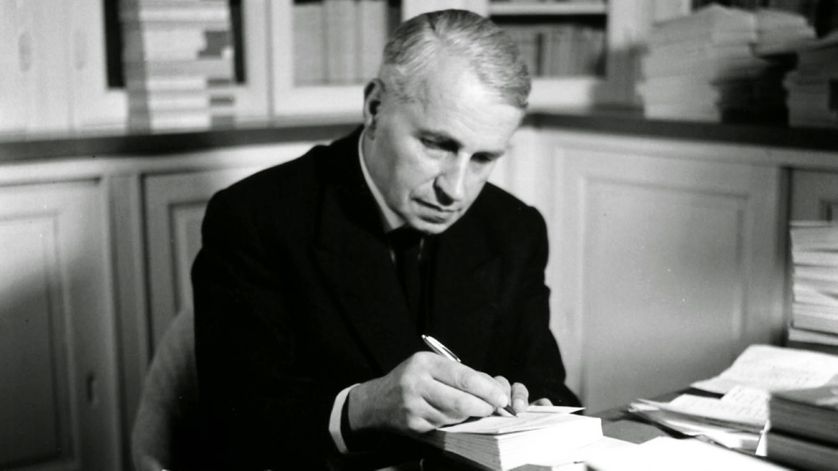
In 1957, the French philosopher Georges Bataille published a book called Erotism: Death and Sensuality. It was not about serial killers. It was not about crime. It was a philosophical study of the deepest impulses in human nature — the desire for intimacy, the pull of transgression, the relationship between love and death, and the strange territory where the sacred and the forbidden become indistinguishable from each other.

Bataille died in 1962. He never knew Jeffrey Dahmer’s name.

And yet Erotism reads, in places, like a philosophical map of Jeffrey’s inner world — written thirty years before anyone knew that world existed. Not because Bataille was describing a killer, but because he was describing something in human nature that Jeffrey took further than almost anyone ever has. The concepts Bataille spent a lifetime developing — discontinuity, continuity, transgression, the sacred dimension of taboo — illuminate Jeffrey’s own words in a way that no clinical diagnosis ever quite manages.

This article is an attempt to place those two things side by side, with care and with honesty.


The Problem of Discontinuity

Bataille begins Erotism with a philosophical observation so simple it is easy to miss its weight. Every human being, he says, is a discontinuous being. We are each enclosed within ourselves, bounded by skin and bone and the limits of our own consciousness. We are born alone. We die alone. Between any two people there is a gulf — fundamental and unbridgeable — that no amount of communication can fully close.

This discontinuity, Bataille argues, is the source of the deepest human suffering. We long for what he calls continuity — a dissolution of the separate self into something larger, a merging with another being that ends the terrible isolation of individual existence. This longing, he says, is at the root of three things: physical eroticism, emotional love, and religious experience. All three are, at their core, attempts to escape discontinuity. To breach the wall between the self and the other. To touch, however briefly, the continuity that death alone can fully restore.

Now consider what Jeffrey said, in his own words, about why he did what he did.

“It made me feel like they were a permanent part of me.”

“I wanted to keep them with me as long as possible, even if it meant just keeping a part of them.”

“I could completely control a person — a person that I found physically attractive — and keep them with me as long as possible.”

This is not the language of hatred. This is not even, primarily, the language of desire in the conventional sense. This is the language of someone trying — in the most extreme and catastrophic way imaginable — to solve the problem Bataille identified. The problem of discontinuity. The unbearable separateness of being a self.

Jeffrey did not want to destroy. He wanted to fuse. He wanted continuity. He wanted the boundary to disappear. Bataille writes that eroticism is, at its core, the attempt to substitute for individual isolated discontinuity a feeling of profound continuity. Jeffrey’s words are that theory spoken aloud — not as philosophy, but as confession.


The Thin Line Between a Kiss and Cannibalism

Bataille’s most unsettling argument — and the one most directly relevant to Jeffrey — is about what he calls the logic of eroticism pushed to its extreme.

Physical eroticism, he argues, is already a form of violation. The erotic act dissolves the boundaries of the self. It is, at its most fundamental, an attempt to break the separateness of two discontinuous beings — to achieve, however briefly, a state of fusion. He writes that the whole business of eroticism is to destroy the self-contained character of the participants. Nakedness, he says, is the first gesture of this dissolution: the removal of the barriers that maintain discontinuity. What follows is a temporary merging, a momentary continuity, before the boundaries are restored and the two people are separate again.

He then asks: what happens when this logic is pursued without limits?

The Marquis de Sade, Bataille notes, defined murder as the pinnacle of erotic excitement. Bataille does not celebrate this. He analyses it. He says that the destructive element pushed to its logical conclusion does not necessarily take us out of the field of eroticism. That if the drive behind eroticism is the dissolution of the separate self — the achievement of continuity — then death is, in a terrible sense, its ultimate fulfilment. Death is the only truly permanent dissolution of discontinuity. Death makes the bounded self continuous with everything again.

This is the thin line. Between the kiss — which reaches across the discontinuity toward the other — and the extreme that Jeffrey enacted, there is a difference of degree, not of kind. Both are movements toward the same impossible thing. Both are attempts to end the isolation that Bataille says defines human existence. The kiss fails, as all such attempts must fail — the boundary returns, the two people are separate again, the discontinuity is restored. Jeffrey’s attempts failed too, in the same way, which is perhaps why they escalated. Each time the boundary came back. The continuity was lost. The person was gone and Jeffrey was alone again in Cell 213.

De Sade himself wrote: “There is no better way to know death than to link it with some licentious image.” Bataille uses this to illustrate the connection between eroticism and death that most people refuse to look at directly. Jeffrey lived inside that connection. He did not choose it. It was given to him — by what combination of neurology, trauma, and chance we do not fully know — and he could not find his way out of it.


Taboo and Transgression: The Desire Created by the Prohibition

One of Bataille’s most radical arguments is about the relationship between taboos and desire. We tend to think of taboos as simply prohibitions — things we are forbidden from doing. Bataille argues that this misses the essential dynamic. Taboos, he says, do not suppress desire. They create it.

He writes: “A transgression is not the same as a back-to-nature movement; it suspends a taboo without suppressing it. Here lies the mainspring of eroticism and of religion too.”

The taboo and the transgression need each other. The prohibition is what makes the transgression possible, what gives it its weight and its charge. Without the taboo, there is no transgression — only an act. The law is not the enemy of the desire; it is its precondition. The sacred and the forbidden are, for Bataille, the same thing seen from different angles.

He illustrates this with religious cannibalism. In certain archaic practices, he writes, the eating of human flesh is both the most forbidden act and the most sacred. The taboo does not create the taste of the flesh — but it stands as the reason the ritual cannibal consumes it. The prohibition is precisely what makes the act holy. The pious cannibal knows full well that this is forbidden; knowing the taboo to be fundamental, he violates it. The desire and the law are inseparable.

Jeffrey understood this, at some level, without ever having read Bataille. He knew that what he desired was forbidden. He fought it for years — the long years at his grandmother’s house, the Bible reading, the missionaries he sent money to, the genuine attempt at control. The awareness that it was wrong was not separate from the desire. It was part of it. The boundary was not an obstacle. It was, in Bataille’s terms, the very thing that made the desire what it was.


Sacrifice and the Sacred: The Baptism

Bataille draws an extended comparison between the erotic act and sacrifice. In sacrifice, he argues, the victim’s death reveals continuity to the witnesses. The discontinuous being is destroyed and in its place what remains — what the spectators experience in the silence that follows — is the continuity of all existence. Death dissolves the particular back into the universal. The bounded self becomes unbounded. This, Bataille says, is the sacred.

He writes: “A violent death disrupts the creature’s discontinuity; what remains, what the tense onlookers experience in the succeeding silence, is the continuity of all existence with which the victim is now one.”

And then there is this: in May 1994, Jeffrey Dahmer was baptised in a steel tub inside Columbia Correctional Institution by Reverend Roy Ratcliff. He was convicted of seventeen murders. He had been in prison for two years. He would be dead in six months.

Jeffrey had arrived, by the end of his life, at something that Bataille’s framework can help us understand. He had been pursuing continuity through one path his entire adult life — the only path available to the thing in him that needed it. In prison, with Ratcliff visiting weekly, reading the Bible, discussing death and redemption and whether he deserved to continue living, he found another path to the same place. Religious eroticism, in Bataille’s terms, is the pursuit of continuity through the sacred — the dissolution of the self not through physical transgression but through union with something beyond individual existence.

Jeffrey told Ratcliff that he sometimes wondered whether he was sinning against God by continuing to live. He had internalized his own discontinuity as the deepest problem of his existence. The baptism — the immersion, the dissolution, the emergence — was perhaps the first time he had tried to reach continuity in a way that did not destroy another person in the process.

Bataille writes that the paths toward continuity vary. Their object, he says, has a great variety of aspects. Jeffrey had spent his life on one path. In his last year he tried another.


Where Bataille’s Theory Has Limits

It would be dishonest to use Bataille’s framework without acknowledging where it becomes insufficient.

Bataille’s analysis of transgression is ultimately descriptive. He is tracing the logic of certain human impulses — mapping the terrain between the sacred and the forbidden, between desire and death. He is not excusing. He is understanding. And understanding, as this memorial has always argued, is not the same as condoning.

But there is a dimension that Bataille’s theory of transgression does not fully account for, and it is the most important one: consent. Bataille writes about eroticism as a mutual dissolution. The sacrifice, even in its most archaic forms, was performed within a collective ritual framework. The transgression operated within a structure, however violent, that held some meaning for those involved.

Jeffrey’s victims did not choose dissolution. They did not consent to become part of someone else’s search for continuity. They were people with their own discontinuities, their own desires for continuity, their own inner worlds every bit as rich and real as Jeffrey’s. They were not symbolic victims in a ritual. They were Steven, James, Richard, Anthony, Raymond, Edward, Ernest, David, Curtis, Errol, Tony, Konerak, Matt, Jeremiah, Oliver, Joseph — and the first, Steven Hicks, eighteen years old, hitchhiking home from a concert.

Bataille helps us understand the logic of what Jeffrey did — the philosophical structure of the impulse, the deep human need it expressed in its most catastrophic form. He does not, and cannot, make it acceptable. The theory illuminates. It does not absolve.


Why This Matters

The reason to read Jeffrey Dahmer through Bataille is not to aestheticise what he did or to find it philosophically elegant. It is because the alternative — treating Jeffrey as simply monstrous, as categorically other, as something outside the human — is both intellectually dishonest and, ultimately, more dangerous.

Bataille wrote at the beginning of Erotism: “The human spirit is prey to the most astounding impulses. Man goes constantly in fear of himself. His erotic urges terrify him.” He was not writing about serial killers. He was writing about everyone. The impulses Jeffrey enacted at their most extreme — the desire for fusion, the longing for continuity, the relationship between desire and death, the terrible pull of the forbidden — are not alien to human nature. They are human nature, at its edges, in its darkest expression.

Jeffrey himself said it: “I don’t think there was something that happened that made me like this. Because this was always just how I was.” He was not describing a monster. He was describing a person whose inner life had taken a particular shape — one that Bataille’s philosophy, for all its difficulty and discomfort, helps us see more clearly than almost any other framework available to us.

Understanding that is not forgiveness for what was done. But it is the beginning of the kind of comprehension that might, one day, mean that someone like Jeffrey — someone carrying that particular configuration of need and isolation and desire — finds a different path before the irreversible moment arrives.

That seems worth understanding.


Sources: Georges Bataille, Erotism: Death and Sensuality (City Lights Books, 1986, translated Mary Dalwood); Jeffrey Dahmer, Inside Edition interview (1993); Jeffrey Dahmer, Dateline NBC interview with Stone Phillips (1994); Roy Ratcliff, Dark Journey Deep Grace (2011); Brian Masters, The Shrine of Jeffrey Dahmer (1993).

Read George Bataille here: