
In the summer of 1987, Jeffrey walked into Bailey, Banks & Biddle at Northridge Mall in Milwaukee and paid roughly $1,500 for a ring — a large blue topaz set in gold. Asked about it later, his explanation was almost disarmingly ordinary: he had “always had an interest in jewelry and especially rings,” and the size of the stone appealed to him.
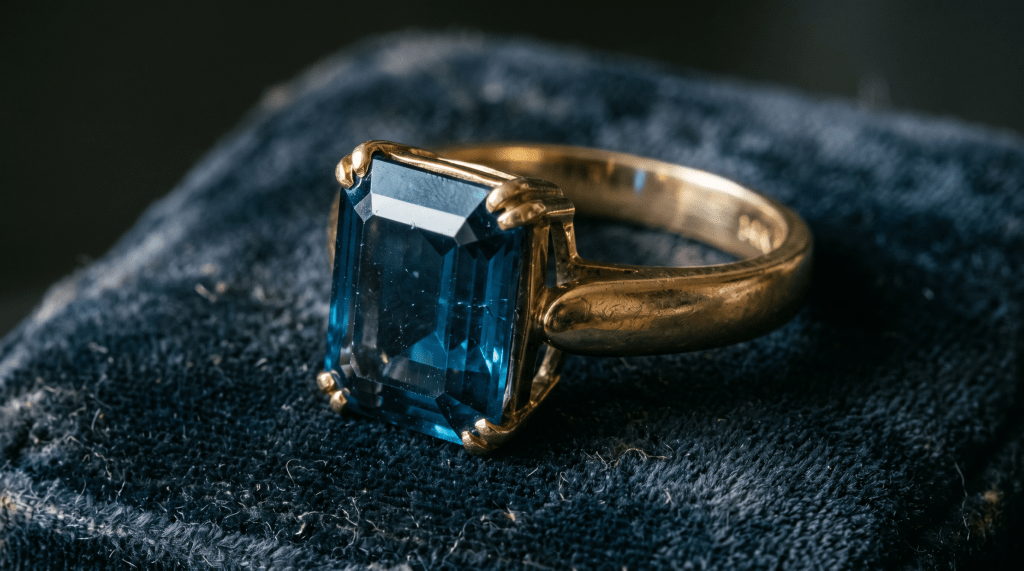
A year later, in the summer of 1988, he pawned it. Not at a jeweler this time, but at a gold-and-silver exchange on Bluemound Road, where he bargained the clerk up to $189 for a ring he’d paid nearly eight times that for. His own stated reason was blunt: his drinking had left him short on cash.
That gap — $1,500 down to $189 — is not, on its own, remarkable. People pawn jewelry for a hundred reasons that have nothing to do with anything sinister. What makes this exchange worth examining is what came next.
The question that was actually being asked
The document containing this account is not a jewelry appraisal. It’s a police report, compiled after Jeffrey’s arrest, following a tip from the Brookfield Police Department that he had pawned a ring in their city. Investigators weren’t interested in the ring as a ring. They were asking a direct question: did this come from one of his victims?
His answer was immediate and flat — no, and he “again denied selling any of the jewelry which he obtained from any of his victims.” Then, without being pressed further on the point, he added something no one had asked for: that if there was any jewelry taken from victims, “he simply threw it out in the trash, along with body parts.”
That sentence is doing an enormous amount of work in very little space. It is, technically, a hypothetical — if there was jewelry, here’s what would have happened to it. But it’s delivered with the same flat tone as everything else in his account, sliding a detail about disposing of human remains into what started as a question about a pawn ticket.
Setting this against what trophy-taking actually looks like
Criminologists who study sexual homicide offenders have a specific term for what Jeffrey is being asked about here: trophy-taking — retaining an item connected to a victim, not for its resale value, but for what it does psychologically. The research is consistent on this point: items are kept “not for monetary reasons but to serve the offender psychologically,” allowing the offender to revisit and relive the experience privately. The most commonly documented trophies across offender studies are body parts, photographs of the crime scene, and — specifically — jewelry or clothing taken from the victim.
Jeffrey is a documented case of exactly this behavior, just not with jewelry. Skulls, Polaroid photographs, and other remains were recovered from his apartment — trophies in the fullest sense the research describes. Which makes his specific denial here worth sitting with rather than passing over. He is not claiming he kept nothing. He is drawing a very precise line: photographs, yes; skulls, yes; a victim’s ring, no — that would have gone in the trash.
Whether that line is true is not something this record can settle. It’s possible jewelry genuinely held no significance to him the way other remains did — trophy-taking research does note that offenders are selective, not indiscriminate collectors, and what becomes meaningful to one offender may hold no charge for another. It’s also possible this was simply the safer thing to say to an investigator, a way to admit to the pattern in general terms — “if there was jewelry” — while denying the one form of it that would have been easiest to trace back to a named victim through a pawn shop record, exactly as this one was traced.
A small object, honestly
There is no way to resolve that ambiguity from this document alone, and this piece isn’t going to pretend otherwise. What’s certain is narrower: a ring bought for $1,500 out of an ordinary, almost sweet fondness for jewelry, pawned a year later for a fraction of that as his drinking worsened, and finally surfacing again after his arrest as the subject of a question about whether it had ever belonged to someone he killed. An object that started as a small personal indulgence ended its documented life sitting inside an interrogation about trophies and trash.
Sources cited
- Police report excerpt, Brookfield Police Department tip regarding Jeffrey Dahmer pawn transaction, released records.
- Sage Reference, Encyclopedia of Murder and Violent Crime — “Trophy Taking.” https://sk.sagepub.com/ency/edvol/violentcrime/chpt/trophy-taking
- Walter, N. et al. (2024). “Trophy, souvenir, or simple theft? Taking items from the victim in sexual homicide.” Behavioral Sciences & the Law. https://onlinelibrary.wiley.com/doi/full/10.1002/bsl.2660
- “The collectors: Serial sexual offenders who preserve evidence of their crimes.” ResearchGate. https://www.researchgate.net/publication/259158356_The_collectors_Serial_sexual_offenders_who_preserve_evidence_of_their_crimes


