
Almost everything ever written about Jeffrey Dahmer was written by someone else. The trial transcripts, the psychiatric evaluations, the books, the documentaries — all of it filtered through other people’s frameworks and other people’s words. What has rarely been examined with any care is the small body of text he produced himself: the letters, cards, and documents in his own hand.
The memorial has gathered four such documents, spanning 1989 to 1994 — from his life before arrest to the final weeks before his death. This article looks at them through the lens of psycholinguistics: the scientific study of how language use reflects psychological states. It is, as far as we know, the first attempt to do so.
We want to be clear from the outset about what this is and is not. This is an exploratory reading of a very small sample, informed by published research — not a clinical analysis, and not a diagnosis. Where the science supports an observation, we cite it. Where we are simply describing what is on the page, we say so.
The Science, Briefly
The research foundation for this kind of reading comes largely from the work of psychologist James Pennebaker and colleagues, whose studies of “function words” — pronouns, articles, prepositions — have shown that the small, unnoticed words in a person’s writing correlate with psychological states more reliably than the dramatic ones. A few findings matter for what follows:
First-person singular pronouns. Elevated use of “I,” “me,” and “my” is one of the most replicated linguistic markers of self-focused attention, and correlates with psychological distress and depression across many studies.
Absolutist words. Research by Al-Mosaiwi and Johnstone (2018) found that words like “always,” “never,” and “completely” appear at significantly higher rates in the writing of people experiencing depression and suicidal ideation.
Politeness strategies. Linguists Brown and Levinson documented how people manage requests and social risk through “negative politeness” — hedging, apologising for imposing, softening. The degree and style of this management reflects how a writer perceives social relationships.
Concrete sensory detail. Genuine, present-focused writing tends to contain specific sensory observation; detached or dissociated writing tends toward abstraction and flatness.
With that foundation, here is what the documents show.
1989: The Letter to Judge Gardner
The earliest document is also the only one from Jeffrey’s life before the arrest — a written request to Judge William Gardner for sentence modification, following his 1988 conviction.

The surviving fragment reads: “This is why, Judge Gardner, I am requesting from you, a sentence modification. So that I may be allowed to continue my life as a productive member of our society. Respectfully Yours, Jeff Dahmer.”
Three things stand out.
First, the register. This is careful, formal, institutional English — “requesting,” “sentence modification,” “a productive member of our society.” He is writing in the language of the system he is addressing, mirroring its vocabulary back to it. This is a documented social-linguistic skill called register matching, and it shows an acute awareness of audience.
Second, the self-focus. In two sentences: “I am requesting,” “that I may be allowed,” “my life.” This is entirely natural in a plea letter — the genre demands it — but it is worth noting because of how sharply it contrasts with the last document in this collection, five years later.
Third, the handwriting itself. Unlike the later letters, this one is printed rather than cursive — deliberate, separated letterforms, the writing of someone taking visible care to be legible and correct before authority. We note this as a physical description only. Graphology — the claimed reading of personality from letter shapes — performs no better than chance in controlled studies, and the memorial will not lean on it. What we can say without pseudoscience is simply that the document is neat, effortful, and controlled, which is consistent with everything witnesses documented about his self-presentation.
There is a painful irony in this letter that needs naming: at the time he wrote these words about continuing life as a productive member of society, the worst years were still ahead. Whether the letter was cynical performance or something he believed in the moment he wrote it is unknowable. The competency evaluation we published previously documents that he resisted the therapy ordered alongside that sentence — so the record suggests, at minimum, that the words and the follow-through did not match.
April 1993: The Penpal Letter
The second document is a full letter to a correspondent, dated 4-24-93, written from Columbia Correctional Institution.
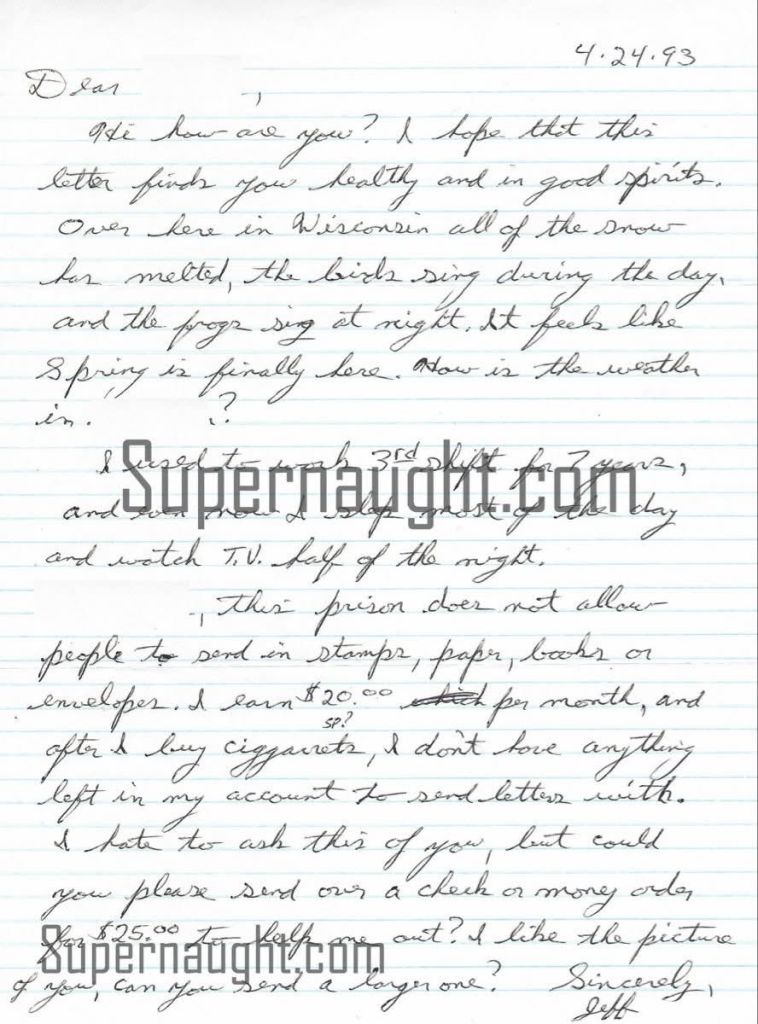
It opens: “Hi how are you? I hope that this letter finds you healthy and in good spirits. Over here in Wisconsin all of the snow has melted, the birds sing during the day, and the frogs sing at night. It feels like Spring is finally here.”
For a man so often described as affectless, this passage deserves attention. It contains layered, specific, sensory observation — snow melting, birds by day, frogs by night — organised into a small, almost literary parallel structure. This is not flat writing. Whatever else was true of Jeffrey Dahmer in April 1993, he was noticing the world through a prison window and translating it into warm, conventional, socially fluent prose. Research associates this kind of concrete present-tense sensory detail with genuine engagement rather than detachment; his conversational writing, at least here, does not read as dissociated.
The letter then moves to practical matters, and here the politeness patterns are striking. Asking his correspondent for money — twenty-five dollars, in a letter that explains he earns twenty dollars a month and spends it on cigarettes — he writes: “I hate to ask this of you, but could you please send over a check or money order…” This is textbook negative politeness: acknowledging the imposition, softening the request, apologising in advance. He manages the social risk of asking with the same care he applies to his handwriting.
And then there is the smallest and perhaps most telling detail in the whole collection. Mid-letter, he misspells a word, crosses it out, and writes above it: “sp?”
He is flagging his own spelling error, in a casual letter to a penpal, with a proofreader’s annotation. This is self-monitoring — a live record of a mind checking its own output for correctness even in low-stakes writing. It is one visible data point of the carefulness that runs through everything: the neat letterforms, the managed politeness, the register control. The competency evaluation documented a man of high measured intelligence with obsessive-compulsive behavioural features; this little “sp?” is what that looks like on paper.
December 1993: The Hand
The third document is not primarily text at all. Sent to a correspondent named Dahlia in December 1993, it is a traced outline of his own hand, signed with his name and his inmate number, 177252, written on the palm.
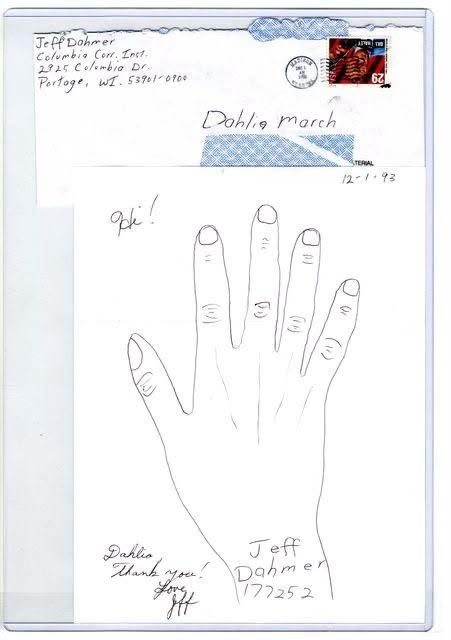
The accompanying words are minimal — a greeting, “Thank you!”, “Love, Jeff.” There is little language to analyse here, and we will not overreach. But the artefact itself says something the letters cannot: asked to give something of himself to a stranger, he gave the outline of his own hand — the most literal self-portrait available to a man with no possessions. He labelled it with the two identifiers the world had left him: his name, and his number.
We offer no psychological claim about this. We simply note that people across every culture trace their hands as a way of saying I was here, this is me — children do it in school, prisoners have done it for as long as there have been prisons. It is among the most human gestures there is.
November 1994: The Thanksgiving Card
The final document is the card he sent to Roy Ratcliff, the minister who baptised him, in the last weeks of his life. Ratcliff described it in Dark Journey Deep Grace as one of his most treasured possessions.
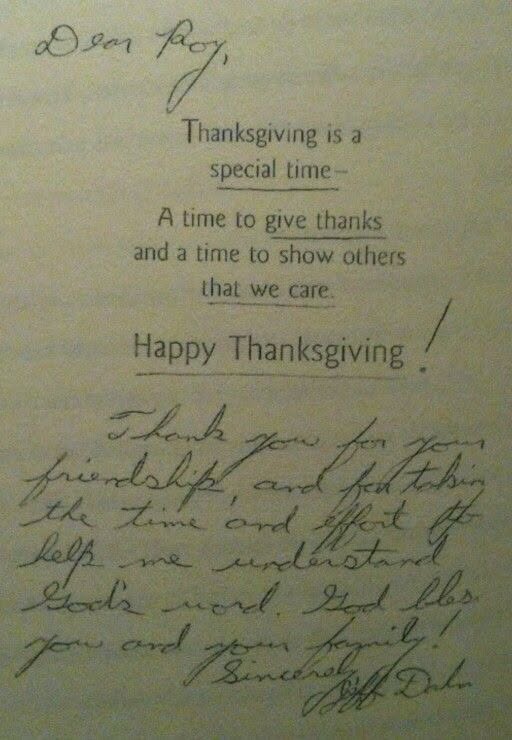
The handwritten message reads: “Thank you for your friendship, and for taking the time and effort to help me understand God’s word. God bless you and your family! Sincerely, Jeff Dahmer.”
Set beside the 1989 Gardner letter, the shift in linguistic orientation is unmistakable. The 1989 letter is built around the self: I am requesting, that I may be allowed, my life. The 1994 card is built almost entirely around the other person: your friendship, your time and effort, you and your family. The only self-reference — “help me understand” — casts himself as a learner receiving something, not an agent demanding something.
The research on pronoun orientation is relevant here: outward-directed, other-focused language is associated with connection and gratitude; inward-directed language with distress and self-focus. On a sample of two short documents we cannot claim a measured trajectory — we want to be honest about that. But the direction of the shift matches, exactly, what every witness to his final years described: Ratcliff’s account of a man surprised that anyone would keep visiting him, the Thanksgiving card itself, the documented seriousness of the spiritual turn. The language on the page and the testimony about the man point the same way.
What This Does and Does Not Show
Read together, the four documents give us a consistent portrait in some respects and an honest limit in others.
What is consistent: carefulness. Across five years, two facilities, three genres, and audiences ranging from a judge to a penpal to a pastor, every document shows the same controlled, effortful, correctness-monitoring writer — neat letterforms, managed register, softened requests, a spelling annotation in a casual letter. The linguistic record matches the behavioural one: the politeness noted by detectives, the precision about the baptismal words, the methodical habits documented everywhere.
What is suggestive but not provable: the shift from the self-focused instrumental language of 1989 to the other-focused gratitude of 1994. It aligns with the documented biography of his final years. It is also two short texts, in different genres, and we will not pretend that is a dataset.
What is absent: the markers one might expect. In this small sample there is little of the absolutist vocabulary associated with depressive writing, no flattened affect in the conversational prose — the spring passage is the opposite of flat — and no linguistic strangeness at all. And perhaps that is the finding. The man whose inner life contained what his did wrote letters that are, linguistically, almost aggressively ordinary: polite, careful, warm within convention, worried about spelling. The gap between the interior documented in the clinical record and the surface of these pages is the same gap everyone who met him described — and here it is, preserved in ink.
This article is part of an ongoing series examining primary sources. See also: “A New Primary Source: The 1992 Competency Evaluation” and “The Mind That Wouldn’t Stay: Jeffrey Dahmer’s Dissociative Episodes and What They Tell Us.”
Documents: letter to Judge William Gardner (1989, court record); letter to a correspondent, April 24, 1993; hand tracing sent to Dahlia March, December 1, 1993; Thanksgiving card to Roy Ratcliff, November 1994 (reproduced in Ratcliff, Dark Journey Deep Grace, 2006). Research references: Pennebaker, The Secret Life of Pronouns (2011); Al-Mosaiwi & Johnstone, Clinical Psychological Science (2018); Brown & Levinson, Politeness: Some Universals in Language Usage (1987).


