
The Great Pants Incident of June 17, 1994
Some documents change history. Treaties. Declarations. Constitutions. This one is about pants.
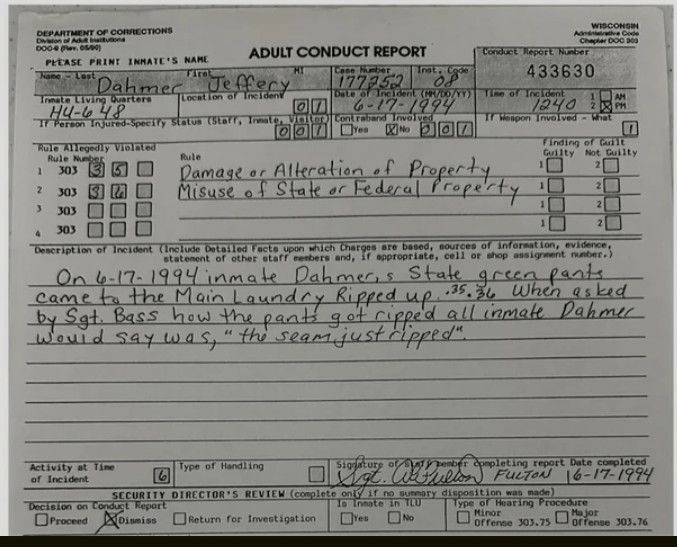
On a Friday afternoon in the summer of 1994, the Wisconsin Department of Corrections sat down, pulled out its official forms, and opened a formal disciplinary case against a pair of green trousers. Or, more precisely, against the man who had been wearing them. What follows is the full story, reconstructed from the surviving evidence: one conduct report, handwritten in pen, with a case number, a code citation, a sergeant, and a seam that simply gave up.
The evidence
The document is a Wisconsin Department of Corrections Adult Conduct Report, number 433630. Here is what it says.
| Field | What the form says |
|---|---|
| Inmate | Dahmer, Jeffery (sic) |
| Case number | 177252 |
| Date and time | June 17, 1994, 12:40 PM |
| Weapon involved | No |
| Rule 303.35 | Damage or Alteration of Property |
| Rule 303.36 | Misuse of State or Federal Property |
| Security director’s decision | Dismiss |
The full description of the incident, as handwritten by staff:
On 6-17-1994 inmate Dahmer’s State green pants came to the Main Laundry Ripped up. 35, 36. When asked by Sgt. Bass how the pants got ripped all inmate Dahmer would say was, “the seam just ripped”.
The victim
We tried to identify the deceased. We really did. But no manufacturer, size, fabric or serial number survives in the record, and the pants left no next of kin. Like so many state-issued garments before them, they lived and died anonymously.
Here is everything we know for certain:
- Name: unknown. Referred to in official documents only as “State green pants.”
- Colour: green.
- Owner: the State of Wisconsin. Never, for one moment, the man wearing them.
- Last known location: the Main Laundry, 12:40 PM, June 17, 1994.
- Cause of death: according to the only witness, the seam just ripped.
They served their full sentence without a single complaint on file, which is more than most of the institution can say. They are survived by an unknown number of identical green pants, all of them, presumably, watching their seams very carefully.
The crime scene
Let us establish the facts. At 12:40 PM, a pair of state-issued green pants arrived at the Main Laundry. They were ripped. That is the entire crime. There was no weapon, a point the form makes sure to confirm with a checked box, in case anyone suspected the pants had been armed.
The Department then reached into the rulebook and came back with not one but two violations.
Count one: Damage or Alteration of Property. The code defines this as damaging, destroying or altering state property without authorisation. Note the word alteration. Somewhere in Wisconsin, a staff member considered the possibility that this was not an accident but a redesign. Unauthorised tailoring. A man in a maximum-security prison, quietly working on his summer collection.
Count two: Misuse of State or Federal Property. This one covers using government property in any way that is not authorised. Which raises the question: what is the authorised use of pants? Wearing them, presumably. Which he was. Until they ripped. As far as the evidence goes, he was charged with misusing a pair of trousers by wearing them until they wore out.
The federal government, mentioned right there in the rule’s title, does not appear to have been involved.
The interrogation
Sgt. Bass, to his credit, went straight to the heart of the matter: how did the pants get ripped?
The suspect’s full statement, preserved for posterity, was four words long: “the seam just ripped.” No lawyer, no alibi, no dramatic confession. The report notes, with a faint air of disappointment, that this was all he would say. Honestly, it is the most reasonable sentence in the entire file. Seams rip. It is what seams do. Anyone who has ever bent over in cheap trousers can testify for the defence.
Also worth noting: the form has a box for “Activity at Time of Incident,” and it reads 6. We do not know what activity 6 is. We would like to believe it was standing very still and not ripping anything.
What was at stake
This is where the comedy gets a little darker. A torn seam was not, on paper, a trivial matter. Under Wisconsin’s discipline rules, a property-damage charge could be treated as minor or major, and the security director weighed factors such as the inmate’s record and the value of the property.
- If minor: a reprimand, loss of privileges, confinement to his room, up to 80 hours of extra duty, or restitution. Restitution, in this case, would mean paying the State of Wisconsin back for its pants.
- If major: a hearing before an adjustment committee and, in a later version of the code, penalties reaching days in segregation.
The form came ready for either path, with a box for a minor hearing and a box for a major one. The machinery was fully assembled. All it needed was a decision.
The verdict
And then, at the bottom of the page, under the Security Director’s Review, someone made a single checkmark: Dismiss.
No hearing. No restitution. No segregation. Somewhere in the Wisconsin correctional system, a person looked at this report, looked at the pants, and decided the State would survive. Justice for the seam. It was, as far as we know, never questioned. It was never even named as a co-defendant.
It is funny, and it should be. But underneath the absurdity sits something real. In prison, every thread a man wears belongs to the State, and a seam giving way after ordinary wear can become a case number, an interrogation, two code citations, and a signature. Jeffrey’s last years were lived almost entirely on paper like this, watched and recorded down to his trousers.
This report was written on June 17, 1994. He had a little over five months left. On November 28 of that year, he was gone. Of everything in his file, the only thing ever cleared of all charges was a seam.
Sources
- The conduct report scan was found on the Tumblr blog researchdahmer, which collects documents like this one.
- Rule definitions and penalty ranges come from Wisconsin’s prison discipline code, chapter DOC 303. The version consulted dates from 2006, so the 1994 wording and penalties may have differed slightly: DOC 303 (2006 text, PDF), DOC 303.35 on the Wisconsin Legislature site.

