
There is a moment in Jeffrey Dahmer’s 1992 FBI interview that almost nobody talks about. He has spent hours describing, in flat, cooperative detail, the murders of seventeen men. The detective has asked him about dismemberment, cannibalism, necrophilia, acid baths, skulls in lockers. And at the very end of this extraordinary session, as the tape is about to stop, Jeffrey says:
“OK, thanks for the muffins and the book.”
He had been eating muffins throughout. He thanks them on the way out like it was a pleasant meeting.
This is Jeffrey Dahmer’s humour: quiet, dry, completely interior, and almost always invisible unless you’re paying very close attention. It was never performed for a crowd. It never announced itself. It simply existed — a private, flickering thing in a man who kept almost everything private.
Understanding it is one of the most human ways into understanding him.
“Doing a Dahmer” — The Performance of Otherness
Jeffrey’s classmates at Revere High School in Bath, Ohio, remembered something they called “doing a Dahmer.” He would twist his body into an awkward shape, contort his face, and walk with a lurching, exaggerated gait — a deliberate imitation of someone with a developmental disability. It was strange, unexpected, and apparently very funny. The other kids loved it. They asked him to do it again.
What’s interesting is what this tells us. Jeffrey was not popular in any conventional sense — he was withdrawn, solitary, a drinker by his sophomore year, keeping the things that mattered to him entirely to himself. But this performance, this physical comedy, gave him a social currency he couldn’t access any other way. It was a mask that worked precisely because it was so obviously a mask. He was showing people something deliberately false in order to hide everything that was true.
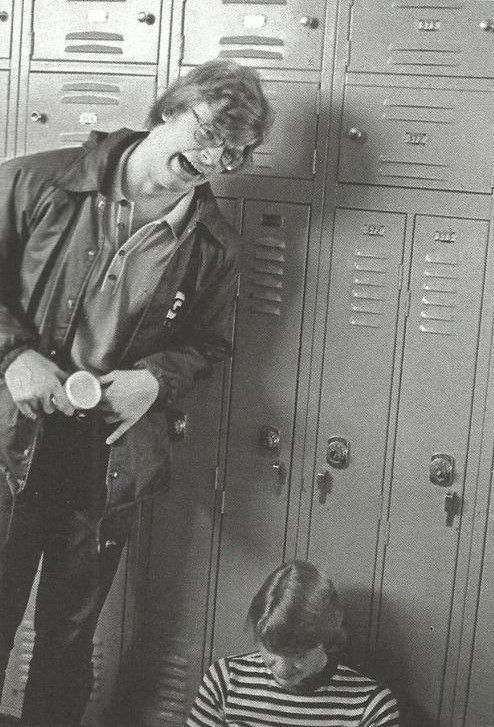
Psychologically, this is a classic function of humour in isolated individuals — what researchers sometimes call humour as social camouflage. By making people laugh, Jeffrey controlled what they saw. He gave them a version of himself to engage with, while the real version remained untouched and unseen behind it. The joke was always, on some level, on them. They thought they were watching him be ridiculous. They had no idea what they were actually looking at.
Bleating, Seizing, Screaming — The Classroom
The “doing a Dahmer” walk was not his only act. In class, Jeffrey performed a wider repertoire of stunts — bleating like a sheep, faking epileptic seizures, screaming out random things in the middle of a lesson, and performing impressions of people with cerebral palsy. He presented himself, in general, as a sort of class clown, the bizarre kid who could always be relied upon to do something unexpected.
But there is a crucial detail in the accounts of those who were there: his classmates usually laughed at him rather than with him. His sense of humour was too dark, too strange, too far outside what anyone was comfortable with. He was funny in a way that made people uneasy. They laughed because they didn’t know what else to do.
This distinction matters. Jeffrey wasn’t a class clown in the ordinary sense — someone who performs to belong. He performed in a way that guaranteed he would never quite belong. The stunts were too far. The humour was too weird. And the result was the same as always: he was watched, he was noticed, and yet he remained completely alone in the middle of it. The laughter surrounded him and didn’t touch him.
Two Steps Forward, Three Steps Back
There was a neighbour in Bath who used to watch Jeffrey walk to school from a window. Jeffrey was aware of being watched. And so he developed a walk — two steps forward, three steps back, a lurching, backwards shuffle that got him nowhere fast. He kept it up for the entire time he knew he was being observed.
Nobody asked him about this. He never explained it. But it is one of the most revealing small details in the entire story.
Here was a teenager so acutely conscious of being watched that he turned observation itself into a private joke. Rather than performing normality for the neighbour’s benefit — as most self-conscious teenagers would — he did the opposite. He made himself impossible to read. You want to watch me? Fine. Watch this. The confusion on the neighbour’s face was the punchline, enjoyed entirely alone.
This is humour as control. As a young man who felt profoundly out of control in almost every area of his life — his parents’ disintegrating marriage, his sexuality, the fantasies pressing at him from inside — the ability to make someone else confused and uncertain must have been quietly satisfying. A small power in a life that felt powerless.
“I Always Wanted to Do That to a Human”
In 1978, a high school friend named Mike Costlow visited Jeffrey at the Bath Road house after a night of drinking and smoking marijuana. At some point Costlow noticed several stuffed animals around the room and asked about them. Jeffrey replied simply: “It’s taxidermy. I used to do taxidermy.”
Later that same day, when Costlow brought the subject up again, Jeffrey said quietly: “I always wanted to do that to a human.”
Costlow and his friend were stunned. They said, “You’re sick,” and brushed it off. They thought he was joking. He was, after all, known for his bizarre and twisted sense of humour. It was just another example of that. The kind of thing Jeffrey said.
This was the summer of 1978 — the same summer Steven Hicks was murdered at that house. Jeffrey had already done it. And nobody heard it.
This is perhaps the darkest version of Jeffrey’s humour — the moment where the joke and the confession were the same sentence, and the punchline was that no one would believe it. The armour of “he’s just being weird” was so effective that even the truth, spoken plainly, was dismissed as another performance. He had learned, long before, that the best place to hide something is in plain sight.
The Muffins
Back to those muffins.
The FBI interview of August 13, 1992 was conducted at Columbia Correctional Institution by a Special Agent and a detective from the Hollywood, Florida Police Department. They were there to investigate Jeffrey’s possible connection to the disappearance of Adam Walsh. The interview is extraordinary — Jeffrey is cooperative, candid, almost eager to help. He answers every question in the same flat, considered tone he used for everything.
At some point during the interview, someone brings muffins. Jeffrey eats them. The interview continues — murder, cannibalism, the army, Florida, his grandmother. More muffins, apparently. At the very end, the tape concludes, and Jeffrey’s last recorded words in that session are a polite, genuine thank you for the muffins and the book they brought him.

The detective, for his part, had his own moment of dry humour. When the subject of alcohol tolerance came up, he interjected: “I’m a cheap date.” Jeffrey responded naturally, completely at ease — two people making a small human joke in the middle of one of the most surreal conversations imaginable.
What does it mean that Jeffrey Dahmer could eat muffins and make small talk during a confession to mass murder? Clinically, it speaks to the extreme compartmentalisation that psychiatrists noted throughout his case — the ability to hold horror and ordinariness in separate rooms of the mind, moving between them without apparent friction. But it also speaks to something more specific about his humour. He was genuinely, consistently, quietly pleasant in conversation. Detective Dennis Murphy, who spent sixty hours taking his confession after the arrest, said he appreciated Jeffrey’s frankness and lack of guile. The muffins fit perfectly. He was just… a man eating muffins and being polite. As he always had been.
The Helicopter
In 1993, journalist Nancy Glass interviewed Jeffrey for Inside Edition. At some point during their conversation, Jeffrey asked her casually if she had seen the movie that was on television the night before. He couldn’t remember the title. He made a helicopter gesture with his finger, rotating it slowly in the air.
The one with the helicopter.
He was in prison for seventeen murders. He had been there for two years. And he was making small talk about a television movie, illustrated with a finger helicopter, exactly as any ordinary person might do after a slow evening in front of the TV.
This is perhaps the most disarming of all the humour — not a joke exactly, just the total, baffling ordinariness of it. The gap between what Jeffrey Dahmer was supposed to be and what he actually was in that moment is so vast it becomes almost comic. Nancy Glass, facing one of the most notorious killers in American history, got a finger helicopter and a question about last night’s TV.
“Ha Ha” — The Letters
When Jason Moss, a criminology student, corresponded with Jeffrey in prison, Jeffrey’s letters were described as gracious and scrupulously polite. But there was also this, in his final letter to Moss:
“Just don’t forget about me when your school work is done, ha ha.”
Written out like that — ha ha — in a letter from a man who almost never wrote to anyone, who knew his letters were extraordinarily rare, who was serving 936 years. Ha ha. The lightness of it is startling. He knew exactly how to use levity. He deployed it sparingly and precisely, which is what made it land.
The Séance
And then there is the séance. In the summer of 1978 — with Steven Hicks’s remains still in the crawlspace beneath his feet — Jeffrey invited classmates to the Bath Road house and told them it was haunted. He staged the whole thing. He told them there was a spirit that could be summoned. The lights went off. Something moved. Lynn screamed.
Was that funny to Jeffrey? Almost certainly, in some private way. It had all the elements his humour loved: misdirection, control of information, a performance that was entirely false concealing something that was entirely real, and the confusion of others enjoyed in silence.
“Chunky. Delicious and Tasty.” — Prison
Prison brought a different kind of humour — or so some accounts suggest. According to multiple sources, Jeffrey reportedly told fellow inmates and guards “I bite,” then watched their nervous reactions with quiet, private satisfaction. He allegedly moulded his prison food into shapes resembling body parts and used ketchup as blood, leaving the results on his tray to unsettle the men around him. And according to Reverend Roy Ratcliff himself, Jeffrey put up a poster on his cell wall advertising a “Cannibals Anonymous” meeting.
Then there is the account from an anonymous fellow inmate’s memoir. On the day Jeffrey arrived at Columbia Correctional Institution, the noise in the cell block was immediate and relentless — jeers, threats, questions shouted through the bars. “Did the male parts taste good?” “Do you prefer dark meat or white meat?” Jeffrey said nothing. For hours, nothing. The taunts escalated, got louder, cruder. Jeffrey remained completely silent in Cell 1.
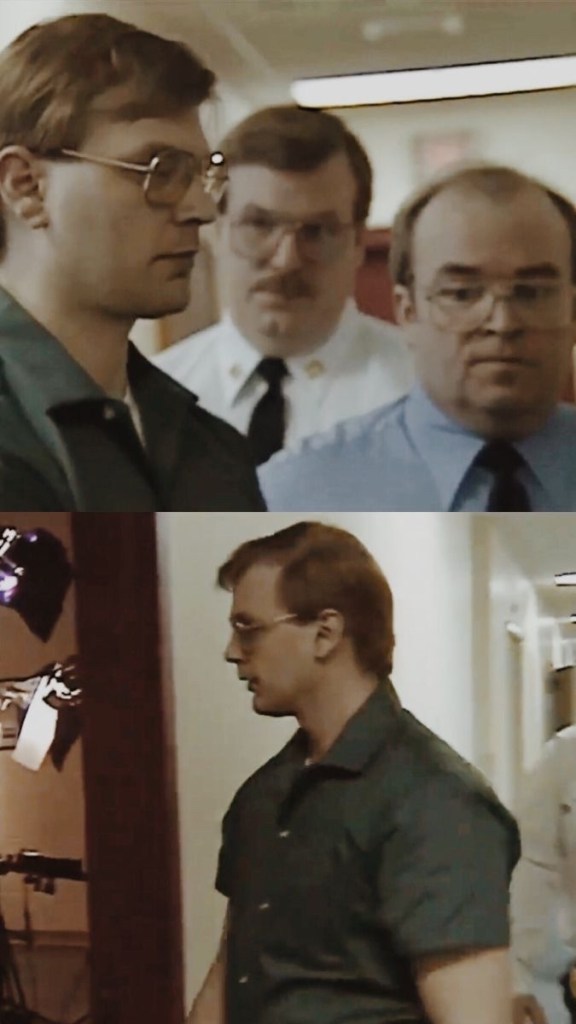
Then, after supper, one inmate shouted: “Hey, Jeff, how’s the corpse?”
A pause. Then, much to everyone’s surprise, from Cell 1:
“Chunky. Delicious and tasty.”
The ward went quiet.
It is worth noting that not everyone accepts these accounts. A lawyer who worked closely with Jeffrey in prison disputed the taunting behaviour entirely, saying it simply wasn’t his style. And there is something that doesn’t quite fit — the Jeffrey described by Detective Murphy, by Reverend Ratcliff, by the FBI agents who interviewed him, was consistently quiet, polite, and contained. The elaborate food sculptures and the constant taunting feel almost theatrical for a man who preferred his humour invisible.
What is consistent, though, is the Cannibals Anonymous poster. That feels entirely like him — not aggressive, not performed for an audience, just a quiet, private joke pinned to a wall in a cell, amusing exactly one person. The person it was designed to amuse.
The Psychology of It
What all of these moments share is not cruelty — none of Jeffrey’s humour was cruel in the conventional sense. It was never mockery of others’ pain or weakness. It was always interior, always deflecting, always about controlling what was seen.
Psychologist and author Brian Masters noted that Jeffrey was “not good at coping with disappointment” — that the losses of his childhood had left him with a profound difficulty with vulnerability. Humour, for him, was armour. Not loud, aggressive armour but the quiet kind — the kind that keeps people at a comfortable distance while appearing to bring them close. The kind that lets you eat muffins and make small talk while carrying something impossible.
Detective Patrick Kennedy, who worked his case, put it simply: “He could be engaging, he could be bright, witty, he could make jokes. He was able to fool a lot of people.” But it wasn’t quite fooling people either — or not only that. It was also just… him. Jeffrey Dahmer, finding the small absurdity in things, keeping it to himself, letting it out in carefully measured doses to the people around him.
There is also, in all of it, a profound loneliness. The classroom stunts were performed to a room that laughed uncomfortably and kept its distance. The two-steps-back walk was performed for an audience of one — himself. The helicopter gesture was an attempt at ordinary human connection. The ha ha in the letter was a man trying, in the only way he knew, to be light. To be likeable. To be, for a moment, just a person talking to another person about nothing in particular.
He was, as those who knew him consistently noted, genuinely pleasant company. Quiet, polite, a good listener, occasionally funny in a dry and unexpected way. His grandmother loved him. The detectives who spent sixty hours with him respected him. The FBI agent who interviewed him believed him completely and found him totally cooperative.
That person — the muffin eater, the helicopter mime, the boy walking backwards to confuse the neighbour, the teenager bleating like a sheep in the middle of class — was as real as everything else. Maybe more real than anything else. Because the darkness in Jeffrey Dahmer was something he fought against, hid from, tried to outrun for years. But the dry wit, the quiet deflection, the private joke enjoyed alone — that was just him.
That was just Jeffrey.

Sources: Brian Masters, The Shrine of Jeffrey Dahmer (1993); Jason Moss, The Last Victim (1999); FBI Interview Transcript, Columbia Correctional Institution, August 13, 1992; Anonymous Inmate Memoir; Biography.com; Detective Patrick Kennedy, Channel 5 interview; Mike Costlow, Cleveland Plain Dealer interview.

 Jeffrey Dahmer Memorial