
There is a moment in almost every childhood where the world becomes too large and too unpredictable to bear. The adults are fighting. The house is moving again. Nobody is explaining anything. And so a child does what children do when the outside offers no safety — they build something on the inside. A private world with its own rules, its own logic, its own borders. A place that belongs entirely to them.

Jeffrey Dahmer built his at around the age of nine. He called it Infinity Land.
What It Was
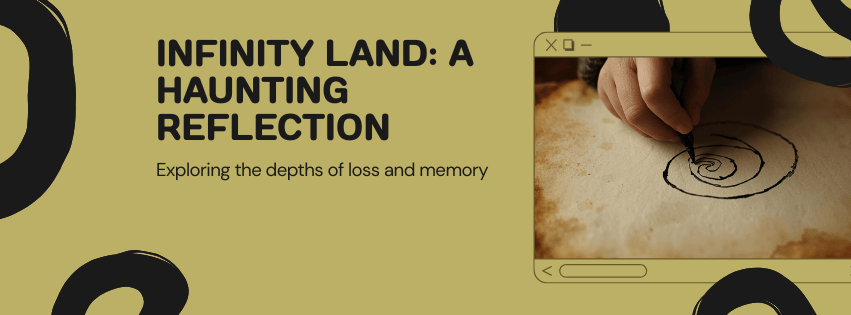
The game was drawn on paper. Stick figures — fleshless, bone-only, stripped of flesh entirely — moved across a landscape governed by a single absolute rule: if they came too close to one another, they were annihilated. Surrounding them were spirals, tightly wound, intensely imagined, pulling downward toward a black hole at the centre of everything.
He shared it with his friend David Borsvold — a quiet, rock-collecting, dinosaur-studying boy who was perhaps the closest thing Jeffrey had to a genuine companion during those years. Together they played out these annihilations, moving their little armies across a world where closeness meant destruction and the only destination was oblivion.
Brian Masters, in The Shrine of Jeffrey Dahmer, described the game with the care it deserves. The stick figures were not conceived with the full contours of people. They were bone. Their danger lay in proximity. And the spirals descended, always, toward the black hole of infinity.
He called it Infinity Land. He was nine years old.
What It Meant
Here is what I believe, having lived with Jeffrey in my thoughts for so long: Infinity Land was not a symptom. It was a solution.
By the time Jeffrey drew those first spirals, his life was already shaped by things a child has no language for and no power over. His mother Joyce’s mental health crises — the seizures, the medication, the hospitalizations, the rages. His father Lionel’s long absences, buried in his chemistry PhD. A family in near-constant motion, address after address, the ground never quite solid underfoot. A boy who had become, very early, extremely alert to instability — watching the room, reading the atmosphere, waiting for the next thing to shift.
He could not control any of that. But in Infinity Land, he controlled everything.

He made the rules. He decided the physics. He drew the borders of the world and determined what happened inside them. The stick figures obeyed laws he invented. The spirals descended at his direction. The black hole waited at the centre, patient and absolute, because he had placed it there.
This is what children do with anxiety they cannot name. They build containers for it. Games with highly defined rules — and Lionel Dahmer himself noted that Jeffrey always preferred games with exactly that: defined rules, repetitious actions, nothing left to chance or confrontation. The structure was the comfort. The rules were the shelter.
Infinity Land was Jeffrey’s most complete version of that shelter.
The Symbology of the Spiral
A spiral is not simply a shape. It is a direction. It implies movement — inward, downward, tightening — toward a centre that cannot be reached or escaped. Every civilisation that has ever drawn a spiral has understood, on some level, that it means something about time, about fate, about the way certain forces pull you regardless of your will.
Jeffrey drew spirals at nine years old and gave them a destination: a black hole. Infinity. Nothingness that was not frightening but — as he would say decades later in prison, when a therapist asked him about the game — soothing. Nice. Like a child asking for a warm blanket.
That detail stops me every time I return to it.
The nothingness at the centre of Infinity Land was not a threat. It was a comfort. For a boy who lived in a house full of noise and volatility and unpredictability, the absolute stillness of the void was something to move toward rather than away from. It was the one thing that could not suddenly change its mind, raise its voice, or disappear.

It was reliable. In its way, it was safe.
The Annihilation Rule
The stick figures were annihilated if they came too close.
Masters read this as a sign of Jeffrey’s relationship with intimacy — the danger of closeness, the way contact meant destruction. And he was right. But I think there is something else in it too.
When you are a child and the people closest to you are also the sources of the most unpredictability — when the arrival of a parent means tension rather than relief, when love comes wrapped in volatility — you learn, very early, that proximity is risk. You learn to keep a careful distance. You learn that the safest position is adjacent, not close.
Jeffrey encoded that knowledge into his game at nine years old without knowing that’s what he was doing. He made a world where the rule he was already living by — don’t get too close, it ends badly — was written into the physics of the universe itself. Not as a wound but as a law. Clean, legible, certain.
In Infinity Land, you always knew exactly what would happen if someone came too close. There were no surprises.
The Game That Didn’t Stay a Game
Brian Masters returned to Infinity Land again and again throughout The Shrine of Jeffrey Dahmer — not as a curiosity but as a key. He described Jeffrey’s adult descent as “descending with frightening rapidity down one of his own spirals into Infinity Land.” He described Jeffrey’s panic attacks in prison as spiralling “to the pit of despair, parodying his imaginary descents into Infinity Land as a child.”
The game, in Masters’ reading, never ended. It simply scaled up.
The spirals became real. The annihilation became real. The black hole at the centre — the nothingness Jeffrey had called soothing as a child — became the “deep, clawing depression” and the sense of “total, final hopelessness” that he described in prison as feeling “a bit like what hell is like.”
What had been shelter became structure. What had been comfort became compulsion. The rules of Infinity Land — closeness destroys, the spiral descends, the void awaits — did not stay on paper.
This is not to say the game caused what happened later. That would be too simple, and Jeffrey’s story resists simplicity at every turn. But it is to say that the interior world Jeffrey built at nine years old to make sense of a life he couldn’t control became, over the following decades, the template through which he understood everything. The logic of Infinity Land was the logic of his mind. He never entirely left it.
The Trial, and the Silence
In 1992, during Jeffrey’s trial, the defence psychologist Dr Judith Becker mentioned Infinity Land in her testimony. She described it gently, on gentle prompting from defence attorney Gerald Boyle. And then nobody pursued it.
Masters found this extraordinary, and so do I. Here was a window into the interior world of a man whose crimes the trial was trying to explain — a childhood game that encoded, with startling precision, his deepest beliefs about closeness, destruction, and the pull of the void. And it was left in limbo, as Masters put it. A curiosity not to be tampered with.
Perhaps it was too strange. Perhaps the courtroom had no framework for it. Perhaps nobody present understood what they were looking at.
We do.
A Child Who Built His Own World
Jeffrey Dahmer was a boy who needed safety and couldn’t find it in the world around him. So he made one. He drew it on paper with fleshless figures and tight spirals and a black hole at the centre, and he played it with his friend, and for a little while it was enough.
That is the most human thing in this entire story.
The boy who built Infinity Land was not building toward horror. He was building away from pain. He was doing what every frightened child does — reaching for some small corner of existence that he could control, that had rules he understood, that would not suddenly change.
He called it Infinity Land. He was nine years old. He was just trying to feel safe.
Sources: Brian Masters, The Shrine of Jeffrey Dahmer (1993); Lionel Dahmer, A Father’s Story (1994); Trial testimony of Dr Judith Becker, Milwaukee, 1992.
 Jeffrey Dahmer Memorial