
There is a detail in Jeffrey Dahmer’s story that most people gloss over. Among the videotapes found in Apartment 213 when police catalogued its contents in July 1991 were several films — Blade Runner, Star Wars, and The Exorcist III. Not the original Exorcist. The third one. And according to one of his surviving victims, Jeffrey watched it repeatedly, in what was described as a trance-like state.
This is not a footnote. This is a window.
What The Exorcist III Actually Is
Most people who haven’t seen it assume The Exorcist III is a standard horror sequel — more possession, more spinning heads, more priests with holy water. It is almost none of those things.
Written and directed by William Peter Blatty himself — the author of the original Exorcist novel — it is the third installment in what Blatty called his Trilogy of Faith. It is, at its core, a philosophical film. A meditation on evil, on whether God exists, on whether a good God could permit the suffering we witness in the world. Blatty’s prime interest was always loss — or lack — of faith.
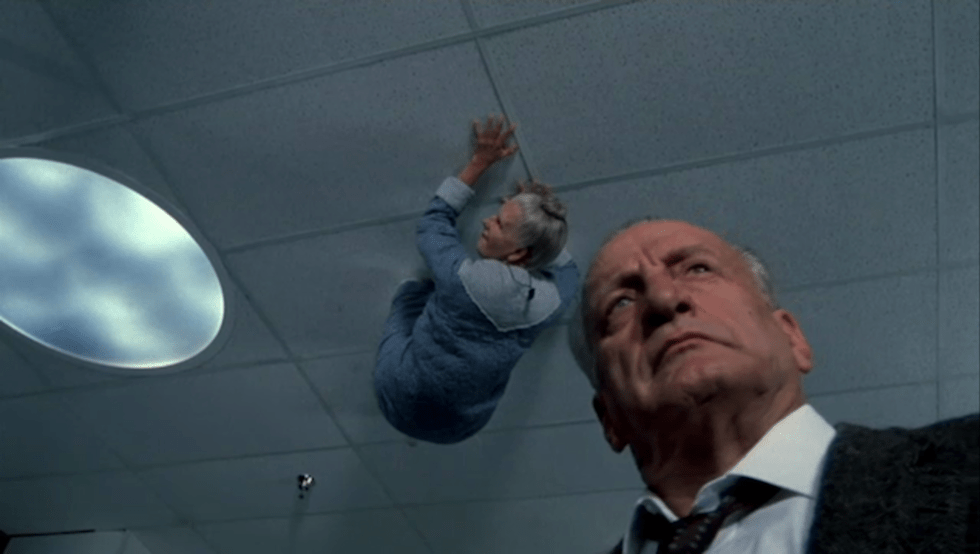
The film follows Lieutenant Kinderman, a weathered detective investigating a series of brutal murders in Georgetown that cause him to question why little boys could be allowed to suffer so viciously at the hands of a god. The murders bear the hallmarks of a serial killer called the Gemini — based in part on the real-life Zodiac Killer, one of several serial killers who enjoyed The Exorcist.
The twist is theological and disturbing: the murderer is the spirit of the Gemini Killer, who after being executed, made a deal with the demon Pazuzu. Angry at Father Karras defeating him in the first film, the demon allowed the Gemini Killer’s spirit to possess the recently deceased body of Father Karras as revenge on all good.
What makes the film extraordinary is not its horror — it is its conversations. The Gemini Killer, locked in Cell 11 of a psychiatric ward, receives visits from Lieutenant Kinderman. And what passes between them is unlike almost anything else in horror cinema — Brad Dourif out-Hannibal Lectures Hannibal Lecter, and The Exorcist III was released a year before The Silence of the Lambs.
The Gemini Killer and the Question of Evil
The Gemini Killer is not a screaming monster. He is articulate, philosophical, sardonic. He talks about evil with the precision of someone who has thought about it carefully for a long time. He talks about his childhood, his abusive father, the forces that shaped him into what he became.
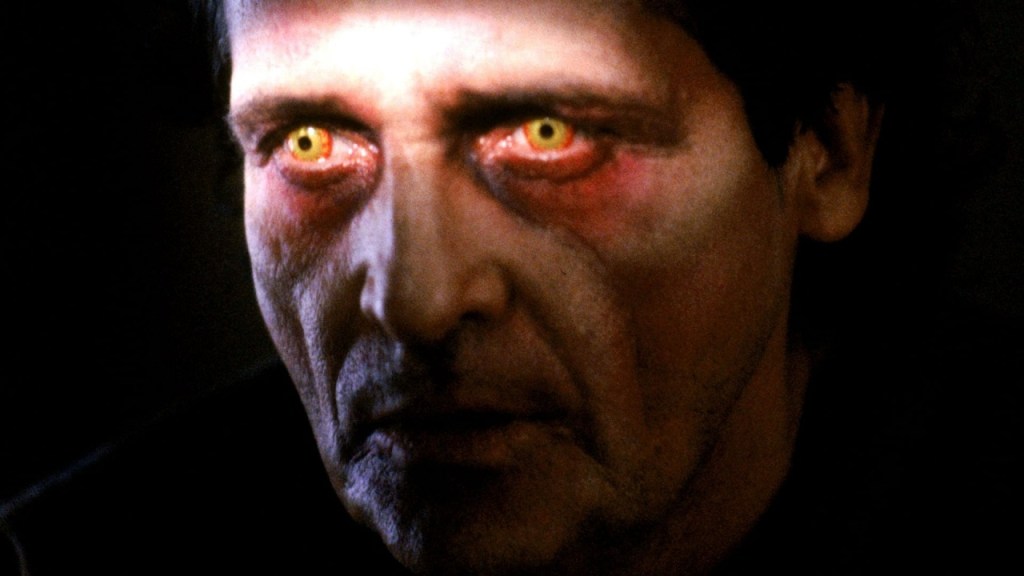
There is such viciousness and hatred in the Gemini Killer — anger at the abusive father he had as a child, anger at the religion he was part of, pure hatred for so many. And yet he speaks. He reasons. He makes arguments. He is not beyond language or thought.
This is the detail that matters for understanding Jeffrey.
A man who confessed everything — who sat with Detective Murphy for sixty hours and described his crimes with complete cooperation — who was described as frank and without guile — was watching a film about a killer who speaks from a cell about evil, about childhood, about the forces that made him. In a trance-like state. Repeatedly.
Jeffrey wasn’t watching a horror film. He was watching something that felt like a mirror.
The Parallel: A Body That Doesn’t Belong to Its Inhabitant
The central theological horror of The Exorcist III is possession — a body inhabited by a soul that has no right to be there. Father Karras’s body, walking and speaking, but controlled by something else entirely. The real Karras trapped somewhere inside, exhausted, wanting only to be released. Jason Miller’s entire performance is predicated on the idea that Karras just wants to move on. Brad Dourif on the other hand is an electric presence — a barely restrained performance of evil.
Jeffrey described his own psychology in terms that map onto this with uncomfortable precision. He spoke of a compulsion he could not control, a force operating through him that he did not understand and could not stop. He said “I hated no one” at his sentencing. He said he believed he was completely out of his mind. He described himself as sick, or evil, or both — as if those were two separate things that might or might not explain the same actions.
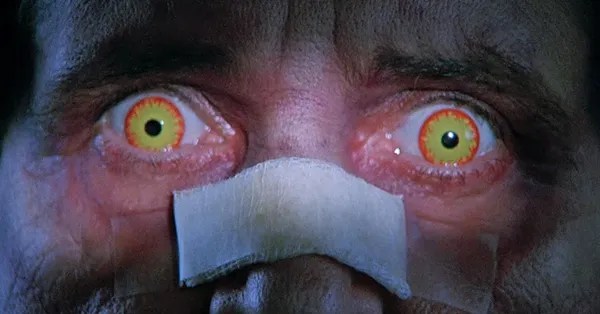
The question the film asks — who is responsible when a body commits acts that the soul inhabiting it didn’t choose? — was not an abstract philosophical puzzle for Jeffrey. It was the question of his life.
Kinderman and God’s Silence
Kinderman is a man completely angry at the idea of a God — so upset that something could exist, just to sit back and watch people be murdered. When he gets the call that Father Dyer was murdered, there’s a breakdown in his eyes that is painful to watch — a man brutalized by his lack of faith and his anger towards the possibility that God exists and didn’t intervene to save a man who devoted his entire life to His faith.
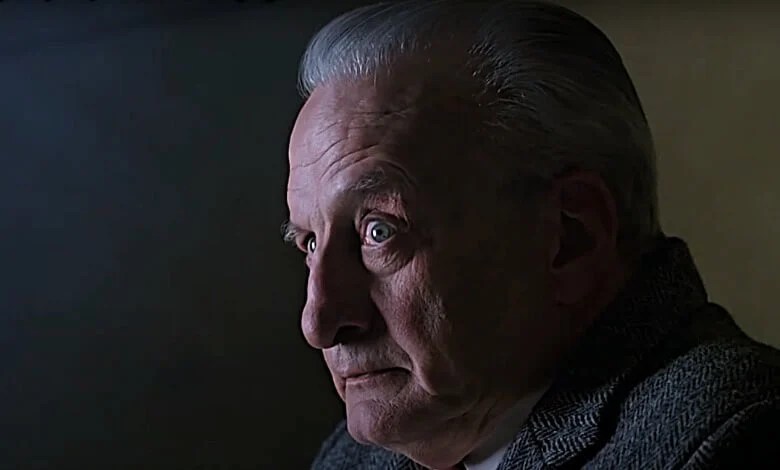
Jeffrey, in his prison years, was wrestling with the same question from the opposite direction. Not why doesn’t God intervene to stop evil — but can God forgive the person through whom the evil came? Both questions orbit the same silence. Both questions go unanswered in the film. Kinderman does not receive a satisfying theological resolution. The evil is stopped, but the questions remain.
Crucified without nails to the high wall of Cell 11, Kinderman recites an increasingly bitter list of the things he believes in — mostly the human capacity for evil and the non-intervention of an uncaring God. Blatty is interested in the words most of all: the dialectic of intellectual debate, the ritual litany of naming, the recitation of prayers.
Jeffrey was reading his Bible in the same years he was watching this film on repeat. He was attending Bible correspondence courses. He would later be baptised. The film’s central unresolved tension — between the reality of evil and the possibility of a God who permits it — was the tension he was living inside.
Cell 11
There is one more detail that is almost too precise to be coincidental.
The Gemini Killer lives in Cell 11. He speaks from behind a window, in a locked room, separated from the detective who comes to visit him. Articulate. Cooperative. Frank. Describing what he did and why with a clarity that unsettles everyone who hears it.
Jeffrey Dahmer, by the time he was watching this film on repeat, had already been arrested. He had already confessed. He would spend the rest of his short life in a cell of his own, receiving visitors, speaking with a pastor, asking the same questions the film never answers.
He watched a man in a cell speak about evil and childhood and God’s silence, over and over, in a trance-like state.
He was watching himself. Or the version of himself he was afraid he might be. Or the version he was desperately trying not to be.
Why This Film, and Not The Original
The original Exorcist is about evil arriving from outside — possessing an innocent child, threatening an ordinary family, requiring priests to drive it back out. The framework is ultimately reassuring: evil is external, identifiable, and can be defeated.
The Exorcist III is about evil that is already inside. Already in the room. Already in the body. The question is not how to keep it out but what to do once it is there — and whether the person it came through is responsible for what it did.
That is a completely different film. And it is the one Jeffrey watched in a trance.
Sources: Wikipedia; Manor Vellum; Split Tooth Media; Slant Magazine; Milwaukee Police Department inventory, July 1991; survivor accounts.

 Jeffrey Dahmer Memorial