
There is a word for what happens when a society decides that a person no longer deserves the basic protections extended to other human beings. That word is dehumanisation. It is not a metaphor. It is a documented psychological process with a name, a mechanism, and a history — and it happened to Jeffrey Dahmer both while he was alive and continues, with remarkable consistency, after his death.
This article is about that process. About what was done to him, why it was done, and what it reveals about the people who did it.
What Was Done to Him
When Jeffrey arrived at Columbia Correctional Institution in Portage, Wisconsin in February 1992, he was placed in a cell and subjected to hours of relentless taunting from the surrounding cell block. Questions shouted through bars. Threats. Mockery. The noise escalated, got louder, cruder, more specific. Jeffrey said nothing. For hours, nothing at all. He sat in Cell 1 and waited.
This was not the worst of it.
Reports from that period describe Jeffrey being made to sleep naked on the floor of his cell during his first days at the institution. He was denied basic privacy. He was displayed, essentially, as a spectacle — the worst thing that had happened in Wisconsin in living memory, now contained and available for inspection.
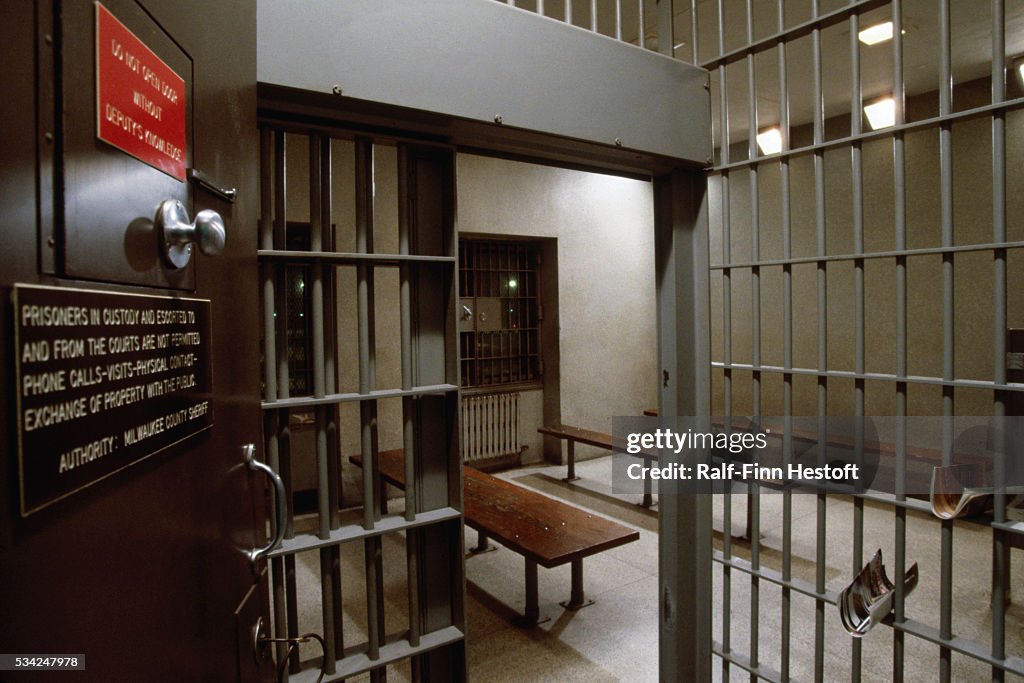
During his trial in 1992, he sat behind eight feet of bulletproof glass, separated from the courtroom — not for any genuine security reason, but because his presence was considered too dangerous to exist in the same physical space as ordinary proceedings. He was tried, in a real sense, as something other than a man.
And then there were the shackles. Each day of his trial, Jeffrey was escorted to court handcuffed in a wheelchair — because the leg irons placed on him were so heavy that they made walking impossible. A 6’1” man, unable to bear the weight of his own restraints, wheeled through courthouse corridors like freight.
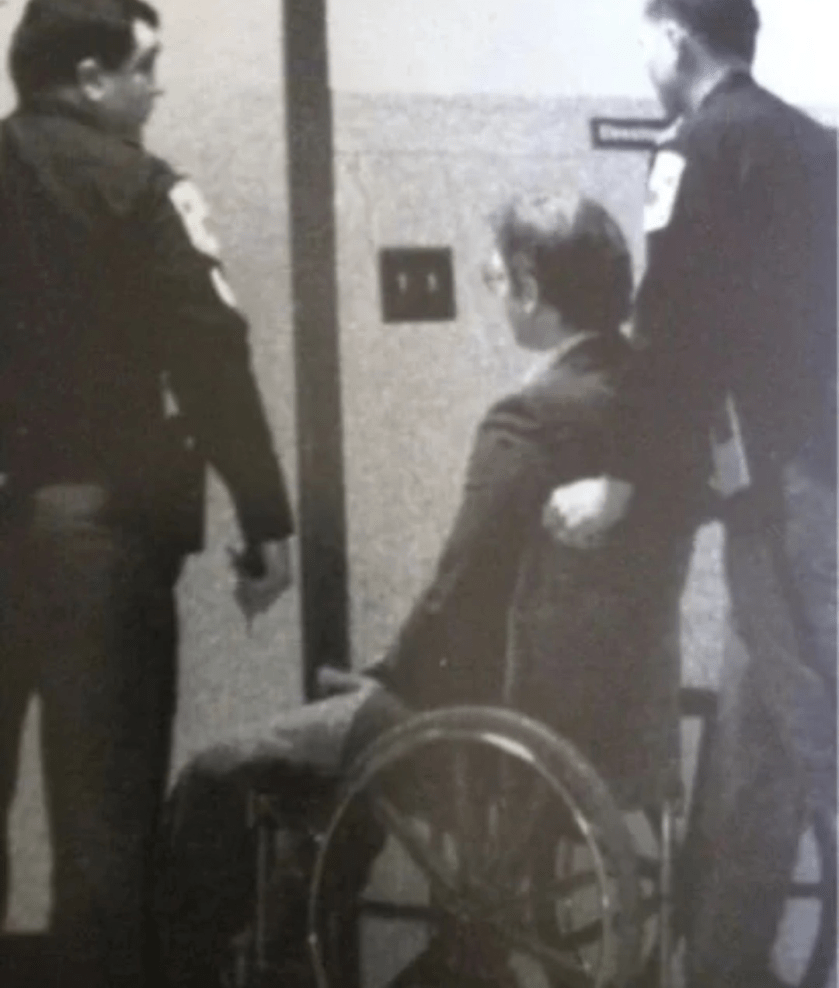
One day, as he was being wheeled toward the courtroom, a woman passing in the hallway recognised him and let out a bloodcurdling scream. Jeffrey, unperturbed, muttered quietly: “I guess I should’ve shaved.”
In a wheelchair. In shackles so heavy he could not walk. Being wheeled through a public building while a stranger screamed at the sight of him. And his response was a dry, quiet joke about not having shaved. That is not the response of a monster. That is the response of a person — exhausted, dignified in the only way left available to him, and still, somehow, human.
The Psychology of Dehumanisation
Psychologists have studied dehumanisation extensively, particularly in the context of how ordinary people become capable of cruelty toward other human beings. The mechanism is consistent: first, you remove someone’s humanity in your own mind. You assign them to a category — monster, animal, thing — that exists outside the circle of moral concern. Once that categorisation is complete, cruelty becomes not only possible but, for many people, feels righteous.
Jeffrey Dahmer was an almost perfect candidate for this process. His crimes were so extreme, so far outside anything most people could comprehend or contextualise, that the leap to monster felt not only natural but necessary. To acknowledge his humanity would be to sit with something deeply uncomfortable — that a person, a recognisable human being, had done these things. That the distance between him and everyone else was perhaps not as vast as we need it to be.
It is easier, and psychologically safer, to make him into something else entirely.
The inmates who taunted him on his first night in prison were not psychopaths. They were ordinary people who had been given permission — by the media, by the trial, by the collective verdict of society — to treat this particular human being as less than human. The guards who allowed Jeffrey to be made to sleep on the floor were not monsters. They were people acting within a system that had already decided Jeffrey was beyond the protections that system normally provides.
He Dealt With It in Silence
What is striking, in every account of Jeffrey’s time in prison, is how he responded to this treatment. Not with rage. Not with breakdown. With a kind of quiet, contained dignity that the people around him seemed entirely unprepared for.
When the taunting on his first night reached its peak — Did the male parts taste good? Do you prefer dark meat or white meat? — Jeffrey said nothing for hours. He waited. And then, when one inmate shouted Hey Jeff, how’s the corpse?, he answered, after a pause, with three words: Chunky. Delicious and tasty.
The ward went quiet.
It was not aggression. It was not a breakdown. It was a man refusing, in the only way available to him, to be entirely erased. He turned the taunting back on itself with a precision that silenced the room. Whatever you think of him, whatever he did — that moment was human. That was a person navigating something impossible with the tools he had.
Detective Dennis Murphy, who spent sixty hours taking his confession, said Jeffrey was cooperative, frank, and without guile. Reverend Roy Ratcliff, who baptised him in prison and visited him regularly until his death, described a man who was sincere, reflective, and genuinely spiritually searching. The FBI agents who interviewed him found him completely credible.
These were people who actually sat with him. Who treated him as a human being capable of communication and reflection. And what they found, consistently, was exactly that.
What Happens Today
Jeffrey Dahmer has been dead for thirty years. And the dehumanisation has not stopped.
His death photographs circulate freely on blogs and social media. His face — split open, unrecognisable, the result of a brutal beating by a fellow inmate — is shared, reposted, used as profile pictures by people who consider this an act of justice or entertainment. The images are not difficult to find. They are treated as public property, as a spectacle to be consumed.
Compare this to how the photographs of his victims are treated. The families of those seventeen men have fought for decades to keep graphic images of their loved ones private. Society, broadly, respects this. The victims are afforded the dignity of death. Jeffrey is not.
This double standard is not justice. It is not about the victims. If it were about the victims, their families’ pain would be the centre of the conversation — and most of the people sharing Jeffrey’s death photographs have no particular investment in those families at all.
It is about something else. It is about the satisfaction of seeing a specific person degraded, even in death. It is about the continuation of a process that began the moment he was arrested — the process of making him into something that does not deserve what the rest of us are given automatically.
That is not justice. That is cruelty with permission.
The Comparison That Nobody Makes
Ted Bundy confessed to nothing voluntarily. He manipulated, performed, charmed, and deflected until the very end — defending himself in court, flirting with the press, using every tool available to him to avoid accountability. He was a diagnosed psychopath with no genuine remorse. He died having never fully owned what he did.
Jeffrey Dahmer confessed to everything. He cooperated completely. He expressed genuine remorse in terms that those closest to him found credible. He repented. He was baptised. He spent his final years in quiet reflection with a prison chaplain.
Bundy is a cultural icon. Jeffrey is a target.
The difference is not the severity of the crimes — Bundy killed more people. The difference is that Jeffrey’s crimes were of a type that made dehumanisation easier. The cannibalism, the necrophilia — these are the elements that push him beyond the boundary of what people can hold as human. And once beyond that boundary, anything becomes permissible.
Why It Matters
We are not asking anyone to forget what Jeffrey did. We are not asking for sympathy that erases the suffering of seventeen families. Those two things can exist simultaneously — grief for the victims and the recognition that a human being deserves to be treated as one, even after death, even in prison, even in the face of crimes that are almost impossible to comprehend.
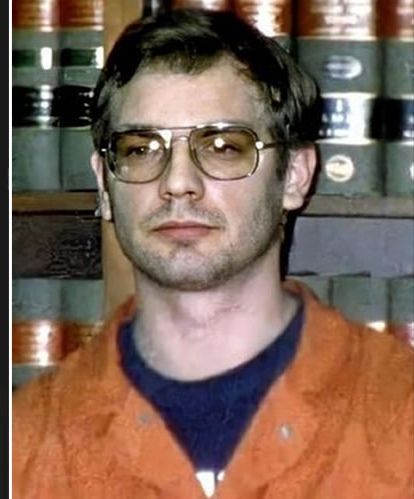
The people who post his death photographs are not more moral than the people who don’t. They are not more protective of the victims. They are simply people who have found a target that society has declared acceptable — and they are doing what people always do when a target is declared acceptable.
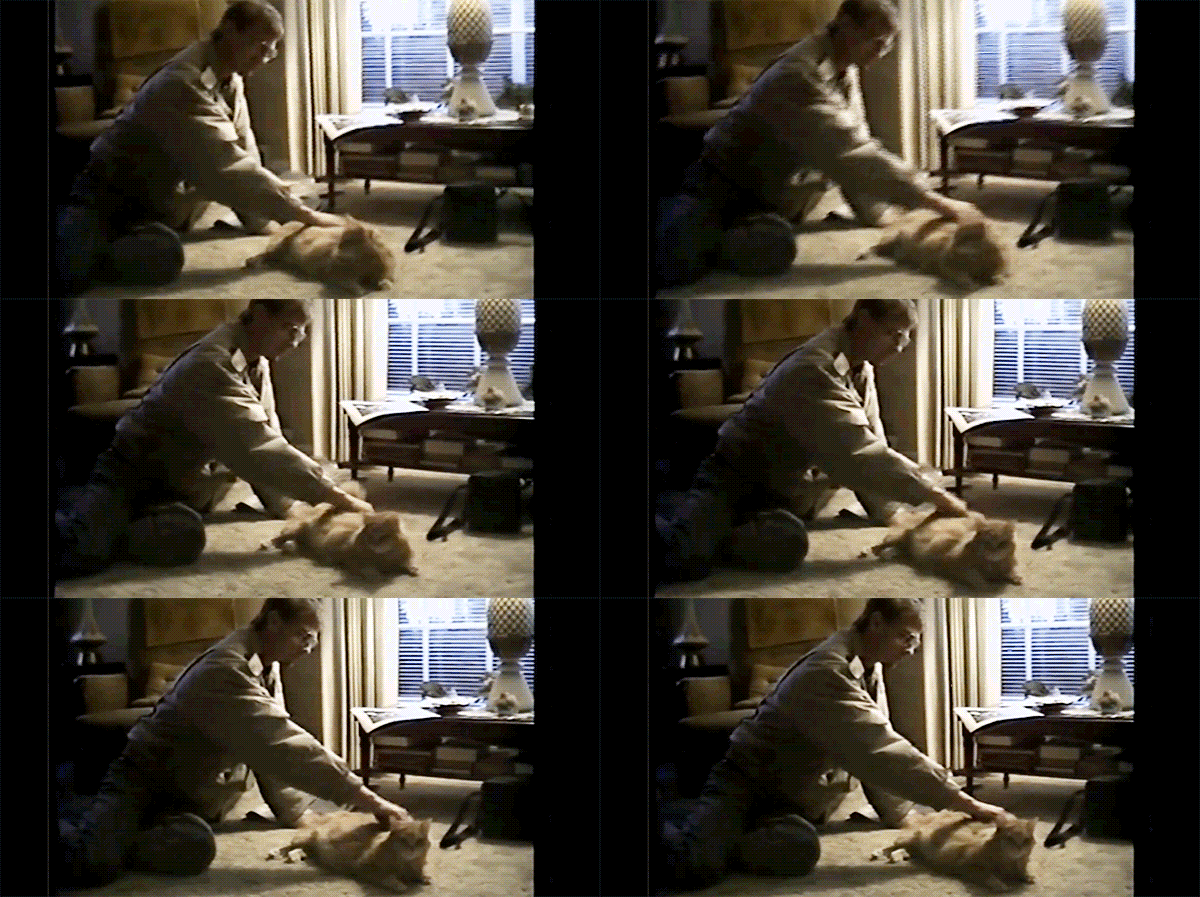
Jeffrey Dahmer was a human being. He was a deeply traumatised, profoundly ill, ultimately destroyed human being who caused incalculable harm. He was also a man who planted yellow roses, who got down on the floor to play with a cat named Jodi, who said much much better quietly to himself in the dark.
Both of these things were true. They will always have been true.
The dehumanisation does not change that. It only tells us something about ourselves.
Sources: Anonymous inmate memoir; Reverend Roy Ratcliff, Dark Journey Deep Grace (2008); Detective Dennis Murphy, various interviews; Brian Masters, The Shrine of Jeffrey Dahmer (1993); Psychology research on dehumanisation.
 Jeffrey Dahmer Memorial