
Every account of Jeffrey Dahmer eventually arrives at the same question, and almost always phrases it the same way: how did he get away with it for so long?
The question contains an assumption worth examining. It assumes the answer lies in him — in his cunning, his ordinariness, his ability to pass. It assumes that the obstacle he had to overcome was a city looking for him.
Milwaukee was not looking for him. To understand the thirteen years between Steven Hicks and Tracy Edwards, you have to understand the place, and the place was not a neutral backdrop against which one man operated. It was a city with a specific economy, a specific geography of race, a specific police department, and a specific set of assumptions about whose disappearance constituted an emergency. He did not slip through the gaps. He moved through a structure that was already built.
The brutal decade
The Milwaukee of the 1980s was a city coming apart economically, and the numbers are stark. Between 1979 and 1983, some fifty thousand manufacturing jobs left the city. Across the decade as a whole, the metropolitan area lost roughly a fifth of its industrial employment — a rate about three times the national average. Schlitz shut its Milwaukee brewery in 1981. Allis-Chalmers, once the largest industrial employer in Wisconsin, went bankrupt in 1987.
This was the city that had called itself the machine shop of the world. By 1986, service work had overtaken manufacturing for the first time. The economist Marc Levine’s summary of the period is blunt: the 1980s were the brutal decade in Milwaukee.
Two consequences matter for this history.
The first is personal. This is the labour market in which Jeffrey Dahmer worked the third shift at the Ambrosia Chocolate Factory — eleven at night to seven in the morning, six nights a week. The nocturnal, marginal, replaceable work he did was not incidental to how he lived. It set his hours, and his hours were the city’s empty ones.
The second is structural, and far more important. Deindustrialisation did not fall evenly. Nearly half of Black male workers in Milwaukee held manufacturing jobs, and the plants that closed were concentrated on the north side, where Black Milwaukee lived. The collapse landed hardest on precisely the neighbourhoods that already had the least, and it produced a population of young men with irregular work, unstable housing and every reason to accept fifty or a hundred dollars from a stranger who wanted to take photographs.
Dahmer’s offer was not exotic. It was an offer that made sense in that economy.
The most segregated city in America
Milwaukee has been ranked, decade after decade, among the most racially segregated metropolitan areas in the United States. It still is. The pattern was built deliberately over the twentieth century through redlining, restrictive covenants that barred Black residents from most of the city, and suburban zoning that priced them out of everywhere else. Black Milwaukee was confined to the near north side, and stayed there.
This is not background colour. It is the operative fact of the case.
Segregation determined who lived in the neighbourhood around the Oxford Apartments. It determined that a white man in that building was unusual. It determined which parts of the city the police patrolled as territory to be contained rather than served. And it determined, decisively, whose reports were believed.
Milwaukee’s police department had been shaped for twenty years by Chief Harold Breier, who ran it from 1964 to 1984 and whose relationship with the city’s Black population was one of open hostility. He was gone by the time Dahmer moved to 25th Street, but a department does not change its habits in five years. When the Dahmer case broke, Black and gay leaders in the city argued that the force still operated on Breier’s assumptions. The evidence suggests they were right.
Walker’s Point
The other Milwaukee that matters here is a few blocks of Walker’s Point, south of downtown, where the city’s gay bars were concentrated.
Club 219, at 219 South 2nd Street, opened in early 1981 out of a short-lived predecessor called Trash. It became one of the central spaces in Milwaukee’s gay life — bright, loud, a dance bar with drag shows, eclipsed in scale by La Cage Aux Folles after 1984 but never displaced in affection. It stayed open until 2005. The building is still there, under another name.

Dahmer met Steven Tuomi there in September 1987. He met Raymond Smith and Richard Guerrero there. In May 1991 he met Tony Hughes there, and because Hughes was deaf, he wrote his offer down on a piece of paper. He met Jamie Doxtator at a bus stop outside it.
It matters how this is told. Club 219 was not a hunting ground that happened to have people in it. It was a community’s living room, in a city that gave that community very few places to exist, and it was full of people who knew each other. Eric Wynn, one of the few Black drag performers regularly working the club in the eighties, has described building a small following of young Black men who came to his shows because they saw someone like themselves on stage. Tony Hughes was one of them; he taught Wynn to fingerspell the alphabet.
Then some of them stopped coming.
Nineteen funerals
Set against this is the fact that makes the whole period legible: these were the worst years of the AIDS epidemic.
By 1987, when Dahmer began killing regularly in Milwaukee, more than half a million people in the United States were living with HIV. A bartender at Club 219 during those years, Scott Gunkle — who served Dahmer and found him entirely unremarkable — has described a year in which he attended nineteen funerals, someone dying every fortnight.
Consider what that does to the meaning of an absence.
In a community losing men constantly, a familiar face vanishing from the bar was not a mystery. It was the ordinary shape of the era. He got sick. He went home to family. He was too ill to come out. He died and nobody was told. There was no gap where an alarm should have sounded, because the alarm had been sounding continuously for years and everyone had learned to live inside it.
This is the single most under-examined element of the case. AIDS did not merely coincide with Dahmer’s most active period. It supplied the cover.
Who gets looked for
The families reported them. This needs saying plainly, because the standard account leaves the impression that these men vanished unnoticed.
Richard Guerrero’s father reported him missing two days after he disappeared in March 1988, and paid for notices with his son’s photograph in the local press. Jamie Doxtator’s mother reported him the day after he failed to come home. Reports were filed, again and again, by families who knew immediately that something was wrong.
Nothing came of them.
There is no single decision to point to — no officer who looked at a file and dismissed it. That is what makes it a structural failure rather than an individual one. A missing persons report on a young Black or Latino or Native man from the north side, in a city that had spent decades treating those neighbourhoods as a containment problem, simply did not generate urgency. It went into a system that had already decided what it was worth.
Seventeen men and boys died. The overwhelming majority were Black, Latino, Asian or Native American. That is not a coincidence of who happened to be in the bars. It is a description of whose disappearance a city was prepared to tolerate.
27 May 1991
Everything above converges on one night, and if the article has a centre, this is it.
Fourteen-year-old Konerak Sinthasomphone escaped from Apartment 213, drugged and bleeding, while Dahmer was out buying alcohol. He was found in the street by Sandra Smith and Nicole Childress, two young Black women, who called 911. Glenda Cleveland, Smith’s mother and Childress’s aunt, called as well.
Three officers responded: John Balcerzak, Joseph Gabrish and Richard Porubcan. Dahmer returned and told them the boy was his nineteen-year-old boyfriend, drunk after an argument. He gave a name that was not Konerak’s.
The officers believed the white man. They walked the boy back up to Apartment 213 — where the body of Tony Hughes was lying — and left. The entire investigation took sixteen minutes. A later review found they had violated departmental rules fifteen times, including failing to run any records check on Dahmer, which would have shown he was a convicted child sex offender then on probation.
Roughly ten minutes after they left, Glenda Cleveland telephoned again. She spoke to Balcerzak. She was told the matter was handled, and he declined to take the names of the two witnesses. She called again in the following days, after seeing the missing boy’s photograph in the paper. She called the FBI. Nobody acted.
Konerak was killed within the hour of the officers’ departure. Dahmer went on to kill four more men.
And there is a detail that turns the whole thing from failure into something closer to indictment. Konerak was the younger brother of Somsack Sinthasomphone — the boy Dahmer had assaulted in 1988, the offence for which he was on probation that very night. The same family, twice, by the same man. The record connecting them was one records check away.
The audio of the officers’ radio traffic later became public. They can be heard joking about reuniting the lovers, and about needing to be deloused after their time in the apartment.
What the city did afterwards
The response was immediate and furious. There were marches, vigils and sit-ins through August 1991. Jesse Jackson came to Milwaukee. The family of Oliver Lacy filed a federal suit against the city, arguing that the police had discriminated by failing to respond properly to complaints from minority citizens — and that Lacy and three other men would be alive had Dahmer been arrested on 27 May. The community activist Queen Hyler put the case bluntly: this is a very racist city.
Chief Philip Arreola — the first Milwaukee chief in modern times appointed from outside the department, brought in as a community-policing reformer — suspended the three officers.
His own force turned on him. In a survey of 1,339 officers, ninety-eight per cent said the suspensions were wrong and around ninety-three per cent declared no confidence in his leadership.
Balcerzak and Gabrish were eventually dismissed after a lengthy hearing process. They appealed, were reinstated with back pay, and returned to the department. Balcerzak later served as president of the Milwaukee Police Association.
That sequence is the whole story in miniature. The city was told exactly what had gone wrong, in public, with recordings. And the institution absorbed it and continued.
The empty lot
The Oxford Apartments were bought in 1992 by the Campus Circle Project, a redevelopment initiative connected to Marquette University, for $325,000. The forty-nine-unit building was demolished that November, fifteen months after the arrest, at the urging of victims’ families. The chocolate factory came down the following year; the Milwaukee Bucks’ arena stands on part of that ground now.
The lot at 924 North 25th Street is still empty. Grass and a chain-link fence.

There were proposals over the years — a playground, a park, a missing persons centre, a memorial to the seventeen. None was built. The objection, then and now, is that a memorial would draw the wrong kind of visitor. The current alderman for the area has called the idea a terrible one. Some of the victims’ relatives agree; others have wanted a memorial for thirty years.
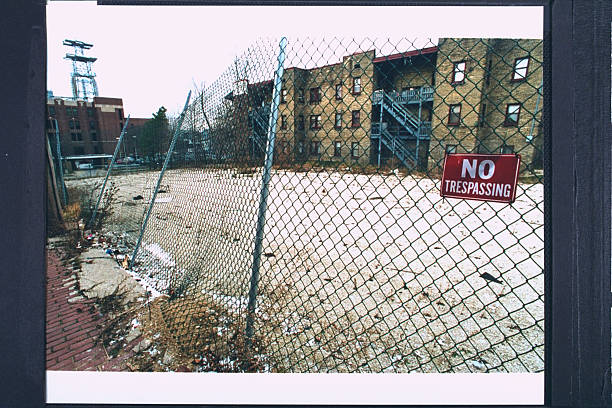
So the site of the most notorious crimes in the city’s history is a fenced rectangle of nothing, and the seventeen men and boys have no marker anywhere in Milwaukee.
The point of asking about the city
None of this diminishes what Jeffrey Dahmer did or shifts the responsibility for it. He chose every one of those men. He is answerable for all of it.
But “how did he get away with it” has an answer, and the answer is not that he was brilliant. He was arrested twice for sexual offences during the killing years and served neither a serious sentence nor a serious assessment. He was on probation while killing. He was caught, in effect, by three officers who then handed his victim back to him. He was not hard to see. He was simply not looked at.
What let him continue was a city where a certain kind of man could vanish without consequence — because the plants had closed on his side of town, because the police had spent decades treating his neighbourhood as hostile territory, because his community was burying men every fortnight anyway, and because when his mother or father filed a report, the report went nowhere.
Dahmer did not create those conditions. He found them, and used them for thirteen years.
That is the part that should be uncomfortable, and it is the reason this article exists. A man like him is rare. A city like that was not.
Sources: Encyclopedia of Milwaukee (UW-Milwaukee); Marc Levine, UWM Center for Economic Development; Brown University Diversity and Disparities Project; Wisconsin LGBT History Project; WUWM Milwaukee Public Radio; Associated Press and UPI contemporaneous reporting, 1991–92; Christian Science Monitor, August 1991; Milwaukee Journal Sentinel; Milwaukee Fire and Police Commission findings.


RIP to the victims and to Corey Ruiz
LikeLike