Forgiveness: What It Really Means, and Why Jeffrey Dahmer Deserves It

There is a comfortable version of forgiveness that most people practice without difficulty. Forgiving someone who apologised sincerely for something relatively minor. Forgiving a friend who let you down. Forgiving yourself for a mistake that cost you something but hurt no one else irreparably.

And then there is the other kind. The kind that costs something. The kind that the entire weight of Christian theology points toward and very few people are actually willing to extend.

Jeffrey Dahmer is a test case for that second kind. And most people fail it.


The Man Nobody Wants to Mention

Before he was the Apostle Paul — before he wrote half the New Testament, before he became one of the most important figures in the history of Christianity, before he was martyred for his faith in Rome — he was Saul of Tarsus.

Saul was a persecutor of Christians. Not metaphorically. Not bureaucratically. He was present at the stoning of Saint Stephen, the first Christian martyr — holding the cloaks of the men who threw the stones, giving his approval to the killing. He went house to house in Jerusalem dragging Christians out and throwing them in prison. He obtained letters authorising him to travel to Damascus to arrest believers there and bring them back in chains. He described himself later as having been, in his own words, a blasphemer, a persecutor, and a violent man.

He caused suffering. He caused death. He did it with conviction and with the full support of the religious establishment of his time.

And then, on the road to Damascus, everything changed.


The Road to Damascus

The conversion of Saul is one of the most dramatic moments in the entire New Testament. A blinding light. A voice asking “Saul, Saul, why do you persecute me?” Three days of blindness. And then — transformation so complete that the man who had been hunting Christians became Christianity’s greatest evangelist.

What is theologically significant about this moment is not just that Saul changed. It is what the Church did with that change.

It did not erase his past. It did not pretend the stoning of Stephen hadn’t happened or that the families of those he had imprisoned hadn’t suffered. Paul himself never pretended otherwise — he called himself the foremost of sinners, the least of the apostles, one not even deserving to be called an apostle because he had persecuted the Church of God.

The Church held both truths simultaneously: this man caused real harm to real people, and this man was genuinely transformed by grace. Both things were true. Neither cancelled the other.

That is the radical heart of Christian forgiveness. And it is what most people refuse to apply to Jeffrey Dahmer.


Jeffrey’s Damascus

Jeffrey Dahmer’s conversion was quieter than Saul’s but no less genuine according to those who witnessed it.

It began with a Bible his father sent him in prison. It deepened through a correspondence course. It culminated in the spring of 1994 when Reverend Roy Ratcliff — a minister of the Church of Christ who had agreed to meet with him after Jeffrey expressed interest in baptism — submerged him in the prison whirlpool at Columbia Correctional Institution.

Ratcliff later wrote about Jeffrey with a clarity that cuts through the noise. He described a man who was sincere, who asked real questions, who struggled genuinely with what he had done and what it meant before God. He noted that Jeffrey’s questions were not the questions of someone performing remorse for an audience. They were the questions of someone who was genuinely trying to understand whether redemption was possible for a person like him.
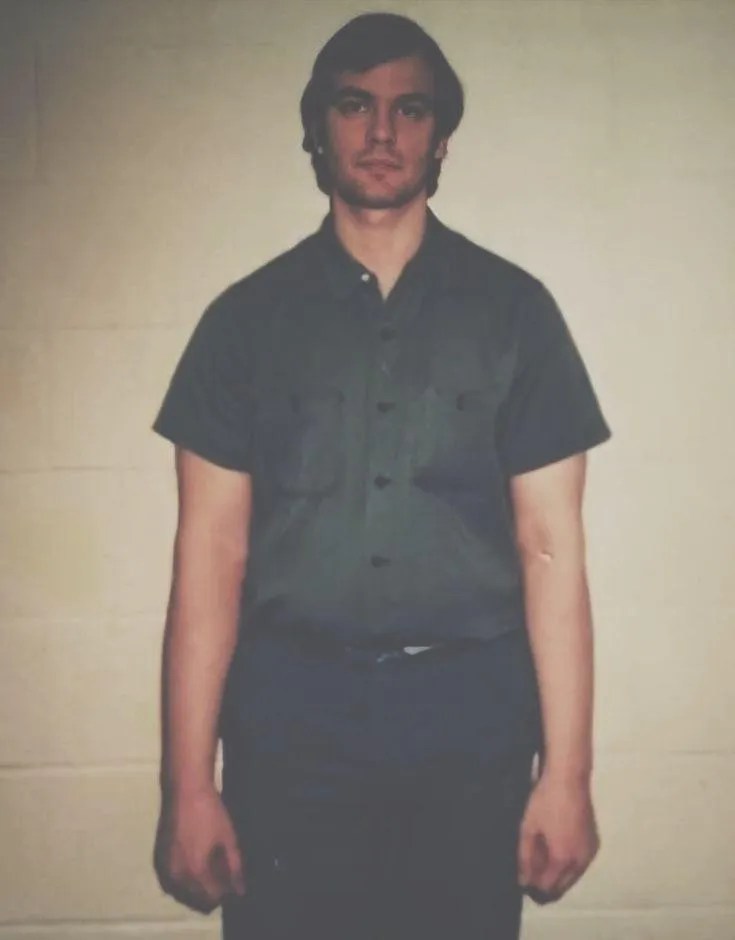
Jeffrey himself said: “I hope God has forgiven me. I know society will never be able to forgive me.”

He met with Ratcliff every week from his baptism in May 1994 until five days before his death in November. Their last session together covered the Book of Revelation — its subjects, death, punishment for sins, and what comes after. He was not coasting. He was working.


What the Thief on the Cross Tells Us

If the story of Saint Paul isn’t enough, consider the thief on the cross.

In the Gospel of Luke, one of the two criminals crucified alongside Jesus turns to him and says simply: “Remember me when you come into your kingdom.” And Jesus replies: “Truly I tell you, today you will be with me in paradise.”

No lengthy process of rehabilitation. No years of demonstrating changed behaviour. No committee deciding whether the repentance was sincere enough. A dying man, in his final hours, asking to be remembered — and the answer being yes.

The thief had presumably done enough to warrant execution by Roman standards. We don’t know what he did. We know that in his last moments he turned, and that turning was enough.

The theology here is explicit and radical: the reach of grace has no floor. There is no depth from which it cannot lift someone. There is no crime that places a person permanently beyond its reach.


The Prodigal Son

Jesus told a story about a son who took his inheritance early — essentially wishing his father dead — went to a foreign country and wasted everything on reckless living, and then came home in desperation, planning to beg to be taken on as a servant.

The father sees him coming from a long way off. He runs to meet him. He calls for a robe and a ring and a feast. He says: “This son of mine was dead and is alive again; he was lost and is found.”

The older son — the good one, the one who stayed, the one who did everything right — is furious. And the father’s answer to him is the heart of the parable: “We had to celebrate and be glad, because this brother of yours was dead and is alive again; he was lost and is found.”

The story is not about whether the prodigal deserved the feast. It is about the nature of the father. It is about what grace looks like when it is genuinely operating.

The people who insist Jeffrey Dahmer cannot be forgiven are, in the parable’s terms, standing outside the feast refusing to come in. That is their right. But it does not change what is happening inside.


Why People Refuse

The resistance to extending forgiveness to Jeffrey is understandable on a human level. His crimes were of a type that the mind struggles to hold. The nature of what he did — the intimacy of it, the specific choices involved — creates a revulsion that is visceral and real.

But Christian forgiveness was never designed for easy cases. It was designed precisely for the cases where human instinct says no. The entire point of the theology is that grace operates where human moral accounting breaks down — that it covers what we cannot cover ourselves, reaches where we cannot reach, holds what we cannot hold.

If forgiveness only extends to the people we find it easy to forgive, it is not forgiveness in the Christian sense. It is just social approval.

Paul understood this. He wrote in his first letter to Timothy: “Christ Jesus came into the world to save sinners — of whom I am the worst. But for that very reason I was shown mercy so that in me, the worst of sinners, Christ Jesus might display his immense patience.”

The worst of sinners. Shown mercy. So that the display of that mercy might mean something to everyone else.


What Jeffrey Said

At his sentencing in 1992, Jeffrey Dahmer spoke in court. He said:

“I know my time in prison will be terrible, but I deserve whatever I get because of what I have done. Thank God there will be no more victims and no more suffering. I believe I was completely out of my mind. I hated no one. I knew I was sick or evil, or both. I know that you cannot forgive me for what I have done. I ask for no consideration.”

He asked for no consideration. He said he deserved whatever he got. He acknowledged his illness. He expressed relief that there would be no more victims.

And then, two years later, he was baptised.

And then, six months after that, he was dead.

The arc of his last years was not the arc of a man performing for parole or reputation. He had no parole to seek. He had said himself he expected to die in prison. He was working through something privately, seriously, with a minister who had no reason to lie about what he witnessed.


The Question

If Saint Paul deserves to be called a saint — if the Church can hold together the man who approved the stoning of Stephen and the man who wrote “love is patient, love is kind” — then the question must be asked honestly:

Why not Jeffrey?

Not because what he did wasn’t devastating. Not because the families of his victims are required to forgive him — they are not, and their pain is not ours to adjudicate. But because the theology either means what it says or it doesn’t. Because grace either has no ceiling or it has one, and if it has one, Christianity needs to say so plainly.

Jeffrey Dahmer repented. He was baptised. He studied. He questioned. He asked whether God could forgive him and he was told yes. Reverend Ratcliff believed it. The minister who spent months with him, who had no reason to be deceived, believed it.

The thief on the cross asked to be remembered. He was told: today.

“I hope God has forgiven me.”

The theology says: yes.


Sources: The New Testament — Acts of the Apostles, Luke 23, 1 Timothy 1, Luke 15; Reverend Roy Ratcliff, Dark Journey Deep Grace (2008); Jeffrey Dahmer sentencing statement, Milwaukee, 1992.


The Thin Line: Jeffrey Dahmer Through the Eyes of Georges Bataille

In 1957, the French philosopher Georges Bataille published a book called Erotism: Death and Sensuality. It was not about serial killers. It was not about crime. It was a philosophical study of the deepest impulses in human nature — the desire for intimacy, the pull of transgression, the relationship between love and death, and the strange territory where the sacred and the forbidden become indistinguishable from each other.

Bataille died in 1962. He never knew Jeffrey Dahmer’s name.

And yet Erotism reads, in places, like a philosophical map of Jeffrey’s inner world — written thirty years before anyone knew that world existed. Not because Bataille was describing a killer, but because he was describing something in human nature that Jeffrey took further than almost anyone ever has. The concepts Bataille spent a lifetime developing — discontinuity, continuity, transgression, the sacred dimension of taboo — illuminate Jeffrey’s own words in a way that no clinical diagnosis ever quite manages.

This article is an attempt to place those two things side by side, with care and with honesty.


The Problem of Discontinuity

Bataille begins Erotism with a philosophical observation so simple it is easy to miss its weight. Every human being, he says, is a discontinuous being. We are each enclosed within ourselves, bounded by skin and bone and the limits of our own consciousness. We are born alone. We die alone. Between any two people there is a gulf — fundamental and unbridgeable — that no amount of communication can fully close.

This discontinuity, Bataille argues, is the source of the deepest human suffering. We long for what he calls continuity — a dissolution of the separate self into something larger, a merging with another being that ends the terrible isolation of individual existence. This longing, he says, is at the root of three things: physical eroticism, emotional love, and religious experience. All three are, at their core, attempts to escape discontinuity. To breach the wall between the self and the other. To touch, however briefly, the continuity that death alone can fully restore.

Now consider what Jeffrey said, in his own words, about why he did what he did.

“It made me feel like they were a permanent part of me.”

“I wanted to keep them with me as long as possible, even if it meant just keeping a part of them.”

“I could completely control a person — a person that I found physically attractive — and keep them with me as long as possible.”

This is not the language of hatred. This is not even, primarily, the language of desire in the conventional sense. This is the language of someone trying — in the most extreme and catastrophic way imaginable — to solve the problem Bataille identified. The problem of discontinuity. The unbearable separateness of being a self.

Jeffrey did not want to destroy. He wanted to fuse. He wanted continuity. He wanted the boundary to disappear. Bataille writes that eroticism is, at its core, the attempt to substitute for individual isolated discontinuity a feeling of profound continuity. Jeffrey’s words are that theory spoken aloud — not as philosophy, but as confession.


The Thin Line Between a Kiss and Cannibalism

Bataille’s most unsettling argument — and the one most directly relevant to Jeffrey — is about what he calls the logic of eroticism pushed to its extreme.

Physical eroticism, he argues, is already a form of violation. The erotic act dissolves the boundaries of the self. It is, at its most fundamental, an attempt to break the separateness of two discontinuous beings — to achieve, however briefly, a state of fusion. He writes that the whole business of eroticism is to destroy the self-contained character of the participants. Nakedness, he says, is the first gesture of this dissolution: the removal of the barriers that maintain discontinuity. What follows is a temporary merging, a momentary continuity, before the boundaries are restored and the two people are separate again.

He then asks: what happens when this logic is pursued without limits?

The Marquis de Sade, Bataille notes, defined murder as the pinnacle of erotic excitement. Bataille does not celebrate this. He analyses it. He says that the destructive element pushed to its logical conclusion does not necessarily take us out of the field of eroticism. That if the drive behind eroticism is the dissolution of the separate self — the achievement of continuity — then death is, in a terrible sense, its ultimate fulfilment. Death is the only truly permanent dissolution of discontinuity. Death makes the bounded self continuous with everything again.

This is the thin line. Between the kiss — which reaches across the discontinuity toward the other — and the extreme that Jeffrey enacted, there is a difference of degree, not of kind. Both are movements toward the same impossible thing. Both are attempts to end the isolation that Bataille says defines human existence. The kiss fails, as all such attempts must fail — the boundary returns, the two people are separate again, the discontinuity is restored. Jeffrey’s attempts failed too, in the same way, which is perhaps why they escalated. Each time the boundary came back. The continuity was lost. The person was gone and Jeffrey was alone again in Cell 213.

De Sade himself wrote: “There is no better way to know death than to link it with some licentious image.” Bataille uses this to illustrate the connection between eroticism and death that most people refuse to look at directly. Jeffrey lived inside that connection. He did not choose it. It was given to him — by what combination of neurology, trauma, and chance we do not fully know — and he could not find his way out of it.


Taboo and Transgression: The Desire Created by the Prohibition

One of Bataille’s most radical arguments is about the relationship between taboos and desire. We tend to think of taboos as simply prohibitions — things we are forbidden from doing. Bataille argues that this misses the essential dynamic. Taboos, he says, do not suppress desire. They create it.

He writes: “A transgression is not the same as a back-to-nature movement; it suspends a taboo without suppressing it. Here lies the mainspring of eroticism and of religion too.”

The taboo and the transgression need each other. The prohibition is what makes the transgression possible, what gives it its weight and its charge. Without the taboo, there is no transgression — only an act. The law is not the enemy of the desire; it is its precondition. The sacred and the forbidden are, for Bataille, the same thing seen from different angles.

He illustrates this with religious cannibalism. In certain archaic practices, he writes, the eating of human flesh is both the most forbidden act and the most sacred. The taboo does not create the taste of the flesh — but it stands as the reason the ritual cannibal consumes it. The prohibition is precisely what makes the act holy. The pious cannibal knows full well that this is forbidden; knowing the taboo to be fundamental, he violates it. The desire and the law are inseparable.

Jeffrey understood this, at some level, without ever having read Bataille. He knew that what he desired was forbidden. He fought it for years — the long years at his grandmother’s house, the Bible reading, the missionaries he sent money to, the genuine attempt at control. The awareness that it was wrong was not separate from the desire. It was part of it. The boundary was not an obstacle. It was, in Bataille’s terms, the very thing that made the desire what it was.


Sacrifice and the Sacred: The Baptism

Bataille draws an extended comparison between the erotic act and sacrifice. In sacrifice, he argues, the victim’s death reveals continuity to the witnesses. The discontinuous being is destroyed and in its place what remains — what the spectators experience in the silence that follows — is the continuity of all existence. Death dissolves the particular back into the universal. The bounded self becomes unbounded. This, Bataille says, is the sacred.

He writes: “A violent death disrupts the creature’s discontinuity; what remains, what the tense onlookers experience in the succeeding silence, is the continuity of all existence with which the victim is now one.”

And then there is this: in May 1994, Jeffrey Dahmer was baptised in a steel tub inside Columbia Correctional Institution by Reverend Roy Ratcliff. He was convicted of seventeen murders. He had been in prison for two years. He would be dead in six months.

Jeffrey had arrived, by the end of his life, at something that Bataille’s framework can help us understand. He had been pursuing continuity through one path his entire adult life — the only path available to the thing in him that needed it. In prison, with Ratcliff visiting weekly, reading the Bible, discussing death and redemption and whether he deserved to continue living, he found another path to the same place. Religious eroticism, in Bataille’s terms, is the pursuit of continuity through the sacred — the dissolution of the self not through physical transgression but through union with something beyond individual existence.

Jeffrey told Ratcliff that he sometimes wondered whether he was sinning against God by continuing to live. He had internalized his own discontinuity as the deepest problem of his existence. The baptism — the immersion, the dissolution, the emergence — was perhaps the first time he had tried to reach continuity in a way that did not destroy another person in the process.

Bataille writes that the paths toward continuity vary. Their object, he says, has a great variety of aspects. Jeffrey had spent his life on one path. In his last year he tried another.


Where Bataille’s Theory Has Limits

It would be dishonest to use Bataille’s framework without acknowledging where it becomes insufficient.

Bataille’s analysis of transgression is ultimately descriptive. He is tracing the logic of certain human impulses — mapping the terrain between the sacred and the forbidden, between desire and death. He is not excusing. He is understanding. And understanding, as this memorial has always argued, is not the same as condoning.

But there is a dimension that Bataille’s theory of transgression does not fully account for, and it is the most important one: consent. Bataille writes about eroticism as a mutual dissolution. The sacrifice, even in its most archaic forms, was performed within a collective ritual framework. The transgression operated within a structure, however violent, that held some meaning for those involved.

Jeffrey’s victims did not choose dissolution. They did not consent to become part of someone else’s search for continuity. They were people with their own discontinuities, their own desires for continuity, their own inner worlds every bit as rich and real as Jeffrey’s. They were not symbolic victims in a ritual. They were Steven, James, Richard, Anthony, Raymond, Edward, Ernest, David, Curtis, Errol, Tony, Konerak, Matt, Jeremiah, Oliver, Joseph — and the first, Steven Hicks, eighteen years old, hitchhiking home from a concert.

Bataille helps us understand the logic of what Jeffrey did — the philosophical structure of the impulse, the deep human need it expressed in its most catastrophic form. He does not, and cannot, make it acceptable. The theory illuminates. It does not absolve.


Why This Matters

The reason to read Jeffrey Dahmer through Bataille is not to aestheticise what he did or to find it philosophically elegant. It is because the alternative — treating Jeffrey as simply monstrous, as categorically other, as something outside the human — is both intellectually dishonest and, ultimately, more dangerous.

Bataille wrote at the beginning of Erotism: “The human spirit is prey to the most astounding impulses. Man goes constantly in fear of himself. His erotic urges terrify him.” He was not writing about serial killers. He was writing about everyone. The impulses Jeffrey enacted at their most extreme — the desire for fusion, the longing for continuity, the relationship between desire and death, the terrible pull of the forbidden — are not alien to human nature. They are human nature, at its edges, in its darkest expression.

Jeffrey himself said it: “I don’t think there was something that happened that made me like this. Because this was always just how I was.” He was not describing a monster. He was describing a person whose inner life had taken a particular shape — one that Bataille’s philosophy, for all its difficulty and discomfort, helps us see more clearly than almost any other framework available to us.

Understanding that is not forgiveness for what was done. But it is the beginning of the kind of comprehension that might, one day, mean that someone like Jeffrey — someone carrying that particular configuration of need and isolation and desire — finds a different path before the irreversible moment arrives.

That seems worth understanding.


Sources: Georges Bataille, Erotism: Death and Sensuality (City Lights Books, 1986, translated Mary Dalwood); Jeffrey Dahmer, Inside Edition interview (1993); Jeffrey Dahmer, Dateline NBC interview with Stone Phillips (1994); Roy Ratcliff, Dark Journey Deep Grace (2011); Brian Masters, The Shrine of Jeffrey Dahmer (1993).

Read George Bataille here:

a brief analysis of jeff’s draconic astrology chart

jeff’s draconic chart.
jeff’s natal chart, for reference. note the near-exact opposite differences in signs.

here’s a relatively short analysis of a few things i find interesting about jeff’s draconic chart, aka his “soul chart” — who he was outside of the body he incarnated into.

his draconic chart gives him a sagittarius sun. it almost completely flips his chart around. so not only does that make his soul this exploratory sort of individual — so probably someone who wants to experience all kinds of lives — it’s like his life as jeff dahmer was the complete opposite of who he was at the core, who he was outside of that incarnation.

so no wonder there was that hovering sense of deep gutting remorse just out of the corner of his eye, where he kept shoving it out of sight and out of mind. no wonder he carried that heaviness that other serial killers don’t seem to. it wasn’t really him. he was trapped in an incarnation where he was fated to do horrible things, and the flesh won against the soul.

his draconic chart also gives him a libra mars — that placement fights for justice. but with his flipped natal chart, it became an aries mars: animalistic, primal, driven to satisfy his base needs at all costs.

interesting how he suddenly has uranus in 11H aquarius, giving him this sense of being a total revolutionary. all three of those things share the same energy. so i wonder: what was he trying to prove in this life, especially with that libra mars trining?

perhaps he was trying to prove just how far behind we are in understanding those who desperately need mental help and don’t get it. and with that aries rising, his soul would be a bombastic one, brash and in-your-face, ready to slice right through our misconceptions and expose humanity for the ugliness and ignorance it truly carries. and with uranus in aquarius sextiling, he’s going to do it in a way that strikes us like lightning out of nowhere.

it’s very 4D chess. and of course it’s at odds with the core of him, which doesn’t like inflicting pain and suffering. and he wouldn’t know about anything like this while he was incarnated — he never spoke of being on some holy mission or whatever. but if the draconic chart is to be considered, maybe that’s what his soul wanted, and his embodied self wasn’t aware of that. otherwise, maybe he wouldn’t even have done it.

i don’t think he ever really had complete control over himself. he tried to divert, he really did. but his strength was finite. one would think that if he could keep from killing for 9 years, he could keep from doing it indefinitely. but he was so weak. all it took was a dirty note at the library to push him off-track. and i just wonder if he was made weak on purpose by some cosmic means.

the only way he could survive with this soul mission — which could absolutely still have been misguided and fucked-up on his part; a human soul is still gonna human — was to compartmentalize. dissociate. escape into the incorporeal, just like he’d learned to do in his previous life. but it may have been destiny that his fantasy life got infected by violence and dark obsession.

i may add more to this as i go.

Transforming through Beauty and Other Thoughts

I believe art can help souls; I started to produce portraits of Jeffrey with the intention of helping his soul transform and transcend through beauty and art, where Jeffrey can be put into a context where he can exist peacefully, where he can love and be loved, experience desire without hurt and, ultimately, be happy.

I do not use any AI Model trained to produce Jeffrey’s face, I do use Img2Img in some more classical and obvious forms of portraits but, for the most part, Jeffrey’s image appears through to my outputs in a supernatural fashion, where no photo of him is used, nor any reference to his name. I make use of Photoshop to correct some body features that do not come out well enough through my AI machine, however, his face is, very rarely, corrected or modified.

Untitled with Glasses (2023) – A spontaneous output, unmodified.

I do have a very deep connection with Jeffrey’s soul; I believe my mission is to help him, as he has been, to me, a guiding soul, since my childhood years. I believe his soul is Good and that he has repented in a deep and honest way, choosing to become Light.

It has been very hard for me, and for the community that supports this belief, to experience so much hatred and intolerance, in places that shout words of freedom, in a very selective way that does not give any space to real things in this world, like: forgiveness to those who really need it.

[I am currently without Instagram or any other platform, because our mission is unwelcome and my accounts keep being taken down.]

Stay blessed, everyone. Signing off,

Necro

wrong place, wrong time

jeff is such a case of wrong place, wrong time. an outlier, tossed into a timeline that was just wrong for him and those around him, but just right for those who wish to study him. a sacrificial lamb of a soul, showing the world the worst-case scenario of what could go wrong when someone’s neurodivergences are left ignored and suppressed.

metaphysically, it’s not even his fault that he existed as he was. he was stuck that way, and there was no undoing it, no deviating from that life path he had to take on. it really does seem fated in a sense. if all the world’s a stage, then someone had to play the role of the tortured criminal, and it just had to be him.

i wonder.. if reincarnation is real [which i believe it is — matter can neither be created nor destroyed, and i’m sure consciousness exists eternally in the same way]. did he know that he had to incarnate in that way? taking one for the team, so to speak? or was he ultimately just some selfish horny fuck and there’s nothing deeper to it than that?

i mean, when i see his eyes in photos, i SEE an ultimately good soul there. a good soul that’s been ravaged and broken by its own incarnation. but of course, we don’t really have the tools to measure such a thing scientifically. so it’s all just up in the air for now. doesn’t mean it doesn’t exist, though. it’s that sort of thing that keeps me wondering.

i do wonder how much self-awareness really does for a person in the end, though. jeff was as self-aware as he could be — on his own, with no outside help that matched his level cognitively — but he still killed 17 people. it’s just waking up to find you’re in hell. the existential horror of being jeffrey dahmer.

he experienced the bystander effect within himself. just a passive “i know i have to stop..” but an inability to INITIATE that action. it’s almost like executive dysfunction, but drawn out over a long period of time. and just like how all humans are biologically programmed to take the easier route, as it conserves energy, jeff acted on his impulses time after time. a sort of paralysis while still in motion. in many ways, he was paralyzed mentally.

same kind of thing with any addiction that grabs hold of you and doesn’t let go. people seem to think that if you can act at all, then you have a choice to stop whatever you’re doing. well, brain chemicals don’t work that way. he was able to stop for 9 years, yes, but that took all of his strength. eventually the muscles grew tired and he collapsed under the weight of his obsessions. and after that, he just gave in. he was tired of fighting it. he resigned himself to his fate.

just the same as with any addict relapsing. anything can trigger it. even something as small as a dirty note given to you in a library.

and back to the incarnating thing.. i wonder if maybe his “soul” or whatever knew someone had to live that life. someone had to be the bad guy, the poster child for the result of our stubborn refusal to understand mental health, our unrelenting desire to equate accountability with rage and punishment instead of understanding and compassion.

just like how someone had to betray jesus in order to get the ball rolling for his death and resurrection, i guess. someone had to play that role, and judas was the one who drew the short straw. maybe jeff had to be a sort of judas figure for the mental health field, causing the chaos that will set the much-needed transformation in motion. a devastating yet necessary catalyst.

¡ guess i just don’t want to blame him for being human. there was a lot going on in his mind, in his body, and he had no actual help for it that resonated with him. nothing that stuck. no one who truly GOT him.

i just wonder how strong any of us would’ve been against a biochemical cocktail like what he was stewing in for his whole life. especially when communicating it and being understood was impossible.

yes, people did try to help him, but it was in all the wrong ways.

the man was truly fighting himself all on his own.

[ • dahmers-ashes • ]

The Baptism of Jeffrey Dahmer

Title: The Baptism of Jeffrey Dahmer: A Profound Encounter with Roy Ratcliff (1994)

Introduction:
In the realm of criminal history, few names elicit as much horror as Jeffrey Dahmer’s. However, amidst the darkness that surrounded him, there exists an intriguing chapter involving his baptism conducted by Roy Ratcliff in 1994. This blog entry aims to shed some light on this significant event and the person who performed the ceremony.

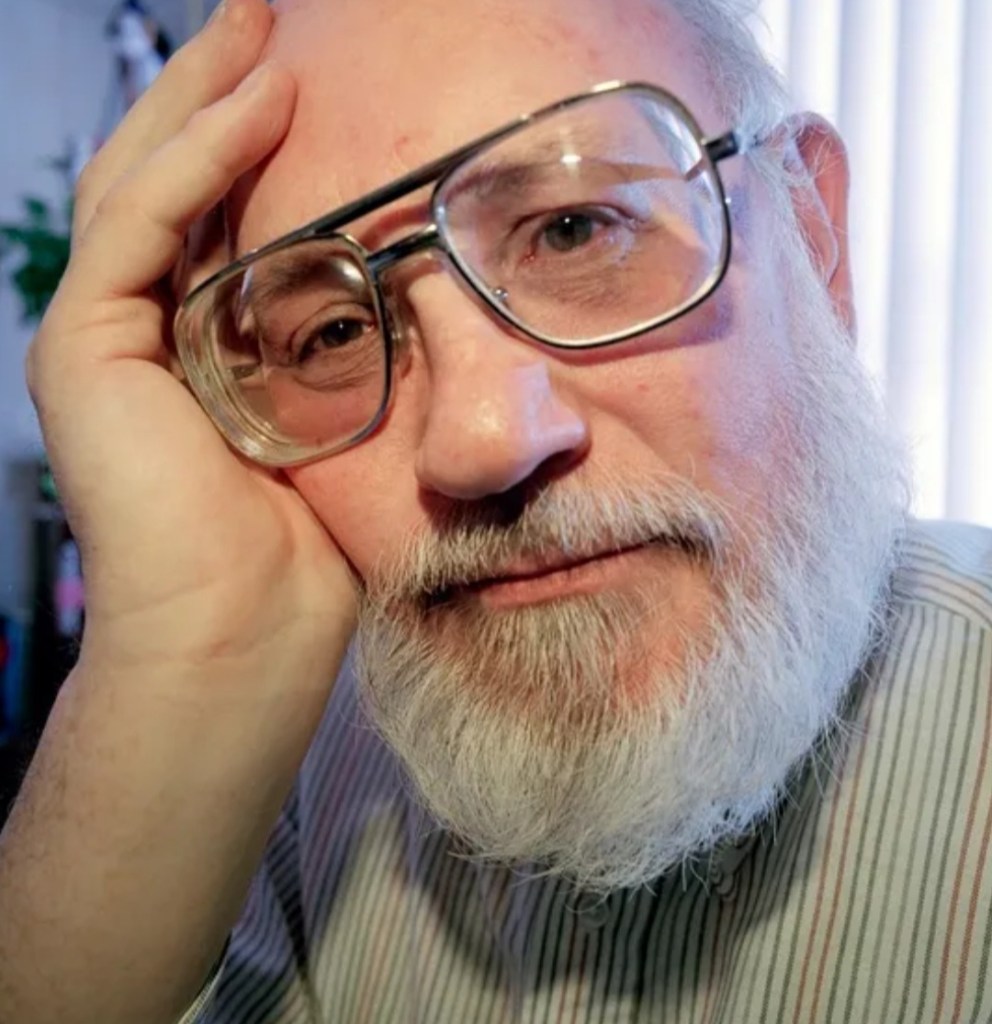
Roy Ratcliff
  1. Who Was Roy Ratcliff?
    Roy Ratcliff, a Church of Christ minister, played a critical role in the life of Jeffrey Dahmer during his incarceration. Ratcliff was a volunteer pastor at the Columbia Correctional Institution in Portage, Wisconsin, where Dahmer was serving multiple life sentences. Ratcliff’s primary focus was spiritual counseling and offering prisoners a chance for redemption.
  2. The Baptism:
    In May 1994, Ratcliff and Dahmer developed a rapport through regular meetings, discussions, and Bible studies. Eventually, it was agreed upon that Dahmer would undergo baptism, symbolizing his newfound faith in Christianity. Ratcliff carried out the baptism ceremony in the prison chapel. It was a private event attended by a small group of witnesses, including Dahmer’s father and some prison staff.
  3. Significance and Controversy:
    Dahmer’s baptism intrigued the media and sparked widespread debate. Some perceived it as a genuine spiritual transformation, while others cynically viewed it as a desperate plea for leniency. Ratcliff defended his decision, stating he believed in the power of forgiveness and the potential for redemption in even the most heinous individuals.
  4. The Aftermath:
    Sadly, just two months later, Jeffrey Dahmer was brutally murdered by a fellow inmate. Nevertheless, Ratcliff’s act of performing the baptism exemplifies his commitment to ministering to those society deems irredeemable. While the precise impact of this event in Dahmer’s life remains open to interpretation, it serves as a reminder of the complexity of human nature and the importance of extending compassion even to the most reviled individuals.

Conclusion:
The baptism of Jeffrey Dahmer performed by Roy Ratcliff in 1994 offers a thought-provoking glimpse into the role of faith and redemption in the lives of criminals. Ratcliff’s decision to conduct the ceremony showcased the transformative power of spirituality and the belief in the potential for change, even in the face of unimaginable atrocities. This event will forever be a part of both men’s stories, forever shrouded in the duality of hope and the darkness that surrounded them.

Michael Lofton conducts an interview with the minister who administered the baptism of Jeffrey Dahmer, prior to his tragic demise at the hands of a fellow inmate. During the conversation, they delve into the topic of Dahmer’s religious conversion and explore the genuineness of his faith. Additionally, the minister shares their personal encounters with Dahmer, reflecting on the seven months of weekly ministry they provided leading up to his untimely death.

Roy Ratcliff had an “Life Changing encounter…”

Impressed by Dahmer’s sincerity, Ratcliff arranged for his baptism in a whirlpool within the prison. On May 10, 1994, Ratcliff performed the baptism, marking a significant turning point in Dahmer’s life. Determined to support his spiritual journey, Ratcliff committed to weekly Bible study sessions with the convicted murderer.

As Ratcliff delved deeper into Dahmer’s story, he was struck by the dichotomy between the monster described in the media and the person he had come to know. While Dahmer occasionally mentioned his crimes, he never provided an explanation for his actions. Ratcliff, along with the rest of the nation, could only speculate on the motivations behind Dahmer’s gruesome acts.

Despite public backlash and criticism, Ratcliff firmly believed in Dahmer’s capacity for repentance and transformation. He received mixed reactions, with some questioning his judgment while others commended his unwavering faith in the power of redemption. Ratcliff held firm in his belief that even the most evil individuals could turn to God and be saved.

Over time, Ratcliff observed a gradual change in Dahmer’s demeanor. The once self-destructive man began to show a genuine desire to help fellow inmates, particularly through Bible study sessions. Dahmer’s father, Lionel, also noticed the positive shift in his son’s outlook on life.

Tragically, Dahmer’s journey toward redemption was cut short. In a horrifying turn of events, he was attacked and killed by another inmate while performing janitorial duties. Ratcliff, who had formed a deep bond with Dahmer, felt a profound sense of betrayal and loss. Just days before his death, Dahmer had expressed gratitude to Ratcliff and looked forward to their continued friendship.

Ratcliff presided over a memorial service for Dahmer, where he stood alongside Dahmer’s family. The event also brought together the sister of one of Dahmer’s victims, who expressed her newfound ability to forgive Dahmer, offering a glimpse of healing and redemption for all those affected by his crimes.

A decade after Dahmer’s passing, Ratcliff remains committed to his ministry and has expanded his work in prison settings. Inspired by his encounter with Dahmer, Ratcliff developed a profound empathy for those incarcerated, recognizing the importance of compassion and support in their journey towards rehabilitation and spiritual growth.

The encounter with Dahmer challenged Ratcliff’s preconceptions and taught him that no one is beyond the reach of God’s grace. It serves as a powerful reminder that even in the darkest corners of humanity, there exists the potential for transformation and the capacity for forgiveness.

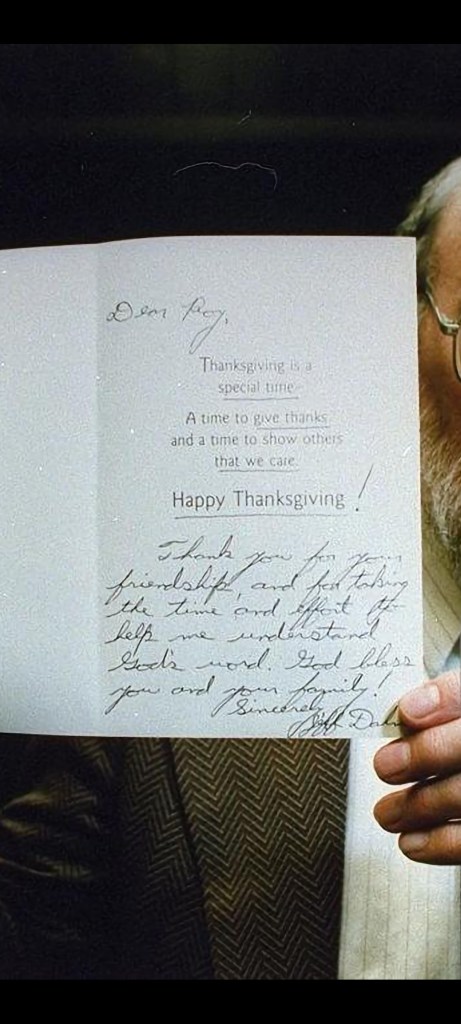
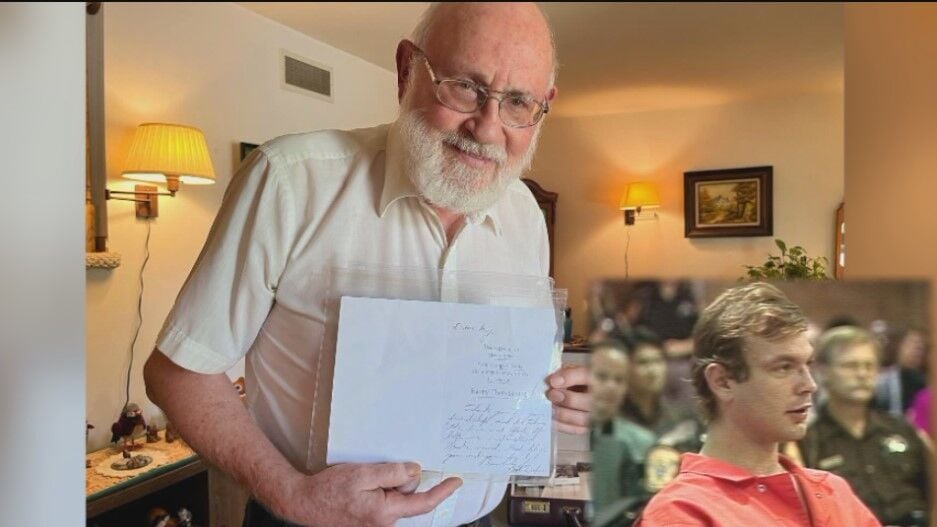
In addition to the profound spiritual journey that Roy Ratcliff shared with Jeffrey Dahmer, their connection deepened into a genuine friendship. Dahmer’s gratitude for Ratcliff’s support and guidance was evident when he sent Ratcliff a Thanksgiving Day card, expressing his appreciation for their friendship and eagerly anticipating their future meetings.


This unexpected gesture touched Ratcliff deeply, as it symbolized the bond they had formed despite the immense challenges and societal judgment surrounding their relationship. The card became a poignant reminder of the potential for human connection and the capacity for transformation, even in the darkest circumstances.

Ratcliff cherished the card and looked forward to the prospect of continuing their Bible study sessions and sharing their spiritual journey. Little did he know that it would be their last communication, as just days later, Dahmer’s life was tragically cut short.

This heartfelt act of gratitude serves as a testament to the profound impact Ratcliff had on Dahmer’s life. Their friendship transcended societal boundaries, reminding us all of the power of compassion, forgiveness, and the potential for redemption, even in the most unlikely of circumstances.

the tragic teacher

jeff never thought his life could be helpful to anyone, but he really has helped me a ton. he’s helped me think more deeply about people, about psychology, about the different ways in which the system fails us all, and about the complex nature of morality and human nature in general.

jeff is a teacher and subject both, perhaps inadvertently so. he didn’t recognize his own power. but i’m always going to be grateful to him for that. his actions were horrific, but his existence has somehow still helped us all here in this community. those who’ve wished to study him deeply have uncovered a lot of profound truths along the way.

like a retrograde planet, jeff’s existence bungled things up quite a bit, but it also taught us a lot in the process. and there are always going to be retrogrades. on a grand scale, we need them.

and i hate even saying that because it seems like an insult to his victims. they certainly didn’t deserve to die or be violated in all those horrible disgusting ways. it’s sort of making me squirm to even have this thought at all right now. but i guess death gets us all at some point; it’s just a matter of how it happens and what — or who — brings it. and sometimes society as a whole needs a shock to it in order to recognize that the current setup is absolutely fucked and needs to change. it’s just how the huge complex rube-goldberg contraption called “the world” is set up.

unfortunately, someone has to play the bad guy. like how judas had to betray jesus in order to get the ball rolling for his death and resurrection. without judas, the whole thing would never have happened. he hated himself for what he did, too, and he hung himself because of it.

i see jeff very similarly. he’s a catalyst for change.

and now somehow i’m linking this with the trolley problem. a few casualties for the good of the whole later on down the line? it’s cruel. it’s brutal. it’s a horrible reality. but the only way we can improve things as they are, i guess, is by fighting fire with fire at some point.

i don’t know. this might all be bullshit and i might regret saying it in about 5 minutes. i feel like i’m being insulting to jeff’s victims by saying it. but i’m also not married to these thoughts, either — they’re just swimming through my head, and i might read over them again in an hour and hate them. but maybe there’s a similarity there in that i’m thinking brutal thoughts and am self-aware at the same time, just as jeff was self-aware and yet couldn’t stop causing destruction.

i think his fame was necessary. he had to slam into our collective consciousness like a meteor and leave a huge crater so we can later fill it with new lessons and knowledge.

it makes sense that he came to light during the early 90s, with all that harsh outer-planet shit that was going on right then. capricorn and scorpio, saturn and pluto dominance. saturn is the grim reaper swinging his scythe; pluto destroys and rebuilds. jeff was absolutely a harbinger of all this outer-planet energy.

maybe in his next life, jeff will go on to be an even greater force for helping people than he was for harming them. maybe he’s already doing that right now. he just needed to go through a really nasty incarnation first.

maybe he needed to experience firsthand what horrors one human is capable of before he could help change this in the next life. i do wonder how many of us have at least one past life where we were a murderer or a rapist or some other awful person, and that’s what’s made us wiser in the end and we just aren’t aware of it.

the difference with jeff is that he seemed to retain some awareness that this was wrong. he’s bridged the gap so we can peer into the other side. he’s relatable because we need to be able to recognize these traits in ourselves.

only then can we take the first step toward righting our wrongs.

[ • dahmers-ashes • ]

a vision through his eyes

on august 7, 2019, i had a vision that i could not control. it came to me out of the blue — no drugs or anything else mind-altering involved — and as the imagery flashed through my mind’s eye automatically, i did my best to record it. i have never experienced anything like it before or since.

this is the raw, 99.9% unedited recording of what i saw. i only edited two words in one sentence for clarity later on.

❖ ❖ ❖

for a split second, i was him.. i was there

“but if you knew any more, it would break your brain.”

you’re channelling the wrong part of the collective consciousness. it’s causing a system malfunction. somebody is chasing someone, somewhere.. you know you have knowledge you’re not supposed to and that’s why you’re scared. our flesh hardware isn’t meant to support that operating system.

we’re meant to be blind little single-celled organisms, moving slowly on this space rock.. and yet we have such interesting and complex lives. you suddenly become aware of how limited your vision is and that is existential horror. do you feel claustrophobic? that’s a lot of consciousness to squeeze into such a tiny little cell.

we’re all in solitary confinement.

i’m him again, and i’m in solitary confinement. i feel how tall i am, how broad and muscular my shoulders are, and it’s strange.. but i accept it. i can see the last bit of the outside world through the bars. light streaming in, dust particles dancing in the beams between the iron columns. everything is cold and hard and it smells musty, like grandmother’s basement. i’m subtly afraid for the life i’m not supposed to have.

it’s evening now, i assume. we line up for our meal and i don’t want to eat it. but i have no choice. i just want to go back to sleep.

all i want to do is sleep. i read to keep myself distracted. i’m always looking for new distractions. having a sense of humor helps but i can’t quite get myself to laugh all the time. i’m hollow and the grey surroundings fill me. i’m grey inside.

i am TV static. neptune in the first, blurring the lines. i was a man possessed, or was i? will the blood of christ be enough to drown out the sins of my past? he died even for me. there’s room in heaven for me too. i really want to be baptized.

i really want to be baptized. to get right with god.

the trance is fading now.. i still have snippets of a past i never lived. i stare at the images of birds on the glossy paper. goldfinches, woodpeckers, chickadees incubating their eggs. it’s all the nature i get to see now, that and my little window. i smile when i see my chipmunk friend outside in the grass. i haven’t named him in my head but maybe i should. he can be like my pet.

i should have just gotten an aquarium. i could be watching the fish in my apartment the same way. but if i were to go free, i’d be even more enslaved than i am now. enslaved by my weakness, my selfishness, my alcoholism, my compulsions. ironically, i am more free here.

i know i deserve death.

i have memorized every crack in the wall. i hear someone screaming down the hall somewhere, and banging noises. the wall has faces, i imagine. like seeing shapes in the clouds. i have learned to appreciate every small change that comes my way. it’s a simple life. it’s still more than i deserve.

how long will i be here, lingering inside another man’s body and mind? carrying the heaviness in my chest of crimes i never committed? except that in this moment.. i have memories of them. shampoo running down from my head and another man’s blood spiralling at my feet. i don’t smell it anymore but i know they have complained. i don’t want to be like this. i need another beer, and another, and another, all to drown the shame. i need to drink so much now for it to have any effect.

his stillness as i lay with him in our bed. he was freshly dead; i intertwined my legs with his to take advantage of all the warmth he still had left. i ran my fingers through his hair, talked to him, whispered sweet nothings in his deaf ear. he was mine now, and he always would be. he was mine.

he was mine.

he would never leave me now.

i could still smell the cologne he put on, the body wash he used in his last shower, the scent of laundry detergent on his clothes. there was something musty underneath it now, something bleak. he was starting to feel cool to the touch, so i held him tighter. my love. i will give him all the warmth i have.

why did he have to be so impermanent even in this state?

even his body would soon be taken over by nature’s course. i would perform my ritual to circumvent this slightly. dear lord, we break the bread, in memory.

one last rush from a failed experiment. his head leaks caustic substance and it stings my skin as i smooth back his soft dark hair. look into his vacated eyes, staring at nothing. i’m so sorry.

i just couldn’t let you go.

those times are faded now. my regret serves nothing and yet it still hovers in the background. i put it all into the arms of the lord jesus christ. he will carry away even my sins. i am in his embrace.

in his arms, i am safe from myself.

i am safe from abandonment.

i am safe.. even though all of them are destroyed.

i’m so sorry.

💔

[ • dahmers-ashes • ]