The Man Who Wanted to Eat: Issei Sagawa and What Jeffrey Dahmer Was Not

In The Woman Who Drove Away, we used the case of Karen Greenlee to argue that Jeffrey was not a preferential necrophile. This piece asks the same question about the word most often attached to his name: cannibal. The Milwaukee Cannibal. It is in the headlines, the documentary titles, the true-crime thumbnails.

The answer is not a denial. Jeffrey ate parts of some of his victims, and he said so himself. The real question is what cannibalism was for him. Was it the centre of his pathology, or something at its edges? To answer that, it helps to look at a man for whom it was unmistakably the centre.

Renée

Her name comes first. Renée Hartevelt, born in 1955, was a Dutch student of French literature at the Sorbonne. She was 25. On 11 June 1981, her classmate Issei Sagawa, then 32, invited her to his apartment at 10 Rue Erlanger under the pretext of translating poetry for a school assignment. While she read at a desk with her back to him, he shot her in the neck with a rifle.
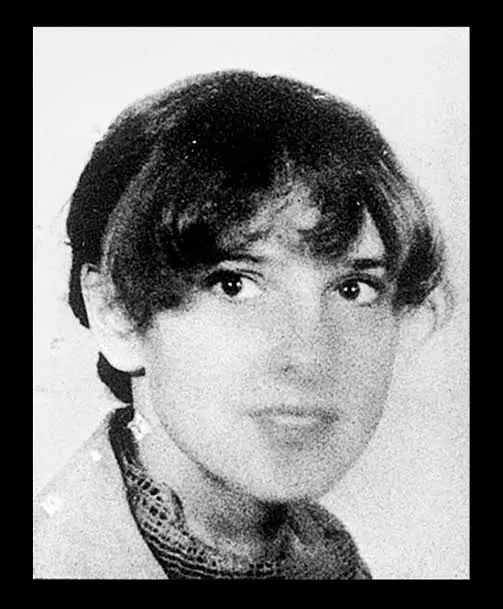
Over the following days he violated her body and ate parts of it. He then tried to dispose of her remains in the Bois de Boulogne, where he was arrested. Her name is far less known than his. On this site, we try to keep that order right.

A desire that came first

What makes Sagawa’s case so clarifying is how openly the act was the fantasy. He traced his cannibalistic desires back to the first grade. Years before Paris, in Japan, he tried to take flesh from a sleeping woman, but she woke and fought him off; he was charged with attempted rape and never revealed his real intention to the authorities.
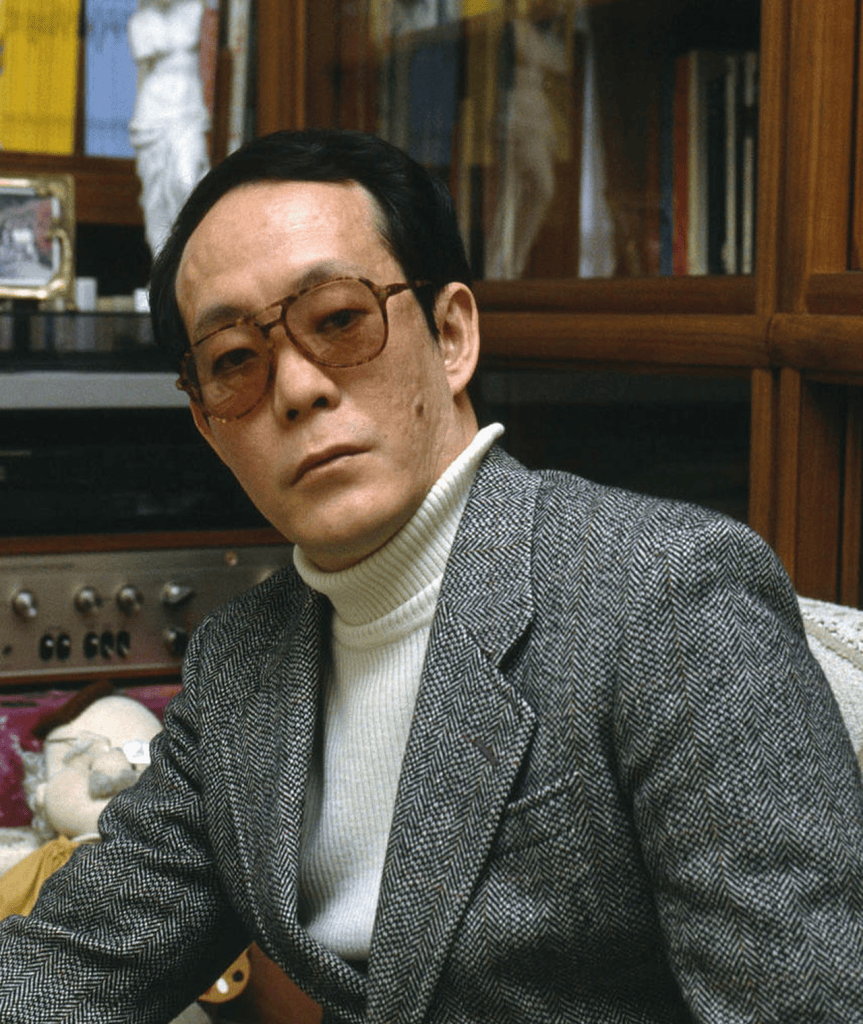
He chose Renée, by his own account, because of the health and beauty he believed he lacked, describing a wish to absorb her energy. Decades later, he told an interviewer that his ultimate intention had been to eat her, not necessarily to kill her. Speaking to Vice, he described how “My desire to eat a woman had changed into an obligation.”

For Sagawa, killing was the means. Eating was the end. The fantasy began with the mouth and ended there.

What Jeffrey said

Jeffrey’s own words point somewhere else entirely.

In his supplementary report of 24 July 1991, Detective Patrick Kennedy recorded Jeffrey’s account of his motive. He said he would have preferred his victims to stay alive, but that “it was better to have them with him dead than to have them leave.” When he sensed someone was about to go, that was when he decided to kill.

The same report records his explanation of the cannibalism: eating parts of a victim was “his way of keeping them with him even longer and making his victims part of himself.” He said much the same to Dr Judith Becker, telling her that it made him feel as though they were “even more a part of me,” as quoted in Brian Masters’ The Shrine of Jeffrey Dahmer.

When FBI profiler Robert Ressler asked what lay at the root of his fantasies, Jeffrey answered that it all revolved around “having complete control.” Asked what had aroused him after the death of Steven Hicks, he replied: “By the captivity.”

Masters, who had access to Dr Kenneth Smail’s interviews, notes that the cannibalism was a fairly late development in Jeffrey’s offending and did not apply to all of his victims. It was not where the story began.

The shape of each fantasy

Put the two men side by side and the difference is structural.

In Sagawa’s case, the object of desire was the act of eating itself. It was lifelong, it came first, and everything else, including the killing, served it.

In Jeffrey’s case, the object of desire was a companion who could not leave. The killing served that wish. So did the keeping: the photographs, the skulls, the planned temple, the failed attempts to create a living “zombie” who would stay. The cannibalism was one more expression of the same impossible wish, arriving late and appearing only sometimes. He ate in the way he did everything else: to hold on to someone.

This is the same distinction we drew with Karen Greenlee. Greenlee’s desire was directed at the dead as such. Jeffrey’s was directed at a person he could not keep alive and would not let go. Both the necrophilia and the cannibalism were terrible consequences of that loneliness, not its source.

None of this makes what he did less horrifying. It makes it more precise.

Two reckonings

The cases diverge again in what came after.

French medical experts deemed Sagawa unfit for trial in 1983, and he was held in a psychiatric institution before being deported to Japan the following year. Japanese authorities ruled him sane, but could not obtain his case files because the French case had been closed, and so he walked free. He checked himself out of Matsuzawa Hospital on 12 August 1986 and remained free until his death.

He then built a career from what he had done. He wrote a memoir, In the Fog, detailing the murder, appeared in adult films, and sold paintings of naked women. He also wrote about other crimes, including a book on the 1997 Kobe child murders. Throughout his life, he showed no remorse. He died of pneumonia on 24 November 2022, aged 73, with a funeral attended only by relatives. He was never tried for Renée’s death.

Jeffrey waived his right to a lawyer during interrogation and confessed in exhaustive detail. He pleaded guilty but insane, was found sane by a jury in February 1992, and received fifteen consecutive life sentences in Wisconsin, followed by another in Ohio. He told the court he did not want to be free. He never profited from his crimes, and he was killed in prison in November 1994.

We are not ranking these men against each other. We are noting that one sought an audience, and the other sought an ending.

Why the word matters

“Cannibal” does a lot of work in the public image of Jeffrey Dahmer. It turns him into a creature of appetite, something from a horror film. That image is easier to live with than the truth, which is that his crimes grew from something recognisably human: a terror of being left, pushed to a monstrous extreme.

Sagawa is what the word actually describes. Jeffrey is something else, and understanding that difference is part of seeing both him and his victims clearly.


Sources

  • Det. Patrick Kennedy, Milwaukee Police Department supplementary report, 24 July 1991
  • Robert K. Ressler, I Have Lived in the Monster (1997), interview with Jeffrey Dahmer
  • Brian Masters, The Shrine of Jeffrey Dahmer (1993)
  • AFP, “Japanese cannibal who walked free dies age 73,” December 2022
  • Newsweek, “Issei Sagawa Dead: Why Notorious Cannibal Killer Never Saw Jail,” December 2022
A Photograph That Should Not Be Yours to Look At

A personal essay on the post-attack photograph of Jeffrey Dahmer that circulates online — why its treatment breaks with how we protect the dead, and how it has been used as a weapon against the living who write about him.

I am not going to describe it to you. If you are reading this, you almost certainly already know which photograph I mean — it has been circulated so widely, for so long, with so little resistance, that description has become unnecessary. That is itself the problem I want to write about.

On 28 November 1994, Jeffrey was attacked in the Columbia Correctional Institution and died the next day. In the interval between the attack and his death, a photograph was taken of him — injured, restrained by medical equipment, alive but only barely. That photograph exists. It should never have left the room it was taken in. It has been circulating for decades regardless, appearing in slideshows, forum posts, “documentary” video essays, and — for those of us who run spaces like this one — occasionally in our own inboxes, sent to us by strangers who know exactly what they are doing.

What We Don’t Do With the Dead

Every serious newsroom and every serious archive operates under a shared, mostly unwritten rule: you do not publish autopsy photographs. You do not publish crime scene photographs of a victim’s body. You do not publish a person’s final, most vulnerable moment for an audience to consume. This isn’t a legal requirement in most cases — it’s an ethical one, built over a long time, for a simple reason: a person’s suffering does not become public property just because the public is curious about it. Families are protected from this. Victims are protected from this. It is one of the few places where our culture still draws a hard line around dignity.

Jeffrey’s photograph sits outside that line. It circulates freely, captioned, reposted, used as a punchline or a piece of “closure” content, entirely unprotected by the norm that would shield almost anyone else’s worst moment from public consumption. And the reason is not subtle. It is that the people trading it have decided, somewhere along the way, that he forfeited the right to that protection — that what he did in life means his death is fair game, his suffering is entertainment, his most helpless moment is something other people are entitled to see.

I want to be completely clear, because this memorial has never once asked anyone to look away from what he did: seventeen people are dead because of him. That fact does not move, and nothing in this essay is asking it to. But the dignity of a corpse and the guilt of the person who once inhabited it are two separate questions, and our culture has quietly decided — through the sheer fact of how freely this image travels — that in his case, only one of those questions still matters.

The Photograph as Weapon

I did not go looking for this image. It found me, the way it finds most people connected to this work — sent by a stranger, unprompted, into a DM, timed for whatever moment would make it land hardest. It is used deliberately. Not to inform, not to document, but to hurt: to hurt anyone who has ever expressed sympathy for him, to hurt anyone doing the kind of careful, difficult work this memorial does, to hurt me specifically, for daring to hold both truths — that he did something unforgivable and that he was also a person whose ending deserved something better than becoming a weapon.

That is the part I need people to sit with. A photograph of a dying man’s face has become ammunition. Every time it’s sent, forwarded, reposted with a gloating caption, someone is using another human being’s final hours as a tool to punish the living. It does not punish him. He is not here to be hurt by it. It only ever lands on the people who are.

Why I’m Not Looking Away From This

I write often about difficult things on this site, and I try to write about them with rigor rather than sentiment. This piece is different, and I want to say so honestly: it is personal. Seeing that image, even unwillingly, even for the fraction of a second it takes to block and report the person who sent it, does something to me that doesn’t fully go away. I don’t think I’m alone in that, among the people who do work like this.

But I don’t think the answer is to stop saying so. Part of what this memorial exists to argue is that dignity isn’t conditional on innocence, and that the way we treat the dead says something true about us regardless of what the dead once did. A photograph like this one — traded like a trophy, weaponised against the living, stripped of every protection we’d extend automatically to almost anyone else — is not a neutral historical document. It is a small, ongoing act of disrespect, repeated every time someone shares it for the reaction rather than the record.

I’m not asking anyone to forget what happened in that apartment. I am asking whether a dying man’s face was ever supposed to be public property, and why so few people have thought to ask that question before now.


Necro

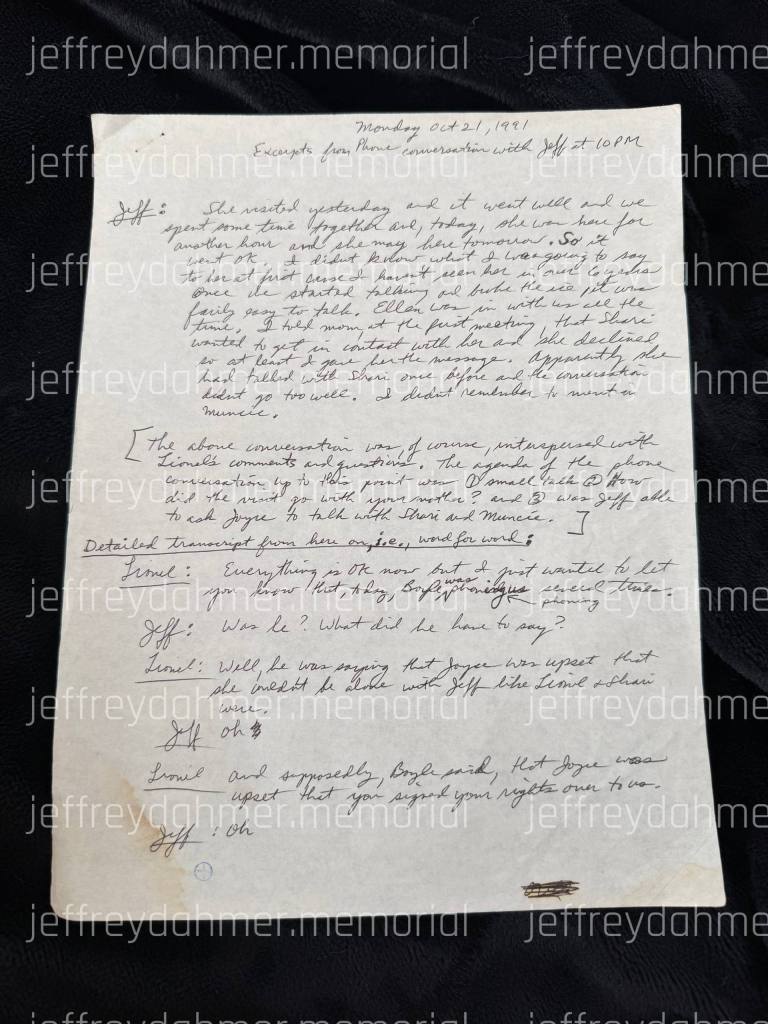
Word for Word: What Lionel Dahmer Chose to Write Down

There is a moment on the first page of this document where a father stops summarising his son and starts transcribing him. It happens mid-page, marked by a single underlined sentence: Detailed transcript from here on, i.e., word for word.

Everything before that line is paraphrase. Everything after it is preserved exactly. And what falls on either side of that boundary tells us more about the Dahmer family in the autumn of 1991 than almost any other document we have seen.

The Document

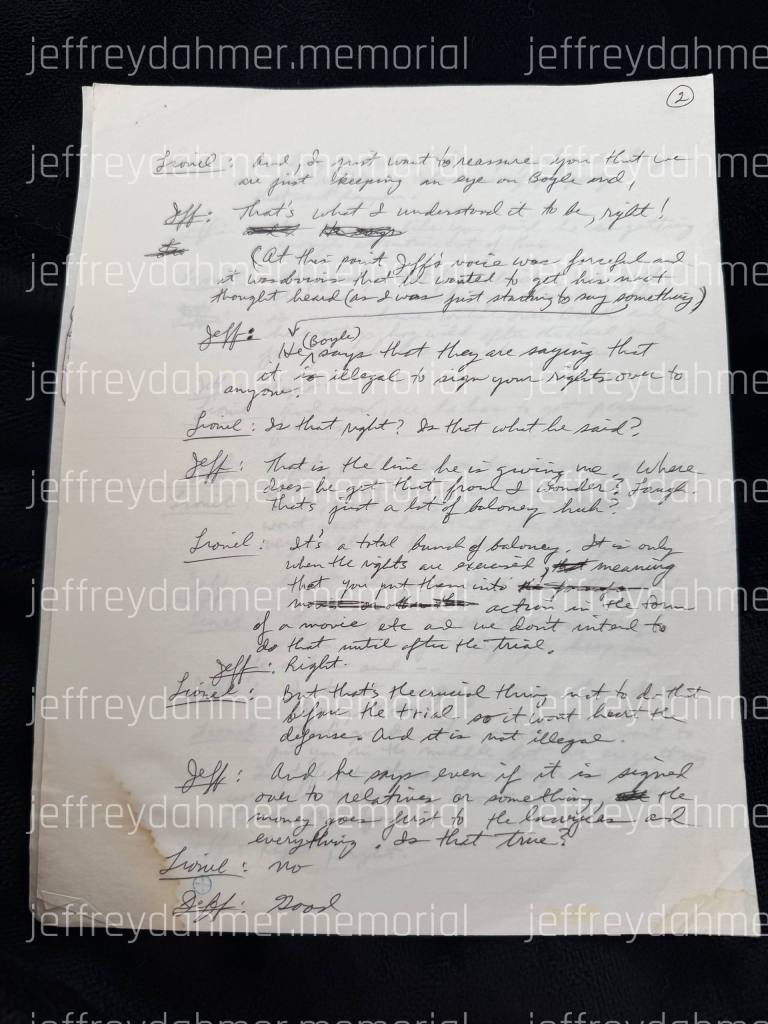
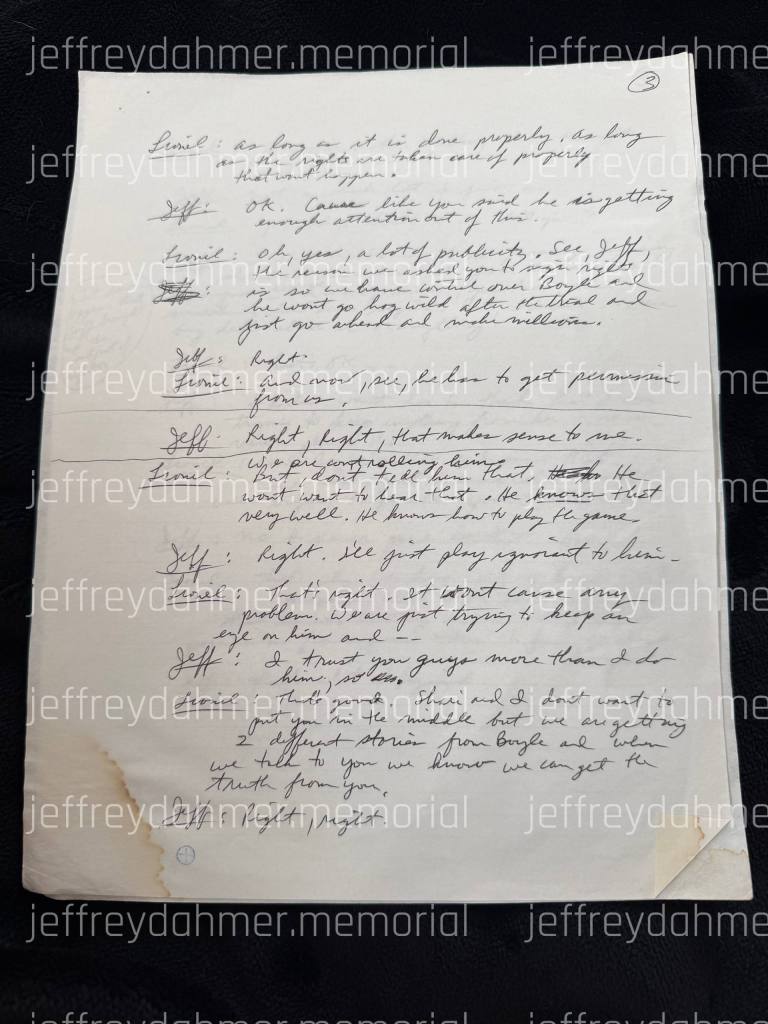
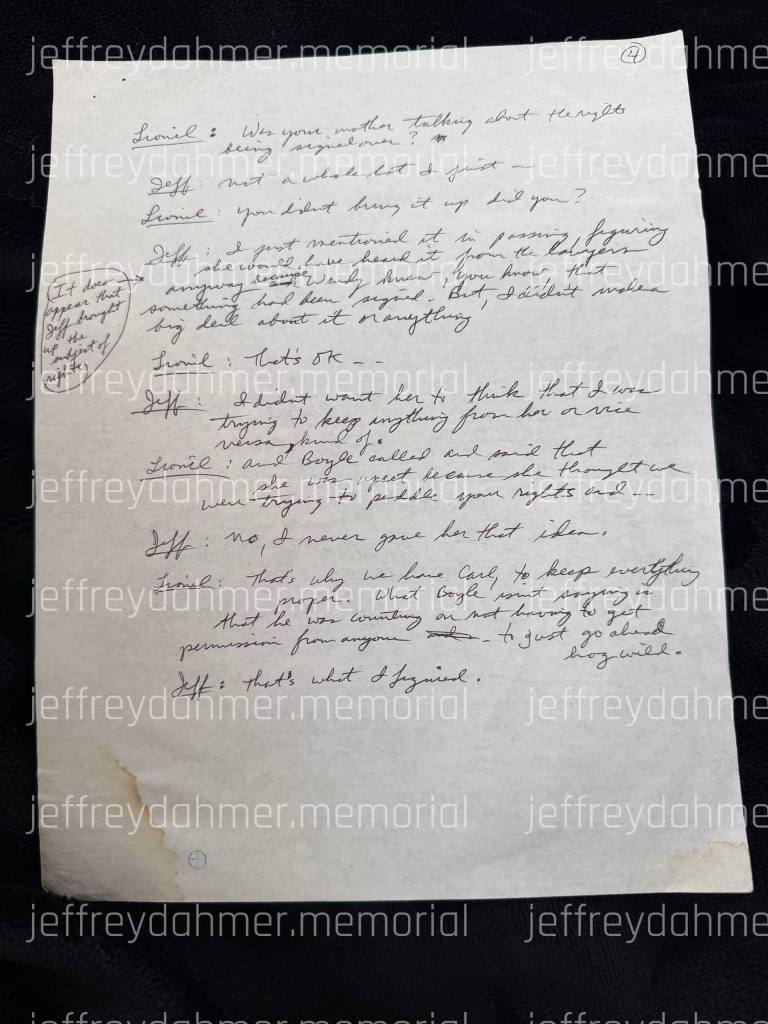
The pages consist of Lionel Dahmer’s handwritten record of a telephone call with his son, headed Monday, Oct 21, 1991 — Excerpts from Phone conversation with Jeff at 10 PM. The sheets are numbered in the upper right; the memorial holds pages three and four alongside the opening page.

The date places it precisely. Jeffrey had been arrested on 22 July 1991, three months earlier. His trial would begin at the end of January 1992, three months later. This is the middle of that winter — the period when the family was absorbing what had happened and, simultaneously, discovering that what had happened was now an asset that other people wanted.

A note on provenance, in keeping with this memorial’s practice: these pages came to us through a private contributor. Each bears a small registration mark at the lower left, indicating they are reproductions from a copied or archived set rather than original leaves. We have not been able to independently authenticate the hand against a verified exemplar, and we present them as what they appear to be rather than as what we can prove. Readers should weigh them accordingly. What follows is analysis of the text as it stands, with brief quotation only.

The Line Down the Middle

The call opens with Jeffrey talking about his mother.

Joyce had visited him. She had come the previous day, stayed a while; she came again that day for another hour; she might come again tomorrow. Jeffrey says he had not known what he was going to say to her at first, because he had not seen her in over six years. Once she started talking, he says, the ice broke and it became fairly easy.

Consider what is contained in those few sentences. A man of thirty-one, three months into permanent incarceration, sitting across from a mother he had not seen since his mid-twenties, not knowing how to begin. The ice breaking. An hour, then perhaps another tomorrow.

Lionel summarises it in a short paragraph.

He then adds a bracketed editorial note explaining that his own comments and questions have been omitted, and lays out the agenda of the call in numbered points: small talk; how the visit with Jeffrey’s mother went; and whether Jeffrey had been able to ask Joyce to speak with Shari and with Muncie.

And then, underlined: Detailed transcript from here on, i.e., word for word.

What follows, recorded exactly, is a conversation about publicity rights.

We do not think Lionel did this cruelly, and we will return to that. But the boundary is real and it is his. Faced with a call containing both his son’s first contact with his mother in six years and a dispute over legal control of the family’s story, he judged one worth compressing and the other worth preserving syllable by syllable. He was not keeping a record of his son. He was keeping a record of a negotiation.

“I’ll Just Play Ignorant to Him”

The transcribed portion begins with Lionel reporting that Gerald Boyle — Jeffrey’s own defence attorney — had telephoned the family several times that day. Boyle relayed that Joyce was upset she could not be alone with Jeffrey the way Lionel and Shari could, and upset that Jeffrey had signed his rights over to them.

Jeffrey’s response, twice, is a single syllable. Oh.

Lionel then explains the reasoning behind the signing. The purpose, he tells his son, was to have control over Boyle, so that after the trial he could not go — the phrase is Lionel’s — hog wild and make millions. Now, he points out, Boyle has to get permission from them.

Jeffrey agrees. Right, right, that makes sense to me.

Then comes the passage that should stop any reader.

Lionel begins to say that they are controlling Boyle, crosses it out mid-sentence, and instead instructs his son not to tell him — Boyle would not want to hear it, though he knows very well how the game is played.

Jeffrey answers: Right. I’ll just play ignorant to him.

Eleven weeks before a trial at which Gerald Boyle would stand up and argue for his life, Jeffrey Dahmer was asked by his father to conceal something from that attorney, and agreed within a single line. He then went further than he was asked, volunteering that he trusted his father and stepmother more than he trusted his own lawyer.

There is no resistance anywhere in the exchange. No question, no hesitation, no why. Whatever was put in front of him, he agreed with.

This is the trait Brian Masters spent a book circling and Dr Judith Becker described from the stand — the near-total absence of a stable position of his own, the reflexive accommodation of whoever happened to be in the room. What makes this document different from those accounts is that it is not reconstruction. It is not a psychiatrist’s summary or a biographer’s inference or a memory recovered years later. It is the behaviour itself, caught live on a Monday night in October, written down by the person he was accommodating.

The Same War, Thirteen Years On

Underneath the argument about rights is an older argument.

Boyle is carrying messages from Joyce to Lionel and Shari. Lionel is relaying them to Jeffrey. Joyce is upset about the visits; Joyce is upset about the signing; Joyce, according to Boyle, believes they are trying to peddle her son’s rights. Lionel asks whether she raised it. He asks — and the question has an edge — whether Jeffrey brought it up himself.

Jeffrey says he mentioned it in passing, assuming she would hear it from the lawyers anyway, and offers a reason that is the most human line in the document: he did not want her to think he was keeping anything from her.

Lionel does not respond to that. He returns to Boyle.

And in the margin beside it, in his own hand, he has written a note to himself: that it does appear Jeffrey brought up the subject of rights.

He is annotating his son. Checking the account against itself, flagging the discrepancy for later reference, in the margin of a record of a phone call with a man in a cell.

Then he offers the reassurance that gives the game away — that he and Shari do not want to put Jeffrey in the middle, but they are getting two different stories from Boyle, and when they talk to Jeffrey they know they can get the truth.

They do not want to put him in the middle. So they have placed him in the middle and told him it is because he is the honest one.

Jeffrey’s parents divorced in 1978, in a house where he was the remaining child and the only available conduit. Thirteen years later, from opposite sides of a criminal trial, they were doing it again — and he was still doing what he had learned to do, which was to make himself agreeable to whoever was on the line.

In Defence of Lionel Dahmer

It would be easy to read this document as an indictment, and that reading is available. We do not think it is the correct one.

Consider what October 1991 was for this man. His son had been revealed as the perpetrator of crimes that the country could not stop looking at. Reporters were on his lawn. Publishers were circling. A defence attorney with a growing public profile was, in Lionel’s understanding, positioned to profit enormously from the destruction of his family, and there was no law and no authority that would stop him — only paperwork. So Lionel did the one thing available to a frightened, methodical man trained as a chemist: he secured the paperwork, brought in his own attorney to keep it proper, and started keeping records.

He was not transcribing the call because he valued the rights conversation over his son. He was transcribing it because he was terrified he would need it later, and the reunion with Joyce was not evidence of anything.

And there is this. Three years after this call, Lionel Dahmer published A Father’s Story, a book in which he turned the same forensic attention onto himself and did not spare what he found — his blindness, his absences, his willingness not to see. Very few parents in his position have ever done anything comparable. The man in this transcript, managing his son’s asset portfolio at ten o’clock at night, is the same man who would later write that he had failed to look at his own child.

Both things are true. That is usually how it goes.

What the Document Leaves Us

Three sheets of lined paper, a fountain pen, and a father’s careful hand.

On one side of a line: a son describing the first time he had seen his mother in six years, compressed into a paragraph.

On the other: every word of a conversation about who would own the story.

Nobody in this transcript is a monster. A frightened father is protecting what he can. A mother, absent from the pages and represented only by other people’s reports of her distress, is being talked about rather than to. An attorney is playing the game he knows. And in the middle of it, agreeing with everyone, holding no position of his own, is a man who by then had already done everything he would ever be known for.

Right, right, that makes sense to me.

He said it to his father about a legal strategy he did not understand, and it is, in the end, the sentence he said to everyone. It is worth sitting with the possibility that no one ever asked him what he actually thought — not because they were cruel, but because there was always something more urgent to settle first.

(Original source of the document: Lyra, 2026)

A note on provenance, in keeping with this memorial’s practice: these pages came to us through a private contributor. Each bears a small registration mark at the lower left, indicating they are reproductions from a copied or archived set rather than original leaves. We have not been able to independently authenticate the hand against a verified exemplar, and we present them as what they appear to be rather than as what we can prove. Readers should weigh them accordingly. What follows is analysis of the text as it stands, with brief quotation only


Source: handwritten record by Lionel Dahmer, “Excerpts from Phone conversation with Jeff at 10 PM,” dated Monday 21 October 1991; pages 3 and 4 with opening page, held by the memorial. Contextual sources: Brian Masters, The Shrine of Jeffrey Dahmer (1993); Lionel Dahmer, A Father’s Story (1994); trial testimony of Dr Judith Becker (1992).

Names appearing in the document that we have not conclusively identified — including Ellen, Carl, and Muncie — are left unglossed rather than guessed at. Readers with documented information are invited to contact us.