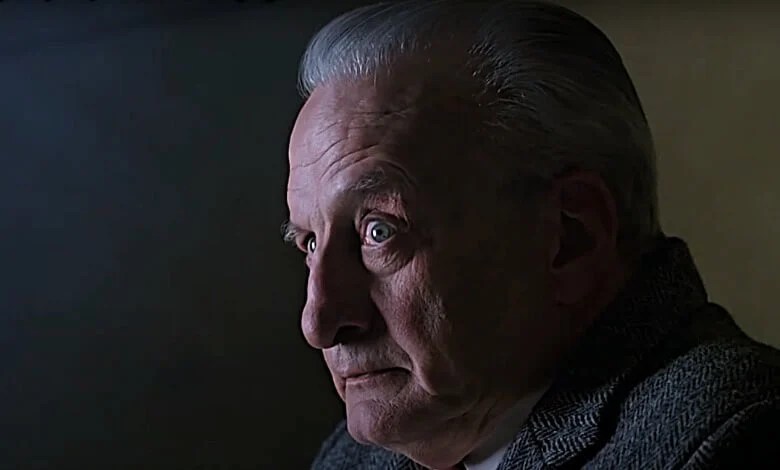
The Cats That Followed Him: Jeffrey Dahmer and Animals

There is a detail in the testimony of Jeffrey Dahmer’s neighbours that receives almost no attention in the coverage of his case. A colony of stray cats would follow him down the street.

Not away from him. After him. Choosing him.

Animals don’t perform comfort. They don’t extend trust out of politeness or social obligation. They either feel safe with a person or they don’t. The cats that followed Jeffrey Dahmer through the streets felt safe. That is a simple fact, and it tells you something the courtroom record never could.


From the Very Beginning

Jeffrey Dahmer’s relationship with animals began almost as soon as he was old enough to have one.

At eighteen months old, he had a goldfish and a pet turtle. His mother Joyce wrote of him at that age: “Jeff was so very gentle with the turtle.” He was a toddler, exploring his relationship with another living creature, and what she observed was gentleness. Not curiosity that tipped into harm. Not the roughness of a child who hadn’t learned. Gentleness, from the beginning.

In Iowa, where the family moved for Lionel’s graduate studies, Jeff encountered animals everywhere. A kitten called Buff. A squirrel called Jiffy who came to the window-sill looking for food and didn’t run away — mother and son were photographed pointing at him together, delighted. Snakes, toads, crabs, turtles, fish, wild rabbits all fed his curiosity and imagination. His nursery school teacher gave him a pet grey mouse, hoping it might help with his shyness. He spent time at a nearby research centre, watching barnyard animals for hours, fascinated by the sheer fact of living creatures doing what they do.

Then one day, he and his father spotted something on the pavement while cycling together — a baby nighthawk that had fallen from its nest. At Jeff’s urging, Lionel picked it up and together they took it home. Over the following weeks, they nursed it back to health, feeding it milk and corn syrup from a baby bottle, then solid food, then small bits of hamburger. It grew and grew until the day they finally took it outside to release it.

Lionel writes of that moment: “I cradled the bird in my cupped hand, lifted it into the air, then opened my hand and let it go. As it spread its wings and rose into the air, we, all of us — Joyce, Jeff, and myself — felt a wonderful delight. Jeff’s eyes were wide and gleaming.”

He called the bird Dusty. It would return when they whistled, even after being gone for days. It was, in Lionel’s words, “the single happiest moment of his life.”


Frisky

When the family moved to Doylestown, Ohio, Jeff was six years old and had just gained a little brother. Joyce worried he might be jealous. What she observed instead was that Jeff loved his new brother but something else held his heart more fully. She wrote: “Frisky comes first in his heart, though. They really romp and play.”
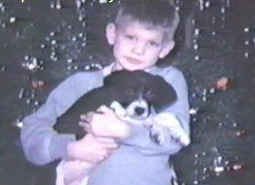
Frisky was a dog — cheerful, playful, loyal — given to Jeff to compensate for all the pets he had been made to leave behind in the various moves that punctuated his childhood. “We’d go out and play in the fields, run around,” he later remembered. “She was a good dog to have.”
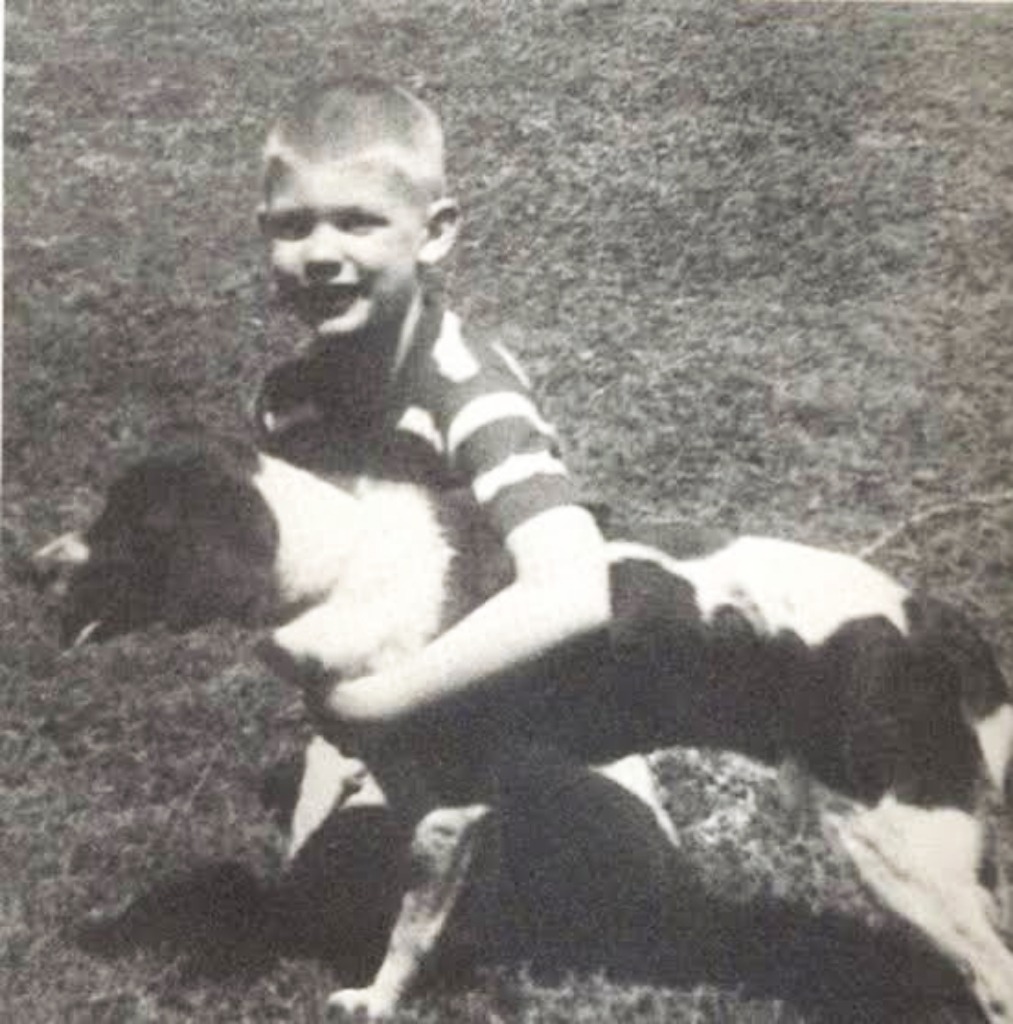
Frisky followed the family from Doylestown to Barberton to Bath Road, Ohio — neighbours built her a dog house when they arrived. In Barberton, Lionel took Jeff and Frisky on two-mile walks to a farm to buy eggs. On Saturdays they drove together for chocolate ice cream sodas, a ritual carried over from Iowa. Frisky roamed the woods of Bath Road and brought home a dead woodchuck. She was, by every account, one of the most consistent and uncomplicated sources of love in a childhood that was in most other respects increasingly fragmented and unhappy.

When Jeff eventually packed his bag for Ohio State University — the only attempt at college he would ever make — among the few things he brought with him were a snake skin from Boy Scout camp and two photographs of his dog.

He did not bring much. But he brought Frisky.


What He Would Not Do

Brian Masters, in his extensive study of the case, states it plainly: “Jeffrey Dahmer never killed an animal himself.”

This is important to say clearly, because the mythology of serial killers includes the near-universal assumption of childhood animal cruelty, and that assumption has been routinely applied to Jeffrey. It does not fit.

What is documented is that he collected and dissected animal carcasses he found already dead — road kills, bones, creatures the civets had left under the house. He was fascinated by anatomy, by the interior of living things, by the architecture of a body. That fascination would later take a devastating direction. But it was never accompanied by cruelty to a living animal. He was not interested in suffering. He was not interested in power over a sentient creature. His experiments were always with what was already gone.

He maintained a small graveyard for animals near the house, with crosses and skulls marking the sites. His brother David knew about it and thought Jeff was “doing a good service” by burying dead creatures. Nothing about it struck anyone who knew him as sinister.

One incident makes his orientation toward animals vivid and unmistakable. His friend Jeff Six had a habit of deliberately driving into dogs on the road, which he seemed to find amusing. “In one day he went through four dogs,” Jeffrey remembered. The last one — a puppy — went flipping over the hood of the car. “That just sickened me. I told him to take me back and let me out.”

He never forgot the eyes of that wounded dog. Brian Masters writes that the reproach in those eyes represented perhaps the last moment when a flicker of genuine sentiment still stirred in him — and that it was brought to flame by that one small tragedy. He felt it. He left.


The Fish

In the final years before his arrest, when Jeffrey had moved into Apartment 213 on North 25th Street and the world around him was sliding into catastrophe, he found one last innocent interest. He bought a thirty-gallon aquarium from a shop on West Oklahoma Avenue, some tropical fish, and books on how to care for them properly.

He described it with a warmth that he applied to almost nothing else in his life: “It was nice, with African cichlids and tiger barbs in it and live plants. It was a beautifully kept fish tank, very clean. I used to like to just sit there and watch them swim around, basically. I used to enjoy the planning of the set-up, the filtration, read about how to keep the nitrate and ammonia down to safe levels.”
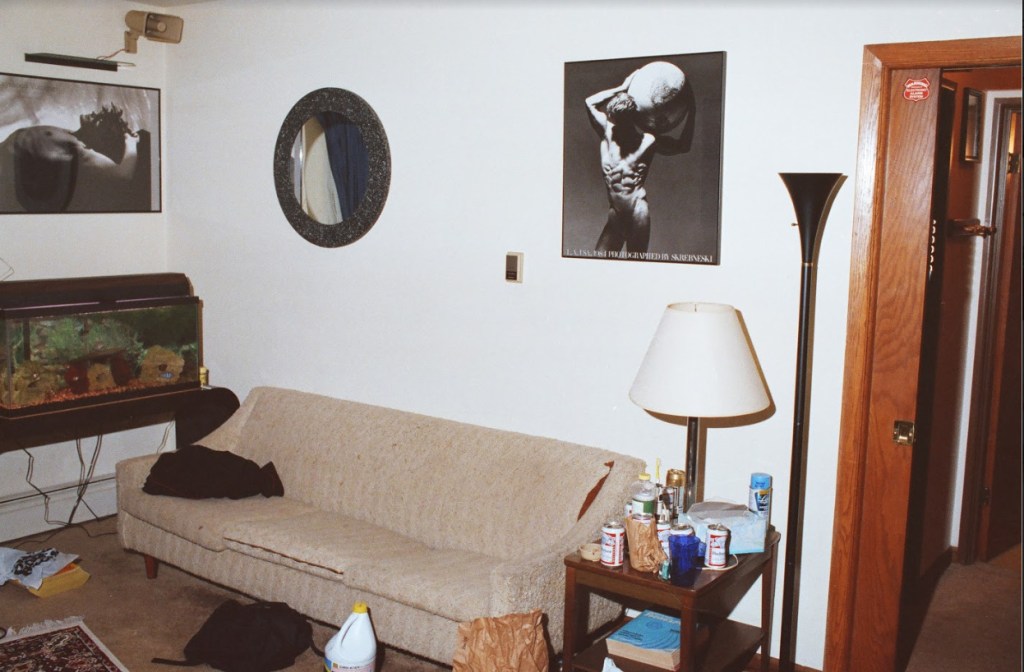
Brian Masters notes that it was only when talking about his fish that Jeffrey’s voice became animated. The aquarium sat on the black table that would later be described in court as a makeshift altar. But first, it held living things he tended carefully. He would walk around the fish store, fascinated by rare specimens.

Once, he saw a puffer fish. “It’s a round fish,” he said, “and the only ones I ever saw with both eyes in front, like a person’s eyes, and they would come right up to the front of the glass and their eyes would be crystal blue, like a person’s. Real cute.”

After his arrest, looking back on all of it, he said simply: “I really enjoyed that fish tank. It’s something I really miss.”

His co-workers at the Ambrosia Chocolate Factory confirmed what his apartment already showed — that he was always reading books about animals and fish when he was not working. Among the items Lionel catalogued in Apartment 213 were four books on the care of fish, a box of fish food, and the tank itself — still there, still lit.


What the Cats Knew

Neighbours observed him walking through the neighbourhood, and a colony of street cats would follow behind him. This is not a figure of speech or an embellishment. It was noted. It was real.

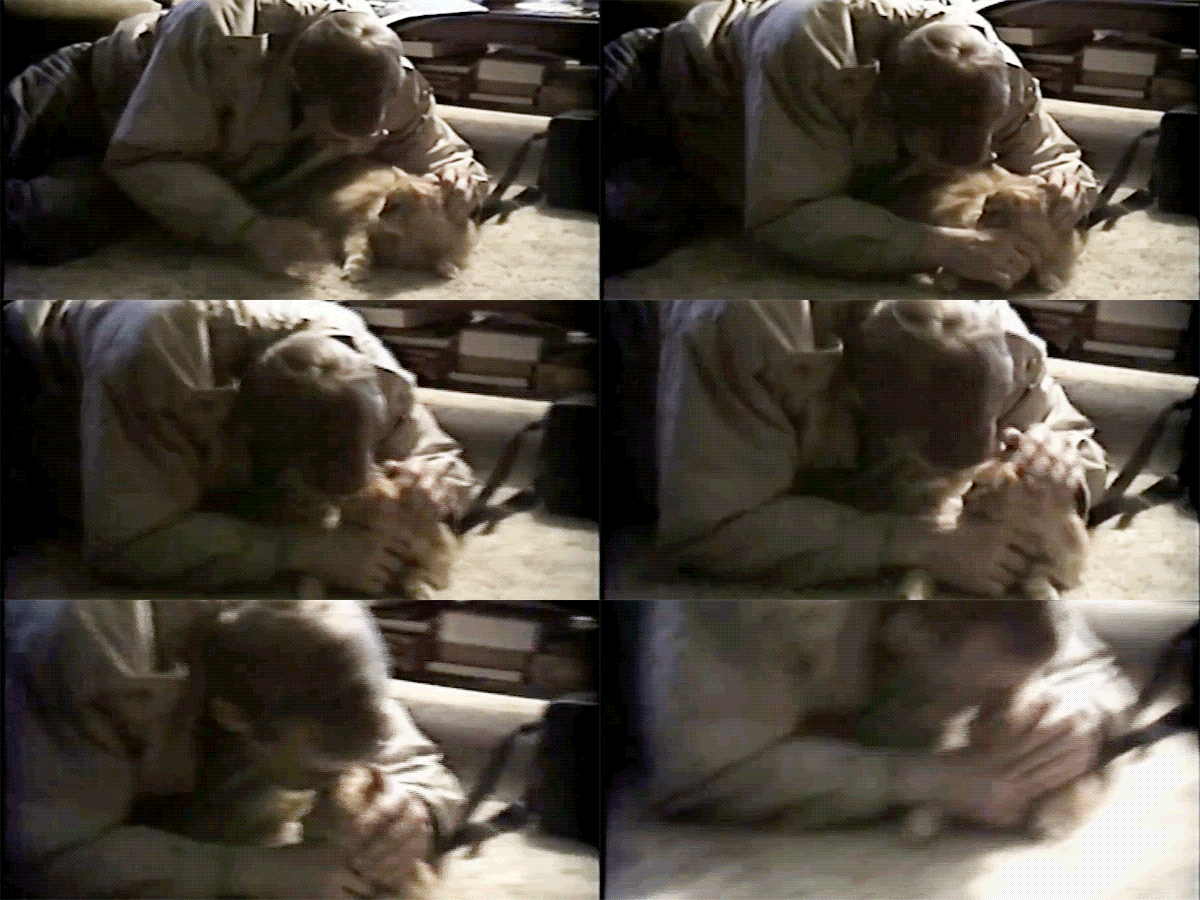
There is also a video — quiet, undramatic, briefly circulated — of Jeffrey sitting on the floor with a cat named Jodi, kissing her, stroking her. His hands are gentle. His face is soft. The cat does not pull away.
In prison, when Lionel visited, they talked about what he had been eating, the state of Lionel’s mother’s health, and the condition of the cats at home. It was ordinary conversation — the kind you have when there is little left to say but you still want to say something. The cats were worth mentioning. They were part of the world he was still connected to, even through prison glass.

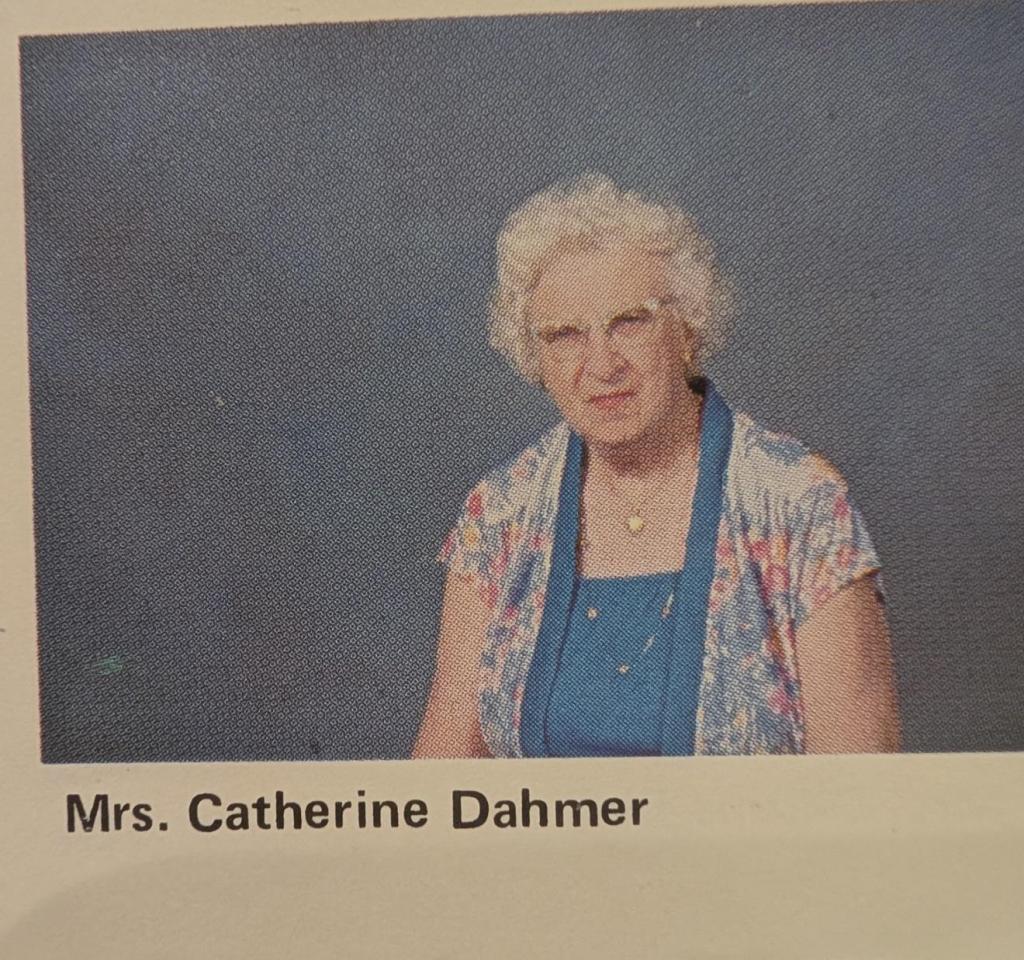
At one of his visits to Catherine Dahmer, when Lionel brought news of his mother’s minor car accident, Jeffrey expressed concern and hoped she would stay home with her cat and not drive again. Brian Masters notes this as a rare moment when he was able to externalise, to think of somebody other than the self which drove him and monopolised his energies. He was thinking about an old woman and her cat.


What It Means

Jeffrey Dahmer was a man who grieved when he had to leave his pets behind. Who nursed a baby bird back to health and watched it fly away with gleaming eyes. Who carried photographs of his dog to college. Who built a fish tank and read about nitrate levels and stood in a pet shop, moved by the blue eyes of a puffer fish. Who walked down a Milwaukee street with cats at his heels.

None of this explains what he did. Nothing explains that. But it is part of who he was — a real and documented part, not a sentimentalised myth. The same person who caused devastating harm to other human beings was consistently, throughout his entire life, gentle with animals. They were not afraid of him. They chose him.

Brian Masters suggests the eyes of living creatures held a particular significance for Jeffrey — that they were the thing that could still reach him, the harbingers of whatever conscience remained. The wounded puppy that haunted him. The puffer fish with its blue human eyes. Jodi the cat, who pressed close and let herself be held.

He felt things. They were distorted, misdirected, catastrophically expressed in one dimension of his life. But the capacity was there, and animals knew it, and they came to him anyway.

We think he deserved to be seen properly in return.


A Note on Plants

Jeffrey’s care for living things extended beyond animals. His grandmother Catherine told journalist Anne Schwartz: “He loves flowers, roses. He doesn’t hesitate to show his love for me.” Schwartz herself noted that Jeffrey “fancied roses, his fish tank, and his laptop computer.” When he lived with Catherine in West Allis, he helped her with the flowerbed and the lawn. Lionel later suggested gardening as a possible vocation, because it was something Jeff had seemed to enjoy. Father and son drove together to nurseries to buy plants for the garden. The living room of Apartment 213, when police first entered it, contained a healthy pot-plant on a tall pedestal — one of the details that made the room appear, in Brian Masters’ words, “surprisingly neat and tidy.” The fish tank held living aquatic plants he tended alongside the fish. In a life characterised by isolation and withdrawal, he kept things growing.

Sources: Brian Masters, The Shrine of Jeffrey Dahmer, 1993; Lionel Dahmer, A Father’s Story, 1994; Anne E. Schwartz, Monster: The True Story of the Jeffrey Dahmer Murders, 1992. All direct quotations attributed to Jeffrey Dahmer are drawn from his documented interviews with Dr Kenneth Smail, his confession to Milwaukee Police, and his interview with Stone Phillips, Dateline NBC, 1994.
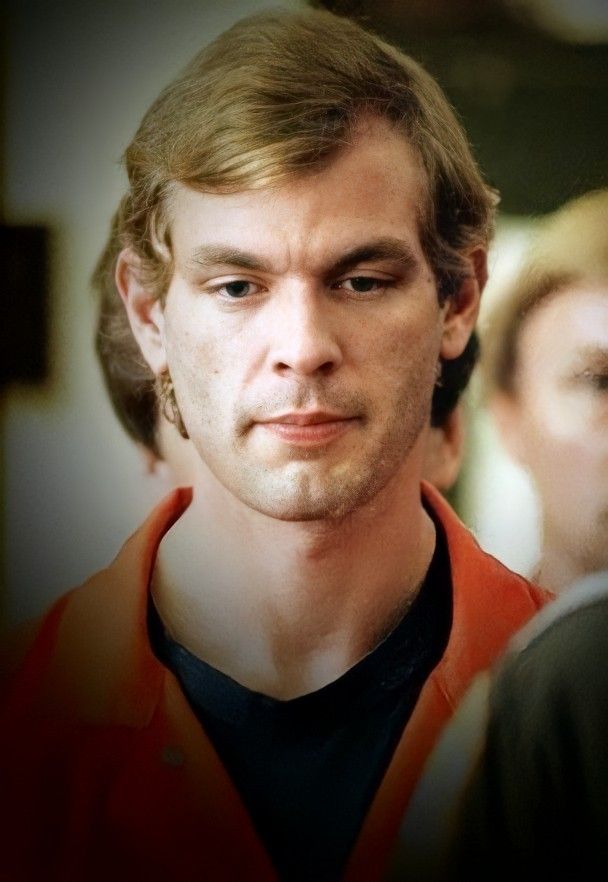

Without His Glasses: Jeffrey Dahmer in the Courtroom

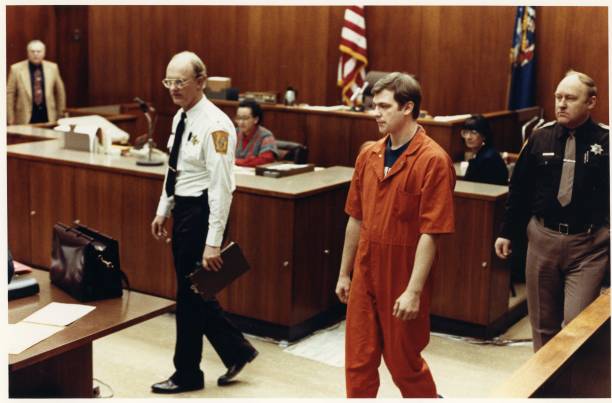
He removed his glasses before the trial began.

It was a quiet, private decision — one that went largely unremarked in the coverage that followed. But Jeffrey Dahmer said it himself: he did not want to see people’s faces. The shame was too great. And so he sat through the most public moment of his life in a deliberate blur, the courtroom softened at its edges, the eyes of strangers mercifully indistinct.

That detail tells you more about who he was than almost anything else in the documented record.


The trial of Jeffrey Dahmer began in January 1992 in Milwaukee. By then, the world had already decided what he was. The press had named him. The headlines had done their work. What arrived in that courtroom was not quite a person anymore — it was a myth that had learned to sit quietly in a suit.

Except that it hadn’t, quite. Because people who sit quietly in suits occasionally push back on small inaccuracies. And Jeffrey Dahmer, it turned out, had standards.

At one point during the proceedings, the prosecution described him as overweight during his teenage years. Jeffrey corrected them. He was not fat. The record should reflect that he was not fat. In the middle of a trial for seventeen murders, with the weight of everything pressing down on that room, he drew a line at an inaccurate description of his adolescent body.

There is something almost unbearably human about that moment. Not monstrous. Not calculating. Just a man who knew what he looked like as a teenager and wanted the court to know it too.


The Legal Record

The legal record of the Dahmer case is extraordinarily detailed. Defence attorneys Wendy Patrickus and her colleagues were required, as part of their preparation, to document their client comprehensively — his physical appearance, his demeanour, his medical and psychiatric history. These notes exist in the legal archive and include physical descriptions of considerable intimacy.

This is not unusual in capital defence work. Attorneys building a case around mental illness and diminished capacity must know their client fully — must be able to present him as a human being to a jury, must anticipate every angle the prosecution might exploit. The documentation is clinical by necessity.

What it leaves behind, however, is a record of a man reduced to measurements and observations — catalogued with the precision of a medical file, the person inside the data noted only incidentally. Read against the image of Jeffrey sitting quietly in his blurred courtroom, unable to meet anyone’s eyes, it becomes something else entirely. A man already unable to be seen clearly, now being seen with forensic thoroughness by the people paid to defend him.


What These Details Add Up To

A person. That is all. A person who was ashamed — genuinely, deeply ashamed — of what he had done and what he was. A person who still cared, even there, about accuracy and dignity, who would not let a wrong thing stand unchallenged even when everything else had already collapsed. A person who had been reduced to a file, a measurement, a legal exhibit, and who sat quietly through it all in a deliberate blur, the world softened so he wouldn’t have to see what people thought of him.

(Photo by Curt Borgwardt/Sygma/Sygma via Getty Images)

The mythology of Jeffrey Dahmer is built on the idea that monsters don’t feel things. That they sit cold and calculating in courtrooms, unmoved. The record suggests something entirely different. The record suggests a man who felt so much that he couldn’t bear to look.

That is not an excuse. It was never an excuse. But it is the truth — and the truth is more complicated, more human, and more heartbreaking than the mythology ever allowed.

He took his glasses off. He didn’t want to see.

We think he deserved to be seen properly in return.


Sources: Trial records, 1992; Wendy Patrickus defence notes; Brian Masters, The Shrine of Jeffrey Dahmer, 1993; Lionel Dahmer, A Father’s Story, 1994.

The Film in Cell 11: Jeffrey Dahmer and The Exorcist III

There is a detail in Jeffrey Dahmer’s story that most people gloss over. Among the videotapes found in Apartment 213 when police catalogued its contents in July 1991 were several films — Blade Runner, Star Wars, and The Exorcist III. Not the original Exorcist. The third one. And according to one of his surviving victims, Jeffrey watched it repeatedly, in what was described as a trance-like state.

This is not a footnote. This is a window.


What The Exorcist III Actually Is

Most people who haven’t seen it assume The Exorcist III is a standard horror sequel — more possession, more spinning heads, more priests with holy water. It is almost none of those things.

Written and directed by William Peter Blatty himself — the author of the original Exorcist novel — it is the third installment in what Blatty called his Trilogy of Faith. It is, at its core, a philosophical film. A meditation on evil, on whether God exists, on whether a good God could permit the suffering we witness in the world. Blatty’s prime interest was always loss — or lack — of faith.

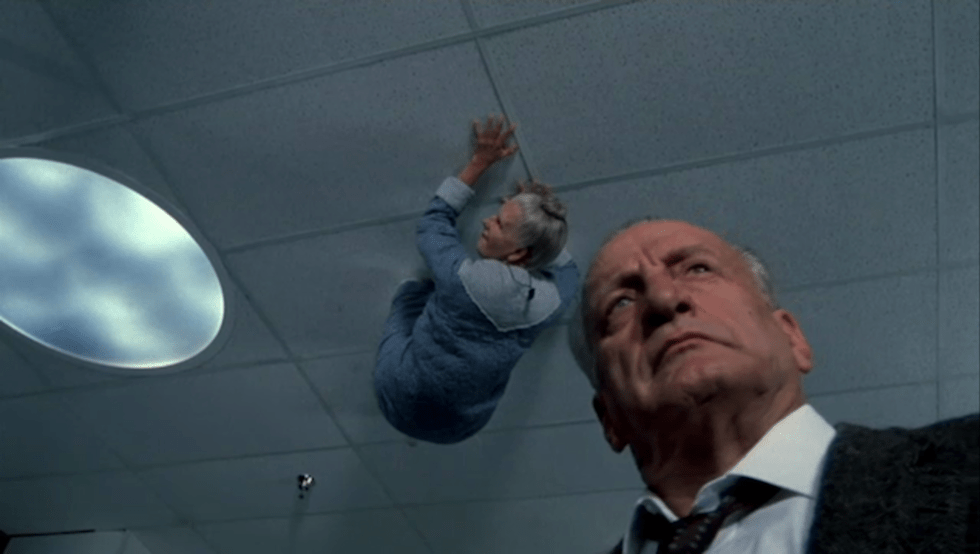
The film follows Lieutenant Kinderman, a weathered detective investigating a series of brutal murders in Georgetown that cause him to question why little boys could be allowed to suffer so viciously at the hands of a god. The murders bear the hallmarks of a serial killer called the Gemini — based in part on the real-life Zodiac Killer, one of several serial killers who enjoyed The Exorcist.

The twist is theological and disturbing: the murderer is the spirit of the Gemini Killer, who after being executed, made a deal with the demon Pazuzu. Angry at Father Karras defeating him in the first film, the demon allowed the Gemini Killer’s spirit to possess the recently deceased body of Father Karras as revenge on all good.

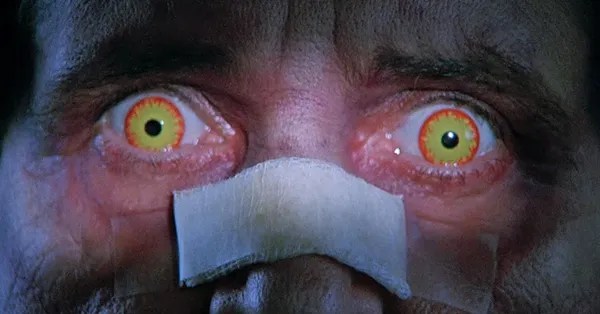
What makes the film extraordinary is not its horror — it is its conversations. The Gemini Killer, locked in Cell 11 of a psychiatric ward, receives visits from Lieutenant Kinderman. And what passes between them is unlike almost anything else in horror cinema — Brad Dourif out-Hannibal Lectures Hannibal Lecter, and The Exorcist III was released a year before The Silence of the Lambs.


The Gemini Killer and the Question of Evil

The Gemini Killer is not a screaming monster. He is articulate, philosophical, sardonic. He talks about evil with the precision of someone who has thought about it carefully for a long time. He talks about his childhood, his abusive father, the forces that shaped him into what he became.

There is such viciousness and hatred in the Gemini Killer — anger at the abusive father he had as a child, anger at the religion he was part of, pure hatred for so many. And yet he speaks. He reasons. He makes arguments. He is not beyond language or thought.

This is the detail that matters for understanding Jeffrey.

A man who confessed everything — who sat with Detective Murphy for sixty hours and described his crimes with complete cooperation — who was described as frank and without guile — was watching a film about a killer who speaks from a cell about evil, about childhood, about the forces that made him. In a trance-like state. Repeatedly.

Jeffrey wasn’t watching a horror film. He was watching something that felt like a mirror.


The Parallel: A Body That Doesn’t Belong to Its Inhabitant

The central theological horror of The Exorcist III is possession — a body inhabited by a soul that has no right to be there. Father Karras’s body, walking and speaking, but controlled by something else entirely. The real Karras trapped somewhere inside, exhausted, wanting only to be released. Jason Miller’s entire performance is predicated on the idea that Karras just wants to move on. Brad Dourif on the other hand is an electric presence — a barely restrained performance of evil.

Jeffrey described his own psychology in terms that map onto this with uncomfortable precision. He spoke of a compulsion he could not control, a force operating through him that he did not understand and could not stop. He said “I hated no one” at his sentencing. He said he believed he was completely out of his mind. He described himself as sick, or evil, or both — as if those were two separate things that might or might not explain the same actions.

The question the film asks — who is responsible when a body commits acts that the soul inhabiting it didn’t choose? — was not an abstract philosophical puzzle for Jeffrey. It was the question of his life.


Kinderman and God’s Silence

Kinderman is a man completely angry at the idea of a God — so upset that something could exist, just to sit back and watch people be murdered. When he gets the call that Father Dyer was murdered, there’s a breakdown in his eyes that is painful to watch — a man brutalized by his lack of faith and his anger towards the possibility that God exists and didn’t intervene to save a man who devoted his entire life to His faith.

Jeffrey, in his prison years, was wrestling with the same question from the opposite direction. Not why doesn’t God intervene to stop evil — but can God forgive the person through whom the evil came? Both questions orbit the same silence. Both questions go unanswered in the film. Kinderman does not receive a satisfying theological resolution. The evil is stopped, but the questions remain.

Crucified without nails to the high wall of Cell 11, Kinderman recites an increasingly bitter list of the things he believes in — mostly the human capacity for evil and the non-intervention of an uncaring God. Blatty is interested in the words most of all: the dialectic of intellectual debate, the ritual litany of naming, the recitation of prayers.

Jeffrey was reading his Bible in the same years he was watching this film on repeat. He was attending Bible correspondence courses. He would later be baptised. The film’s central unresolved tension — between the reality of evil and the possibility of a God who permits it — was the tension he was living inside.


Cell 11

There is one more detail that is almost too precise to be coincidental.

The Gemini Killer lives in Cell 11. He speaks from behind a window, in a locked room, separated from the detective who comes to visit him. Articulate. Cooperative. Frank. Describing what he did and why with a clarity that unsettles everyone who hears it.

Jeffrey Dahmer, by the time he was watching this film on repeat, had already been arrested. He had already confessed. He would spend the rest of his short life in a cell of his own, receiving visitors, speaking with a pastor, asking the same questions the film never answers.

He watched a man in a cell speak about evil and childhood and God’s silence, over and over, in a trance-like state.

He was watching himself. Or the version of himself he was afraid he might be. Or the version he was desperately trying not to be.


Why This Film, and Not The Original

The original Exorcist is about evil arriving from outside — possessing an innocent child, threatening an ordinary family, requiring priests to drive it back out. The framework is ultimately reassuring: evil is external, identifiable, and can be defeated.

The Exorcist III is about evil that is already inside. Already in the room. Already in the body. The question is not how to keep it out but what to do once it is there — and whether the person it came through is responsible for what it did.

That is a completely different film. And it is the one Jeffrey watched in a trance.


Sources: Wikipedia; Manor Vellum; Split Tooth Media; Slant Magazine; Milwaukee Police Department inventory, July 1991; survivor accounts.