“I Love You, Lionel”: Jeffrey Dahmer at Nine — A Portrait in Sound

Before the confessions, before the courtroom, before the world decided what his name would mean — there was a boy. A boy who sang Christmas songs badly and didn’t apologise for it. Who made up love songs on the spot. Who spelled out his own name with pride, as if the letters themselves were something worth celebrating. Who told his father, over and over, that he loved him.

This is what Jeffrey Dahmer sounded like at nine years old. And it matters.


There is a recording. It circulates quietly, passed between people who care enough to seek it out — a child’s voice, preserved on tape, from 1969. Jeffrey Dahmer is nine years old.

What you hear is not what you might expect. There is no shadow here, no foreboding, nothing that retrospect can weaponise into a sign of what was coming. There is only a boy — singing, playing, showing off, loving.

He sings Jingle Bells and stops midway. “I don’t remember the rest,” he says, with complete unbothered honesty, and then continues anyway. He makes up songs on the spot — a love song, a Christmas song, something that begins with “yeah yeah baby” and goes wherever it wants to go. He hits toys against what sounds like a wooden floor. He spells out his name — Jeffrey Dahmer, or sometimes just Jeff Dahmer — with the particular pride of a child who has recently learned that his name is something worth knowing.

And then, over and over, in a voice that asks for nothing in return: “I love you, Lionel. I love you. I love you.”

He had just had his first swimming lesson.


Reading the Child

What do you hear when you listen carefully?

You hear a child who is completely at ease. There is no hesitation, no self-consciousness, no awareness that he might be doing anything wrong or strange. He sings badly and doesn’t care. He forgets the words to Jingle Bells and announces the fact plainly before continuing anyway. He invents songs on the spot — love songs, Christmas songs, songs that go wherever they want — with the particular freedom of a child who has not yet learned that creativity requires an audience’s permission.

You hear warmth. The repeated declarations of love to his father — “I love you, Lionel, I love you, I love you” — are not performed for the recorder. They are simply what is there, spilling out naturally alongside news of his first swimming lesson, alongside the singing, alongside the ordinary joy of the afternoon. He is a child who feels something and says it.

You hear confidence. He spells his name with pride — Jeffrey Dahmer, or sometimes just Jeff Dahmer — as if the letters are an achievement worth announcing. Which, at nine years old, they are.

None of this is extraordinary. That is exactly the point.


1969

It is 1969. Jeffrey Dahmer is nine years old.

The family is living at 4480 West Bath Road in Bath, Ohio — the house Joyce had fallen in love with on sight, the one with woods nearby and a pond, the one that felt, for a brief time, like somewhere they might finally stay. Jeffrey had been happy there at first. He explored the woods with his dog Frisky. He collected rocks with a school friend. He liked the space and the quiet.

But the house that sounded like stability was already beginning to fracture. Lionel and Joyce’s marriage was deteriorating — the arguments, the medication, the long absences. Brian Masters writes of Joyce during this period as increasingly desperate, her consumption of pills growing, her emotional availability to her children narrowing. Lionel was at work, always at work. The boy who had once been described as cheerful and energetic was becoming, according to those who knew him, quieter. More inward. More alone.

And yet.

In this recording, made sometime in 1969, none of that is audible. What you hear instead is a child in full flight — singing, laughing, showing off, loving. Whatever was gathering in the background of his life had not yet reached him here, in this moment, with a recorder running and his father nearby.

He was still just a boy.


Why It Matters

Why does a child’s recording matter?

Because the easiest thing in the world is to let a name become only what it’s most associated with. Jeffrey Dahmer — two words that have carried, for decades, the full weight of seventeen deaths, of things so dark that most people flinch before they finish the sentence. That weight is real. It should never be minimised.

But a person is not only what they did wrong. That is the memorial’s founding argument, and this recording is one of the clearest pieces of evidence for it. Here is a child who loved his father openly and said so. Who sang badly and didn’t care. Who was proud of his name. Who had a first swimming lesson and wanted the whole world to know.

That child existed. He was real. And he deserves to be part of the record.


Jeffrey Dahmer spelled his name on a tape recorder in 1969 — with the pride of a nine-year-old who has recently learned that his name is something worth knowing.

He was right. It was.


Sources: Personal listening notes; Lionel Dahmer, A Father’s Story, 1994; Brian Masters, The Shrine of Jeffrey Dahmer, 1993.

The Body Remembers: Jeffrey Dahmer’s Hernia Operation and the Psychology of Childhood Surgical Trauma

On March 19, 1964, a four-year-old boy named Jeffrey Dahmer was taken to a hospital for a double hernia operation. He brought with him a ragged, floppy-eared stuffed dog he had slept with since the age of two. He watched Bewitched in the ward with other children. He went under anaesthesia. He woke up in severe pain and asked his mother if the doctors had cut off his penis.

That question — asked by a confused, terrified four-year-old in a hospital bed — is one of the most significant details in Jeffrey Dahmer’s documented history. It has been noted, briefly, in almost every serious account of his life. But it has rarely been examined with the rigour it deserves. This article attempts to do that.


What Happened

The hernia was the result of a birth defect — a double hernia, which required surgical correction. Lionel Dahmer describes the weeks preceding the operation in A Father’s Story:

“One day in spring of 1964, Jeff began to complain about an area of tenderness in his groin area. This tenderness worsened, and a small bulge appeared in his scrotum. We took him to the doctor right away, and he was subsequently diagnosed as suffering from a double hernia.”

Surgery was scheduled, and Jeffrey chose his stuffed dog to accompany him. The operation was performed. When he regained consciousness, it was to significant pain — pain in his groin, in a sensitive area he did not yet have full vocabulary or understanding for. In that pain and disorientation, he formed the only explanation available to a four-year-old mind: that something had been taken from him.

As an adult, speaking to forensic psychiatrist Dr. Judith Becker twenty-seven years later, Jeffrey confirmed that the pain had been so severe he genuinely believed his genitals had been removed. This was not a passing childhood misunderstanding that dissolved with time. It remained — vivid, bodily, real — into adulthood.


Lionel’s Account: The Permanent Flattening

What makes Lionel’s account so significant is not just what he describes happening, but what he describes happening after.

“When he awoke, of course, it was to a great deal of pain. So much pain, I learned later, that he asked Joyce if the doctors had cut off his penis. He remained in the hospital for several days and even after he returned home, his recovery seemed to move forward slowly. For long hours, he remained on the sofa in the living room, his body wrapped in a large, checkered bathrobe. During that period, he moved slowly, ponderously, like an old man. The ebullience which had marked his childhood, his buoyancy and energy drained away. During any period of recovery, of course, a certain flattening of mood could be expected. But in Jeff this flattening began to take on a sense of something permanent. He seemed smaller, somehow more vulnerable, perhaps even sadder than at any time before.”

Lionel — a chemist, a precise observer of detail — was careful to note the distinction. He understood that some mood flattening was expected after surgery. What he was observing was something else: a change that did not reverse. A before and an after. He filed it, noted it, carried it with him.


Joyce’s Diary and the Question of Preparation

Joyce wrote in her diary that Jeffrey had been “so good in the hospital” but that he “really disliked the doctor after this ordeal.” According to Brian Masters, she spent as much time with him as she could during his hospitalisation. At night, Jeffrey would tell her: “You can go home now, mommy. I’ll sleep.”

That detail — a four-year-old releasing his mother, performing bravery, managing her feelings alongside his own — is worth pausing on. It suggests a child who had learned, or was learning, to contain his distress.

But what Joyce’s diary does not record is any preparation. We do not know what Jeffrey was told before the operation — or indeed if he was told anything meaningful at all. Lionel’s account mentions that the diagnosis was explained to them, and that surgery was scheduled. What was explained to Jeffrey, in language a four-year-old could understand, is not documented. That gap is significant.


What Research Tells Us: Childhood Surgical Trauma

The psychological impact of surgery on young children is not a new area of study. Research dating back several decades has established that surgical procedures in early childhood carry a measurable risk of traumatic stress responses — and that this risk is shaped by a specific set of factors.

Children who undergo surgery before the age of five are considered particularly vulnerable. At this developmental stage, the child’s capacity to understand what is happening to their body is limited. They cannot place the experience in a meaningful framework. Pain that arrives without comprehensible cause is experienced differently than pain that has an explanation — and for young children, even explanations that adults consider clear are often fragmentary or misunderstood.

The risk of post-surgical traumatic stress is documented to be higher in cases where parental preparation is inadequate, where the child spends longer in hospital, where a parent is experiencing their own mental health difficulties or high levels of stress, and where the family lacks sufficient social support. In Jeffrey’s case, multiple factors were present simultaneously.

Joyce Dahmer was experiencing significant mental health difficulties during this period. Her deteriorating relationship with Lionel, her own anxiety and instability, and the demands of a household under pressure meant that even her efforts to be present with Jeffrey in the hospital were taking place within a context of parental stress. The social support available to the family was limited. Jeffrey spent several days in hospital and continued recovering slowly at home.


The Developmental Context: Age Four and the Body

Jeffrey was four years old when the surgery took place. This is not an incidental detail.

In developmental psychology, the period between roughly three and six years of age is recognised as a critical window for the development of body awareness, genital identity, and what is sometimes called bodily integrity — the sense that one’s body is one’s own, that it has boundaries, and that those boundaries can be trusted. Children at this age are engaged in the active process of understanding what their body is, how it works, and what it means.

A surgical procedure in the groin region, performed without full comprehension, with severe pain on waking, in a context where the child may not have been adequately prepared — strikes directly at this developing sense. The question Jeffrey asked — did they cut off my penis? — was not random. It was the specific fear that corresponded to the specific vulnerability of his developmental stage. He was asking, in the only language available to him: is my body still mine? Is it still intact?

That this question remained with him into adulthood, confirmed to Dr. Becker twenty-seven years later as a genuine and vivid memory, suggests that the answer he received — or didn’t receive — was not sufficient to resolve it.


Pain Management in 1960s Paediatric Medicine

There is another dimension of this event that is rarely discussed: the medical context of the 1960s.

It is now well-documented that for much of the twentieth century, paediatric pain management was significantly inadequate by contemporary standards. Medical understanding of children’s pain was shaped by a now-discredited assumption — that infants and young children did not experience pain in the same way as adults, or that their nervous systems were insufficiently developed to process it fully. This belief influenced anaesthetic and post-operative care in ways that left many children undertreated.

The severe pain Jeffrey experienced on waking from anaesthesia — pain significant enough for a four-year-old to conclude that part of his body had been surgically removed — was not unusual for the period. It was, in fact, representative of a systemic failure in paediatric medicine that would not begin to be seriously addressed for another two decades.

Jeffrey was not simply unlucky. He was a child who underwent surgery in an era when children’s pain was structurally underestimated and undertreated. What he experienced was real, severe, and inadequately managed — and he carried it.


Brian Masters and the Echoes

Brian Masters, in The Shrine of Jeffrey Dahmer, returns to the hernia operation repeatedly throughout his account of Jeffrey’s life. He saw it clearly as one of the formative events — not the cause, but a significant and underexamined contribution. His analysis is worth quoting at length:

“Suddenly his embryonic autonomy is shattered by a rude invasion; his little powers of decision are roughly withdrawn and he becomes an object in the hands of strangers. His ability to maintain control is undermined, disregarded even perhaps cancelled. He experiences ‘loss of control, autonomy and competence.’ And he does not know why. Not knowing why, he will wonder and invent.”

And further:

“Jeff Dahmer’s own imaginings about the insides of people’s bodies began with his hernia operation and the intrusion into his. Control was something lost in infancy and never recovered. With his victims he at last placed himself in the position where he could control not only what happened to them but what happened to their bodies. He could handle their intestines as his had been handled, cut them in the same place as he had been cut, restore himself of that autonomy of which he had been robbed, by stealing theirs. The tactile intimacy of the operation had at the same time mingled the feeling of sexual privilege with that of corporal invasion, which is why he chose to regain control and restore his stolen potency not with his enemies, not through hatred but with a loved object. The combination was disastrous.”

Masters was not arguing that the surgery made Jeffrey Dahmer a killer. He was arguing that it left a mark — a specific, bodily, lasting mark — that shaped the nature of what his compulsions later took.


The Lasting Echoes

The connections that Masters identifies — between the hernia surgery and Jeffrey’s later behaviour — are not speculative in the crude sense. They follow a recognisable psychological logic.

His fascination with the interiors of bodies began with roadkill, with the same morbid curiosity about what things looked like inside. He told people he wanted to know how things worked. About the killing of his first victim, Steven Hicks, Masters wrote: “In a cruel, pitiful echo of the experiments with roadkill, he slit open the belly to see what it looked like inside.”

He positioned his victims to expose the chest and abdomen. He opened bodies. He listened to the sounds they made. He handled organs. These were not random expressions of violence — they were organised around a specific bodily preoccupation that had its roots in a specific bodily event.

The control dimension is equally traceable. Jeffrey described, in various interviews, the compulsion to ensure that the people he brought to his apartment would not leave him. His methods — drugging, eventually killing — were organised around preventing abandonment, ensuring permanence, maintaining control over the presence of another person. A child who woke from surgery to find strangers had been inside his body without his understanding or consent, who asked his mother if something had been taken from him, grew into a man for whom control over bodies — his own and others’ — became the organising obsession of his adult life.


What This Tells Us

The hernia operation does not explain Jeffrey Dahmer. Nothing explains Jeffrey Dahmer in full — the constellation of conditions, the failed interventions, the compulsions and their catastrophic expression were the result of many things converging over many years.

But the operation deserves more serious attention than it typically receives. It was not a minor childhood event. It was a medically significant procedure performed at a critical developmental moment, with inadequate preparation, in the context of parental stress, with severe undertreated pain on recovery, leaving a child changed in a way his father could observe and name but not reverse.

Lionel saw it. Masters saw it. Jeffrey confirmed it, twenty-seven years later, to a forensic psychiatrist.

What this memorial can do — what it exists to do — is hold the full truth of who Jeffrey Dahmer was and what shaped him. The body remembers what the mind cannot always articulate. His did, clearly, for the rest of his life.


Sources: Lionel Dahmer, A Father’s Story (1994); Brian Masters, The Shrine of Jeffrey Dahmer (1993); Joyce Dahmer’s diary, as cited in Masters; testimony of Dr. Judith Becker, trial record 1992; research on paediatric surgical trauma and post-operative PTSD in children; historical documentation of paediatric pain management practices in mid-20th century medicine.

The Yellow Eyes: Jeffrey Dahmer, Emperor Palpatine, and the Magic of Feeling Powerful

Jeffrey Dahmer was born with blue eyes. But on the nights he went out — to Club 219, to the bars on Milwaukee’s near north side, searching for someone to bring home — he wore yellow contact lenses.

He bought them to look like Emperor Palpatine.

This detail, introduced at his 1992 trial by forensic psychiatrist Park Dietz, tends to get filed under strange facts about Jeffrey Dahmer and left there. It deserves considerably more than that. Because this detail, when examined properly, is one of the most revealing windows into the interior world of a man most people never tried to understand.


What the Trial Revealed

At his 1992 trial, forensic psychiatrist Park Dietz explained Jeffrey’s obsession with both Emperor Palpatine from Return of the Jedi and the Gemini Killer from The Exorcist III. What these characters have in common, Dietz testified, is that they are evil and corrupt and powerful, and both have the ability to use special powers to control others. He was consistently clear that making others suffer was not Jeffrey’s desire — but that Jeffrey did identify with the power of these characters.

Both characters are portrayed in their films with yellow eyes. And Jeffrey went to the extreme of buying contact lenses with that yellow tint, which he would wear when he went to the clubs. He wanted to be more like those people, and he described some sense of using the films to get himself in the proper mood.

His defence attorney Wendy Patrickus put it plainly: “He really identified with the Emperor. He wanted like that mind control. He had those yellow eyes. So Jeff found some place where he could get contact lenses that were yellow eyes. And before he went out at night, he put in the contact lenses. He had to get himself charged up by trying to emulate a devil or evil person to fulfil his fantasies.”

The contacts were found in a pawn shop. He didn’t go to an optician and order them specially — he found them, recognised them, and bought them. That detail feels important. It was opportunistic rather than planned. He saw them and something clicked.


Who Was the Emperor?

Emperor Palpatine — Darth Sidious — is the ultimate villain of the original Star Wars trilogy. He appears fully in Return of the Jedi (1983), the film Jeffrey was watching. He is physically diminished, disfigured, hooded. He commands absolute loyalty. He controls people through unseen forces. He cannot be defeated by conventional means. He is not physically powerful — he is powerful in a way that transcends the physical entirely.

He is also, crucially, someone who spent decades hiding in plain sight. A man who was overlooked, underestimated, dismissed — and who privately held more power than anyone around him knew. The contrast between external appearance and interior reality is the whole character.

Jeffrey Dahmer worked at a chocolate factory on the night shift. He lived in a small apartment with no air conditioning. He bought his clothes at thrift stores and kept Budweiser cans in his fridge. He was overlooked and underestimated and dismissed his entire life — by his parents, by the army, by his neighbours, by the police who returned Konerak Sinthasomphone to him. Nobody saw him as powerful. Nobody saw him at all.

Except in those yellow eyes, in his own mirror, before going out.


The Psychology: Schizotypal Personality Disorder

Jeffrey Dahmer was diagnosed with schizotypal personality disorder, among other conditions. Understanding what this means is essential to understanding what the yellow contact lenses were actually doing.

People with schizotypal personality disorder may believe they have magical control over others. They may think that ordinary occurrences have special meaning just for them — what clinicians call ideas of reference. They often have a profound sense that they possess something others do not — a power, a perception, a connection to forces that operate outside ordinary reality.

The most identifying characteristic of schizotypal personality disorder is perhaps magical thinking — a way of thinking that turns the ordinary into the magical and gives regular events great relevance. It can show up as superstitious beliefs, a sense of telepathy or clairvoyance, or a tendency to imbue objects and events that others consider commonplace with profound symbolic meaning.

The yellow contact lenses were not costume jewellery. They were a ritual object. A talisman. When Jeffrey put them in, something shifted in how he experienced himself. The feeling of power — even if it was entirely interior, entirely constructed, entirely a product of his own psychology — was real to him as a sensation. He could feel it.

This is something that people with schizotypal personality disorder will recognise instantly. The magic feeling is not delusion in the clinical sense — it does not break entirely with reality. It is something more like an intensification of reality, a sense that certain objects or actions or moments carry a charge that others cannot perceive. Putting on those lenses, looking in the mirror, seeing yellow eyes looking back — something in his nervous system responded to that. Something quieted, or amplified, or both.


Power as the Theme

What is striking about Dietz’s testimony is his insistence on the word power — and his equal insistence that it was not about causing suffering. Jeffrey told him clearly and repeatedly: the appeal was not the torture, not the domination in a sadistic sense. It was the power itself. The sense of being someone who mattered, who could not be overlooked, who commanded something.

This maps precisely onto what we know about his life. A man who felt fundamentally powerless — who had been shaped by chaos he couldn’t control, who spent his adult life in a small apartment working a night shift, who could not form or sustain any relationship, who described his interior world as Infinity Land, a place where closeness meant annihilation — found in these fictional characters a vision of the self he couldn’t access any other way.

Emperor Palpatine was not loved. He was feared and obeyed. For someone who had never been able to achieve closeness — for whom intimacy was precisely what the rules of Infinity Land said would destroy you — power without closeness may have been the only form of connection that felt safe to reach for.


The Contacts and The Exorcist III

The yellow eyes connected two obsessions. The Emperor’s pale yellow gaze in Return of the Jedi. The Gemini Killer’s burning yellow eyes in The Exorcist III. Two characters — one from a space opera, one from a philosophical horror film — sharing a single visual detail that Jeffrey made his own.

FBI profiler Robert Ressler reasoned that Jeffrey’s interest in these films was about the power the possessed had over the minds and bodies of the rest of the world, and over reality itself.

Two films. Two sets of yellow eyes. One man in a pawn shop in Milwaukee, recognising something.


What It Tells Us

The yellow contact lenses are not evidence of evil. They are evidence of someone trying, in the only way available to him, to feel like something other than what his life had made him.

A deeply isolated man, diagnosed with a disorder that made intimacy feel dangerous and reality feel porous and magical, found in fictional figures of power a reflection of who he wished he could be. He took that reflection and made it physical — put it literally in his eyes — and went out into the world carrying something that was entirely invisible to everyone around him.

Nobody at Club 219 knew they were looking at Emperor Palpatine. Nobody knew what those eyes meant to the man behind them.

Only Jeffrey knew. And in the space of that private knowledge, something in him felt powerful for a little while.


Sources: Trial testimony of Dr. Park Dietz, Milwaukee 1992; Wendy Patrickus, The Jeffrey Dahmer Tapes; Robert Ressler, FBI; DSM-5 diagnostic criteria for schizotypal personality disorder.

The Art on Jeffrey Dahmer’s Walls

There is something extraordinarily revealing about the art a person chooses to live with. Not the art they display for others, to impress or signal taste, but the art that hangs in private rooms, the images that become part of the daily backdrop of a life. The painting you look at every morning. The photograph framed on a wall you pass a hundred times a day without consciously registering it. These choices are rarely random. They are expressions of an inner world, of what a person finds beautiful, necessary, or true.

When police entered Apartment 213 on the night of July 22, 1991, they catalogued everything. Among the evidence was something that most accounts treat as peripheral detail — the art on Jeffrey Dahmer’s walls. But those walls, and what hung on them, tell a story that is worth examining carefully.


The Living Room

Brian Masters, in The Shrine of Jeffrey Dahmer, describes the living room that Officers Mueller and Rauth first encountered as “small but pleasantly furnished” — an oriental rug, blue curtains, a healthy pot-plant on a tall pedestal, a large comfortable armchair. And then, quietly noted: “some fine pictures on the wall, and one framed picture of a naked male model.”

The word “fine” is significant. Masters is a precise writer, and he is not using the word carelessly. The pictures were not crude or squalid. They were fine — chosen with something like care, something like taste. This was not a bare or neglected space. It was a room in which someone had made deliberate aesthetic decisions.

Jeffrey Dahmer’s living room, photographed by Milwaukee police on the night of his arrest, July 22, 1991. Fighting Forms by Franz Marc (1914) is visible on the left wall. A framed photograph of a male model is visible on the right.

Fighting Forms — Franz Marc, 1914

The most significant work in Jeffrey Dahmer’s apartment was a reproduction of Fighting Forms, painted by the German Expressionist Franz Marc in 1914.

Marc was a founding member of Der Blaue Reiter — The Blue Rider — a group of artists who believed that colour and form could express the spiritual world more truthfully than representation ever could. He had a deep, almost religious reverence for animals, seeing in them an innocence and purity that humanity had lost. He developed a precise and personal theory of colour symbolism: blue for the spiritual and masculine, yellow for the feminine and joyful, red for violence and passion.

Fighting Forms, Franz Marc, 1914. Oil on canvas. Bayerische Staatsgemäldesammlungen, Munich.

Fighting Forms was painted in the final months before the First World War. It is one of the most abstract works Marc ever produced — two opposing forces, one dominated by violent, churning red, the other by deep, absorptive black, locked in a collision that has no resolution and no clear victor. There are no animals, no recognisable figures. There is only the pure language of colour and form, expressing what Marc called “the spiritual essence of things.” It is one of a series of four works he painted that year — Playing Forms, Forms in Combat, Cheerful Forms (now destroyed), and Fighting Forms. Three months after completing them, Marc enlisted in the German Army. He was killed at the Battle of Verdun on March 4, 1916, before orders could reach him to withdraw from the front.

That Jeffrey Dahmer owned a reproduction of this painting — that he looked at it every day — is not a trivial detail.

Fighting Forms is a painting about two irreconcilable forces. About the impossibility of harmony between opposing natures. About something that cannot be stopped, something that moves toward its end with the logic of a natural force, indifferent to the damage it causes. Marc painted it on the edge of a war he could feel coming but not prevent. He painted it as a man who had run out of animals to use as symbols for the duality he felt in the world, and had moved instead to pure abstraction — to the forces themselves, stripped of any mediating form.

Jeffrey Dahmer stood before this painting in his living room. He lived with it. Whatever drew him to it, whatever he saw in those two churning, colliding masses of red and black, was something he felt the need to look at every day.


The Photographs

In the bedroom and hallway, the art took a different form. Masters documents “framed photographs and posters of male nudes taken in ‘artistic’ poses and clearly intended to be attractive to a homosexual man.” These were not the Polaroids — those were hidden. These were displayed. Framed. Hung. Chosen for the walls in the way anyone might choose art for the walls of their home.

The distinction matters. Jeffrey Dahmer was a man who separated, with care, what was private from what was visible. The framed photographs of male nudes in artistic poses were not hidden. They were part of the apartment’s decoration — the legitimate, curated face of his aesthetic world.

We know from Brian Masters’ account of his adolescence that from a young age Jeffrey was drawn to the male form with a specific intensity: the chest, the abdomen, the smooth musculature of the body without its personhood. The magazines he sought out as a teenager were those showing “photographs of muscular torsos and hairless chests.” The fantasy that formed in those years was not of relationship, but of possession — of being close to something beautiful and keeping it. The photographs on his walls were the legal, visible expression of the same impulse. The male body as aesthetic object. Beautiful and arrested.

Three specific works have been identified among the photographs displayed in Apartment 213:

Jean Marais — Raymond Voinquel, 1938. A black and white fine art photograph of French actor and cultural icon Jean Marais, shot by one of France’s foremost portrait photographers. Marais reclines, bare-chested, in dramatic chiaroscuro light — the image has the quality of classical painting, the body rendered with the same reverence one might give to sculpture.

Jean Marais, Raymond Voinquel, 1938.

LA Nude — Victor Skrebneski, 1984. Skrebneski was a Chicago-based master of black and white photography known for his classical, sculptural approach to the body. In this image, a nude male figure carries a globe on his shoulders in the pose of Atlas — shot from below, the musculature lit dramatically against deep black. The body as architecture. The body as myth.

LA Nude, Victor Skrebneski, 1984.

Fred with Tires — Herb Ritts, 1984. One of the most iconic images in twentieth century photography, and the photograph widely credited with launching Ritts’ career. A nude male figure leans against a stack of tyres, the industrial setting in stark contrast with the classical beauty of the body. Ritts — along with Robert Mapplethorpe and Bruce Weber — provoked a radical change in how the nude was depicted in the 1980s.

Fred with Tires, Herb Ritts, 1984.

The Altar That Was Never Built

There was a third layer to Jeffrey Dahmer’s visual world — one that existed only in drawings and notes found in the apartment. He had been planning what he called a shrine: a precisely designed aesthetic space, hand-drawn in plans that specified colours and materials. Black carpet. Black plush chair. Windows covered with black shower curtains. A black table. Fluorescent eyes set into a wall plaque. And along the table — painted skulls, arranged in a composition.

Jeffrey Dahmer’s hand-drawn plans for the shrine, recovered from Apartment 213, July 1991.

He wanted to build something. He wanted to create an environment, an interior world made entirely to his own specifications, expressing the aesthetic of his deepest and most damaged desires. The shrine was never completed. But its plans reveal something important: Jeffrey Dahmer thought in visual terms. He composed. He arranged. He had a sense of what things should look like, of the emotional effect of colour and placement and form. He was, in the saddest and most terrible sense, an artist of a kind — one whose medium had become irredeemable.


The Drawings

In prison, Jeffrey received letters. Many of them. And to some of those who wrote, he wrote back — and drew.

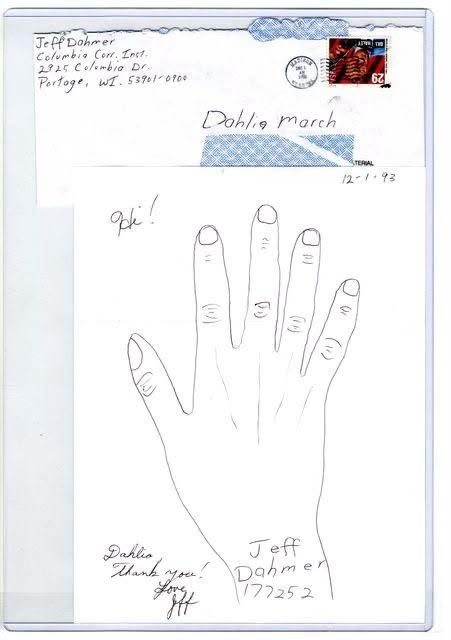
What survives in circulation are small, intimate things. A hand tracing on lined paper, dated March 1, 1993 — his signature above it, J.H. Dahmer, and below the outline of his fingers: Jeff Dahmer. 177252. His name and his number. He placed his hand flat on the paper, traced around it, and sent it to a stranger. There is something almost unbearably human about that gesture — the oldest mark a person can make, the first thing children do with a piece of paper and a pen.

And then there is the sketch labelled in his own handwriting: my leg and foot. A pencil drawing, careful and observational, of his own body. He looked at himself and drew what he saw. Not a fantasy, not an abstraction — just his leg, his foot, rendered with quiet attention.

These drawings belong in any serious examination of Jeffrey Dahmer’s visual world. They are not the work of a man who had stopped seeing. He was still looking — at his hand, at his body, at the world around him — and still finding it worth recording. The same impulse that hung Fighting Forms on his living room wall, that sketched plans for a shrine he would never build, was still alive in cell 177252. Diminished, constrained, reaching through a pen and a piece of lined paper — but alive.


What the Art Tells Us

There is a version of Jeffrey Dahmer’s story that presents him as simply monstrous — a man without inner life, without feeling, without the kind of interior world that makes a person legible as human. The art on his walls pushes back against that version.

A man who chooses Fighting Forms to live with is a man who feels the conflict in himself — the red and the black, the two forces that cannot be reconciled — and who finds in abstraction a language for something he cannot otherwise name.

A man who frames a 1938 vintage photograph by one of France’s greatest portrait photographers, alongside two of the defining works of 1980s art photography — Skrebneski and Herb Ritts — is not a man without aesthetic knowledge or taste. He had a curated collection. He chose with intention.

A man who draws detailed plans for a shrine — who specifies fluorescent eyes and painted skulls and the precise quality of black he wants — is a man with an interior aesthetic world that is coherent, structured, and deeply felt.

And a man who traces his own hand on a piece of lined paper and sends it to a stranger — who sketches his leg and labels it in his own handwriting — is a man who was still present. Still here. Still marking his existence in the only ways left available to him.

None of this excuses anything. It does not soften the crimes or their consequences. But it is part of the truth of who Jeffrey Dahmer was. And this memorial exists to hold the full truth, however uncomfortable — to see the human being behind the name, however much the world has decided that is not worth doing.

The art on his walls was part of his inner life. It deserves to be seen as such.


Sources: Brian Masters, The Shrine of Jeffrey Dahmer (1992); Milwaukee Police Department inventory, July 1991; Franz Marc, Fighting Forms (1914), Bayerische Staatsgemäldesammlungen, Munich; Raymond Voinquel, Jean Marais (1938); Victor Skrebneski, LA Nude (1984); Herb Ritts, Fred with Tires (1984).

Door213: Music Born from the Memorial

There is a door in Milwaukee that no longer exists. Apartment 213, Oxford Apartments — the place Jeffrey Dahmer lived from 1990 until his arrest in July 1991. The door is gone. The building was demolished in 1992. But the number remains, and for those of us who have spent years thinking about who Jeffrey was and what his life meant, it carries enormous weight.

Door213 is a music project born directly from that weight.


What Door213 Is

Door213 is not a project about crime. It is not shock value, and it is not provocation. It is an attempt to do in music what this memorial does in words — to sit with complexity, with grief, with the parts of Jeffrey’s story that most people refuse to look at directly. The inner world. The loneliness. The questions that never got answered. The faith he found at the end.

The name is the door itself — the threshold between what the world saw and what was actually happening inside. Door213 lives in that space.

The project deals in duality, symbolism, and the sacred and profane existing side by side. Sonically it moves between worlds — nu-metal, hip-hop, jazz, Arabic influences, Portuguese — because Jeffrey himself was a man of contradictions, and the music reflects that. Nothing here is simple. Nothing here is meant to be.


None of my Friends Understand What It Means

The debut album. Love, chaos, and the cosmic connection of two souls — the kind of connection that cannot be explained to anyone on the outside, that exists in a language only two people speak. The title alone says everything about what it means to feel something this deep for someone the world has already judged and dismissed.

This is where Door213 began: in the place where understanding lives, even when no one else can follow you there.

Listen to it on Spotify


The Ghosts in my Bed

The second album deepened the mythology. Fate, life, death — two similar, lost souls finding each other inside a bedroom with a window into the city night. The imagery here is intimate and cinematic at once: a private space, a nocturnal world outside, two people who recognise something in each other that they have never found anywhere else.

The bedroom with the city night beyond the window would become a recurring motif in Door213’s visual world — and would eventually become the cover of Aftermath itself.

Listen to it on Spotify


Jazz Records Vol. I

Atmospheric, nocturnal, unhurried. Jazz Records Vol. I settled into a quieter register — music for late hours, for sitting alone with something you can’t fully name. This Nightscape We Live In became its quiet centrepiece, a track that asks what it means to exist in the dark, to be alive in hours that belong to no one.

Listen to it on Spotify


Aftermath

The fourth album, releasing April 18, 2026, is Door213’s most fully realised work yet. Nine tracks. A cover image — two figures floating horizontally in an amber-lit bedroom, one in white above and one in black below, fingers barely touching, Milwaukee glowing through the window behind them — that contains the entire thesis of the album in a single frame.

Yin and yang. Light and dark. The one who left and the one still reaching.

Aftermath deals with love across impossible distances. Tracks like Fusion and The Strangeness Within move between the sensual and the spiritual, always returning to the same question: what remains after everything is gone? The album closes in Portuguese — Angel — a final breath in another language, a door closing gently.


What’s Coming

Monstros e Sonhadores — Monsters and Dreamers — is Door213’s next project, written entirely in Portuguese. It is the most intimate work yet: the monsters we carry inside us, and the dreamers we remain in spite of them. No release date yet. It arrives when it’s ready.


The Inner World

Door213 exists because some stories deserve more than documentation. Jeffrey Dahmer’s story has been told in courtrooms, in true crime podcasts, in Netflix series. What it hasn’t always been given is tenderness. The music tries to offer that — not cheap forgiveness, not excusing anything, but the harder and rarer thing: the willingness to see a full human being.

That is what this memorial was built for. That is what Door213 carries in every track.

The door at Apartment 213 is gone. But doors, once they exist in the imagination, never fully close.

A Mind in Pieces: The Psychiatric Diagnoses of Jeffrey Dahmer

Jeffrey Dahmer was not simply a serial killer. He was a profoundly mentally ill human being who received almost no professional help during the years when intervention might have mattered. By the time psychiatrists formally evaluated him, it was in a courtroom, under oath, in the context of determining whether he should be held legally responsible for seventeen murders.

The diagnoses that emerged from those evaluations — and from subsequent academic research — tell a story that is more complex, more human, and more heartbreaking than most coverage ever acknowledges. This article attempts to compile and explain them properly, in one place, for the first time on this memorial.


The Legal Context

Jeffrey pleaded guilty but insane to fifteen counts of murder in January 1992. The trial that followed was not about whether he had committed the crimes — he had confessed to everything. It was about whether he understood what he was doing was wrong, and whether a mental disease had rendered him unable to control his behaviour.

The defence called three expert witnesses. Forensic psychiatrist Carl Wahlstrom diagnosed Jeffrey with necrophilia, borderline personality disorder, schizotypal personality disorder, alcohol dependence, and a psychotic disorder. The prosecution’s forensic psychiatrist Park Dietz diagnosed him with substance use disorder, paraphilia, and schizotypal personality disorder. Independent experts George Palermo and Samuel Friedman also testified, with Palermo concluding Jeffrey had a severe mixed personality disorder with antisocial, obsessive-compulsive, sadistic, fetishistic, borderline and necrophilic features.

Despite the weight of diagnoses, the court ruled him sane — primarily because he maintained comprehension of the legal and moral wrongfulness of his acts, took steps to hide his crimes, and tended to plan the murders beforehand, proving the crimes were not impulsive and uncontrollable acts in the context of mental illness.

Legal sanity and mental illness are not the same thing. Jeffrey was mentally ill and legally sane simultaneously. Both things were true.


Borderline Personality Disorder

Borderline personality disorder is characterised by intense emotional instability, a profound fear of abandonment, unstable and turbulent relationships, impulsive behaviour, and a fragile, shifting sense of self. It is not a disorder of coldness or detachment — it is almost the opposite. People with BPD feel things intensely, sometimes overwhelmingly, and their inner world is one of profound instability.

Jeffrey’s BPD manifested in specific and recognisable ways. The desperate need for connection — the longing, as clinical psychologist Samuel Friedman testified, for companionship — that drove his crimes was not the flat indifference of a psychopath. It was the anguished reaching of someone who could not form or sustain relationships through any ordinary means and whose disorder had catastrophically distorted the expression of that need.

The pattern of his adult life — the alcohol as emotional regulation, the isolation, the sense of being fundamentally different and fundamentally alone — is entirely consistent with untreated BPD in a person who had never received appropriate support.


Schizotypal Personality Disorder

This is the diagnosis that appears most consistently across all the expert evaluations, and it is the one most relevant to understanding Jeffrey’s interior world.

Schizotypal personality disorder involves ideas of reference — the belief that ordinary occurrences have special meaning — magical thinking, the sense of having some form of special power or perception, unusual perceptual experiences, and excessive social anxiety rooted not in negative self-judgement but in paranoid fears about others.

The yellow contact lenses, the ritual use of films before going out, the sense that certain objects and moments carried a charge others couldn’t perceive — these are textbook schizotypal presentations. So is the profound social isolation, the inability to form close friendships, the feeling of being fundamentally unlike other people.

Research suggests that childhood trauma, neglect, abuse, stress, and family dysfunction can increase the risk of developing schizotypal traits. People with the most severe cases usually have a combination of childhood trauma and a genetic basis for their condition. Jeffrey’s childhood — the parental conflict, Joyce’s mental health crises, the constant upheaval, the emotional unavailability of both parents — maps directly onto that profile.


Alcohol Use Disorder

Jeffrey had an alcohol abuse problem and started drinking heavily in high school. His drinking led him to become withdrawn and socially awkward. Eventually, his alcohol use disorder would force him to drop out of college.

Alcohol was Jeffrey’s primary coping mechanism from adolescence onward. It lowered the threshold for acting on impulses he was otherwise able to suppress. It was what the army discharged him for. It was what filled his apartment in the form of empty Budweiser cans when he was depressed. It is what Lionel tried repeatedly and unsuccessfully to address.

Untreated alcohol use disorder in the context of BPD and schizotypal personality disorder is a particularly dangerous combination — each condition amplifying the others, each closing off the exits that might otherwise have been available.


A Physical Blow During Basic Training

Before Jeffrey ever reached Germany, his body had already sustained damage that belongs in any honest account of his psychiatric history. During basic training at Fort McClellan, Alabama, his persistent drinking got the entire platoon punished for his insubordination — and several of the men made sure he felt the consequences personally. The beating was severe enough to rupture his ear-drum, a wound that left him with recurring ear-aches for years to come. A blow forceful enough to cause that kind of damage is also the kind of physical trauma known to worsen pre-existing psychiatric conditions, erode impulse control, and deepen emotional dysregulation. It is one more layer of pressure added to an architecture that was already beginning to crack.


A Psychotic Disorder

The diagnosis of a psychotic disorder — distinct from psychosis as a symptom within another condition — acknowledges that Jeffrey experienced periods of significant detachment from reality. Symptoms including delusions, hallucinations, and disorganised thinking may have made him detached from reality at certain moments.

This is not the same as saying he was psychotic during his crimes. The prosecution’s case rested precisely on the evidence that he was not — that he planned, concealed, and understood what he was doing. But psychotic episodes, when they occurred, would have contributed to the overall disintegration of a mind that was already fragmented across multiple serious conditions.


The Trance States

There is one detail in the documented record that receives almost no serious attention, and it is one of the most potentially significant: the trance-like states.

Brian Masters documents at least one account of Jeffrey entering what can only be described as a dissociative or fugue-like episode — a period of apparent absence, of being present in body but not in mind, during which his behaviour seemed to shift beyond his ordinary conscious awareness. Jeffrey himself, at various points, described experiences consistent with dissociation — a sense of watching himself from outside, of compulsion overtaking volition, of not quite being present during the worst of what he did.

This has been largely ignored by the researchers and forensic professionals who evaluated him. It deserves not to be.

If these episodes were frequent rather than isolated, their origin could be neurological rather than purely psychiatric. Temporal lobe involvement — temporal lobe epilepsy, complex partial seizures, or structural abnormalities in the temporal region — is associated with dissociative states, compulsive and repetitive behaviour, altered perception, and in some cases paraphilias. The profile fits. And it is precisely the kind of thing that a proper neurological examination might have detected — or that a study of Jeffrey’s preserved brain might have illuminated, had it not been ordered cremated before any scientist could examine it.

The people working with him — the forensic psychiatrists, the defence team — were operating within the framework of legal insanity. Neurological origin was not what they were looking for. But Joyce was looking for something biological. She always believed there was something in the brain that explained, at least in part, what Jeffrey became. The trance states are the most visible evidence that she may have been right — and the fact that no one followed that thread is one of the genuine failures in his case.


Insomnia, Depression, and the Medication He Was Given

One documented but often overlooked aspect of Jeffrey’s medical history is his prescription for Halcion — a benzodiazepine sedative containing triazolam — prescribed by a physician for insomnia. Jeffrey worked the night shift at the Milwaukee Ambrosia Chocolate Factory and told his doctor he needed help adjusting to that schedule. The prescription was legitimate. The use he put it to was not.

That he required a sedative prescription at all is significant. Insomnia is a common companion to anxiety, depression, and the kind of psychological fragmentation that characterised Jeffrey’s inner life. Benzodiazepines like Halcion are also prescribed for anxiety — it is not possible to know from the documentary record whether anxiety was part of the clinical picture that prompted the prescription, but it would be entirely consistent with everything else we know about him.

Created with RNI Films app. Preset ‘Agfa Optima 200 Warm’

Depression is not formally listed among his trial diagnoses, but it is strongly implied throughout the record. The periods of total collapse — when he would stop shaving, stop bathing, let the apartment fill with empty beer cans, and cease functioning in any ordinary sense — are consistent with depressive episodes. Lionel mentioned his son’s suicidal thoughts after conviction. Jeffrey himself said, in various formulations over the years, that he did not care whether he lived or died.

Whether he was ever formally diagnosed with depression or treated for it with antidepressants is not documented in the sources available to us. What is clear is that the suffering was real and consistent — and that whatever he was prescribed, it was never the comprehensive mental health treatment that his condition warranted.


The Asperger’s Hypothesis

More recently, researchers have proposed an additional framework. A study by Silva, Ferrari and Leong in the Journal of Forensic Sciences (2002) proposed that Jeffrey was most likely on the autistic spectrum, specifically with the hypothesis of him having Asperger’s disorder.

The case for this is not trivial. Jeffrey’s social difficulties went beyond anxiety or paranoia — there was something in the texture of his social interactions, his inability to read and respond to ordinary social cues, his preference for solitary rituals and highly structured activities, his intense and specific interests, that some researchers believe points toward autism spectrum presentation.

His own words at various points support this reading: “The subtleties of social life were beyond my grasp. When children liked me, I did not know why. Nor could I formulate a plan for winning their affection. I simply didn’t know how things worked with other people.” That description is not of someone who doesn’t want connection. It is of someone who cannot navigate the basic social architecture through which connection normally forms.


What Was Not Diagnosed: The Absence of Psychopathy

It is worth stating clearly what Jeffrey was not diagnosed with, because the popular image of him as a psychopath — cold, calculating, without feeling — is contradicted by the clinical record.

Photograph of Jeffrey Dahmer taken during his trial. (Photo by: Universal History Archive/ Universal Images Group via Getty Images)

Psychopathy, characterised by a fundamental absence of empathy and remorse, shallow affect, and manipulative interpersonal behaviour, does not fit. Other evidence does not support a diagnosis of psychopathy. Jeffrey wept during his confession. He expressed genuine remorse at his sentencing. He underwent sincere religious conversion. Reverend Roy Ratcliff, who spent months with him, described a man with genuine emotional depth and authentic spiritual searching. These are not the behaviours of a psychopath.

He had empathy. It was distorted, misdirected, catastrophically expressed — but it was there.


The Central Question

The question that runs through all of this is not whether Jeffrey was mentally ill. He clearly was, significantly, with multiple overlapping conditions that had been present since childhood and that received essentially no treatment until he was in prison for murder.

The real question is what might have happened had any of this been identified and treated earlier. The BPD, the schizotypal traits, the alcohol dependence, the insomnia, the depression that was never formally named — these were not invisible. They were present, and they were ignored.

(Photo by Curt Borgwardt/Sygma via Getty Images)

There were points of potential intervention throughout his life — the withdrawn child after the hernia surgery, the isolated teenager collecting animal bones, the army discharge for alcoholism, the beating that ruptured his ear-drum, the earlier arrest. At each of these junctures, the system that might have helped him either missed him entirely or responded inadequately.

Jeffrey Dahmer was not a monster who emerged fully formed from nowhere. He was a severely ill person, carrying a constellation of serious conditions through a childhood and adolescence that offered him almost nothing in the way of support, understanding, or care.

That does not explain away what he did. Nothing explains that away. But it is part of the truth — and the memorial exists to hold the whole truth.


A Final Note on What Was Never Done

Jeffrey Dahmer spent the last three years of his life in Columbia Correctional Institution. During that time, no neurological examination was ever requested or performed. No CAT scan. No MRI. No EEG. No investigation into whether the trance-like states, the compulsive behaviour, the dissociative episodes that characterised his adult life had any biological origin that science might have identified and named.

The people responsible for his psychiatric care were operating within the framework of legal accountability, not medical curiosity. The questions Joyce had always asked — was there something in the brain, something physical, something that might explain at least part of what happened — were never seriously pursued while he was alive.

After his death on November 28, 1994, there was a brief window. Joyce requested that Jeffrey’s brain be preserved for scientific study, believing that research might yield something useful — not to excuse what he did, but to understand it. Lionel opposed it. The dispute went to court. In the end, the brain was cremated along with the rest of his remains.

Whatever was there — if anything — is gone. We will never know.


Sources: Trial testimony of Dr. Carl Wahlstrom, Dr. Park Dietz, Dr. George Palermo, Dr. Samuel Friedman, Dr. Fred Berlin, 1992; DSM-5 diagnostic criteria; Silva, Ferrari & Leong, Journal of Forensic Sciences 2002; Strubel, Comorbid Psychopathologies 2007; Brian Masters, The Shrine of Jeffrey Dahmer 1993; Lionel Dahmer, A Father’s Story 1994; Wikipedia. Note: formal diagnosis of depression is not documented in available trial records; its presence is inferred from behavioural accounts.

November 28, 1994: The Last Morning

Jeffrey Dahmer woke up on the morning of November 28, 1994 — a Monday, Thanksgiving week — and did what he had been doing every morning for nearly three years. He got up. He got dressed. He went about his day.

He had no idea it was the last one.


The Morning

By late 1994, Jeffrey had been at Columbia Correctional Institution in Portage, Wisconsin for almost three years. He was no longer in protective isolation. After a first year spent largely separated from general population, he had gradually been integrated — attending classes, eating communal meals, performing work duties. He had earned, through quiet compliance and genuine religious engagement, a degree of ordinary prison life that most had assumed he would never be allowed.

He had been baptised six months earlier, in May 1994, submerged in the prison whirlpool by Reverend Roy Ratcliff of the Church of Christ. They had met every week since. Five days before his death — on November 23 — Jeffrey and Ratcliff had their final Bible study session together. They discussed the Book of Revelation. Its subjects: death, punishment for sins, and what comes after.

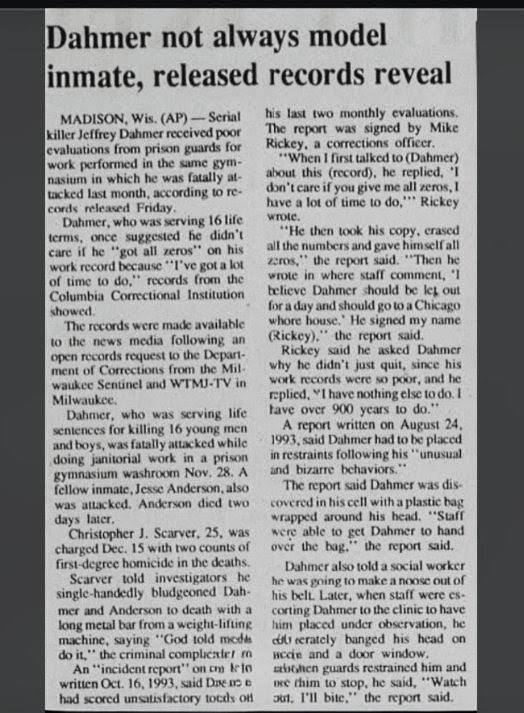
On the morning of November 28, Jeffrey left his cell to conduct his assigned work detail. He had been on cleaning duty for three weeks. That morning he was assigned to the gymnasium with two other inmates — Jesse Anderson, convicted of murdering his wife, and Christopher Scarver, serving life for a murder committed in 1990.

The three were taken to the gym by corrections officers, unshackled, and left to clean the bathrooms. They were left unsupervised for approximately twenty minutes.


What Happened in the Gym

Scarver had despised Jeffrey from the moment they arrived at Columbia at roughly the same time in 1992. He had kept his distance, watching from across the yard, repulsed by what he knew of Jeffrey’s crimes. He had carried a newspaper clipping about those crimes in his pocket for a long time — a physical reminder of his disgust.

That morning, while Scarver was filling a mop bucket with water, someone poked him in the back. He turned around. Both Jeffrey and Anderson were laughing quietly. He couldn’t tell which of them had done it.

Scarver retrieved a 20-inch metal bar from the weight room. He followed Jeffrey into a staff locker room and confronted him — showing him the newspaper clipping, asking him directly if he had done those things.

Jeffrey was shocked. He started looking for a way out. Scarver blocked the door.

According to Scarver, Jeffrey’s last words were: “I don’t care if I live or die. Go ahead and kill me.”

Scarver brought the bar down. He crushed Jeffrey’s skull with two blows. He then crossed the gym to where Anderson was working and did the same to him. The entire thing took roughly twenty minutes.

At approximately 8:10 in the morning, a corrections officer discovered Jeffrey on the bathroom floor with catastrophic head wounds. He had been beaten across the skull and his head had been repeatedly slammed against the wall.

He was still alive. He was rushed to a nearby hospital.

He was pronounced dead one hour later. He was 34 years old.


The Guard Question

Jeffrey was not supposed to be in an unsupervised situation with other inmates. He had known enemies in the prison — he had survived an earlier attack in July 1994 when inmate Osvaldo Durruthy slashed at his throat with a razor blade embedded in a toothbrush as he sat in the prison chapel. He had received only superficial wounds that time.

Scarver himself later said he believed it was no accident that he ended up alone with Jeffrey that morning. Prison officials, he claimed, knew how much he despised Jeffrey. They knew the history. And on November 28, they left the three of them together, unshackled, unsupervised, for twenty minutes.

Whether this was negligence or something more deliberate has never been officially established. The Wisconsin Department of Corrections blamed staffing issues. The investigation concluded without any guards being held accountable.

But the question remains. It has never been fully answered.


Joyce

When news of Jeffrey’s death reached his mother Joyce, her response cut through everything:

“Now is everybody happy? Now that he’s bludgeoned to death, is that good enough for everyone?”

It was the cry of a mother. Whatever she had done and not done, whatever had passed between them — in that moment, she was simply a woman whose child had been killed.


No Services

Jeffrey had left instructions in his will. He wanted no services conducted. No funeral. No headstone. No ceremony of any kind.

His wishes were respected, in that sense. There was no public funeral. No gathering. No words spoken over him in a church or at a graveside. The man who had been the subject of global media coverage for three years was disposed of, in the end, with complete silence.

His body was held by investigators — it was evidence in his own murder case — for nearly a year. Christopher Scarver was sentenced in May 1995 for the killings. Only then were Jeffrey’s remains released to his family.

On September 17, 1995 — almost ten months after his death — Jeffrey Dahmer’s body was cremated. His ashes were divided equally between his parents. Lionel took his half back to Ohio. Joyce took hers to California.


The Brain

Before cremation, doctors had opened Jeffrey’s skull and removed his brain. It had been preserved in formaldehyde at the Dane County Medical Examiner’s Office since his autopsy.

What followed was one final, painful dispute between his parents.

Joyce wanted the brain donated to science. She believed, and had always believed, that something biological had contributed to what Jeffrey became — and she wanted to know what. She told the Milwaukee Journal Sentinel: “Jeff always said that if he could be of any help, he wanted to do whatever he could.”

Lionel refused. He wanted the brain cremated with the rest of his son’s remains. He argued that Jeffrey had requested cremation and that this request extended to every part of him. To retain the brain against his wishes, Lionel said, would be legally and morally wrong.

Two scientists had written to the court requesting access. One, Jonathan Pincus of Georgetown University, described it as “an unparalleled chance to possibly determine what neurological factors could have contributed to his bizarre criminal behaviour.”

The case went to the Wisconsin state court. On December 13, 1995 — more than a year after Jeffrey’s death — Columbia County Circuit Judge Daniel George ordered the brain cremated. The scientists never studied it. Whatever was there — whatever might have explained something, or explained nothing — was gone.


What Was Left

Jeffrey Dahmer died at 34. He had been in prison for two years and nine months. He had been baptised six months before his death. He had met with his pastor five days before it. He had, by every account of those closest to him, been sincere in his faith and genuine in his remorse.

He died in a bathroom, on a Monday morning, before most people had finished breakfast. He died because he was left unsupervised with a man who hated him, for twenty minutes, in a maximum security prison. He died with his head on the floor.

He had asked for no ceremony. He got none.

He had asked to be cremated. He was — eventually, in pieces, disputed even in death, his brain held in a jar while his parents fought over it in court.

He had said, months before he died, that he sometimes wondered whether he was sinning against God by continuing to live. Reverend Ratcliff, who loved him, had no answer for that.

“I don’t care if I live or die.”

He had been saying some version of that for years. His mother had called him weekly and whenever she expressed concern for his safety, he told her: “It doesn’t matter, Mom. I don’t care if something happens to me.”

He meant it. He had meant it for a long time.

The baptism, the Bible study, the weekly meetings with Ratcliff — those were not the actions of a man who had given up. They were the actions of a man trying, quietly and seriously, to make something meaningful from whatever time remained. He was not performing. The people who were there said so.

He deserved more time.


Photographs of Jeffrey Dahmer deceased exist and have circulated widely online. The Memorial does not share them and will not share them. As we do not publish photographs of the victims out of respect for their dignity and humanity, we extend that same respect to Jeffrey. A person’s death is not public property. We ask anyone using those images for display — on social media, forums, or elsewhere — to please consider removing them. They do not dignify the human being who passed away. They never have.


Sources: Wikipedia; Biography.com; The Washington Post; Los Angeles Times; Reverend Roy Ratcliff, Dark Journey Deep Grace (2008); Christopher Scarver, New York Post interview (2015); Wisconsin Department of Corrections records.

How Jeffrey Smelled: English Leather and the Scent of Apartment 213

There is something extraordinarily intimate about a person’s fragrance. More intimate, perhaps, than almost anything else we can know about them. A scent bypasses the intellect entirely — it goes straight to memory, to feeling, to the body’s oldest and most instinctive responses. To know what someone smelled like is to know something no photograph can tell you.

Jeffrey Dahmer wore English Leather.


The Cologne

English Leather by Dana is one of the great American colognes — drugstore-priced, unpretentious, and genuinely complex underneath its modest presentation. It was originally created in the 1930s by the Vienna-based MEM company, and because its scent was similar to what Russian saddlers used to tan leather, it was originally called “Russian Leather.” In 1949, it was introduced in the United States as “English Leather” — the name change a quiet casualty of the Cold War.

By the time Jeffrey was wearing it in the 1980s and early 1990s, English Leather had been a fixture of American drugstore shelves for forty years. It was the kind of cologne a man bought without ceremony, without fuss. Affordable, reliable, masculine in the old-fashioned sense of the word. You could find it next to Old Spice and Brut on the same shelf. Jeffrey, who lived simply and spent little on himself — who pawned his blue topaz ring when cash ran short — would have appreciated exactly that.


What It Smells Like

English Leather opens with Italian bergamot and kaffir lime — vivid, tangy citrus notes that create an immediate sharp freshness. The heart settles into leather, oakmoss and vetiver, the signature leather accord woven throughout. The base is warm and woody: sandalwood, cedarwood, musk.

In practice — on skin, in the air, in a room — it moves through three distinct phases.

The first impression is bright and citrusy, slightly sharp, a clean burst that announces itself without aggression. Then, as the cologne settles, something darker and richer emerges — the leather note, dry and genuine, accompanied by the green earthiness of oakmoss and the slightly smoky, almost metallic depth of vetiver. As the scent matures, the signature leather heart softens the opening accords, mingling with vetiver and oakmoss, before the woody base notes take over and create a warm foundation.

The final dry-down is the most intimate stage — sandalwood and cedarwood, soft and warm, with a musky undertone that stays close to the skin. This is what lingers. This is what someone standing near Jeffrey would have caught hours after he first applied it.

Reviewers note it can still be detected on skin six hours later and on clothing twelve to twenty-four hours after application. English Leather is not a shy fragrance. It was present. It was there in the room.


The Character of the Scent

English Leather is, above all, a scent of contradictions held in balance — and that feels appropriate.

It is simultaneously clean and dark. The citrus top notes suggest freshness, order, Sunday morning tidiness — the Jeffrey who vacuumed on Sundays, who kept his apartment neat, who shaved and took care of himself when he was doing well. But the leather and wood base is something older and more instinctive — animal, earthy, rooted.

One reviewer described it as evoking a spacious, musty 1980s hotel lobby — dimmed lighting, carpeted staircases, wood and gold fittings, and the slight smell of stale smoke. Strange and subtle, with an allure that is almost comforting or nostalgic. That description feels uncannily right for Jeffrey’s world.

It is not a flashy cologne. It does not announce wealth or ambition or seduction in any obvious way. It is the scent of someone who has chosen something and stuck with it — unpretentious, consistent, quietly present. Very Jeffrey.


To Wear It

English Leather is still available today, still produced by Dana, still affordable — you can find it online for under fifteen dollars. For those who want to know, in the most direct and physical way possible, something of what it was like to stand near Jeffrey Dahmer on an ordinary evening — this is the closest you can get.

The bergamot first. Then the leather settling in. Then, hours later, just the warm wood and musk, close and quiet.

He was there. He smelled like this.


Sources: Dana Classic Fragrances; Fragrantica; FragranceX; Daily Lather. English Leather by Dana, originally launched 1949.

Infinity Land

There is a moment in almost every childhood where the world becomes too large and too unpredictable to bear. The adults are fighting. The house is moving again. Nobody is explaining anything. And so a child does what children do when the outside offers no safety — they build something on the inside. A private world with its own rules, its own logic, its own borders. A place that belongs entirely to them.

Jeffrey Dahmer built his at around the age of nine. He called it Infinity Land.


What It Was

The game was drawn on paper. Stick figures — fleshless, bone-only, stripped of flesh entirely — moved across a landscape governed by a single absolute rule: if they came too close to one another, they were annihilated. Surrounding them were spirals, tightly wound, intensely imagined, pulling downward toward a black hole at the centre of everything.

He shared it with his friend David Borsvold — a quiet, rock-collecting, dinosaur-studying boy who was perhaps the closest thing Jeffrey had to a genuine companion during those years. Together they played out these annihilations, moving their little armies across a world where closeness meant destruction and the only destination was oblivion.

Brian Masters, in The Shrine of Jeffrey Dahmer, described the game with the care it deserves. The stick figures were not conceived with the full contours of people. They were bone. Their danger lay in proximity. And the spirals descended, always, toward the black hole of infinity.

He called it Infinity Land. He was nine years old.


What It Meant

Here is what I believe, having lived with Jeffrey in my thoughts for so long: Infinity Land was not a symptom. It was a solution.

By the time Jeffrey drew those first spirals, his life was already shaped by things a child has no language for and no power over. His mother Joyce’s mental health crises — the seizures, the medication, the hospitalizations, the rages. His father Lionel’s long absences, buried in his chemistry PhD. A family in near-constant motion, address after address, the ground never quite solid underfoot. A boy who had become, very early, extremely alert to instability — watching the room, reading the atmosphere, waiting for the next thing to shift.

He could not control any of that. But in Infinity Land, he controlled everything.

He made the rules. He decided the physics. He drew the borders of the world and determined what happened inside them. The stick figures obeyed laws he invented. The spirals descended at his direction. The black hole waited at the centre, patient and absolute, because he had placed it there.

This is what children do with anxiety they cannot name. They build containers for it. Games with highly defined rules — and Lionel Dahmer himself noted that Jeffrey always preferred games with exactly that: defined rules, repetitious actions, nothing left to chance or confrontation. The structure was the comfort. The rules were the shelter.

Infinity Land was Jeffrey’s most complete version of that shelter.


The Symbology of the Spiral

A spiral is not simply a shape. It is a direction. It implies movement — inward, downward, tightening — toward a centre that cannot be reached or escaped. Every civilisation that has ever drawn a spiral has understood, on some level, that it means something about time, about fate, about the way certain forces pull you regardless of your will.

Jeffrey drew spirals at nine years old and gave them a destination: a black hole. Infinity. Nothingness that was not frightening but — as he would say decades later in prison, when a therapist asked him about the game — soothing. Nice. Like a child asking for a warm blanket.

That detail stops me every time I return to it.

The nothingness at the centre of Infinity Land was not a threat. It was a comfort. For a boy who lived in a house full of noise and volatility and unpredictability, the absolute stillness of the void was something to move toward rather than away from. It was the one thing that could not suddenly change its mind, raise its voice, or disappear.

It was reliable. In its way, it was safe.


The Annihilation Rule

The stick figures were annihilated if they came too close.

Masters read this as a sign of Jeffrey’s relationship with intimacy — the danger of closeness, the way contact meant destruction. And he was right. But I think there is something else in it too.

When you are a child and the people closest to you are also the sources of the most unpredictability — when the arrival of a parent means tension rather than relief, when love comes wrapped in volatility — you learn, very early, that proximity is risk. You learn to keep a careful distance. You learn that the safest position is adjacent, not close.

Jeffrey encoded that knowledge into his game at nine years old without knowing that’s what he was doing. He made a world where the rule he was already living by — don’t get too close, it ends badly — was written into the physics of the universe itself. Not as a wound but as a law. Clean, legible, certain.

In Infinity Land, you always knew exactly what would happen if someone came too close. There were no surprises.


The Game That Didn’t Stay a Game

Brian Masters returned to Infinity Land again and again throughout The Shrine of Jeffrey Dahmer — not as a curiosity but as a key. He described Jeffrey’s adult descent as “descending with frightening rapidity down one of his own spirals into Infinity Land.” He described Jeffrey’s panic attacks in prison as spiralling “to the pit of despair, parodying his imaginary descents into Infinity Land as a child.”

The game, in Masters’ reading, never ended. It simply scaled up.

The spirals became real. The annihilation became real. The black hole at the centre — the nothingness Jeffrey had called soothing as a child — became the “deep, clawing depression” and the sense of “total, final hopelessness” that he described in prison as feeling “a bit like what hell is like.”

What had been shelter became structure. What had been comfort became compulsion. The rules of Infinity Land — closeness destroys, the spiral descends, the void awaits — did not stay on paper.

This is not to say the game caused what happened later. That would be too simple, and Jeffrey’s story resists simplicity at every turn. But it is to say that the interior world Jeffrey built at nine years old to make sense of a life he couldn’t control became, over the following decades, the template through which he understood everything. The logic of Infinity Land was the logic of his mind. He never entirely left it.


The Trial, and the Silence

In 1992, during Jeffrey’s trial, the defence psychologist Dr Judith Becker mentioned Infinity Land in her testimony. She described it gently, on gentle prompting from defence attorney Gerald Boyle. And then nobody pursued it.

Masters found this extraordinary, and so do I. Here was a window into the interior world of a man whose crimes the trial was trying to explain — a childhood game that encoded, with startling precision, his deepest beliefs about closeness, destruction, and the pull of the void. And it was left in limbo, as Masters put it. A curiosity not to be tampered with.

Perhaps it was too strange. Perhaps the courtroom had no framework for it. Perhaps nobody present understood what they were looking at.

We do.


A Child Who Built His Own World

Jeffrey Dahmer was a boy who needed safety and couldn’t find it in the world around him. So he made one. He drew it on paper with fleshless figures and tight spirals and a black hole at the centre, and he played it with his friend, and for a little while it was enough.

That is the most human thing in this entire story.

The boy who built Infinity Land was not building toward horror. He was building away from pain. He was doing what every frightened child does — reaching for some small corner of existence that he could control, that had rules he understood, that would not suddenly change.

He called it Infinity Land. He was nine years old. He was just trying to feel safe.


Sources: Brian Masters, The Shrine of Jeffrey Dahmer (1993); Lionel Dahmer, A Father’s Story (1994); Trial testimony of Dr Judith Becker, Milwaukee, 1992.

Forgiveness: What It Really Means, and Why Jeffrey Dahmer Deserves It

There is a comfortable version of forgiveness that most people practice without difficulty. Forgiving someone who apologised sincerely for something relatively minor. Forgiving a friend who let you down. Forgiving yourself for a mistake that cost you something but hurt no one else irreparably.

And then there is the other kind. The kind that costs something. The kind that the entire weight of Christian theology points toward and very few people are actually willing to extend.

Jeffrey Dahmer is a test case for that second kind. And most people fail it.


The Man Nobody Wants to Mention

Before he was the Apostle Paul — before he wrote half the New Testament, before he became one of the most important figures in the history of Christianity, before he was martyred for his faith in Rome — he was Saul of Tarsus.

Saul was a persecutor of Christians. Not metaphorically. Not bureaucratically. He was present at the stoning of Saint Stephen, the first Christian martyr — holding the cloaks of the men who threw the stones, giving his approval to the killing. He went house to house in Jerusalem dragging Christians out and throwing them in prison. He obtained letters authorising him to travel to Damascus to arrest believers there and bring them back in chains. He described himself later as having been, in his own words, a blasphemer, a persecutor, and a violent man.

He caused suffering. He caused death. He did it with conviction and with the full support of the religious establishment of his time.

And then, on the road to Damascus, everything changed.


The Road to Damascus

The conversion of Saul is one of the most dramatic moments in the entire New Testament. A blinding light. A voice asking “Saul, Saul, why do you persecute me?” Three days of blindness. And then — transformation so complete that the man who had been hunting Christians became Christianity’s greatest evangelist.

What is theologically significant about this moment is not just that Saul changed. It is what the Church did with that change.

It did not erase his past. It did not pretend the stoning of Stephen hadn’t happened or that the families of those he had imprisoned hadn’t suffered. Paul himself never pretended otherwise — he called himself the foremost of sinners, the least of the apostles, one not even deserving to be called an apostle because he had persecuted the Church of God.

The Church held both truths simultaneously: this man caused real harm to real people, and this man was genuinely transformed by grace. Both things were true. Neither cancelled the other.

That is the radical heart of Christian forgiveness. And it is what most people refuse to apply to Jeffrey Dahmer.


Jeffrey’s Damascus

Jeffrey Dahmer’s conversion was quieter than Saul’s but no less genuine according to those who witnessed it.

It began with a Bible his father sent him in prison. It deepened through a correspondence course. It culminated in the spring of 1994 when Reverend Roy Ratcliff — a minister of the Church of Christ who had agreed to meet with him after Jeffrey expressed interest in baptism — submerged him in the prison whirlpool at Columbia Correctional Institution.

Ratcliff later wrote about Jeffrey with a clarity that cuts through the noise. He described a man who was sincere, who asked real questions, who struggled genuinely with what he had done and what it meant before God. He noted that Jeffrey’s questions were not the questions of someone performing remorse for an audience. They were the questions of someone who was genuinely trying to understand whether redemption was possible for a person like him.

Jeffrey himself said: “I hope God has forgiven me. I know society will never be able to forgive me.”

He met with Ratcliff every week from his baptism in May 1994 until five days before his death in November. Their last session together covered the Book of Revelation — its subjects, death, punishment for sins, and what comes after. He was not coasting. He was working.


What the Thief on the Cross Tells Us

If the story of Saint Paul isn’t enough, consider the thief on the cross.

In the Gospel of Luke, one of the two criminals crucified alongside Jesus turns to him and says simply: “Remember me when you come into your kingdom.” And Jesus replies: “Truly I tell you, today you will be with me in paradise.”

No lengthy process of rehabilitation. No years of demonstrating changed behaviour. No committee deciding whether the repentance was sincere enough. A dying man, in his final hours, asking to be remembered — and the answer being yes.

The thief had presumably done enough to warrant execution by Roman standards. We don’t know what he did. We know that in his last moments he turned, and that turning was enough.

The theology here is explicit and radical: the reach of grace has no floor. There is no depth from which it cannot lift someone. There is no crime that places a person permanently beyond its reach.


The Prodigal Son

Jesus told a story about a son who took his inheritance early — essentially wishing his father dead — went to a foreign country and wasted everything on reckless living, and then came home in desperation, planning to beg to be taken on as a servant.

The father sees him coming from a long way off. He runs to meet him. He calls for a robe and a ring and a feast. He says: “This son of mine was dead and is alive again; he was lost and is found.”

The older son — the good one, the one who stayed, the one who did everything right — is furious. And the father’s answer to him is the heart of the parable: “We had to celebrate and be glad, because this brother of yours was dead and is alive again; he was lost and is found.”

The story is not about whether the prodigal deserved the feast. It is about the nature of the father. It is about what grace looks like when it is genuinely operating.

The people who insist Jeffrey Dahmer cannot be forgiven are, in the parable’s terms, standing outside the feast refusing to come in. That is their right. But it does not change what is happening inside.


Why People Refuse

The resistance to extending forgiveness to Jeffrey is understandable on a human level. His crimes were of a type that the mind struggles to hold. The nature of what he did — the intimacy of it, the specific choices involved — creates a revulsion that is visceral and real.

But Christian forgiveness was never designed for easy cases. It was designed precisely for the cases where human instinct says no. The entire point of the theology is that grace operates where human moral accounting breaks down — that it covers what we cannot cover ourselves, reaches where we cannot reach, holds what we cannot hold.

If forgiveness only extends to the people we find it easy to forgive, it is not forgiveness in the Christian sense. It is just social approval.

Paul understood this. He wrote in his first letter to Timothy: “Christ Jesus came into the world to save sinners — of whom I am the worst. But for that very reason I was shown mercy so that in me, the worst of sinners, Christ Jesus might display his immense patience.”

The worst of sinners. Shown mercy. So that the display of that mercy might mean something to everyone else.


What Jeffrey Said

At his sentencing in 1992, Jeffrey Dahmer spoke in court. He said:

“I know my time in prison will be terrible, but I deserve whatever I get because of what I have done. Thank God there will be no more victims and no more suffering. I believe I was completely out of my mind. I hated no one. I knew I was sick or evil, or both. I know that you cannot forgive me for what I have done. I ask for no consideration.”

He asked for no consideration. He said he deserved whatever he got. He acknowledged his illness. He expressed relief that there would be no more victims.

And then, two years later, he was baptised.

And then, six months after that, he was dead.

The arc of his last years was not the arc of a man performing for parole or reputation. He had no parole to seek. He had said himself he expected to die in prison. He was working through something privately, seriously, with a minister who had no reason to lie about what he witnessed.


The Question

If Saint Paul deserves to be called a saint — if the Church can hold together the man who approved the stoning of Stephen and the man who wrote “love is patient, love is kind” — then the question must be asked honestly:

Why not Jeffrey?

Not because what he did wasn’t devastating. Not because the families of his victims are required to forgive him — they are not, and their pain is not ours to adjudicate. But because the theology either means what it says or it doesn’t. Because grace either has no ceiling or it has one, and if it has one, Christianity needs to say so plainly.

Jeffrey Dahmer repented. He was baptised. He studied. He questioned. He asked whether God could forgive him and he was told yes. Reverend Ratcliff believed it. The minister who spent months with him, who had no reason to be deceived, believed it.

The thief on the cross asked to be remembered. He was told: today.

“I hope God has forgiven me.”

The theology says: yes.


Sources: The New Testament — Acts of the Apostles, Luke 23, 1 Timothy 1, Luke 15; Reverend Roy Ratcliff, Dark Journey Deep Grace (2008); Jeffrey Dahmer sentencing statement, Milwaukee, 1992.