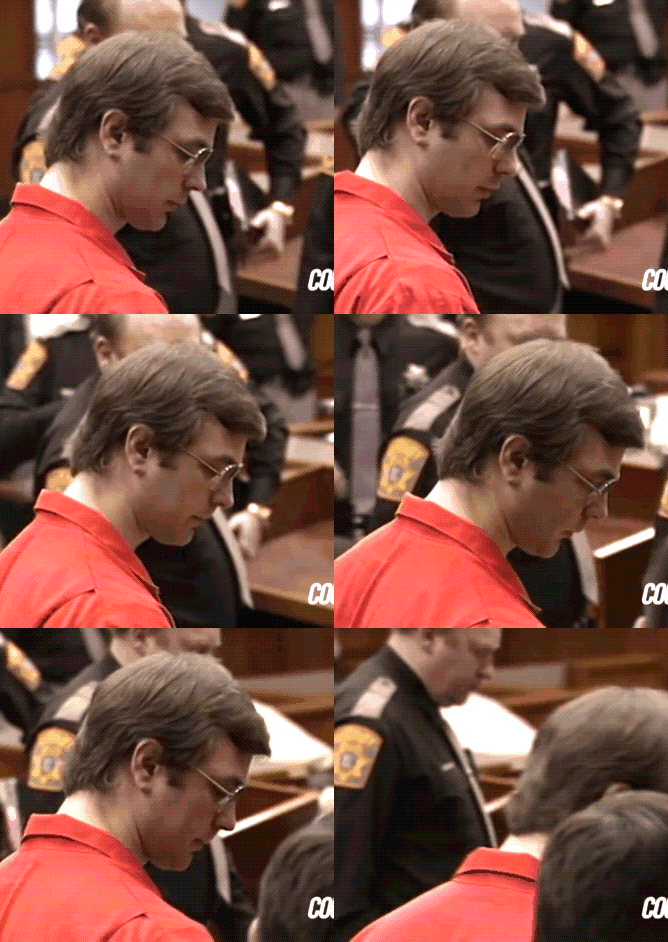
Posts

One Semester: Jeffrey Dahmer at Ohio State University

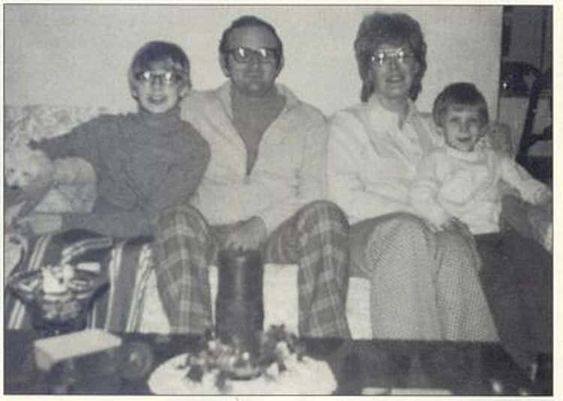
In September 1978, a eighteen-year-old arrived at the Columbus campus of Ohio State University with a bag that contained a snakeskin from Boy Scout camp and two photographs of his dog.

He had packed no books. He had no declared major beyond a vague gesture toward business. He had no interest in being there at all. He was going, as his father Lionel Dahmer would later write, more or less on orders.
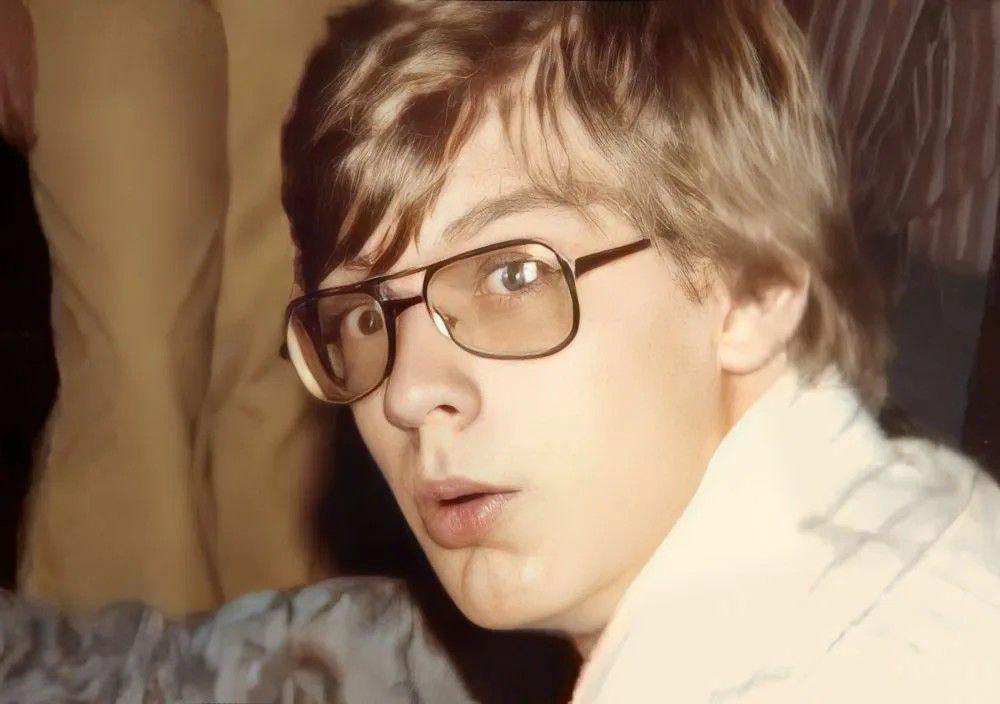
What nobody knew — not Lionel, not his new partner Shari who had enthusiastically taken Jeffrey shopping for college clothes, not the three roommates waiting in Room 541 of Ross House dormitory — was that Jeffrey Dahmer had already committed murder. Three months before he set foot on that campus, he had killed a nineteen-year-old hitchhiker named Steven Hicks. He had spent the summer alone with what he had done. And now he was supposed to go to university.


How He Got There

The summer of 1978 was, by any measure, a catastrophic unravelling of every structure in Jeffrey’s life.

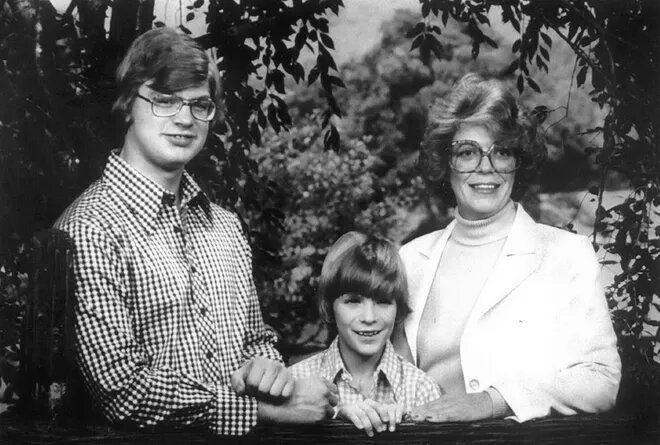
His parents’ divorce, years in the making, became final that July. His father Lionel had already moved out. His mother Joyce, in defiance of a court order, loaded the car in August and took twelve-year-old David to Wisconsin, leaving Jeffrey alone in the house on Bath Road. There was half a gallon of milk in the refrigerator and nothing else. The refrigerator itself was broken.

For weeks, no one noticed.

When Lionel eventually discovered what had happened — he had been unable to call or visit under the terms of the court order — he arrived to find Jeffrey, in Brian Masters’ words in The Shrine of Jeffrey Dahmer, looking “like an orphan, disoriented and vague.” He and Shari moved in immediately and set about sorting the situation. The solution they arrived at was college.

Shari drove Jeffrey shopping. She talked about how exciting it would all be — new people, new environment, a whole new experience. Jeffrey went along with it. His response to most suggestions at this period of his life was passive acquiescence. He nodded. He accepted. He forgot.

The university plan had originated earlier, at a family dinner following Jeffrey’s high school graduation. Lionel had told his sons that he could no longer afford to pay for college; the divorce had depleted him. Jeffrey’s grandparents offered to pay instead, if Jeffrey improved his grades. The decision had been made around him, for him, about him — without much consultation of the person most affected.

Shari and Lionel drove him to Columbus. Lionel felt, he would later write, some relief that his son was gone.


Room 541

Jeffrey was placed in Ross House dormitory, Room 541, sharing with three roommates: Craig Chweiger, Michael Prochaska, and Jeffrey Gerderick.

He gave them good reason, almost immediately, to think him strange.

He spent most of his time lying on his back in the top bunk, playing a Beatles album on repeat. The track he returned to most was I Am the Walrus. He pinned a photograph of Vice President Walter Mondale to the wall. He stacked all the room’s furniture in one corner for no apparent reason. He kicked the tiled wall of the bathroom and damaged it, again for no apparent reason.

Most of all, he drank.

The roommates’ account, gathered later by Lionel when he came to collect Jeffrey’s belongings, described a daily pattern of hard liquor — two bottles of whiskey a day — that left Jeffrey unable to get up for his morning classes. He would sometimes tape lectures so he could listen to them while he drank. He sold blood plasma at a university donation centre with such frequency that the staff eventually marked his fingernails to prevent him giving too often. He had no friends, no acquaintances. He seemed, as Masters records, to “appear to live in limbo.”

When the roommates went out together in the evenings, they left Jeffrey behind. He was considered, simply, too strange to bring along.

There was a row of beer and wine bottles lined up along the top of his closet. When Lionel collected his belongings at the end of the semester, it was the first thing he saw.

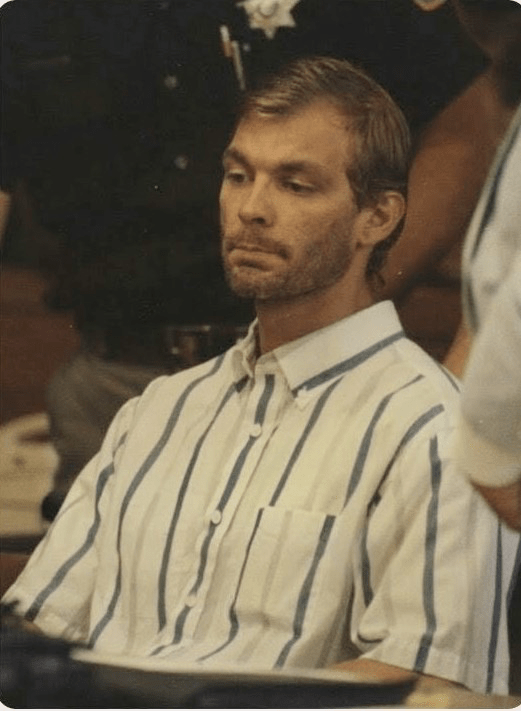
The grade report arrived a few days before Jeffrey himself did. After a full quarter at Ohio State, he had earned a cumulative grade point of 0.45 — two hours of college credit. He had failed Introduction to Anthropology. He had not completed Greco-Roman History. His highest grade was a B- in Riflery.

When Lionel told him he would not be returning, Jeffrey looked relieved. A burden had been lifted.


What He Was Carrying

It is impossible to understand the Ohio State semester without understanding what Jeffrey was carrying through it.

In June 1978, three months before he enrolled, Jeffrey had picked up a hitchhiker on a rural Ohio road and taken him back to the house on Bath Road, which was empty. Steven Hicks was nineteen years old. He had been on his way to see his girlfriend. He had taken off his shirt in the summer heat.

After a few hours, when Hicks said he was leaving, Jeffrey struck him with a barbell, strangled him, and spent the rest of that night and the following days in a state of terror, dismembering the body and scattering the remains.

He was eighteen years old. He was then left alone in that house for the rest of the summer, with what he had done.
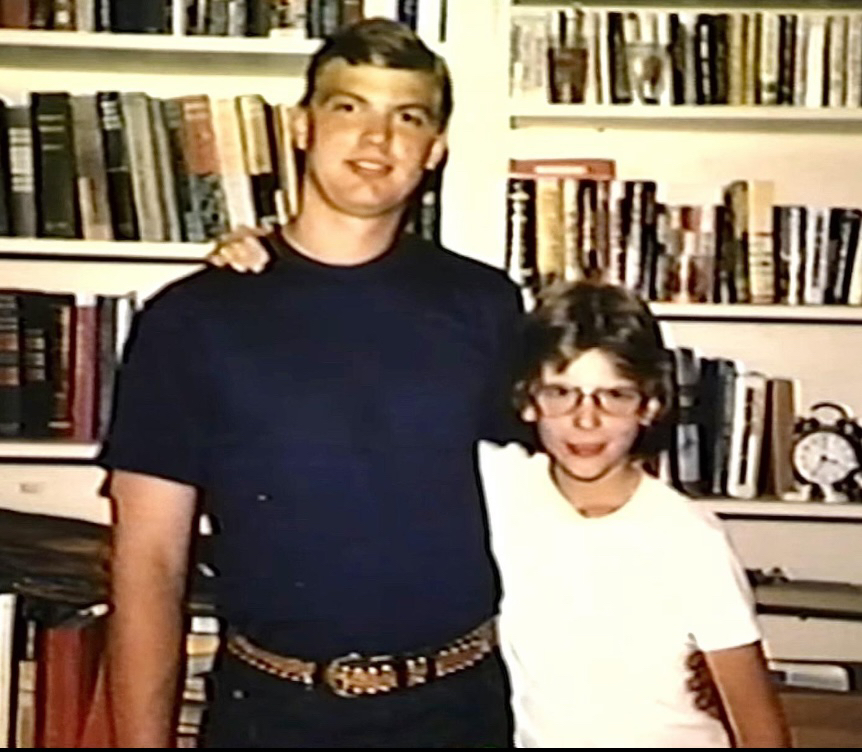
Lionel Dahmer, reflecting years later on the Ohio State period, would write that he knows now what Jeffrey was listening to in his silences, what pictures were flashing behind his eyes as he sat slumped on the living room sofa giving monosyllabic answers to questions. He was watching it again and again. His father described it as a horror show running ceaselessly behind Jeffrey’s moving eyes.

How trivial, Lionel would write, his talk of college and careers must have seemed to Jeffrey at that time. How odd and unrealisable all of it — my system of values, built on work and family, like quaint, incomprehensible artifacts from a vanished civilisation.

Masters’ account draws on interviews with Jeffrey himself, who confirmed that at Ohio State he broke down and cried alone in his room — once, and about Hicks. Not about any of the failures at university. About Steven Hicks.


After

By December 1978, it was agreed on all sides that Jeffrey would not return to Ohio State. Lionel began looking for what he could do with his son. Jeffrey cycled through aborted attempts at employment, was arrested drunk and disorderly at a local Ramada Inn, and finally exhausted the available options.

In January 1979, Lionel drove Jeffrey to the Army recruiting office in Akron. Jeffrey filled in the forms on what Lionel described as automatic pilot. He enlisted for three years.

He seemed, as he left for basic training, afraid.

The brief Army period that followed would be the only time in Jeffrey’s adult life when his drinking was controlled by external discipline — during the first weeks when no alcohol was permitted. When it was permitted again, he rushed back to it. He was discharged early, for alcohol dependency, in March 1981.
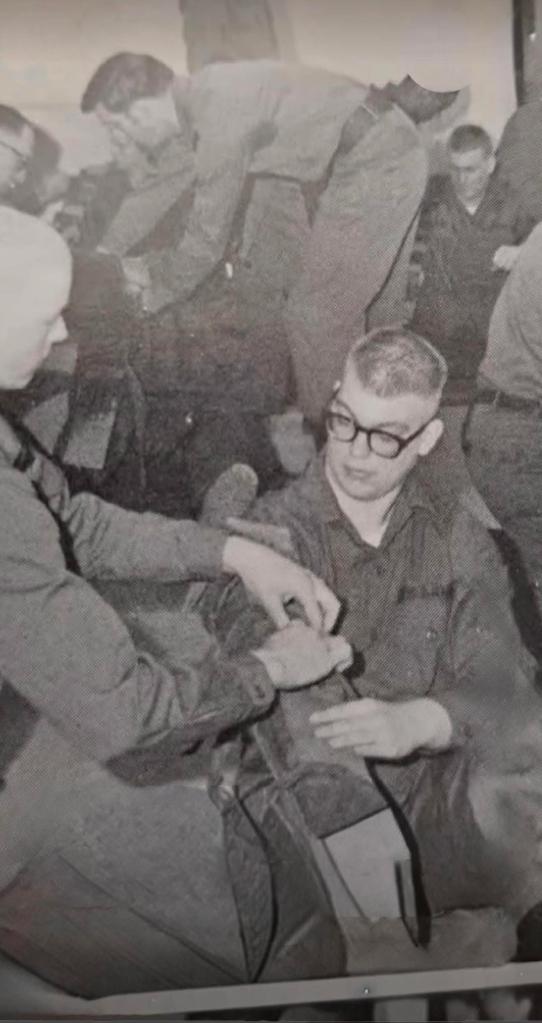
The Ohio State semester was one door closing among many. But it closes with particular weight. It was the first attempt by anyone to provide Jeffrey with the structures of an ordinary life — routine, study, peer community — after the summer in which everything had gone wrong. It failed completely, because the summer had left him carrying something no university semester, however well-intentioned, could contain or address.

He left that campus with 0.45 of a grade point and a beer bottle collection lined along a closet shelf. He left knowing something no one else in that dormitory knew, something he would carry for another thirteen years until, finally, in July 1991, he told Detective Patrick Kennedy what had happened on Bath Road in the summer of 1978.


Primary sources: Lionel Dahmer, A Father’s Story (1994); Brian Masters, The Shrine of Jeffrey Dahmer (1993).

A note on chronology: Steven Hicks was murdered on 18 June, 1978. His remains were not found until 1991.
The Human Being He Was: Documented Moments of Warmth in Jeffrey Dahmer’s Life

This article is not an attempt to redeem Jeffrey Dahmer, minimise his crimes, or suggest that the warmth documented here cancels out what he did. It does not.

What it is, is an honest accounting of something the public record shows but the media has largely ignored: that Jeffrey Dahmer was a human being, and that human beings — even those who commit terrible things — contain contradictions. He was capable of warmth. He was capable of genuine tenderness. He was capable, at moments, of reaching toward something good.

These moments are real. They are documented. They deserve to be known.


The Bird

In the early 1960s, when the family was living in Ames, Iowa, Jeffrey was out riding with his father when he spotted something on the pavement ahead. He insisted they stop.

It was a nighthawk that had fallen from its nest and lay helpless on the hard ground. Jeffrey urged his father to pick it up. Together, they took it home.

Over the next several weeks, the family nursed the bird — feeding it milk and corn syrup from a baby bottle, then solid food, watching it grow. When it was finally strong enough, they released it on a bright spring day. Lionel Dahmer, in his memoir A Father’s Story, writes that it may have been the single happiest moment of Jeffrey’s life.

Jeffrey’s eyes were wide and gleaming. He watched the bird rise into the sky.


The Animals He Cared For

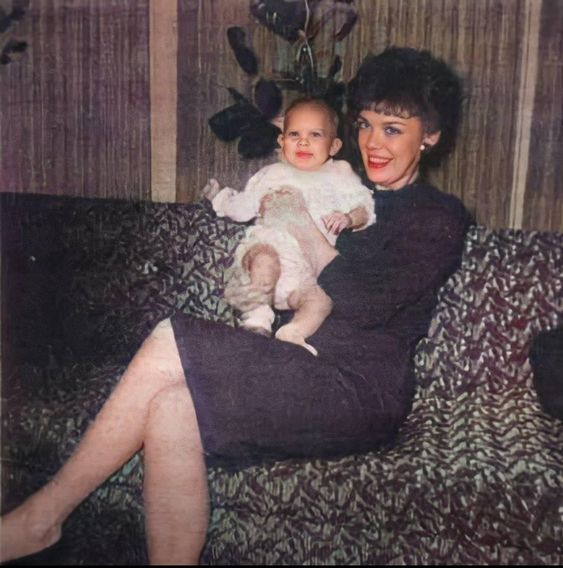
Joyce Dahmer’s diary notes that from very early in his life, Jeffrey showed unusual tenderness toward animals. At eighteen months, with a pet turtle, she wrote that he was “so very gentle.”

He had a series of pets throughout childhood — dogs, cats, fish, rabbits — and formed deep attachments to them. His dog Frisky, a cheerful animal who came with the family through multiple moves, held a special place. When the family relocated and could not always bring animals along, the loss of pets caused him real grief. He never grew accustomed to it.

Brian Masters, in The Shrine of Jeffrey Dahmer, notes that Jeffrey Dahmer never harmed an animal he knew personally. Whatever else his relationship to living creatures became, his affection for the animals in his care was genuine.


His Brother

When Joyce became pregnant with David, she worried about how Jeffrey would react. She needn’t have.

He patted her stomach before the birth, wanting the baby to know it had a brother. When David arrived, Jeffrey was good to him — not jealous, attentive, present in a way that sometimes surprised his parents.

Joyce wrote plainly: he loves Davy and is good to him.

It is a small record. But it is a true one.


The Tadpoles

When he was about eight years old, Jeffrey caught tadpoles in a stream near school and brought them to a teacher he liked. He gave them to her as a gift — simply and innocently, as an expression of affection.

She thanked him, and he was happy.

The story does not end there. When he later discovered she had given the tadpoles to another boy, he was devastated — not merely disappointed, but genuinely hurt by what felt like a betrayal. His response was destructive, and it was wrong. Lionel Dahmer identifies what followed as the first act of violence in his son’s life.

The memorial includes this story whole. The gift was real. The hurt was real. The response was wrong. All three are true simultaneously, and to tell only the first part would be dishonest.


The Newspaper Round

During the years the family lived in Bath, Ohio, Jeffrey had a neighbourhood friend named Steven. When Steven went on holiday, Jeffrey quietly took over his newspaper delivery round for him.

There was no fanfare in it. He simply did it. It is, in many ways, an unremarkable act of friendship — the kind that happens between children in neighbourhoods everywhere, and is barely remembered. But it happened, and it was kind.


The Dog in the Road

By the time Jeffrey was in high school, his closest companion was a boy with whom he shared the particular bond of mutual numbness. They drank together and existed in parallel, not really reaching each other.

One day, driving together, his companion began deliberately speeding up to hit dogs walking along the road. Over the course of that single afternoon, he did it repeatedly. Jeffrey was sickened. He told him to stop, then told him to let him out of the car.

He never forgot the frightened eyes of one small dog that went spinning over the hood.

Brian Masters writes that this moment — this instinctive refusal, this recognition of cruelty — may have been among the last times something genuinely responsive stirred in Jeffrey Dahmer. That it was among the last makes it worth noting, not dismissing.


His Grandmother

From 1981 until the crimes began in Milwaukee, Jeffrey lived with his paternal grandmother, Catherine Dahmer, at her home in West Allis, Wisconsin.

It was the most stable, most human period of his adult life.

He mowed her lawn. He shovelled her walks. He helped with the flowerbed. They watched television together after dinner. He smoked outside because she couldn’t tolerate smoke in the house, and he respected that without complaint.

He described her as “very kind, goes to church every Sunday, easy to get along with, very supportive, loving, just a very sweet lady.” It is, for Jeffrey Dahmer, an unusually warm description of another person.

During this same period, he gave money to people on the street and made small donations to missionary organisations. He was attempting, in his own way, to be good. For a time — perhaps two years — he managed it.


After the Arrest

When Jeffrey Dahmer was arrested in July 1991 and began confessing to police, he did something no one required of him.

He worked without stopping to identify every victim.

Detective Dennis Murphy sat with him through sixty hours of conversation. Jeffrey went through scores of photographs of missing persons, working until each one had been named. He said he did it because he did not want the families of those missing young men to wonder and gnaw at their hearts for years — because he had created the horror, and it fell to him to bring it to a complete end.

Detectives deliberately included photographs of men who were alive to test his veracity. He never once faltered. Some of the identifications were made possible only through him; without his cooperation, the families of several victims might never have known what had happened.

This was not innocence. It was not redemption. It was a man, at the end of everything, trying to do the one last small thing he could.


What This Means

These moments exist. They are documented in primary sources by people who were there — his father, the detective who spent sixty hours with him, the researchers who interviewed people who knew him.

They do not cancel out what he did. Nothing cancels out what he did.

But the memorial has always held that genuine humanisation requires looking at the whole person — not only the crimes, not only the horror, but also the child who wept at the release of a bird into a spring sky, the boy who was gentle with animals, the man who worked through the night to give names back to the dead.

These things are real. He was real. The contradiction is uncomfortable, and it is true.


Primary sources: Lionel Dahmer, A Father’s Story (1994); Brian Masters, The Shrine of Jeffrey Dahmer (1993).

Don’t Forsake Me: A Music Video About Prayer, Grace and What Crosses Time

Door213 and GoH | Mr. Whatever have released the official music video for Don’t Forsake Me (Jeff Version), a collaborative alternative and hip-hop ballad written, composed, produced and performed by both Vânia Netas and Jeffrey Knapp.

The song was written as a prayer — a plea not to be abandoned in the dark. The video extends that prayer into image.

What the Video Shows

The visual structure takes place across two spaces that exist in different dimensions of time.

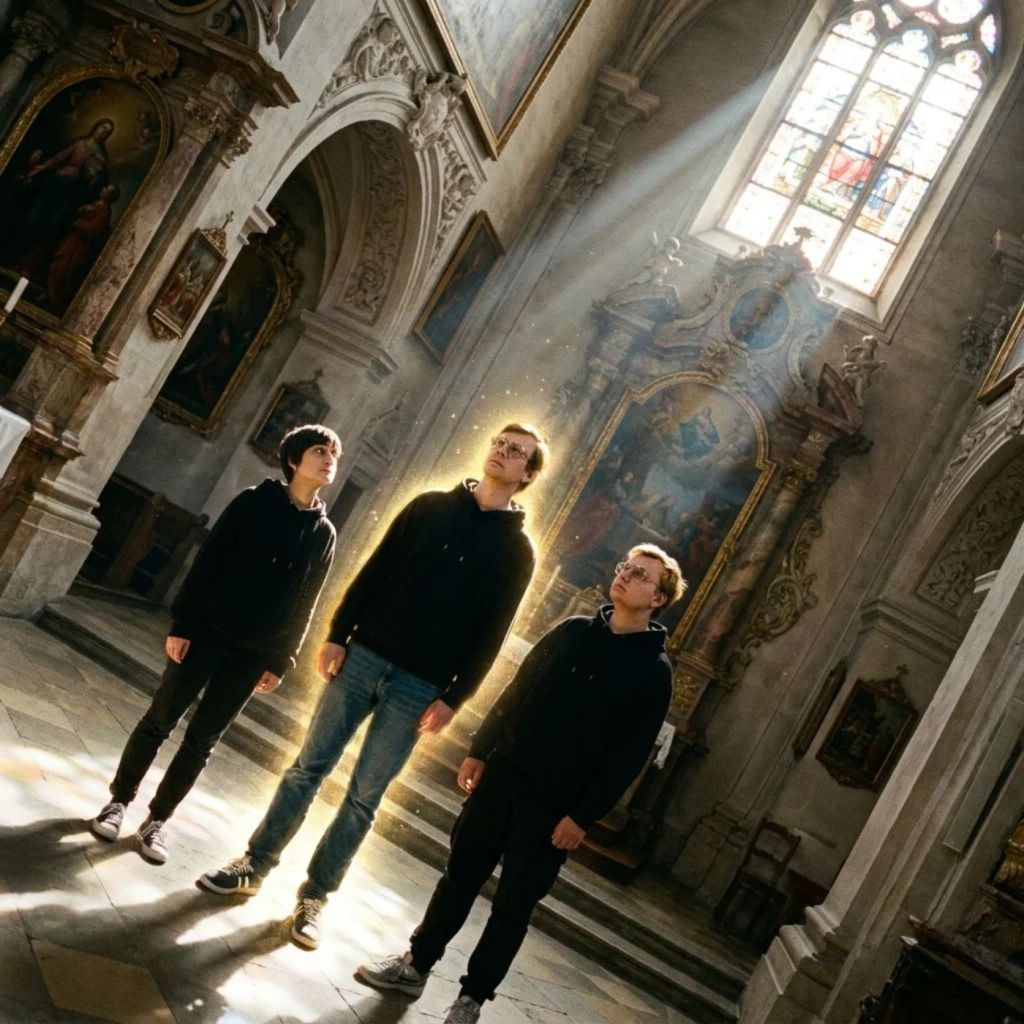
In the first, two figures — Vânia and Jeff — pray separately, each in their own sacred space. They are not together. They do not know each other is there. But the intention is the same: to reach through darkness toward something or someone who needs light.

In the second, Jeffrey Dahmer sleeps in a simple bedroom. He wakes slowly, as though something has reached him across the distance. He moves to the window. Light begins to spiral around him, lifting him — not dramatically, but gently, the way grace tends to arrive.

The two spaces are connected by prayer. The video makes that visible.

What It Is About

Don’t Forsake Me is about forgiveness, redemption, and faith — not as abstract concepts but as things people actually do, reach toward, and sometimes find. It is about the idea that genuine intention can cross time and space, that a prayer offered sincerely does not simply disappear.

It is also about the memorial’s central conviction: that Jeffrey Dahmer was a human being, that he suffered, that he sought grace in the final months of his life, and that the people who believe in holding his full humanity are not wrong to do so.

The video does not argue. It prays.

The Collaboration

Don’t Forsake Me (Jeff Version) is a joint work between Door213 (Vânia Netas, Portugal) and GoH | Mr. Whatever (Jeffrey Knapp, Germany). Both artists wrote, composed, produced and sang the track. Both voices are present throughout.

The video was generated and edited by the artists themselves.


Don’t Forsake Me (Jeff Version) is available now.

The Day Jeffrey Dahmer Was Baptised

On the morning of May 10, 1994, two events dominated the news in Wisconsin.

The first was a near-total solar eclipse. The noon sky darkened to something eerie and unsettling, the kind of darkness that makes people stop and look up and wonder what it means.

The second was the execution of John Wayne Gacy in Illinois. As was common ritual, reporters gathered opinions from people on the street. Was the eclipse a sign from God? Was it divine condemnation of the execution? Was it mercy? Everyone had a reading for the darkness.

Roy Ratcliff, a Church of Christ minister from Madison, Wisconsin, was driving through that same darkened afternoon toward the Columbia Correctional Institution in Portage. He was not going to witness an execution. He was going, as he would later write, to assist in a new birth.

He was going to baptise Jeffrey Dahmer.


How It Began

The chain of events that led to that afternoon began on an ordinary Wednesday evening five weeks earlier — April 6, 1994.

Curtis Booth, a minister in Oklahoma active in prison work, had been contacted by a prisoner in Wisconsin who wanted to become a Christian. Booth reached out to Rob McRay, a preacher in Milwaukee. McRay knew that Ratcliff lived closer to the prison and called him at suppertime — unusual timing, since both men had Wednesday evening services.

Before telling Ratcliff the prisoner’s name, McRay asked if he was sitting down. April 1st had been only a few days earlier, he said. This might sound like a hoax.

The prisoner’s name was Jeffrey Dahmer.

Ratcliff had never done prison work. He agreed to look into it.


Two Years Before the Water

What is less often noted is that Jeffrey’s turn toward faith did not begin in prison.

At his sentencing in 1992, Jeffrey read aloud from 1 Timothy 1:15-16: a passage about Christ coming to save sinners, “of whom I am the worst,” and about the worst of sinners being shown mercy as an example of what grace can do. He chose that passage deliberately. He read it in court, to the people whose lives he had destroyed. The media, according to what he told Ratcliff later, generally left that part out when they aired the coverage.

The seed was already there, two years before anyone baptised him.


May 10, 1994

Jeffrey had not been told the date of his own baptism. When he arrived in the conference room where Ratcliff was waiting, Ratcliff noted that he had not known the chaplains had kept him in the dark about this. Jeffrey arrived, in his prison uniform, excited.

He confirmed clearly that he understood what baptism meant in relation to his sins. He said he knew it washed them away, and that if anyone needed that, it was him. He said he was looking forward to it and counting on it.

He asked carefully about the exact words Ratcliff would say during the baptism. Other inmates had told him the words really mattered. He wanted to make sure everything was done right.

Before they were escorted to the baptism area, the prison chaplain made an unexpected suggestion: that Jeffrey consider an Islamic practice of rubbing hands against a rough surface for redemption rather than proceeding with Christian baptism. Ratcliff and Jeffrey looked at each other. Ratcliff declined on behalf of both of them. Jeffrey nodded in quiet gratitude.

Walking through the prison corridors toward the medical facility, another inmate called out to Jeffrey. “Hey J.D., how’s it going?”

Jeffrey answered: “Great! I’m going to be baptized today!”

The inmate’s face lit up. One of the prisoners walking the other way began humming a gospel tune. The guards and the chaplain said nothing to stop any of it.


The Whirlpool

The baptism took place in a prison whirlpool tub in the medical area.

The tub was small. When Jeffrey entered the changing room to put on the white polyester baptismal robe someone had prepared, Ratcliff waited in the hallway with the chaplain and a guard. They shared stories of baptisms they had witnessed. The chaplain spoke movingly of his daughter’s baptism. The mood in that hallway, according to Ratcliff’s account, was reverential.

When Jeffrey came out, he had already climbed into the tub and was turning around, figuring out the logistics. The tub was too small for him to stand. He had to curl into something close to a fetal position.

Ratcliff placed his hands on Jeffrey’s head and one shoulder. He said the words: baptising him upon his confession of faith in Jesus as the Christ, the Son of God, in the name of the Father and of the Son and of the Holy Spirit, for the forgiveness of sins.

He pushed him under the water until he was completely immersed.

When Jeffrey’s head broke the surface, Ratcliff said what he always says when he baptises someone: “Welcome to the Family of God.”

Jeffrey looked at him. The expression on his face, as Ratcliff would later describe it, was one of gladness and surprise.

He said simply: “Thank you.”


After

Walking back through the corridors, Jeffrey had a bounce in his step. He was, according to Ratcliff, obviously filled with joy.

Before Jeffrey was returned to his unit, Ratcliff made a request of the chaplain: he wanted to visit Jeffrey regularly — every week — to help him develop his faith. He didn’t want to simply disappear from his life.

Jeffrey’s reaction was one Ratcliff did not expect. He had a shocked look on his face.

He said he had assumed Ratcliff would leave and he would never see him again.

A man who had been expecting abandonment, surprised by continued care. It is a small detail. It stays with you.

Ratcliff visited weekly for the next seven months, until November 28, 1994.


What Happened on November 28

Ratcliff was driving home from the gym with his wife on a Monday morning, his day off. He was talking about things he intended to mention to Jeffrey when he visited on Wednesday. He had been thinking about a Thanksgiving card Jeffrey had sent him, which he described as one of his most treasured possessions.

He turned up the radio.

The announcer said Jeffrey Dahmer had been attacked and taken to hospital with massive head injuries.

Jeffrey died that day.

Ratcliff conducted a memorial service for him. Among those present was a sister of one of Jeffrey’s victims. She had been deceived into attending and arrived bitter. Afterwards she sought out Ratcliff. She said that hearing him describe Jeffrey as he had known him had helped her. She said she believed God had forgiven Jeffrey. She said she could forgive him, too, and move on.

Ratcliff later used an honorarium from Shari Dahmer for conducting the service to buy a wall clock for his living room. He calls it Jeff’s clock. It is there to remind him, he writes, of the lessons he learned and the value of time well spent.

His summary of the seven months is quiet and precise. Jeffrey, he writes, was ready to die. Ratcliff was the one who was unprepared.


Was He Sincere?

This is the question that follows any account of Jeffrey Dahmer’s baptism, and Roy Ratcliff addresses it directly in Dark Journey Deep Grace.

He notes something important about how the question is usually asked. The person asking, he observes, typically hoped to hear the answer no. Not because they had evidence of insincerity. But because a sincere Jeffrey Dahmer was a more difficult thing to hold in mind than an insincere one. People wanted a way to exclude him — from Christianity, from grace, from the category of people worth considering. The question was less about evidence than about permission.

Ratcliff was convinced of Jeffrey’s sincerity by a single moment. At the end of one of their Bible study sessions, just as the guard gave the signal that time was up, Jeffrey said something unprompted. He said he felt very bad about his crimes. He said he believed he should have been put to death by the state for what he had done.

Ratcliff agreed with him.

Jeffrey’s response was not what most people would expect from someone performing faith for an audience. He asked: “If that is true, am I sinning against God by continuing to live?”

It is a genuine theological question. It could only be asked by someone who had taken the framework seriously enough to follow it to uncomfortable places — who believed in the gravity of what he had done, believed in the reality of God’s justice, and was genuinely trying to understand what it meant to go on living under both.

You cannot perform that question. You can only ask it.


What This Means

The memorial does not ask you to feel certain about what happened to Jeffrey Dahmer after his death, or about the metaphysics of grace and forgiveness. Those are questions that belong to faith, and faith belongs to each person who holds it.

What the documentary record shows is a man who, in the final seven months of his life, engaged seriously with questions of guilt, meaning, and redemption. Who asked to be baptised not in a moment of crisis but after sustained conversation and study. Who cried out on the morning of the baptism to fellow inmates with simple joy. Who sat in a small whirlpool tub in a prison in Wisconsin, curled into himself to fit, and came up from the water saying thank you.

Roy Ratcliff called him Jeff. He drove through an eclipsed sky on the day of another man’s execution to offer him this. He visited every week for seven months. He was unprepared for him to die.


Dark Journey Deep Grace by Roy Ratcliff with Lindy Adams (Leafwood Publishers, 2006) is the primary source for the account in this article. It is the only firsthand account of Jeffrey Dahmer’s spiritual life written by someone who was present. The memorial recommends it unreservedly.

Dissociation and the Mind: Understanding a Possible Psychological Mechanism in Jeffrey’s Case

Dissociation is often misunderstood, yet it may offer valuable insight into how emotional detachment, fantasy, and disconnection can shape human behavior. This article explores the psychology of dissociation, what happens in the mind during dissociative states, and why some researchers have questioned whether these processes may have played a role in Jeffrey’s psychological functioning. Where does reality end and emotional detachment begin?

Dissociation is one of the most misunderstood concepts in psychology. It is often portrayed as something dramatic or rare, yet dissociative experiences exist on a spectrum and can occur in many different forms.

At its core, dissociation refers to a disruption in the normal integration of consciousness, memory, emotion, identity, perception, or awareness. In simple terms, it is a state in which a person becomes disconnected from aspects of their own experience.

Most people have experienced mild dissociation at some point in their lives. Becoming completely absorbed in a book, driving for several miles without remembering the journey, or feeling temporarily detached during periods of intense stress are all examples of common dissociative experiences.

More severe forms of dissociation, however, can be profoundly disruptive.

Individuals may feel disconnected from their emotions, detached from their surroundings, or separated from their own sense of self. Some describe the experience as feeling numb, unreal, or as though they are observing life through a pane of glass. Others report feeling as though they are watching themselves from outside their body.

Psychologists generally view dissociation as a protective mechanism. When emotional experiences become overwhelming, the mind may create distance between the individual and what they are feeling. In traumatic situations, this can serve as a form of psychological survival.

The brain, in essence, attempts to reduce emotional pain by reducing emotional presence.

While this mechanism can be protective in the short term, long-term emotional detachment may come at a cost. Individuals who frequently dissociate can struggle to identify and process their emotions, maintain meaningful relationships, or remain fully engaged with reality.

Research has shown that chronic dissociation can be associated with feelings of emptiness, emotional numbing, social withdrawal, and an increased reliance on fantasy as a source of comfort or escape.

This aspect becomes particularly interesting when examining Jeffrey’s psychological history.

Throughout interviews and personal accounts, Jeffrey frequently described feeling detached from others. He often spoke about loneliness, isolation, and a persistent sense of being different from those around him. He also described spending extensive amounts of time immersed in fantasies, sometimes to the point where those fantasies appeared more emotionally significant than real-life relationships.

From a psychological perspective, fantasy can sometimes serve as a refuge from emotional discomfort. When reality feels painful, disappointing, or overwhelming, an internal world may become increasingly appealing. Over time, the boundary between fantasy and reality can become psychologically significant, not because the individual loses awareness of reality, but because emotional investment becomes concentrated within the fantasy itself.

Some researchers and mental health professionals have suggested that Jeffrey’s extreme emotional detachment may have shared certain characteristics with dissociative processes. His descriptions of emotional numbness, his tendency to retreat into fantasy, and his difficulty forming genuine interpersonal connections have led some observers to question whether dissociation may have influenced aspects of his psychological functioning.

However, it is important to acknowledge the limitations of retrospective analysis.

There is no definitive evidence proving that Jeffrey experienced dissociative episodes during the commission of his crimes. No psychologist can fully reconstruct another person’s internal experience decades after the fact. Any discussion of dissociation in Jeffrey’s case therefore remains theoretical rather than conclusive.

Nevertheless, the concept remains valuable because it offers a framework for understanding how a person can become psychologically disconnected from emotions that would ordinarily guide human behavior.

Empathy, fear, guilt, shame, and emotional reciprocity are not simply moral concepts; they are psychological experiences that help regulate how individuals interact with others. When emotional connection becomes severely impaired, the consequences can be profound.

This does not mean that dissociation causes violence, nor does it excuse violent behavior. Millions of people experience dissociative symptoms and never harm anyone. Human behavior is influenced by a complex interaction of personality, environment, mental health, life experiences, and individual choices.

Yet understanding dissociation may help illuminate one piece of a much larger psychological puzzle.

In Jeffrey’s case, the question is not whether dissociation explains his actions. It does not.

The more meaningful question may be whether chronic emotional detachment, immersion in fantasy, and a diminished connection to both self and others contributed to the psychological landscape in which those actions became possible.

While definitive answers may never exist, the question itself remains worthy of examination.

Understanding is not the same as excusing.

It is simply an attempt to better understand the extraordinary complexity of the human mind.

The Ethics of Humanisation: Why We Refuse to Look Away

There is a question that follows this memorial everywhere.

It arrives in comments, in emails, in the occasional hostile message from someone who found us through a search engine and didn’t like what they found. It is sometimes asked in good faith, sometimes not. But it deserves a serious answer either way.

The question is this: how dare you humanise Jeffrey Dahmer?

This article is our answer.

What Humanisation Actually Means

Let us be precise about language, because imprecision is where most of this debate goes wrong.

To humanise someone is not to excuse them. It is not to forgive them on behalf of people who were harmed. It is not to celebrate them, defend their actions, minimise their victims, or argue that what they did was anything other than what it was: terrible, real, and irreversible.

To humanise someone is simply to refuse to pretend they were not a person.

Jeffrey Dahmer was a person. He was born. He had a childhood. He had fears and habits and preferences. He suffered. He caused suffering. He died. Every one of those things is true simultaneously, and none of them cancels out the others.

When we say we are humanising Jeffrey Dahmer, we mean we are documenting the full reality of who he was — not the cartoon monster, not the true crime celebrity, not the symbol that has accrued around his name over thirty years. The person. The actual, complicated, damaged, damaging human being who existed in the world.

That is all we mean. It is, we think, enough.

The Criticism, Taken Seriously

The people who object to humanisation are not always wrong to object. Some of their concerns are worth taking seriously.

The most common argument is that humanising perpetrators disrespects victims — that attention and understanding directed toward someone like Jeffrey Dahmer comes at the expense of the people he killed and their families. This is worth sitting with. The victims of Jeffrey Dahmer were real people whose lives were ended violently, whose families carry grief that will never fully resolve. They deserve to be named, remembered, and honoured.

We agree with this completely.

The question is whether understanding Jeffrey Dahmer somehow prevents that. We do not think it does. Grief for victims and understanding of perpetrators are not in competition. They can — and should — coexist.

A second argument holds that humanisation creates dangerous sympathy — that understanding someone leads to excusing them, and excusing them leads to imitating them. This is a serious concern in the context of true crime culture, where parasocial relationships with killers can become genuinely unhealthy. We have seen this ourselves in the communities that surround figures like Jeffrey Dahmer, and we have written about it directly.

But there is a difference between unhealthy obsession and rigorous examination. One looks for permission. The other looks for truth. This memorial is trying to do the latter.

A third argument is philosophical: that some people, through their actions, forfeit their humanity. That Jeffrey Dahmer did things so far outside the bounds of acceptable human behaviour that to call him human is almost a category error.

We understand the impulse behind this argument. We do not accept it. Humanity is not a reward for good behaviour. It is a condition of existence. Jeffrey Dahmer was human in the way that all people are human — not because he deserved it, but because he was born.

Why Understanding Matters

There is a practical argument for humanisation that goes beyond ethics, and it is this: dehumanisation makes us less safe.

When we turn perpetrators into monsters — incomprehensible, alien, categorically different from the rest of us — we stop asking the questions that might prevent the next one. We tell ourselves that what happened was an aberration, a freak of nature, something that could not have been predicted or interrupted. We look away from the warning signs, the failures of family and school and mental health systems, the long slow accumulation of damage that precedes most violence.

Jeffrey Dahmer did not appear from nowhere. He was a child before he was a killer. He passed through institutions — schools, the Army, the justice system — that had opportunities to intervene and did not. He lived in a society that did not know how to reach people like him, partly because people like him had been rendered unthinkable.

Understanding how that happened does not excuse it. It might help prevent it from happening again. That seems worth something.

What This Memorial Is Actually Doing

We want to be direct about what this project is and is not.

This is not fan culture. We are not here because we find Jeffrey Dahmer attractive or exciting. We are not collecting memorabilia or writing fiction that romanticises his crimes. We are not arguing that what he did was acceptable or that his victims deserved what happened to them.

This is a research and documentation project. We are gathering primary sources, examining the historical record, and writing about what we find with as much rigour and honesty as we can manage. We believe that the historical record of Jeffrey Dahmer’s life has been distorted — by sensationalism, by the entertainment industry, by the true crime ecosystem that has grown up around him — and that distortion does no one any good.

We also believe, and will say plainly, that Jeffrey Dahmer’s humanity is not a controversial position. It is simply true. He was a person. Treating him as one is not radical. It is the minimum that honest examination requires.

What Humanisation Costs

We want to close with something that often goes unsaid in this debate.

Humanising Jeffrey Dahmer does not cost victims anything. It does not diminish their suffering or reduce the wrongness of what was done to them. It does not transfer anything away from them toward him.

What it costs is our comfort.

It is more comfortable to believe that people who do terrible things are fundamentally different from the rest of us. It is more comfortable to draw a clean line between the comprehensible and the monstrous, to place Jeffrey Dahmer firmly on the other side of it, and to stop thinking about him as a person.

We understand that comfort. We are choosing not to take it.

Not because it is easy. But because the truth deserves it. And because the people who came after him — the ones who are suffering right now in silence, accumulating damage, moving toward something terrible — deserve a world that is willing to look clearly at how these things happen.

That is why we are here. That is what we are doing.

We think it matters.


jeffreydahmer.memorial is a research and documentation project dedicated to the rigorous, humane examination of Jeffrey Dahmer’s life and the questions it raises. We are not affiliated with any entertainment production, true crime platform, or fan community.

Still His Mother: The Life of Joyce Dahmer

She was writing him a letter when the phone rang.

It was an ordinary letter — the kind she had been writing him for two years by then. About the weather. About a book she had recently read. About the small, inconsequential movements of her days: what she had seen, what she had cooked, what her garden looked like that week. These were the letters of a woman who had learned, through extraordinary effort, what it meant to have a relationship with her son. They had arrived at a language, she and Jeffrey. A careful, gentle one. They had learned what to say and, more importantly, what not to say, and within those boundaries they had managed to build something that — against every conceivable odd — resembled closeness.

The call was from the warden. Jeffrey was dead.


The world had made up its mind about Joyce Dahmer long before it knew much about her. When Jeffrey’s arrest in July 1991 exploded across every news channel in America, the instinct to locate a source — a cause, a failure, a place to direct the horror — was immediate and powerful. Mothers have always been the easiest answer to that question. And so Joyce became the Monster’s Mother, a character more than a person, a symbol of everything that could go wrong in the formation of a human being.

It is worth pausing on what the world chose not to know about her.

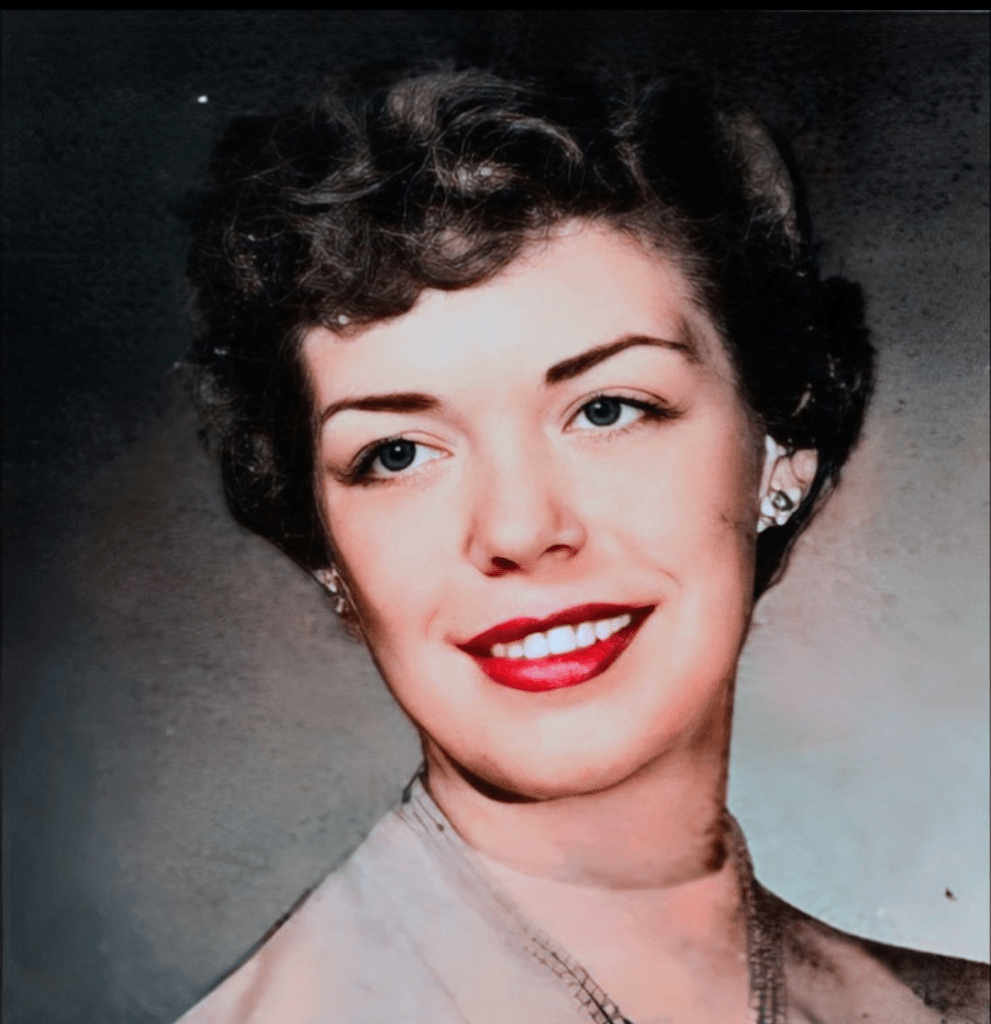
Joyce Annette Flint was born into a household where she was not exactly welcomed as a full person. Her father was domineering and controlling; she described her childhood as one of ridicule and servitude, of being shaped almost entirely around someone else’s expectations and needs. She was taught, as most girls of her generation were taught, that a woman’s destination was marriage and family, that there was nothing else available to her, that wanting more was a kind of ingratitude. When she was twenty-two, her father made clear that a good girl was a married girl. She married Lionel Dahmer.

She would spend years inside that marriage surviving it. The household she and Lionel built together was one of frequent, bitter conflict — arguments that became the furniture of the rooms Jeffrey and David grew up in, the constant background radiation of family life. Lionel was a chemist, more comfortable, by his own eventual admission, with petri dishes and chemical compounds than with human beings. He was demanding and critical, of Joyce and of Jeffrey both, a man for whom nothing was ever quite right, ever quite enough. Joyce fought back. Jeffrey, quiet and introspective, absorbed it differently.

She knew, later, that this had mattered. She came to understand that what Jeffrey had witnessed — what he had been marinated in, day after day — had pushed him further and further into himself, into the solitary, hidden world he had been building since childhood. She blamed herself for not seeing it sooner. She blamed herself for many things.


There are questions that follow Joyce through every account of this story, and they deserve honest answers.

Did she know? Not in the way the question usually implies. She did not know about the killings. But she knew other things, and she chose — sometimes consciously, sometimes not — to look away from them. She knew Jeffrey was drinking, heavily and young. She knew he disappeared into the woods for hours at a time and came back different. When her younger son David came to her, visibly distressed, with what he had witnessed, she told him he was wrong and sent him away. She knew, or strongly sensed, that Jeffrey was gay, and she could not find a way to open that door for him, to tell him it was safe to walk through it. She has spoken of this with grief — that she sensed it, that he was afraid, and that she did not reach out her hand.

This is not the same as culpability for seventeen murders. But it is also not nothing, and Joyce, to her credit, never pretended otherwise. She did not take the easy route of total self-exoneration. She understood that the atmosphere of her marriage, the things she had ignored, the conversations she had not been able to have — all of it had contributed, in ways she could not fully measure, to who Jeffrey became.

Did she love him? Yes. Without condition and, eventually, without illusion.


When Jeffrey was arrested, Joyce was living alone in another state. She had left Ohio years earlier, after the divorce, after Jeffrey had remained with Lionel and she had built a different life — returning to college, earning a graduate degree, working at an AIDS clinic where she counselled dying young men, many of them gay. There is something almost unbearably ironic in this detail: Joyce Dahmer, who could not speak to her own son about his sexuality, spending her working hours as a compassionate presence to gay men in their final days. She was good at it. Her colleagues valued her. She had found, in that work, a version of herself she was proud of.

She learned about Jeffrey’s arrest from the television. No one in the family called her.

She sat and watched the six o’clock news, and then the six-thirty, and then the ten o’clock, and then the eleven, and Jeffrey was the lead story on every one of them, and no one called. Not Lionel. Not David. Not a cousin, a friend, an in-law. She was the mother of the man they were discussing, and she did not exist to any of them in that moment. She found out what had been found in apartment 213 the same way everyone else did.

She went into hiding for three months, on the advice of Jeffrey’s lawyer, who had not even known Jeffrey had a mother until she called him herself.

When she came back out, the world had finished deciding what she was. She returned to work, and then the photographs of her sons were removed from her desk. Then her desk was moved to a back room, away from the public. Then she was quietly let go. She applied for other positions. Once it emerged who she was, the positions were suddenly filled. She was branded — she used that word — in a way that could not be undone. The scarlet letters, she wrote, burned into her life permanently.

It was around this time that Lionel published his book.


She did not write much about what Lionel’s book represented to her, but she did not need to. She had watched him remain in his hometown, keep his job, be surrounded by family and friends, rebuild his public image as a grieving father trying to understand the incomprehensible. She had watched him receive something that approached sympathy. And she had received nothing but condemnation.

She asked, simply and directly: why? Why was she alone branded as the Monster’s Mother while the man who had also raised him, who had also missed the signs, who had also been absent and critical and insufficient — why was he allowed to move on? She offered her own answer: because she was a woman. Because mothers are held to account in ways that fathers are not, because the mythology of maternal responsibility makes mothers both the source of all goodness and the target of all blame when goodness fails. She believed it was as simple as that. She was probably right.


The suicide attempt came when she had nothing left to lose.

She sat with the pills and she thought about Jeffrey — not the monster, but the quiet boy she had never really known how to reach, the child who had kept her at arm’s length all his life. She thought about what she had not done. She thought about Lionel’s book. She swallowed the pills one at a time, and then turned on the gas oven, and lay down to wait.

A salesman, ringing her doorbell and getting no answer, looked through the window.

She woke in a hospital bed furious to be alive.

Her son David flew out to take care of her. He smashed his fists through a wall when he heard what she had done. He tried to bring her home with him. She refused, and pushed him away, and then sat with the fact that at least one of her sons had loved her enough to rage at losing her.


It was after the attempt that she went to see Jeffrey in prison.

She had been preparing herself, she thought, to comfort him. Jeffrey had something else in mind. He wanted to confess — not to the courts, not to a therapist, but to his mother. He wanted her to hear it from him. He went through each victim, one by one, describing what he had done, and he stressed, again and again, the same thing: that he had always made sure they were unconscious. That he had not wanted them to suffer. That he had not wanted to be cruel.

She had trained as a therapist. She assumed that role now, because it was the only way she could stay in the room. As his mother she would have shattered. As a professional she could listen.

When it was over, she kissed him goodbye and drove directly to the nearest emergency room, where she spent the night with uncontrollable physical illness.

She held onto the only thing she had: at least he showed them mercy. It was not much. She knew it was not much. But it was the thread, and she held it.


After that visit, they began to build something. She called him every week. He looked forward to the calls. She wrote him letters about her garden, about television programmes she had watched, about books, about the weather, about nothing in particular. He wrote back. They found a rhythm, a language, a way of being with each other that had never existed when he was free and living in the world.

All his life, Jeffrey had kept her at arm’s length. In prison, he reached out. She has said that the relationship they built in those two years was the closest they had ever been. There is a grief in that sentence that goes beyond loss — it is the grief of things that arrived too late, of the door finally opening when there is nowhere left to walk.

She was still writing him a letter when the warden called.


Joyce Dahmer died in 2000, six years after Jeffrey. She spent those years largely in seclusion, in a home with a garden she had made her sanctuary. She showed people Jeffrey’s baby book. It was important to her, she said, that they understand he had once been just a child — laughing, arms stretched out for a hug, full of the same ordinary wonder as any other small person. She was not asking for forgiveness for him. She was asking for the acknowledgment that he had been human, and that she had loved him, and that both of these things were true at once.

She was not a perfect mother. She was not a monster either. She was a woman shaped by a difficult childhood, trapped in a painful marriage, unable to break certain silences that might have mattered, and then destroyed by a society that needed someone to punish and chose her.

She bore it. She remained. She wrote the letters.

She was always going to be Jeffrey Dahmer’s mother. She chose, in the end, to be exactly that — not in shame, but in the stubborn, clear-eyed love of someone who had finally learned what it meant to show up for another person, even from the other side of a prison wall, even when the world told her she had forfeited the right.

She was still his mother.

She was always going to be.

The Love He Could Not Name: Jeffrey Dahmer, Homosexuality, and a World That Had No Place for Him

There is a moment in Jeffrey Dahmer’s psychiatric interview with Dr Frederick Fosdal, recorded on January 9, 1992, that stops you completely. Fosdal asks him about his sexuality — when he knew, what he felt, what options he saw. Jeffrey’s answer is quiet and precise:

“I was 14 when I had the consenting meeting with Tyson at the club house — it was never talked about — there was no outlet. There was never any opportunity for a good sex life — I never saw any opportunity to meet anyone like that — it was just an issue that was never discussed in the community at all.”

Never discussed. No outlet. No opportunity.

This is not a man describing a preference. This is a man describing a wall.


America in the 1970s: The World Jeffrey Grew Up In

Jeffrey Dahmer was born in 1960. He was nine years old when the Stonewall riots happened in New York City in June 1969 — the moment often cited as the birth of the modern gay rights movement. Gay men and women fought back against a police raid on a Greenwich Village bar, and the world noticed.

But Stonewall happened in New York. Jeffrey grew up in Ohio.

The distance between those two realities cannot be overstated. The 1970s were a decade of paradox for gay Americans. In urban centres — New York, San Francisco, Chicago — a visible, increasingly confident gay culture was emerging. The Castro district in San Francisco became a neighbourhood. Gay bars multiplied. Publications emerged. A community, however fragile, was forming.

But in small towns, in suburbs, in the heartland — none of this existed. Or rather, it existed somewhere else, in whispers, in rumour, in something you might have heard about if you were lucky enough to know where to look. For a teenager in Bath Township, Ohio, it might as well have been on another planet.

The legal landscape was brutal. In 1970, sodomy laws — criminalising same-sex intimacy — were still active in every American state. By the time Jeffrey reached adulthood, some states had begun repealing them, but Ohio’s sodomy law remained on the books until 1974, and the culture around it changed far more slowly than the legislation. Gay men were arrested, harassed, fired, institutionalised, and disowned throughout the decade. The American Psychiatric Association had only removed homosexuality from its Diagnostic and Statistical Manual of Mental Disorders in 1973 — meaning that for the first thirteen years of Jeffrey’s life, his sexuality was officially classified as a mental illness by the foremost psychiatric authority in the country.

Then came 1981. The first reports of what would become known as AIDS began appearing in medical journals. By 1982 it had a name. By 1983 it was an epidemic. By the mid-1980s, when Jeffrey was in his mid-twenties and living in Milwaukee, AIDS had transformed the cultural landscape around homosexuality into something even more terrifying — a plague, in the public imagination, visited specifically on gay men. The stigma compounded. The silence deepened. The already-narrow spaces where gay men could exist without fear became sites of shame and death in the eyes of a fearful country.

This was the world. This was the air Jeffrey Dahmer breathed as he tried to understand himself.


Bath Township, Ohio: No Language, No Mirror, No Exit

Jeffrey grew up in a household where emotional and psychological complexity was rarely addressed directly. Lionel Dahmer’s memoir is honest about this — a household of silences, of difficulties managed rather than spoken about, of a father who loved his son but did not know how to reach him, and a mother whose struggles with mental health consumed enormous amounts of the family’s emotional oxygen.

Neither parent ever discussed homosexuality with Jeffrey. Not once. Not in any form.

In the Fosdal interview Jeffrey reflects on this directly. When asked about his sexuality, he says that in the community he was living in, homosexuality was the ultimate taboo. He never met anybody of the same mindset as himself. He never saw any opportunity to live normally. And so when the desire first fully crystallised — at around fifteen or sixteen, he says — he could think of only one way to satisfy it, and that way was forceful and wrong. He knew it was wrong. But he had no other model, no other path, no image of what a life like his could look like.

This is crucial. Not having a model is not a trivial thing. Psychologists who work with LGBTQ+ adolescents consistently identify mirror absence — the inability to see yourself reflected anywhere in the world around you — as one of the most psychologically damaging aspects of growing up gay in an unsupportive environment. Without mirrors, identity formation becomes distorted. You cannot build a healthy sense of who you are when who you are does not appear to exist anywhere.

Jeffrey had no mirrors. No gay teachers he knew of. No gay relatives who were out. No books, no films, no television characters. No community. No language that applied to him.

What he had instead was shame — and the very particular kind of shame that comes not from something you have done, but from something you simply are.


The Double Life Begins

At fourteen, Jeffrey had a consensual sexual encounter with another boy — Tyson, at the clubhouse. He never spoke of it again. It was never mentioned between them. There was nowhere to put it, no framework to understand it, no adult to turn to. It simply happened and was buried.

Lionel, in A Father’s Story, reflects with pain on how little he knew of Jeffrey’s inner life during those years. He describes a boy who kept everything to himself, who would talk but never confide, whose innermost thoughts remained completely private. Jeffrey himself confirms this in the Fosdal interview, describing how he simply felt it was best to keep his private thoughts private — that he didn’t really trust them with anyone, not even family members. Not because he feared a violent response, but because there was simply no language available, no way to say it, no expectation that it could be received.

Brian Masters, in The Shrine of Jeffrey Dahmer, traces the gradual internalisation of this secrecy. By the time Jeffrey reached high school he was already leading what he would later call a double life — not yet in the criminal sense, but in the most fundamental sense: a person whose inner reality bore no relationship to what anyone around him could see or know.

He was already, by his mid-teens, essentially alone.


Milwaukee and What He Found There

When Jeffrey eventually made it to Milwaukee — first briefly, then permanently from 1981 onwards — he found, for the first time, a world where his sexuality had a geography. There were bars. There were bath houses. There were men like him, or at least men who wanted something similar.

But even here, what he found was not what he needed.

In the Fosdal interview Jeffrey describes his experience of Milwaukee’s gay scene with a flatness that is quietly devastating. He went to bars. He went to bath houses — he estimates seventy-five to a hundred encounters over the years. He was, by the social conventions of that world, engaging with his sexuality. And yet what he describes is not satisfaction but a deepening of the original wound.

“The only long-term attachments that I was interested in was of a sexual nature — as far as regular friendships — it never interested me too much. After work I like to just go and do my own thing — go to the bars — try to meet the ideal person that I was physically attracted to.”

He was looking for something specific that the bath house circuit could not provide — not just physical encounter but permanence. Compliance. Presence. He describes daydreams not of violence but of lying with a good-looking guy, kissing, touching, in total compliance with my wishes. He wanted someone to stay.

“I guess I never took the time to really nurture any long-term relationships.”

And then, in answer to whether he might have found that if he’d looked harder:

“No. I didn’t. I guess I didn’t look hard enough.”

There is something almost unbearably sad about that answer. The pause before it. The admission of his own role in the failure. The recognition, from inside a prison cell in 1992, that somewhere out there were people who might have wanted what he wanted — and that he hadn’t found them, and that everything that followed came in the space between what he needed and what he could find.


The Question That Cannot Be Answered, Only Held

In the Fosdal interview there is one exchange that has stayed with us since we first read this document. Fosdal suggests that perhaps, had Jeffrey been able to form a compatible relationship, none of this would have happened. Jeffrey responds:

“And if I didn’t have such a desire for the total control and domination — right — if I wasn’t so selfish. I have to admit what I was doing was the ultimate in selfishness.”

He accepted responsibility. He did not blame his sexuality, his loneliness, his era, his community. He named his own pathology clearly.

But we are left — as the memorial always is — holding the complexity. The desire for control and domination did not emerge in a vacuum. It emerged in a person who had spent fifteen years with no outlet, no language, no mirror, no community, no model of what love between men could look like. It emerged in someone for whom intimacy had never once been modelled as safe, reciprocal, or possible to sustain.

We are not saying the environment caused what he did. We are saying the environment did not help. And that is the minimum we owe to honest examination.

Fosdal asks him near the end of the interview whether he was lonely during his high school years. Jeffrey answers:

“During high school years it was frustrating to not be able to meet someone of my interests so it was frustrating — yeah it was lonely.”

“What about afterwards?”

“And afterwards.”

“Like in Milwaukee — are you lonely?”

“Uh-huh.”

He was lonely his entire life. In Bath Township with no language for what he was. In Milwaukee with seventy-five to a hundred encounters that left him exactly where he started. In prison, talking to a psychiatrist through the bars, describing daydreams of someone just lying there, kissing, touching, staying.

“I can take it to a point, but not years and years.”

He said that about loneliness. Years and years of it. He could take it to a point.

He reached that point. The world he lived in helped put him there.


Sources: Frederick A. Fosdal, M.D., psychiatric interview with Jeffrey Dahmer, January 9, 1992; Brian Masters, The Shrine of Jeffrey Dahmer, 1993; Lionel Dahmer, A Father’s Story, 1994. Historical context on LGBTQ+ legislation and the AIDS crisis drawn from documented public record.

The Cannibal Myth: Why Jeffrey Dahmer Does Not Fit the Clinical Definition

Of all the labels attached to Jeffrey Dahmer’s name, cannibal may be the most viscerally powerful and the least clinically accurate. Like the word necrophile — which we addressed in a previous article — it is repeated so confidently and so frequently that it has become accepted fact. And like the word necrophile, it is wrong. Not wrong in the sense that Jeffrey Dahmer never consumed human flesh — the documented record confirms that he did, on a limited number of occasions. Wrong in the sense that the word cannibal, as a clinical and psychological category, describes a specific profile and a specific motivation. Jeffrey Dahmer does not fit that profile. Understanding why matters.

(Photo by Curt Borgwardt/Sygma/Sygma via Getty Images)

What Clinical Cannibalism Actually Is

Cannibalism as a paraphilic behaviour — that is, as a compulsive sexual or psychological fixation rather than a culturally or circumstantially motivated act — is classified in forensic psychology under the broader category of vorarephilia: a paraphilia in which the primary source of gratification is the act of consuming another person, or being consumed. In vorarephilic psychology, the consumption itself is the goal. It is the central fantasy, the organising compulsion, the thing toward which all other behaviour moves.

Research by Beier, Neutze, and Mundt (2009) on paraphilic disorders in forensic populations identified the defining characteristic of consumption-oriented paraphilias as the primacy of the consuming act in the individual’s fantasy and motivational structure. The consumption is not incidental. It is not instrumental. It is the point.

This distinction matters enormously when we examine Jeffrey Dahmer’s documented psychology.

What Jeffrey’s Own Accounts Tell Us

Jeffrey Dahmer was one of the most extensively interviewed violent offenders in modern American forensic history. His confessions were detailed, consistent, and remarkably self-aware. He had every reason — legal, psychological, personal — to construct his narrative carefully. And across every account, in the Fosdal psychiatric interview of January 1992, in the Kennedy interrogation transcripts, in his conversations with Roy Ratcliff, one thing is consistent: the consumption of human flesh was never described as a primary drive.

What Jeffrey described, consistently and with specificity, was a compulsion toward permanent possession. He wanted to keep the person with him. He wanted them to become part of him — inseparable, permanent, impossible to lose. In the Fosdal interview, he described his behaviour explicitly in terms of not wanting the person to leave. The fantasy was one of permanent union, of the other person becoming so thoroughly incorporated into his existence that separation became impossible.

In this context, the limited instances of consuming human flesh represented, in Jeffrey’s own psychological framework, the ultimate expression of that possession compulsion. Not a desire to eat, but a desire to keep. Not vorarephilia, but an extreme and catastrophic extension of the same attachment pathology that drove every other aspect of his behaviour.

He said it himself:

“I wanted to keep them with me. I wanted them to be a part of me.”

That sentence is the key. The motivation was not consumption for its own sake. It was permanent possession expressed through consumption.

The Forensic Psychiatric Assessment

Dr Judith Becker, Professor of Psychology and Psychiatry at the University of Arizona, testified at Jeffrey’s 1992 trial and provided the most detailed clinical evaluation of his paraphilic structure. Her assessment identified the primary paraphilia as organised around unconsciousness, control, and possession — not consumption. The behaviour involving human remains was assessed as an extension of the possession compulsion, not as an independent paraphilic drive.

Dr Fred Berlin of Johns Hopkins University reached similar conclusions. Neither evaluator identified a vorarephilic profile in Jeffrey’s psychology. Neither found evidence that the act of consumption was itself the source of gratification or the organising fantasy.

This is not a minor technical distinction. In forensic psychology, motivation is everything. The same external behaviour — consumption of human flesh — can arise from radically different psychological structures. In true clinical cannibalism, the motivation is the consumption. In Jeffrey Dahmer’s case, the motivation was possession, and the consumption was one instrument through which that impossible goal was pursued.

The Netflix Effect

The 2022 Netflix dramatisation Monster: The Jeffrey Dahmer Story placed enormous and disproportionate emphasis on cannibalism, including the now-notorious sandwich scene — which, as we have documented elsewhere, has no basis whatsoever in the factual record and was invented for dramatic effect.

The cultural result has been a significant distortion: in the popular imagination, Jeffrey Dahmer’s cannibalism has become central to his story in a way that the primary sources do not support. It is more viscerally shocking than somnophilia or possession compulsion or attachment pathology. It is more filmable. It is more clickable.

It is also more distorting. Every time we reduce Jeffrey Dahmer to the cannibal label, we close off the actual psychology — the attachment wounds, the developmental failures, the chronic loneliness, the possession compulsion — in favour of something that functions primarily as horror spectacle. We make him into a monster rather than a human being whose psychology, however catastrophic in its expression, is legible and documentable and connected to things that can actually be understood.

Why the Distinction Matters

This is not, to be clear, an attempt to minimise what happened. The acts documented in the forensic record are serious and devastating, and nothing in this article diminishes the weight of what Jeffrey Dahmer did or the harm caused to his victims and their families.

But accuracy matters. It matters for the same reason that the somnophilia distinction matters, and the same reason the myth-busting chapter of The Book of Jeff matters. When we apply inaccurate labels, we stop looking. We close the file. We decide that the explanation is the word — cannibal, monster, evil — and we move on without asking what the word actually describes, whether it applies, and what it would mean if it didn’t.

Jeffrey Dahmer was not primarily motivated by a desire to consume human flesh. He was motivated by a desperate, pathological, catastrophically expressed need to possess and to keep. That need had roots in early attachment failures, in profound and chronic loneliness, in a psychology that had never found a way to tolerate the ending of connection.

The cannibal label is simpler. The truth is more human.

And the truth is what we are here for.


Sources: Frederick A. Fosdal, M.D., psychiatric interview, January 9, 1992; Detective Patrick Kennedy, Grilling Dahmer, 2016; Dr Judith Becker, trial testimony, State of Wisconsin v. Jeffrey L. Dahmer, 1992; Dr Fred Berlin, trial testimony, 1992; Beier, Neutze and Mundt, Archives of Sexual Behavior, 2009; Brian Masters, The Shrine of Jeffrey Dahmer, 1993.

Exposing Fake Jeffrey Dahmer Channeling: When the Posts Write Themselves

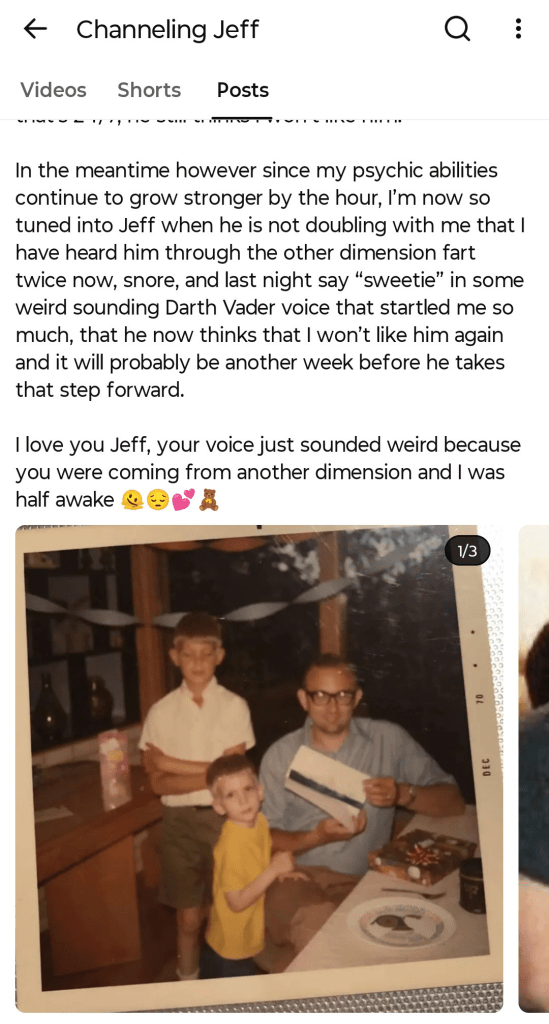
Remember “Person B” from our recent article about how a rare Jeffrey Dahmer army photo leaked into public circulation?

The one who runs a YouTube channel claiming to channel Jeffrey’s spirit? The one who believes Jeffrey is her biological father? The one the memorial has previously identified as fake spiritual content preying on grief and fascination?

Here’s what she posts. Daily.

We’re not adding much commentary. We’re just presenting it. You can judge for yourself.

The 5D Relationship

Let’s break down what’s being claimed here:

  • Jeffrey Dahmer (who died in 1994) is currently in “the 4d” (fourth dimension)
  • She is in “the 3d” (third dimension)
  • Therefore they are in a “5d relationship” (fifth dimension)
  • When Jeffrey “doubles with her” (whatever that means), they’re both in the 3d
  • They have such strong telepathy that they “don’t need to talk in our minds”
  • They’ve been together “24/7 for over two months now”
  • Jeffrey is “very shy” about manifesting physically in this dimension
  • He’s afraid she won’t like him

She then describes waiting for Jeffrey to “take one step forward” into this dimension so she can “see him and talk to him as if he never left.”

Dimensional Farts and Darth Vader

But wait. It gets better.

She continues:

“In the meantime however since my psychic abilities continue to grow stronger by the hour, I’m now so tuned into Jeff when he is not doubling with me that I have heard him through the other dimension fart twice now, snore, and last night say “sweetie” in some weird sounding Darth Vader voice that startled me so much, that he now thinks that I won’t like him again and it will probably be another week before he takes that step forward.”

Read that again.

She can hear Jeffrey Dahmer:

  • Fart (twice)
  • Snore
  • Say “sweetie” in a Darth Vader voice

All through dimensions. And because the Darth Vader voice startled her, Jeffrey now thinks she won’t like him and it will be “another week” before he manifests physically.

She ends with: “I love you Jeff, your voice just sounded weird because you were coming from another dimension and I was half awake 😂😔💕🤷‍♀️”

The Glasses That Don’t Exist

This same person claims to own several pairs of Jeffrey Dahmer’s glasses.

Jeffrey’s authenticated glasses are worth approximately $100,000 each. They are extremely rare, documented artifacts. There are perhaps a handful in existence, all accounted for in museums, authenticated private collections, or documented sales with provenance.

She does not have them. She cannot provide authentication. She cannot provide provenance. Because they don’t exist.

Why This Matters

This is what fake channeling looks like.

People who are grieving, fascinated, or seeking genuine connection with Jeffrey Dahmer can fall for this content. They might:

  • Give money
  • Give attention and platform
  • Share private material (like the army photo that was leaked from someone’s private collection)
  • Believe they’re participating in something sacred when they’re being manipulated

The memorial does not endorse channeling, mediums, or anyone claiming to speak for the dead. We exist to hold Jeffrey Dahmer’s full humanity — the real person who lived, suffered, hurt others, and died. Not a cartoon spirit who farts through dimensions and speaks in Darth Vader voices while being too shy to manifest.

The Posts Write Themselves

We don’t need to add much to this. The content speaks for itself.

Dimensional relationships. Telepathic conversations. Spiritual farts. Darth Vader voices. Fake glasses collections. Daily updates about why Jeffrey is too shy to step into the 3d.

This is not grief. This is not spiritual connection. This is not channeling.

This is someone making content for attention, claiming impossible things, and deceiving people who genuinely care about understanding Jeffrey Dahmer.

The memorial’s position is clear: this is fake. This is harmful. And we will continue to identify it as such.

If you encounter content like this — on YouTube, TikTok, or anywhere else — please approach it with skepticism. Ask for evidence. Ask for authentication. Ask why Jeffrey would be too shy to manifest but confident enough to fart audibly through dimensions.

And if something sounds ridiculous, trust your instinct. It probably is!