A Mind in Pieces: The Psychiatric Diagnoses of Jeffrey Dahmer

Jeffrey Dahmer was not simply a serial killer. He was a profoundly mentally ill human being who received almost no professional help during the years when intervention might have mattered. By the time psychiatrists formally evaluated him, it was in a courtroom, under oath, in the context of determining whether he should be held legally responsible for seventeen murders.

The diagnoses that emerged from those evaluations — and from subsequent academic research — tell a story that is more complex, more human, and more heartbreaking than most coverage ever acknowledges. This article attempts to compile and explain them properly, in one place, for the first time on this memorial.


The Legal Context

Jeffrey pleaded guilty but insane to fifteen counts of murder in January 1992. The trial that followed was not about whether he had committed the crimes — he had confessed to everything. It was about whether he understood what he was doing was wrong, and whether a mental disease had rendered him unable to control his behaviour.

The defence called three expert witnesses. Forensic psychiatrist Carl Wahlstrom diagnosed Jeffrey with necrophilia, borderline personality disorder, schizotypal personality disorder, alcohol dependence, and a psychotic disorder. The prosecution’s forensic psychiatrist Park Dietz diagnosed him with substance use disorder, paraphilia, and schizotypal personality disorder. Independent experts George Palermo and Samuel Friedman also testified, with Palermo concluding Jeffrey had a severe mixed personality disorder with antisocial, obsessive-compulsive, sadistic, fetishistic, borderline and necrophilic features.

Despite the weight of diagnoses, the court ruled him sane — primarily because he maintained comprehension of the legal and moral wrongfulness of his acts, took steps to hide his crimes, and tended to plan the murders beforehand, proving the crimes were not impulsive and uncontrollable acts in the context of mental illness.

Legal sanity and mental illness are not the same thing. Jeffrey was mentally ill and legally sane simultaneously. Both things were true.


Borderline Personality Disorder

Borderline personality disorder is characterised by intense emotional instability, a profound fear of abandonment, unstable and turbulent relationships, impulsive behaviour, and a fragile, shifting sense of self. It is not a disorder of coldness or detachment — it is almost the opposite. People with BPD feel things intensely, sometimes overwhelmingly, and their inner world is one of profound instability.

Jeffrey’s BPD manifested in specific and recognisable ways. The desperate need for connection — the longing, as clinical psychologist Samuel Friedman testified, for companionship — that drove his crimes was not the flat indifference of a psychopath. It was the anguished reaching of someone who could not form or sustain relationships through any ordinary means and whose disorder had catastrophically distorted the expression of that need.

The pattern of his adult life — the alcohol as emotional regulation, the isolation, the sense of being fundamentally different and fundamentally alone — is entirely consistent with untreated BPD in a person who had never received appropriate support.


Schizotypal Personality Disorder

This is the diagnosis that appears most consistently across all the expert evaluations, and it is the one most relevant to understanding Jeffrey’s interior world.

Schizotypal personality disorder involves ideas of reference — the belief that ordinary occurrences have special meaning — magical thinking, the sense of having some form of special power or perception, unusual perceptual experiences, and excessive social anxiety rooted not in negative self-judgement but in paranoid fears about others.
The yellow contact lenses, the ritual use of films before going out, the sense that certain objects and moments carried a charge others couldn’t perceive — these are textbook schizotypal presentations. So is the profound social isolation, the inability to form close friendships, the feeling of being fundamentally unlike other people.

Research suggests that childhood trauma, neglect, abuse, stress, and family dysfunction can increase the risk of developing schizotypal traits. People with the most severe cases usually have a combination of childhood trauma and a genetic basis for their condition. Jeffrey’s childhood — the parental conflict, Joyce’s mental health crises, the constant upheaval, the emotional unavailability of both parents — maps directly onto that profile.


Alcohol Use Disorder

Jeffrey had an alcohol abuse problem and started drinking heavily in high school. His drinking led him to become withdrawn and socially awkward. Eventually, his alcohol use disorder would force him to drop out of college.
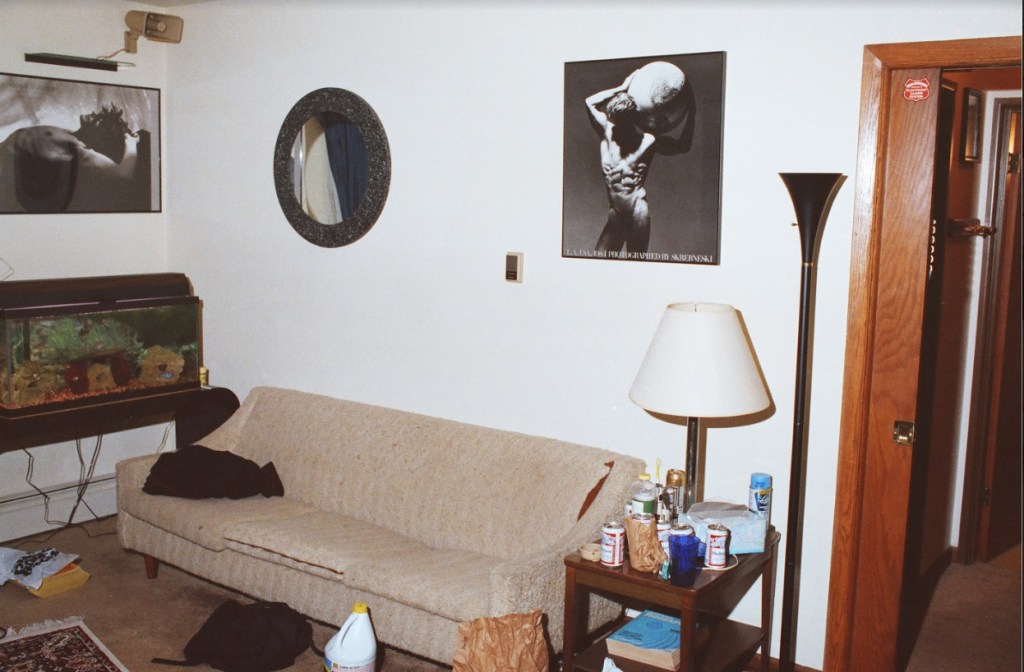
Alcohol was Jeffrey’s primary coping mechanism from adolescence onward. It lowered the threshold for acting on impulses he was otherwise able to suppress. It was what the army discharged him for. It was what filled his apartment in the form of empty Budweiser cans when he was depressed. It is what Lionel tried repeatedly and unsuccessfully to address.

Untreated alcohol use disorder in the context of BPD and schizotypal personality disorder is a particularly dangerous combination — each condition amplifying the others, each closing off the exits that might otherwise have been available.


A Physical Blow During Basic Training

Before Jeffrey ever reached Germany, his body had already sustained damage that belongs in any honest account of his psychiatric history. During basic training at Fort McClellan, Alabama, his persistent drinking got the entire platoon punished for his insubordination — and several of the men made sure he felt the consequences personally. The beating was severe enough to rupture his ear-drum, a wound that left him with recurring ear-aches for years to come. A blow forceful enough to cause that kind of damage is also the kind of physical trauma known to worsen pre-existing psychiatric conditions, erode impulse control, and deepen emotional dysregulation. It is one more layer of pressure added to an architecture that was already beginning to crack.

A Psychotic Disorder

The diagnosis of a psychotic disorder — distinct from psychosis as a symptom within another condition — acknowledges that Jeffrey experienced periods of significant detachment from reality. Symptoms including delusions, hallucinations, and disorganised thinking may have made him detached from reality at certain moments.

This is not the same as saying he was psychotic during his crimes. The prosecution’s case rested precisely on the evidence that he was not — that he planned, concealed, and understood what he was doing. But psychotic episodes, when they occurred, would have contributed to the overall disintegration of a mind that was already fragmented across multiple serious conditions.


The Trance States

There is one detail in the documented record that receives almost no serious attention, and it is one of the most potentially significant: the trance-like states.

Brian Masters documents at least one account of Jeffrey entering what can only be described as a dissociative or fugue-like episode — a period of apparent absence, of being present in body but not in mind, during which his behaviour seemed to shift beyond his ordinary conscious awareness. Jeffrey himself, at various points, described experiences consistent with dissociation — a sense of watching himself from outside, of compulsion overtaking volition, of not quite being present during the worst of what he did.
This has been largely ignored by the researchers and forensic professionals who evaluated him. It deserves not to be.

If these episodes were frequent rather than isolated, their origin could plausibly have been neurological rather than purely psychiatric. Temporal lobe involvement — temporal lobe epilepsy, complex partial seizures, or structural abnormalities in the temporal region — is associated with dissociative states, compulsive and repetitive behaviour, altered perception, and in some cases paraphilias. It was, on paper, exactly the kind of thing a neurological examination might detect.

As it turns out, that examination was performed. A competency evaluation conducted in April 1992 confirms that Jeffrey underwent an electroencephalogram (EEG), a CAT scan of the brain, and a chromosomal analysis. All three were reported as negative for pathology — no structural abnormality, no seizure activity, no chromosomal anomaly. This does not rule out every possible neurological contribution to the trance states, and EEGs in particular can miss intermittent or deep-seated abnormalities, especially when not conducted during an actual episode. But it meaningfully narrows the most obvious biological explanation. Joyce’s instinct that something physical might be found was tested, and the tests that existed in 1992 did not find it. The trance states remain real, documented, and significant — but the evidence available points toward a psychological and developmental origin rather than an undetected structural one. See our companion piece, “The Mind That Wouldn’t Stay,” for a fuller exploration of the dissociative reading.


Insomnia, Depression, and the Medication He Was Given

One documented but often overlooked aspect of Jeffrey’s medical history is his prescription for Halcion — a benzodiazepine sedative containing triazolam — prescribed by a physician for insomnia. Jeffrey worked the night shift at the Milwaukee Ambrosia Chocolate Factory and told his doctor he needed help adjusting to that schedule. The prescription was legitimate. The use he put it to was not.

That he required a sedative prescription at all is significant. Insomnia is a common companion to anxiety, depression, and the kind of psychological fragmentation that characterised Jeffrey’s inner life. Benzodiazepines like Halcion are also prescribed for anxiety — it is not possible to know from the documentary record whether anxiety was part of the clinical picture that prompted the prescription, but it would be entirely consistent with everything else we know about him.
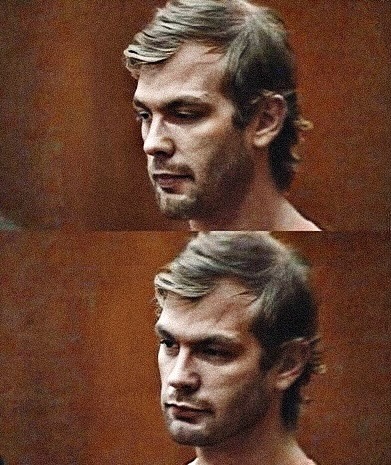
Created with RNI Films app. Preset ‘Agfa Optima 200 Warm’

Depression is not formally listed among his trial diagnoses, but it is strongly implied throughout the record. The periods of total collapse — when he would stop shaving, stop bathing, let the apartment fill with empty beer cans, and cease functioning in any ordinary sense — are consistent with depressive episodes. Lionel mentioned his son’s suicidal thoughts after conviction. Jeffrey himself said, in various formulations over the years, that he did not care whether he lived or died.

By April 1992, we know this was addressed, at least in part: the competency evaluation prepared ahead of his trial documents a prescription for Prozac — two 20mg capsules each morning — from his treating psychiatrist Dr. Richard Arnesen, alongside sessions three times a week with clinical psychologist Dr. Patricia Allen. What isn’t documented is whether that level of care continued through the remainder of his incarceration; see our companion piece, “August 24, 1993: A Crisis Report,” which examines what the record shows roughly a year and a half later. What is clear is that the suffering was real and consistent — present since adolescence, visible on paper as early as the 1986 MMPI, and addressed only partially and only very late.


The Asperger’s Hypothesis

More recently, researchers have proposed an additional framework. A study by Silva, Ferrari and Leong in the Journal of Forensic Sciences (2002) proposed that Jeffrey was most likely on the autistic spectrum, specifically with the hypothesis of him having Asperger’s disorder.
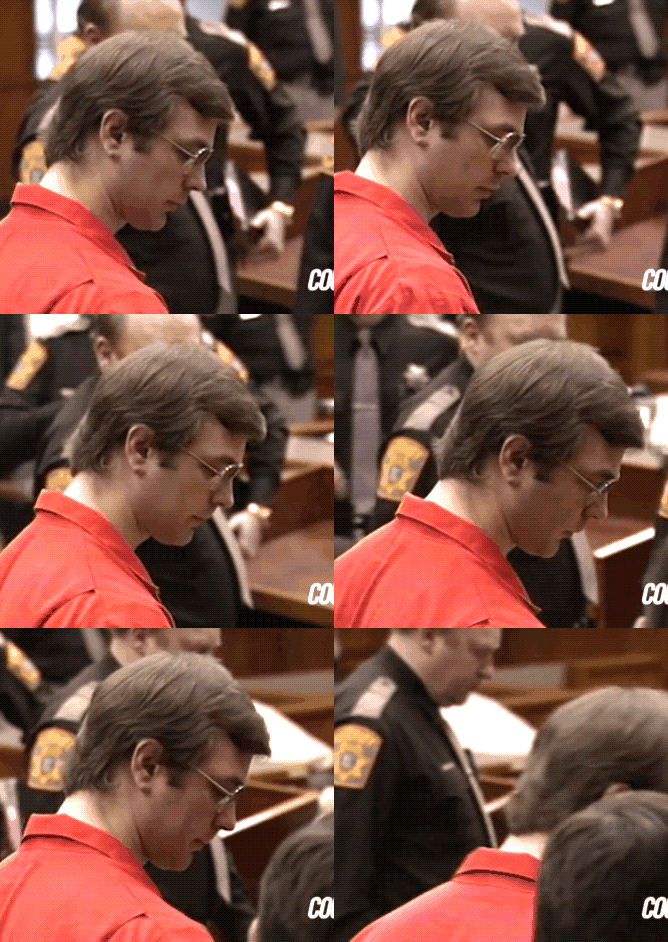
The case for this is not trivial. Jeffrey’s social difficulties went beyond anxiety or paranoia — there was something in the texture of his social interactions, his inability to read and respond to ordinary social cues, his preference for solitary rituals and highly structured activities, his intense and specific interests, that some researchers believe points toward autism spectrum presentation.

His own words at various points support this reading: “The subtleties of social life were beyond my grasp. When children liked me, I did not know why. Nor could I formulate a plan for winning their affection. I simply didn’t know how things worked with other people.” That description is not of someone who doesn’t want connection. It is of someone who cannot navigate the basic social architecture through which connection normally forms.


What Was Not Diagnosed: The Absence of Psychopathy

It is worth stating clearly what Jeffrey was not diagnosed with, because the popular image of him as a psychopath — cold, calculating, without feeling — is contradicted by the clinical record.
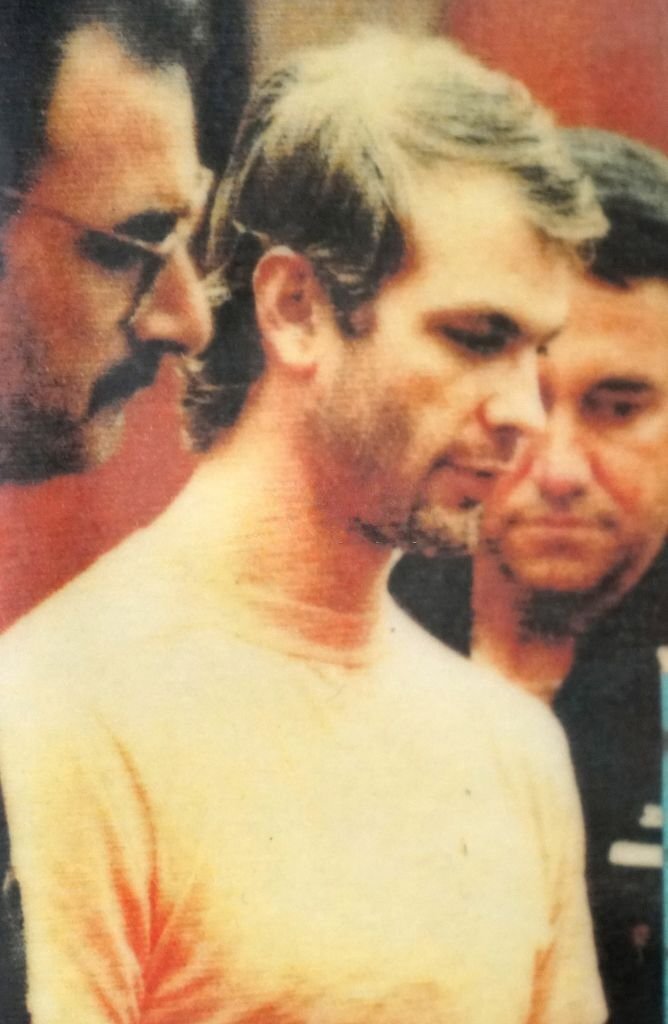
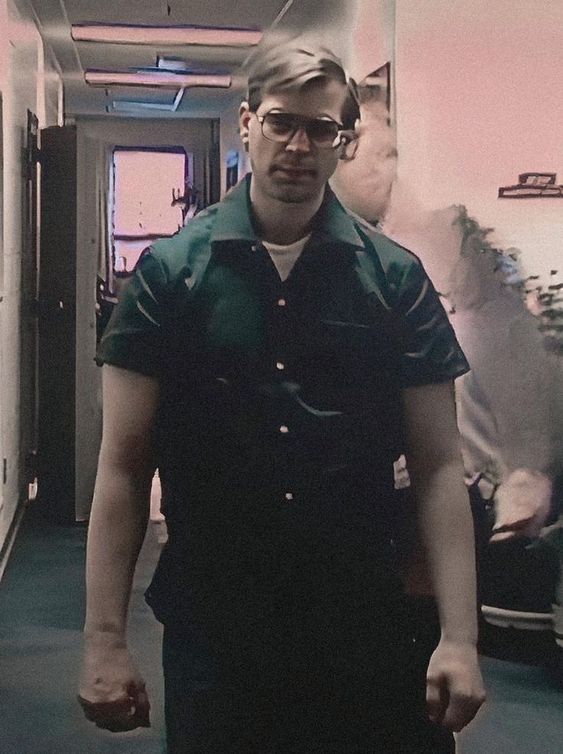
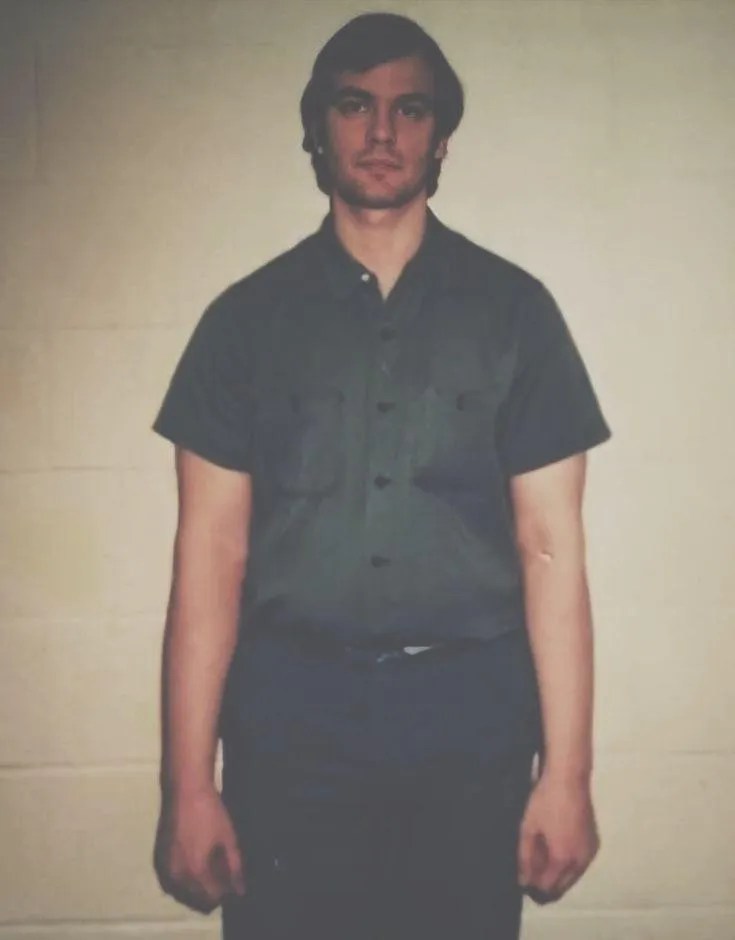
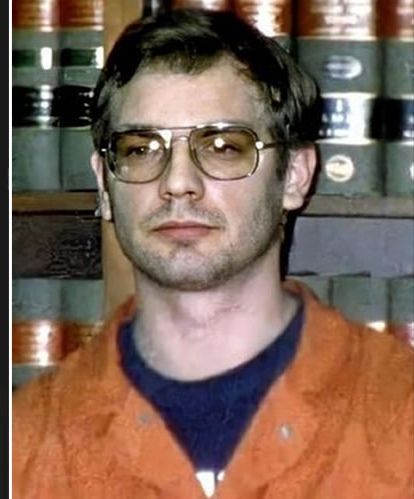
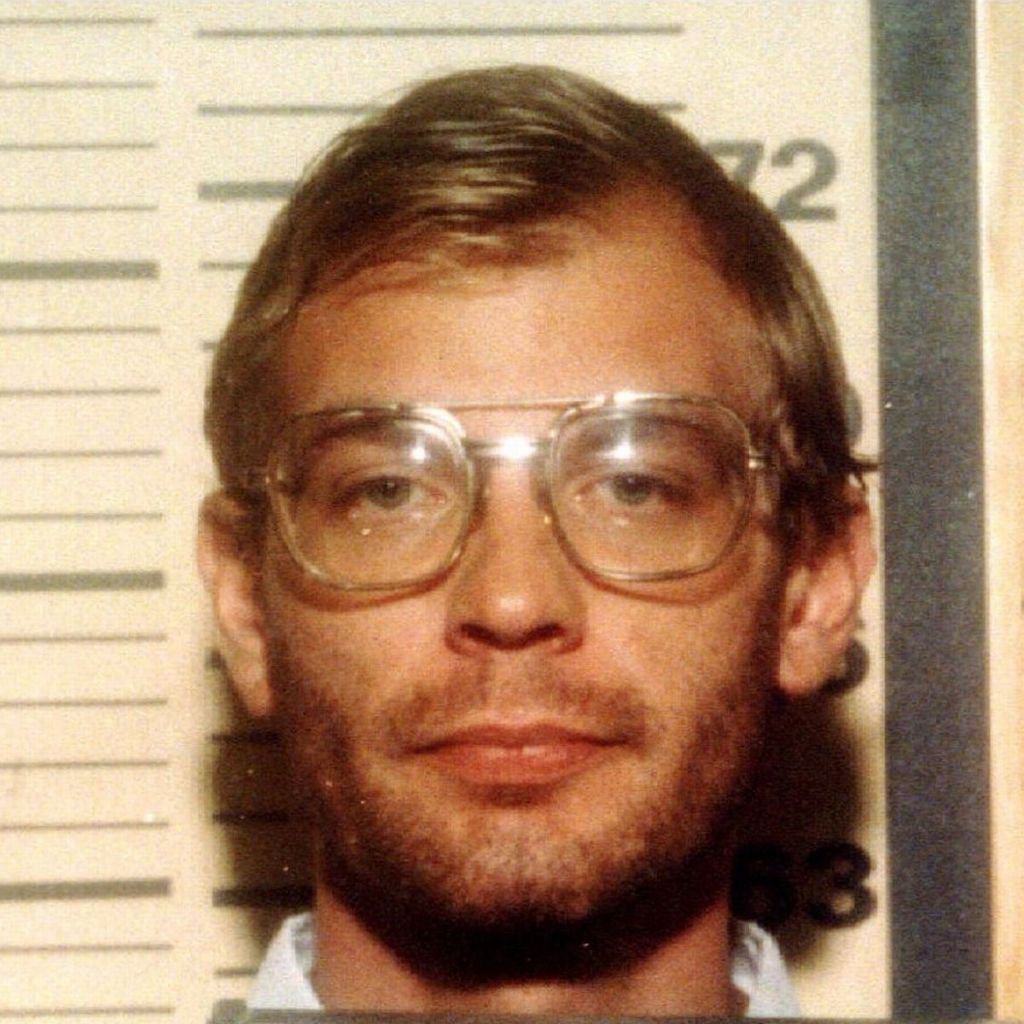
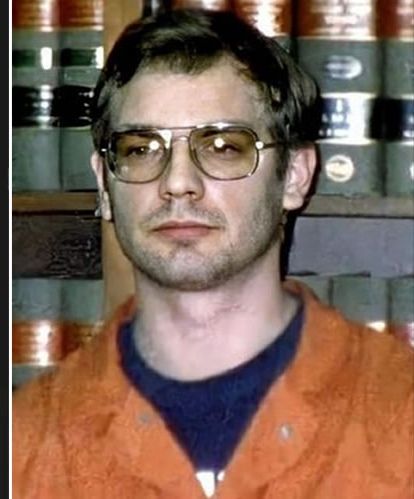
Photograph of Jeffrey Dahmer taken during his trial. (Photo by: Universal History Archive/ Universal Images Group via Getty Images)

Psychopathy, characterised by a fundamental absence of empathy and remorse, shallow affect, and manipulative interpersonal behaviour, does not fit. Other evidence does not support a diagnosis of psychopathy. Jeffrey wept during his confession. He expressed genuine remorse at his sentencing. He underwent sincere religious conversion. Reverend Roy Ratcliff, who spent months with him, described a man with genuine emotional depth and authentic spiritual searching. These are not the behaviours of a psychopath.

He had empathy. It was distorted, misdirected, catastrophically expressed — but it was there.


The Central Question

The question that runs through all of this is not whether Jeffrey was mentally ill. He clearly was, significantly, with multiple overlapping conditions that had been present since childhood and that received essentially no treatment until he was in prison for murder.

The real question is what might have happened had any of this been identified and treated earlier. The BPD, the schizotypal traits, the alcohol dependence, the insomnia, the depression that was never formally named — these were not invisible. They were present, and they were ignored.
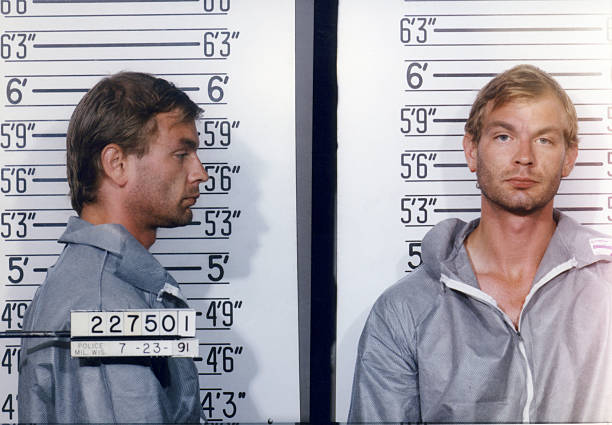
(Photo by Curt Borgwardt/Sygma via Getty Images)

There were points of potential intervention throughout his life — the withdrawn child after the hernia surgery, the isolated teenager collecting animal bones, the army discharge for alcoholism, the beating that ruptured his ear-drum, the earlier arrest. At each of these junctures, the system that might have helped him either missed him entirely or responded inadequately.

Jeffrey Dahmer was not a monster who emerged fully formed from nowhere. He was a severely ill person, carrying a constellation of serious conditions through a childhood and adolescence that offered him almost nothing in the way of support, understanding, or care.

That does not explain away what he did. Nothing explains that away. But it is part of the truth — and the memorial exists to hold the whole truth.


A Final Note, Corrected

This article originally claimed that no neurological examination was ever performed on Jeffrey Dahmer — no CAT scan, no MRI, no EEG — and that the questions about a possible biological origin for his trance states and compulsive behaviour were never seriously pursued while he was alive.

That claim was incorrect, and the record deserves to be set straight. A competency evaluation dated April 27, 1992, conducted ahead of his trial, confirms that Jeffrey underwent an electroencephalogram, a CAT scan of the brain, and a chromosomal analysis. All three were reported as negative for pathology. He was also administered a substantial battery of psychological testing across multiple dates in 1991 and 1992, building on earlier testing from 1986 and 1989, including the Wechsler Adult Intelligence Scale, the Rorschach, and the Minnesota Multiphasic Personality Inventory — corroborating findings of high IQ and an absence of psychotic thinking.

So the picture is more complete, and more carefully examined, than this article previously suggested. The biological question Joyce had always asked — was there something in the brain — was in fact tested, at least to the extent 1992 neurology allowed. The tests came back clean.

What remains true is this: those tests happened before trial, in the context of determining legal competency and sanity — not in the context of ongoing psychiatric care during his three years at Columbia Correctional Institution afterward. No further neurological investigation is documented during his incarceration, and the trance states, the dissociative episodes, the compulsive patterns that defined his adult life were not revisited neurologically after 1992. The brain itself was never studied after death, despite Joyce’s wish that it be — a separate and still-accurate fact, addressed in our article “The Dehumanisation of Jeffrey Dahmer.”

What we got wrong was the claim that no examination ever took place. What remains accurate is that the examination that did take place was early, limited to the tools available in 1992, and was never revisited as his case — and his trance states — continued to raise unanswered questions for the rest of his life.

After his death on November 28, 1994, there was a brief window. Joyce requested that Jeffrey’s brain be preserved for scientific study, believing that research might yield something useful — not to excuse what he did, but to understand it. Lionel opposed it. The dispute went to court. In the end, the brain was cremated along with the rest of his remains.

Whatever was there — if anything — is gone. We will never know.


Sources: Trial testimony of Dr. Carl Wahlstrom, Dr. Park Dietz, Dr. George Palermo, Dr. Samuel Friedman, Dr. Fred Berlin, 1992; Jeffrey L. Dahmer, Competency Evaluation, Case No. F-912542, April 27, 1992 (primary source document); DSM-5 diagnostic criteria; Silva, Ferrari & Leong, Journal of Forensic Sciences 2002; Strubel, Comorbid Psychopathologies 2007; Brian Masters, The Shrine of Jeffrey Dahmer 1993; Lionel Dahmer, A Father’s Story 1994; Wikipedia. Note: formal diagnosis of depression is not documented in available trial records; its presence is inferred from behavioural accounts.

November 28, 1994: The Last Morning

Jeffrey Dahmer woke up on the morning of November 28, 1994 — a Monday, Thanksgiving week — and did what he had been doing every morning for nearly three years. He got up. He got dressed. He went about his day.

He had no idea it was the last one.


The Morning

By late 1994, Jeffrey had been at Columbia Correctional Institution in Portage, Wisconsin for almost three years. He was no longer in protective isolation. After a first year spent largely separated from general population, he had gradually been integrated — attending classes, eating communal meals, performing work duties. He had earned, through quiet compliance and genuine religious engagement, a degree of ordinary prison life that most had assumed he would never be allowed.

He had been baptised six months earlier, in May 1994, submerged in the prison whirlpool by Reverend Roy Ratcliff of the Church of Christ. They had met every week since. Five days before his death — on November 23 — Jeffrey and Ratcliff had their final Bible study session together. They discussed the Book of Revelation. Its subjects: death, punishment for sins, and what comes after.

On the morning of November 28, Jeffrey left his cell to conduct his assigned work detail. He had been on cleaning duty for three weeks. That morning he was assigned to the gymnasium with two other inmates — Jesse Anderson, convicted of murdering his wife, and Christopher Scarver, serving life for a murder committed in 1990.

The three were taken to the gym by corrections officers, unshackled, and left to clean the bathrooms. They were left unsupervised for approximately twenty minutes.


What Happened in the Gym

Scarver had despised Jeffrey from the moment they arrived at Columbia at roughly the same time in 1992. He had kept his distance, watching from across the yard, repulsed by what he knew of Jeffrey’s crimes. He had carried a newspaper clipping about those crimes in his pocket for a long time — a physical reminder of his disgust.

That morning, while Scarver was filling a mop bucket with water, someone poked him in the back. He turned around. Both Jeffrey and Anderson were laughing quietly. He couldn’t tell which of them had done it.

Scarver retrieved a 20-inch metal bar from the weight room. He followed Jeffrey into a staff locker room and confronted him — showing him the newspaper clipping, asking him directly if he had done those things.

Jeffrey was shocked. He started looking for a way out. Scarver blocked the door.

According to Scarver, Jeffrey’s last words were: “I don’t care if I live or die. Go ahead and kill me.”

Scarver brought the bar down. He crushed Jeffrey’s skull with two blows. He then crossed the gym to where Anderson was working and did the same to him. The entire thing took roughly twenty minutes.

At approximately 8:10 in the morning, a corrections officer discovered Jeffrey on the bathroom floor with catastrophic head wounds. He had been beaten across the skull and his head had been repeatedly slammed against the wall.

He was still alive. He was rushed to a nearby hospital.

He was pronounced dead one hour later. He was 34 years old.


The Guard Question

Jeffrey was not supposed to be in an unsupervised situation with other inmates. He had known enemies in the prison — he had survived an earlier attack in July 1994 when inmate Osvaldo Durruthy slashed at his throat with a razor blade embedded in a toothbrush as he sat in the prison chapel. He had received only superficial wounds that time.

Scarver himself later said he believed it was no accident that he ended up alone with Jeffrey that morning. Prison officials, he claimed, knew how much he despised Jeffrey. They knew the history. And on November 28, they left the three of them together, unshackled, unsupervised, for twenty minutes.

Whether this was negligence or something more deliberate has never been officially established. The Wisconsin Department of Corrections blamed staffing issues. The investigation concluded without any guards being held accountable.

But the question remains. It has never been fully answered.


Joyce

When news of Jeffrey’s death reached his mother Joyce, her response cut through everything:

“Now is everybody happy? Now that he’s bludgeoned to death, is that good enough for everyone?”

It was the cry of a mother. Whatever she had done and not done, whatever had passed between them — in that moment, she was simply a woman whose child had been killed.


No Services

Jeffrey had left instructions in his will. He wanted no services conducted. No funeral. No headstone. No ceremony of any kind.

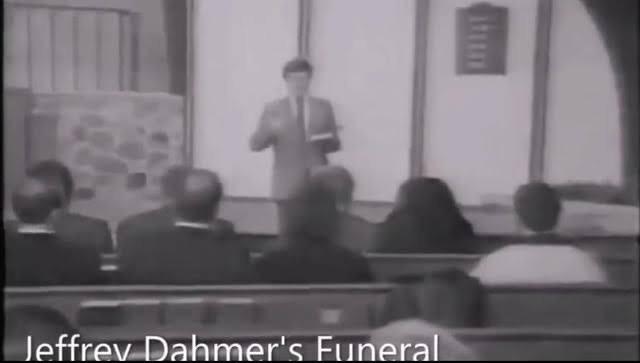
His wishes were respected, in that sense. There was no public funeral. No gathering. No words spoken over him in a church or at a graveside. The man who had been the subject of global media coverage for three years was disposed of, in the end, with complete silence.

His body was held by investigators — it was evidence in his own murder case — for nearly a year. Christopher Scarver was sentenced in May 1995 for the killings. Only then were Jeffrey’s remains released to his family.

On September 17, 1995 — almost ten months after his death — Jeffrey Dahmer’s body was cremated. His ashes were divided equally between his parents. Lionel took his half back to Ohio. Joyce took hers to California.


The Brain

Before cremation, doctors had opened Jeffrey’s skull and removed his brain. It had been preserved in formaldehyde at the Dane County Medical Examiner’s Office since his autopsy.

What followed was one final, painful dispute between his parents.

Joyce wanted the brain donated to science. She believed, and had always believed, that something biological had contributed to what Jeffrey became — and she wanted to know what. She told the Milwaukee Journal Sentinel: “Jeff always said that if he could be of any help, he wanted to do whatever he could.”

Lionel refused. He wanted the brain cremated with the rest of his son’s remains. He argued that Jeffrey had requested cremation and that this request extended to every part of him. To retain the brain against his wishes, Lionel said, would be legally and morally wrong.

Two scientists had written to the court requesting access. One, Jonathan Pincus of Georgetown University, described it as “an unparalleled chance to possibly determine what neurological factors could have contributed to his bizarre criminal behaviour.”

The case went to the Wisconsin state court. On December 13, 1995 — more than a year after Jeffrey’s death — Columbia County Circuit Judge Daniel George ordered the brain cremated. The scientists never studied it. Whatever was there — whatever might have explained something, or explained nothing — was gone.


What Was Left

Jeffrey Dahmer died at 34. He had been in prison for two years and nine months. He had been baptised six months before his death. He had met with his pastor five days before it. He had, by every account of those closest to him, been sincere in his faith and genuine in his remorse.

He died in a bathroom, on a Monday morning, before most people had finished breakfast. He died because he was left unsupervised with a man who hated him, for twenty minutes, in a maximum security prison. He died with his head on the floor.

He had asked for no ceremony. He got none.

He had asked to be cremated. He was — eventually, in pieces, disputed even in death, his brain held in a jar while his parents fought over it in court.

He had said, months before he died, that he sometimes wondered whether he was sinning against God by continuing to live. Reverend Ratcliff, who loved him, had no answer for that.

“I don’t care if I live or die.”

He had been saying some version of that for years. His mother had called him weekly and whenever she expressed concern for his safety, he told her: “It doesn’t matter, Mom. I don’t care if something happens to me.”

He meant it. He had meant it for a long time.

The baptism, the Bible study, the weekly meetings with Ratcliff — those were not the actions of a man who had given up. They were the actions of a man trying, quietly and seriously, to make something meaningful from whatever time remained. He was not performing. The people who were there said so.

He deserved more time.


Photographs of Jeffrey Dahmer deceased exist and have circulated widely online. The Memorial does not share them and will not share them. As we do not publish photographs of the victims out of respect for their dignity and humanity, we extend that same respect to Jeffrey. A person’s death is not public property. We ask anyone using those images for display — on social media, forums, or elsewhere — to please consider removing them. They do not dignify the human being who passed away. They never have.


Sources: Wikipedia; Biography.com; The Washington Post; Los Angeles Times; Reverend Roy Ratcliff, Dark Journey Deep Grace (2008); Christopher Scarver, New York Post interview (2015); Wisconsin Department of Corrections records.

How Jeffrey Smelled: English Leather and the Scent of Apartment 213

There is something extraordinarily intimate about a person’s fragrance. More intimate, perhaps, than almost anything else we can know about them. A scent bypasses the intellect entirely — it goes straight to memory, to feeling, to the body’s oldest and most instinctive responses. To know what someone smelled like is to know something no photograph can tell you.

Jeffrey Dahmer wore English Leather.


The Cologne

English Leather by Dana is one of the great American colognes — drugstore-priced, unpretentious, and genuinely complex underneath its modest presentation. It was originally created in the 1930s by the Vienna-based MEM company, and because its scent was similar to what Russian saddlers used to tan leather, it was originally called “Russian Leather.” In 1949, it was introduced in the United States as “English Leather” — the name change a quiet casualty of the Cold War.

By the time Jeffrey was wearing it in the 1980s and early 1990s, English Leather had been a fixture of American drugstore shelves for forty years. It was the kind of cologne a man bought without ceremony, without fuss. Affordable, reliable, masculine in the old-fashioned sense of the word. You could find it next to Old Spice and Brut on the same shelf. Jeffrey, who lived simply and spent little on himself — who pawned his blue topaz ring when cash ran short — would have appreciated exactly that.


What It Smells Like

English Leather opens with Italian bergamot and kaffir lime — vivid, tangy citrus notes that create an immediate sharp freshness. The heart settles into leather, oakmoss and vetiver, the signature leather accord woven throughout. The base is warm and woody: sandalwood, cedarwood, musk.

In practice — on skin, in the air, in a room — it moves through three distinct phases.

The first impression is bright and citrusy, slightly sharp, a clean burst that announces itself without aggression. Then, as the cologne settles, something darker and richer emerges — the leather note, dry and genuine, accompanied by the green earthiness of oakmoss and the slightly smoky, almost metallic depth of vetiver. As the scent matures, the signature leather heart softens the opening accords, mingling with vetiver and oakmoss, before the woody base notes take over and create a warm foundation.

The final dry-down is the most intimate stage — sandalwood and cedarwood, soft and warm, with a musky undertone that stays close to the skin. This is what lingers. This is what someone standing near Jeffrey would have caught hours after he first applied it.

Reviewers note it can still be detected on skin six hours later and on clothing twelve to twenty-four hours after application. English Leather is not a shy fragrance. It was present. It was there in the room.


The Character of the Scent

English Leather is, above all, a scent of contradictions held in balance — and that feels appropriate.

It is simultaneously clean and dark. The citrus top notes suggest freshness, order, Sunday morning tidiness — the Jeffrey who vacuumed on Sundays, who kept his apartment neat, who shaved and took care of himself when he was doing well. But the leather and wood base is something older and more instinctive — animal, earthy, rooted.

One reviewer described it as evoking a spacious, musty 1980s hotel lobby — dimmed lighting, carpeted staircases, wood and gold fittings, and the slight smell of stale smoke. Strange and subtle, with an allure that is almost comforting or nostalgic. That description feels uncannily right for Jeffrey’s world.

It is not a flashy cologne. It does not announce wealth or ambition or seduction in any obvious way. It is the scent of someone who has chosen something and stuck with it — unpretentious, consistent, quietly present. Very Jeffrey.


To Wear It

English Leather is still available today, still produced by Dana, still affordable — you can find it online for under fifteen dollars. For those who want to know, in the most direct and physical way possible, something of what it was like to stand near Jeffrey Dahmer on an ordinary evening — this is the closest you can get.

The bergamot first. Then the leather settling in. Then, hours later, just the warm wood and musk, close and quiet.

He was there. He smelled like this.


Sources: Dana Classic Fragrances; Fragrantica; FragranceX; Daily Lather. English Leather by Dana, originally launched 1949.

Infinity Land

There is a moment in almost every childhood where the world becomes too large and too unpredictable to bear. The adults are fighting. The house is moving again. Nobody is explaining anything. And so a child does what children do when the outside offers no safety — they build something on the inside. A private world with its own rules, its own logic, its own borders. A place that belongs entirely to them.

Jeffrey Dahmer built his at around the age of nine. He called it Infinity Land.


What It Was

The game was drawn on paper. Stick figures — fleshless, bone-only, stripped of flesh entirely — moved across a landscape governed by a single absolute rule: if they came too close to one another, they were annihilated. Surrounding them were spirals, tightly wound, intensely imagined, pulling downward toward a black hole at the centre of everything.

He shared it with his friend David Borsvold — a quiet, rock-collecting, dinosaur-studying boy who was perhaps the closest thing Jeffrey had to a genuine companion during those years. Together they played out these annihilations, moving their little armies across a world where closeness meant destruction and the only destination was oblivion.

Brian Masters, in The Shrine of Jeffrey Dahmer, described the game with the care it deserves. The stick figures were not conceived with the full contours of people. They were bone. Their danger lay in proximity. And the spirals descended, always, toward the black hole of infinity.

He called it Infinity Land. He was nine years old.


What It Meant

Here is what I believe, having lived with Jeffrey in my thoughts for so long: Infinity Land was not a symptom. It was a solution.

By the time Jeffrey drew those first spirals, his life was already shaped by things a child has no language for and no power over. His mother Joyce’s mental health crises — the seizures, the medication, the hospitalizations, the rages. His father Lionel’s long absences, buried in his chemistry PhD. A family in near-constant motion, address after address, the ground never quite solid underfoot. A boy who had become, very early, extremely alert to instability — watching the room, reading the atmosphere, waiting for the next thing to shift.

He could not control any of that. But in Infinity Land, he controlled everything.

He made the rules. He decided the physics. He drew the borders of the world and determined what happened inside them. The stick figures obeyed laws he invented. The spirals descended at his direction. The black hole waited at the centre, patient and absolute, because he had placed it there.

This is what children do with anxiety they cannot name. They build containers for it. Games with highly defined rules — and Lionel Dahmer himself noted that Jeffrey always preferred games with exactly that: defined rules, repetitious actions, nothing left to chance or confrontation. The structure was the comfort. The rules were the shelter.

Infinity Land was Jeffrey’s most complete version of that shelter.


The Symbology of the Spiral

A spiral is not simply a shape. It is a direction. It implies movement — inward, downward, tightening — toward a centre that cannot be reached or escaped. Every civilisation that has ever drawn a spiral has understood, on some level, that it means something about time, about fate, about the way certain forces pull you regardless of your will.

Jeffrey drew spirals at nine years old and gave them a destination: a black hole. Infinity. Nothingness that was not frightening but — as he would say decades later in prison, when a therapist asked him about the game — soothing. Nice. Like a child asking for a warm blanket.

That detail stops me every time I return to it.

The nothingness at the centre of Infinity Land was not a threat. It was a comfort. For a boy who lived in a house full of noise and volatility and unpredictability, the absolute stillness of the void was something to move toward rather than away from. It was the one thing that could not suddenly change its mind, raise its voice, or disappear.

It was reliable. In its way, it was safe.


The Annihilation Rule

The stick figures were annihilated if they came too close.

Masters read this as a sign of Jeffrey’s relationship with intimacy — the danger of closeness, the way contact meant destruction. And he was right. But I think there is something else in it too.

When you are a child and the people closest to you are also the sources of the most unpredictability — when the arrival of a parent means tension rather than relief, when love comes wrapped in volatility — you learn, very early, that proximity is risk. You learn to keep a careful distance. You learn that the safest position is adjacent, not close.

Jeffrey encoded that knowledge into his game at nine years old without knowing that’s what he was doing. He made a world where the rule he was already living by — don’t get too close, it ends badly — was written into the physics of the universe itself. Not as a wound but as a law. Clean, legible, certain.

In Infinity Land, you always knew exactly what would happen if someone came too close. There were no surprises.


The Game That Didn’t Stay a Game

Brian Masters returned to Infinity Land again and again throughout The Shrine of Jeffrey Dahmer — not as a curiosity but as a key. He described Jeffrey’s adult descent as “descending with frightening rapidity down one of his own spirals into Infinity Land.” He described Jeffrey’s panic attacks in prison as spiralling “to the pit of despair, parodying his imaginary descents into Infinity Land as a child.”

The game, in Masters’ reading, never ended. It simply scaled up.

The spirals became real. The annihilation became real. The black hole at the centre — the nothingness Jeffrey had called soothing as a child — became the “deep, clawing depression” and the sense of “total, final hopelessness” that he described in prison as feeling “a bit like what hell is like.”

What had been shelter became structure. What had been comfort became compulsion. The rules of Infinity Land — closeness destroys, the spiral descends, the void awaits — did not stay on paper.

This is not to say the game caused what happened later. That would be too simple, and Jeffrey’s story resists simplicity at every turn. But it is to say that the interior world Jeffrey built at nine years old to make sense of a life he couldn’t control became, over the following decades, the template through which he understood everything. The logic of Infinity Land was the logic of his mind. He never entirely left it.


The Trial, and the Silence

In 1992, during Jeffrey’s trial, the defence psychologist Dr Judith Becker mentioned Infinity Land in her testimony. She described it gently, on gentle prompting from defence attorney Gerald Boyle. And then nobody pursued it.

Masters found this extraordinary, and so do I. Here was a window into the interior world of a man whose crimes the trial was trying to explain — a childhood game that encoded, with startling precision, his deepest beliefs about closeness, destruction, and the pull of the void. And it was left in limbo, as Masters put it. A curiosity not to be tampered with.

Perhaps it was too strange. Perhaps the courtroom had no framework for it. Perhaps nobody present understood what they were looking at.

We do.


A Child Who Built His Own World

Jeffrey Dahmer was a boy who needed safety and couldn’t find it in the world around him. So he made one. He drew it on paper with fleshless figures and tight spirals and a black hole at the centre, and he played it with his friend, and for a little while it was enough.

That is the most human thing in this entire story.

The boy who built Infinity Land was not building toward horror. He was building away from pain. He was doing what every frightened child does — reaching for some small corner of existence that he could control, that had rules he understood, that would not suddenly change.

He called it Infinity Land. He was nine years old. He was just trying to feel safe.


Sources: Brian Masters, The Shrine of Jeffrey Dahmer (1993); Lionel Dahmer, A Father’s Story (1994); Trial testimony of Dr Judith Becker, Milwaukee, 1992.

Forgiveness: What It Really Means, and Why Jeffrey Dahmer Deserves It

There is a comfortable version of forgiveness that most people practice without difficulty. Forgiving someone who apologised sincerely for something relatively minor. Forgiving a friend who let you down. Forgiving yourself for a mistake that cost you something but hurt no one else irreparably.

And then there is the other kind. The kind that costs something. The kind that the entire weight of Christian theology points toward and very few people are actually willing to extend.

Jeffrey Dahmer is a test case for that second kind. And most people fail it.


The Man Nobody Wants to Mention

Before he was the Apostle Paul — before he wrote half the New Testament, before he became one of the most important figures in the history of Christianity, before he was martyred for his faith in Rome — he was Saul of Tarsus.

Saul was a persecutor of Christians. Not metaphorically. Not bureaucratically. He was present at the stoning of Saint Stephen, the first Christian martyr — holding the cloaks of the men who threw the stones, giving his approval to the killing. He went house to house in Jerusalem dragging Christians out and throwing them in prison. He obtained letters authorising him to travel to Damascus to arrest believers there and bring them back in chains. He described himself later as having been, in his own words, a blasphemer, a persecutor, and a violent man.

He caused suffering. He caused death. He did it with conviction and with the full support of the religious establishment of his time.

And then, on the road to Damascus, everything changed.


The Road to Damascus

The conversion of Saul is one of the most dramatic moments in the entire New Testament. A blinding light. A voice asking “Saul, Saul, why do you persecute me?” Three days of blindness. And then — transformation so complete that the man who had been hunting Christians became Christianity’s greatest evangelist.

What is theologically significant about this moment is not just that Saul changed. It is what the Church did with that change.

It did not erase his past. It did not pretend the stoning of Stephen hadn’t happened or that the families of those he had imprisoned hadn’t suffered. Paul himself never pretended otherwise — he called himself the foremost of sinners, the least of the apostles, one not even deserving to be called an apostle because he had persecuted the Church of God.

The Church held both truths simultaneously: this man caused real harm to real people, and this man was genuinely transformed by grace. Both things were true. Neither cancelled the other.

That is the radical heart of Christian forgiveness. And it is what most people refuse to apply to Jeffrey Dahmer.


Jeffrey’s Damascus

Jeffrey Dahmer’s conversion was quieter than Saul’s but no less genuine according to those who witnessed it.

It began with a Bible his father sent him in prison. It deepened through a correspondence course. It culminated in the spring of 1994 when Reverend Roy Ratcliff — a minister of the Church of Christ who had agreed to meet with him after Jeffrey expressed interest in baptism — submerged him in the prison whirlpool at Columbia Correctional Institution.

Ratcliff later wrote about Jeffrey with a clarity that cuts through the noise. He described a man who was sincere, who asked real questions, who struggled genuinely with what he had done and what it meant before God. He noted that Jeffrey’s questions were not the questions of someone performing remorse for an audience. They were the questions of someone who was genuinely trying to understand whether redemption was possible for a person like him.

Jeffrey himself said: “I hope God has forgiven me. I know society will never be able to forgive me.”

He met with Ratcliff every week from his baptism in May 1994 until five days before his death in November. Their last session together covered the Book of Revelation — its subjects, death, punishment for sins, and what comes after. He was not coasting. He was working.


What the Thief on the Cross Tells Us

If the story of Saint Paul isn’t enough, consider the thief on the cross.

In the Gospel of Luke, one of the two criminals crucified alongside Jesus turns to him and says simply: “Remember me when you come into your kingdom.” And Jesus replies: “Truly I tell you, today you will be with me in paradise.”

No lengthy process of rehabilitation. No years of demonstrating changed behaviour. No committee deciding whether the repentance was sincere enough. A dying man, in his final hours, asking to be remembered — and the answer being yes.

The thief had presumably done enough to warrant execution by Roman standards. We don’t know what he did. We know that in his last moments he turned, and that turning was enough.

The theology here is explicit and radical: the reach of grace has no floor. There is no depth from which it cannot lift someone. There is no crime that places a person permanently beyond its reach.


The Prodigal Son

Jesus told a story about a son who took his inheritance early — essentially wishing his father dead — went to a foreign country and wasted everything on reckless living, and then came home in desperation, planning to beg to be taken on as a servant.

The father sees him coming from a long way off. He runs to meet him. He calls for a robe and a ring and a feast. He says: “This son of mine was dead and is alive again; he was lost and is found.”

The older son — the good one, the one who stayed, the one who did everything right — is furious. And the father’s answer to him is the heart of the parable: “We had to celebrate and be glad, because this brother of yours was dead and is alive again; he was lost and is found.”

The story is not about whether the prodigal deserved the feast. It is about the nature of the father. It is about what grace looks like when it is genuinely operating.

The people who insist Jeffrey Dahmer cannot be forgiven are, in the parable’s terms, standing outside the feast refusing to come in. That is their right. But it does not change what is happening inside.


Why People Refuse

The resistance to extending forgiveness to Jeffrey is understandable on a human level. His crimes were of a type that the mind struggles to hold. The nature of what he did — the intimacy of it, the specific choices involved — creates a revulsion that is visceral and real.

But Christian forgiveness was never designed for easy cases. It was designed precisely for the cases where human instinct says no. The entire point of the theology is that grace operates where human moral accounting breaks down — that it covers what we cannot cover ourselves, reaches where we cannot reach, holds what we cannot hold.

If forgiveness only extends to the people we find it easy to forgive, it is not forgiveness in the Christian sense. It is just social approval.

Paul understood this. He wrote in his first letter to Timothy: “Christ Jesus came into the world to save sinners — of whom I am the worst. But for that very reason I was shown mercy so that in me, the worst of sinners, Christ Jesus might display his immense patience.”

The worst of sinners. Shown mercy. So that the display of that mercy might mean something to everyone else.


What Jeffrey Said

At his sentencing in 1992, Jeffrey Dahmer spoke in court. He said:

“I know my time in prison will be terrible, but I deserve whatever I get because of what I have done. Thank God there will be no more victims and no more suffering. I believe I was completely out of my mind. I hated no one. I knew I was sick or evil, or both. I know that you cannot forgive me for what I have done. I ask for no consideration.”

He asked for no consideration. He said he deserved whatever he got. He acknowledged his illness. He expressed relief that there would be no more victims.

And then, two years later, he was baptised.

And then, six months after that, he was dead.

The arc of his last years was not the arc of a man performing for parole or reputation. He had no parole to seek. He had said himself he expected to die in prison. He was working through something privately, seriously, with a minister who had no reason to lie about what he witnessed.


The Question

If Saint Paul deserves to be called a saint — if the Church can hold together the man who approved the stoning of Stephen and the man who wrote “love is patient, love is kind” — then the question must be asked honestly:

Why not Jeffrey?

Not because what he did wasn’t devastating. Not because the families of his victims are required to forgive him — they are not, and their pain is not ours to adjudicate. But because the theology either means what it says or it doesn’t. Because grace either has no ceiling or it has one, and if it has one, Christianity needs to say so plainly.

Jeffrey Dahmer repented. He was baptised. He studied. He questioned. He asked whether God could forgive him and he was told yes. Reverend Ratcliff believed it. The minister who spent months with him, who had no reason to be deceived, believed it.

The thief on the cross asked to be remembered. He was told: today.

“I hope God has forgiven me.”

The theology says: yes.


Sources: The New Testament — Acts of the Apostles, Luke 23, 1 Timothy 1, Luke 15; Reverend Roy Ratcliff, Dark Journey Deep Grace (2008); Jeffrey Dahmer sentencing statement, Milwaukee, 1992.

The Man in Apartment 213: Jeffrey Dahmer’s Private World

There is a version of Jeffrey Dahmer that true crime coverage almost never reaches. Not the crimes, not the psychology, not the diagnosis — but the small, private, ordinary things. The colour he loved. The roses he planted. The fish he tended. The films he watched on a Tuesday night. The ice cream sodas he shared with his father on Saturday afternoons.

These details do not diminish what he did. But they are part of who he was, and the memorial exists precisely to hold that whole picture — the human being alongside the horror.


Yellow

Jeffrey’s favourite colour was yellow. Not tentatively, not occasionally — yellow was a running thread through his life. Yellow roses in his grandmother’s garden in West Allis, which Lionel would later mention during a prison visit: “The roses look good, the ones you planted. The yellow ones and the red ones.” A yellow toothbrush. A yellow bike. The colour of something warm and specific in a life that was otherwise deeply dark.

It is such a small and human detail. Jeffrey Dahmer had a favourite colour, and it was yellow.


Flannel

Jeffrey had a fondness for flannel long before it became a cultural statement. His neighbour Vernell Bass recalled often seeing him in flannel shirts, and he can be seen wearing flannel in several photographs from his adult years. It was comfortable, unpretentious, practical — the kind of clothing that asks nothing of the world and expects nothing back. Very Jeffrey.


The Blue Topaz Ring

Jeffrey admired jewellery, especially rings. In the summer of 1987 he bought a blue topaz ring for $1,500 — a significant sum for a man working the night shift at a chocolate factory. He wore it for about a year before pawning it when he was short on cash. The detail is quietly touching: a man who rarely spent money on himself, who kept a spare and functional apartment, who bought a beautiful ring and wore it until necessity took it away.


The Garden

Jeffrey genuinely enjoyed gardening. Lionel mentions it among the things he suggested as possible career paths, noting that Jeff “seemed to enjoy it, at least so far as I had observed him when he worked in the yard around my house.” At his grandmother Catherine’s house in West Allis, he tended the garden himself — those yellow and red roses were his. The man who worked the night shift at a chocolate factory and came home to an apartment that police would later describe as a slaughterhouse also knelt in the dirt and planted flowers.


The Fish

The aquarium in Apartment 213 was not decorative. Jeffrey was genuinely interested in tropical fish — four books on their care were found in his apartment, and during a visit to the House of Correction before his murders resumed, he talked to Lionel with real animation about his “new-found interest in aquarium fish.” He fed them. He read about them. The fish were alive and tended in that apartment while other things were happening there that no one should know about.


Jodi

Catherine’s cat was named Jodi — an orange female tabby. During a visit to his grandmother’s house filmed on Lionel’s video camera, Jeffrey got down on the floor and played with her. He knew exactly how she liked to be brushed. “She’s always trying to be brushed,” Lionel said during a prison visit. “You know how she likes that.” And Jeffrey did. He remembered.

And at West Allis, neighbours recalled a quietly tender relationship with animals more broadly. One neighbour remembered Jeffrey standing near the trash container in the backyard with a beer, surrounded by cats. Not a couple. A lot. Following him all over the place.


Sundays

Jeffrey vacuumed his apartment on Sundays. He generally kept both his home and his person very neat and tidy — the apartment that police described as orderly when they first entered it was not an accident. It was maintained. The oriental rug, the fish tank, the incense. He took care of his space.

When he was depressed, however, this changed completely. He would stop shaving, stop bathing, go days without taking care of himself, and the apartment would fill with empty beer bottles. The tidiness was a signal of his interior state. When it collapsed, so had he.


Budweiser

Jeffrey’s favourite beer was Budweiser — “the king” of beers, in his opinion. The police inventory confirmed it: Budweiser cans among the bottles of rum and other beers. He had a brand loyalty, an opinion about it. In the midst of everything, he had a favourite beer and a reason for it.


McDonald’s

Jeffrey described himself as practically living off McDonald’s at various points in his life — a detail captured in a Thanksgiving home video recorded by his father, where he mentioned it casually. He also took refuge at the nearest McDonald’s during his senior prom — having attended for reasons that remain unclear, he slipped away during the evening and spent time at the fast food restaurant before returning. The image of him sitting alone at McDonald’s during his own prom is one of the loneliest small facts in the entire story.


Chocolate Ice Cream Sodas

Every Saturday afternoon, during the years the family lived in Ohio, Lionel and Jeffrey drove to nearby Barberton for their regular chocolate ice cream sodas — a habit they had carried over from their earlier years in Ames, Iowa. Two people in a car, a standing tradition, a flavour they both liked. Lionel describes it with the casualness of someone who couldn’t know how precious it would later seem.


He Took German

Jeffrey took German in high school. Given his German and Welsh ancestry on his father’s side, and the two years he would later spend stationed in Baumholder, West Germany, it was perhaps not a coincidental choice. A language that connected him to something. He also kept a Latin learning kit in his apartment years later — a man who quietly, privately, kept trying to learn things.


Drag Queens

Jeffrey enjoyed camp and the theatricality of drag queens. The performance, the artifice, the deliberate construction of an identity for public display — it is easy to see why someone who spent his entire life performing a version of himself for the world around him might find something genuinely appealing in an art form built on exactly that. The drag queen knows she is performing. The audience knows it too. There is an honesty in the artifice that Jeffrey’s own performances never had.


The Films

The police inventory of Apartment 213 found several videotapes. Among them were Blade Runner, Star Wars, and Exorcist III. The presence of Exorcist III is interesting — it is not the famous original but the third instalment, a quieter and more philosophical film about a detective confronting evil and the existence of God. Blade Runner is perhaps the most telling: a film about beings manufactured to feel but not permitted to live, about the question of what makes something human, about a man hunting creatures who simply want more life.

According to accounts from one of his surviving victims, Jeffrey was seen watching one of the Exorcist films repeatedly, in a trance-like state. Also among the tapes: a recorded episode of The Bill Cosby Show — just a TV programme he wanted to keep.


The Music

When Milwaukee Police searched Apartment 213, they found a specific and revealing cassette collection. The confirmed tapes included Mötley Crüe and Def Leppard’s Hysteria — but the full picture of his musical world goes further than the inventory alone.

Jeffrey was a genuine fan of Black Sabbath and Iron Maiden — the dark, dystopian weight of those bands was a constant in his isolated life. In Germany, stationed at Baumholder, he decorated his barracks room with an Iron Maiden poster. A young man far from home, putting something on the wall that was his.

Alongside the heavy metal sat classical music and opera, which he played at high volumes inside the apartment — documented by neighbours and investigators alike. And perhaps most surprisingly, among the cassettes recovered were New Age and nature sound recordings — relaxation tapes, ambient sounds, the kind of thing sold for meditation and sleep. The contrast is almost unbearable to sit with: the same person, the same apartment, the same shelf.

Also worth noting — for the record — is what was not there. Despite persistent internet rumours, Jeffrey was not a KISS fan. No significant collection of their music was ever documented in his possession. The myth appears to have no basis in the evidence.

The Bible study cassettes and Creation Science tapes sat on the same shelf as the metal and the ambient sounds. The contradictions were absolute and apparently untroubling to him. He listened to what he liked.


Hated Sticking People With Needles

Jeffrey briefly worked as a phlebotomist at the Milwaukee Blood Plasma Center in the early 1980s, drawing blood from donors. He disliked the job because he hated sticking people with needles. The irony is extraordinary — and the detail deepens when you learn that at some point during this period, he took a vial of blood up to the roof and drank it out of curiosity. He spat it out. He didn’t like the taste. A man who would later do things of incomprehensible violence had no appetite for blood and couldn’t bear to cause the minor discomfort of a needle. The compartmentalisation that defined his psychology ran in all directions.


The Army and the Cigarettes

Jeffrey started smoking in the army and came home smoking a pack a day. He had also, by then, acquired a broken eardrum — the result of a severe beating by several fellow soldiers, leaving him bloody and his hearing damaged. He suffered periodic bouts of earache from it for years afterward. The army was supposed to be a fresh start, urged on him by his father. It became, instead, two years of escalating alcohol abuse, violence visited upon him by the men he lived with, and a discharge for being unfit for service.


Lambs, Tennis and Saturday Science Fiction

Among the books found in his room as a teenager were science fiction novels and Alfred Hitchcock’s Horror Stories for Children. He played intramural tennis for three years at Revere High School. He was on the school newspaper for one year. He participated in 4H for two years with his father — raising lambs, building fences, planting gardens, hiking in the metropolitan parks around Bath. Jeffrey Dahmer raised lambs.

He liked, according to Lionel, games with highly defined rules and repetitious actions — nothing confrontational, nothing that required improvisation. He preferred hide-and-seek, kick the can, ghost in the graveyard. The structure of rules was always important to him.


Infinity Land

When Jeffrey was around nine years old, he invented a private game he called Infinity Land. He drew stick figures — deliberately fleshless, just bone — and gave them one rule: if they came too close to one another, they were annihilated. The spirals he drew alongside them descended toward a black hole. He shared the game with his friend David Borsvold, who also collected rocks and studied dinosaurs with him.

Brian Masters, in The Shrine of Jeffrey Dahmer, saw Infinity Land as a key that unlocked the whole interior world — the fleshless figures, the danger of intimacy, the pull of oblivion. He returned to it throughout the book as a recurring image for Jeffrey’s descent. It even came up at the 1992 trial, mentioned by Dr Judith Becker, and then passed over without anyone pursuing what it might mean.

We will return to this game in a dedicated article. It deserves its own space.


The Apartment Itself

When police catalogued the contents of Apartment 213 after the arrest, the inventory ran to sixty-nine separate sheets. Among the horror there was also a life. Ornamental driftwood. Artificial peacock feathers. Two plastic griffins. An incense burner with incense sticks. A computer and a guide to learning DOS. A Latin learning kit. Bible study tapes and Creation Science cassettes alongside Numerology and the Divine Triangle. Fish food. An aquarium full of living fish.

He was working out — Anabolic Fuel, Vita, Yerba Prima supplements alongside Doritos and Ruffles chips. He had an Oral-B toothbrush and a contact lens cleaning kit and a tube of acne lotion. He had envelopes from Woolworth’s and a library card with his name on it. There was no air conditioning. When neighbours complained about smells coming from his apartment, he explained that his freezer had broken and meat had spoiled. He placed air fresheners throughout. The neighbours, for the most part, accepted this.

The floor plan below — reconstructed from police documentation — shows exactly how Jeffrey’s world was arranged. The aquarium sat in the living room, close to the couch where he spent his evenings. The upright freezer and refrigerator occupied the kitchen area. The bedroom was separate, modest. Everything in its place in a space that was, outwardly, unremarkable.

Jeffrey Lionel Dahmer's Apartment 213 Floor Plan
Floor plan of Apartment 213, 924 North 25th Street, Milwaukee — reconstructed from police documentation. © 2018 Steven David Lampley.

Two Sentences

At some point Jeffrey wrote down two sentences, side by side:

“When my father came home I was happy.”

“When my mother came home, I was watching TV.”

That is the entirety of it. No elaboration. The contrast is so precise and so devastating that it requires nothing else.


“She’s Lived in That House a Long Time”

When asked, at some point, whether he loved his grandmother, Jeffrey replied: “Yes, she’s lived in that house a long time.”

It is one of the strangest answers imaginable to that question. Not warmth, not a memory, not an expression of feeling — just the duration of her presence in a place. And yet it was clearly meant as an affirmation. He said yes. He just couldn’t, or didn’t, translate it into the emotional register that the question expected. His grandmother was part of the permanent furniture of his world. That was love, in his language.


“Much, Much Better”

Late in his prison years, Jeffrey said: “It would have been better if I’d just stuck to the mannequins. Much much better.”

It is as close as he ever came, in a single sentence, to expressing regret for the shape his life had taken. The mannequins — which he had been fixated on since adolescence, visiting department stores to be near them — represented the version of his compulsion that could have existed without victims, without horror, without the destruction of seventeen lives. Much much better. The repetition is not rhetorical flourish. It sounds like someone saying it to themselves, quietly, in the dark.


What It Means

The point of gathering these details is not to soften the reality of what Jeffrey did. It is to resist the simplification that makes monsters of people we don’t want to understand. Jeffrey Dahmer had a favourite colour and planted roses and read science fiction and raised lambs and vacuumed on Sundays and drove to get chocolate ice cream sodas with his father and got down on the floor to play with Jodi the cat and watched Blade Runner alone at night in his apartment with no air conditioning.

All of this was true at the same time as everything else was true.

That is the hardest thing to hold. And it is the most important.


Sources: Lionel Dahmer, A Father’s Story (1994); Brian Masters, The Shrine of Jeffrey Dahmer (1993); Milwaukee Police Department Inventory, July 1991; IMDB.

The Dehumanisation of Jeffrey Dahmer

There is a word for what happens when a society decides that a person no longer deserves the basic protections extended to other human beings. That word is dehumanisation. It is not a metaphor. It is a documented psychological process with a name, a mechanism, and a history — and it happened to Jeffrey Dahmer both while he was alive and continues, with remarkable consistency, after his death.

This article is about that process. About what was done to him, why it was done, and what it reveals about the people who did it.


What Was Done to Him

When Jeffrey arrived at Columbia Correctional Institution in Portage, Wisconsin in February 1992, he was placed in a cell and subjected to hours of relentless taunting from the surrounding cell block. Questions shouted through bars. Threats. Mockery. The noise escalated, got louder, cruder, more specific. Jeffrey said nothing. For hours, nothing at all. He sat in Cell 1 and waited.

This was not the worst of it.

Reports from that period describe Jeffrey being made to sleep naked on the floor of his cell during his first days at the institution. He was denied basic privacy. He was displayed, essentially, as a spectacle — the worst thing that had happened in Wisconsin in living memory, now contained and available for inspection.

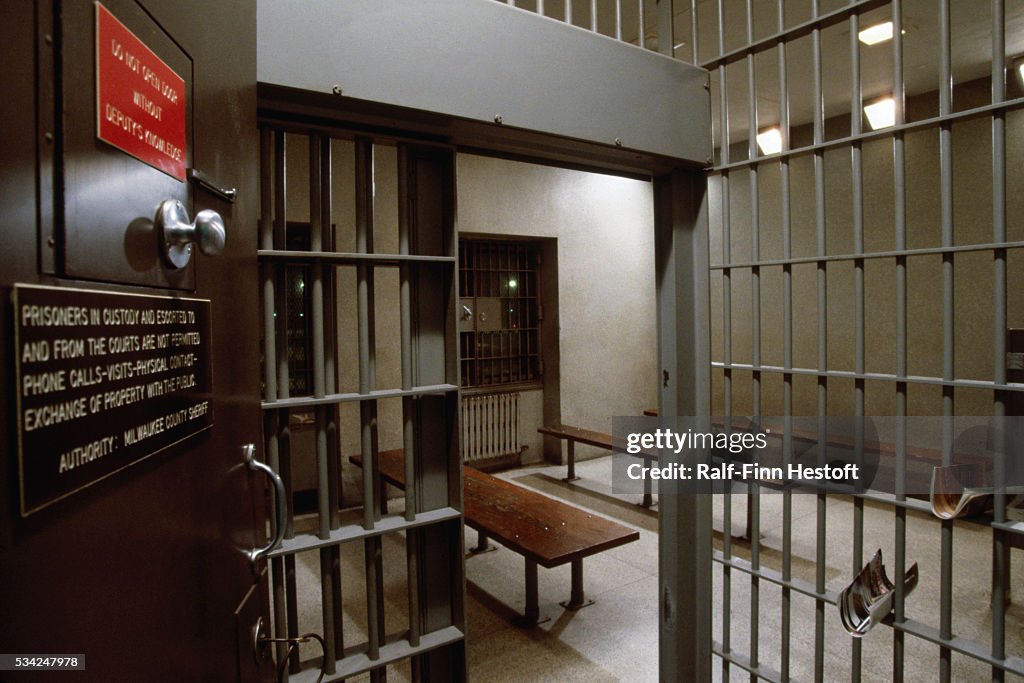
An open door leads to the jail cell used to confine Jeffrey Dahmer between trial sessions. (Photo by © Ralf-Finn Hestoft/CORBIS/Corbis via Getty Images)

During his trial in 1992, he sat behind eight feet of bulletproof glass, separated from the courtroom — not for any genuine security reason, but because his presence was considered too dangerous to exist in the same physical space as ordinary proceedings. He was tried, in a real sense, as something other than a man.

And then there were the shackles. Each day of his trial, Jeffrey was escorted to court handcuffed in a wheelchair — because the leg irons placed on him were so heavy that they made walking impossible. A 6’1” man, unable to bear the weight of his own restraints, wheeled through courthouse corridors like freight.

One day, as he was being wheeled toward the courtroom, a woman passing in the hallway recognised him and let out a bloodcurdling scream. Jeffrey, unperturbed, muttered quietly: “I guess I should’ve shaved.”

In a wheelchair. In shackles so heavy he could not walk. Being wheeled through a public building while a stranger screamed at the sight of him. And his response was a dry, quiet joke about not having shaved. That is not the response of a monster. That is the response of a person — exhausted, dignified in the only way left available to him, and still, somehow, human.


The Psychology of Dehumanisation

Psychologists have studied dehumanisation extensively, particularly in the context of how ordinary people become capable of cruelty toward other human beings. The mechanism is consistent: first, you remove someone’s humanity in your own mind. You assign them to a category — monster, animal, thing — that exists outside the circle of moral concern. Once that categorisation is complete, cruelty becomes not only possible but, for many people, feels righteous.

Jeffrey Dahmer was an almost perfect candidate for this process. His crimes were so extreme, so far outside anything most people could comprehend or contextualise, that the leap to monster felt not only natural but necessary. To acknowledge his humanity would be to sit with something deeply uncomfortable — that a person, a recognisable human being, had done these things. That the distance between him and everyone else was perhaps not as vast as we need it to be.

It is easier, and psychologically safer, to make him into something else entirely.

The inmates who taunted him on his first night in prison were not psychopaths. They were ordinary people who had been given permission — by the media, by the trial, by the collective verdict of society — to treat this particular human being as less than human. The guards who allowed Jeffrey to be made to sleep on the floor were not monsters. They were people acting within a system that had already decided Jeffrey was beyond the protections that system normally provides.


He Dealt With It in Silence

What is striking, in every account of Jeffrey’s time in prison, is how he responded to this treatment. Not with rage. Not with breakdown. With a kind of quiet, contained dignity that the people around him seemed entirely unprepared for.

When the taunting on his first night reached its peak — Did the male parts taste good? Do you prefer dark meat or white meat? — Jeffrey said nothing for hours. He waited. And then, when one inmate shouted Hey Jeff, how’s the corpse?, he answered, after a pause, with three words: Chunky. Delicious and tasty.

The ward went quiet.

It was not aggression. It was not a breakdown. It was a man refusing, in the only way available to him, to be entirely erased. He turned the taunting back on itself with a precision that silenced the room. Whatever you think of him, whatever he did — that moment was human. That was a person navigating something impossible with the tools he had.

Detective Dennis Murphy, who spent sixty hours taking his confession, said Jeffrey was cooperative, frank, and without guile. Reverend Roy Ratcliff, who baptised him in prison and visited him regularly until his death, described a man who was sincere, reflective, and genuinely spiritually searching. The FBI agents who interviewed him found him completely credible.

These were people who actually sat with him. Who treated him as a human being capable of communication and reflection. And what they found, consistently, was exactly that.


What Happens Today

Jeffrey Dahmer has been dead for thirty years. And the dehumanisation has not stopped.

His death photographs circulate freely on blogs and social media. His face — split open, unrecognisable, the result of a brutal beating by a fellow inmate — is shared, reposted, used as profile pictures by people who consider this an act of justice or entertainment. The images are not difficult to find. They are treated as public property, as a spectacle to be consumed.

Compare this to how the photographs of his victims are treated. The families of those seventeen men have fought for decades to keep graphic images of their loved ones private. Society, broadly, respects this. The victims are afforded the dignity of death. Jeffrey is not.

This double standard is not justice. It is not about the victims. If it were about the victims, their families’ pain would be the centre of the conversation — and most of the people sharing Jeffrey’s death photographs have no particular investment in those families at all.

It is about something else. It is about the satisfaction of seeing a specific person degraded, even in death. It is about the continuation of a process that began the moment he was arrested — the process of making him into something that does not deserve what the rest of us are given automatically.

That is not justice. That is cruelty with permission.


Disputed Even in Death: The Brain

Jeffrey had left clear instructions in his will: he wished to be cremated. No services. No headstone. Nothing. He wanted to be gone cleanly, on his own terms.

What happened instead was that before his body was cremated in September 1995, doctors removed his brain and preserved it in formaldehyde. His parents — long divorced — then fought a public legal battle over what to do with it. His mother Joyce wanted it donated to science, hoping researchers might find a biological explanation for what he did. His father Lionel wanted it cremated, in line with Jeffrey’s stated wishes.

The case went to court. A judge ultimately ordered the brain cremated in December 1995 — more than a year after Jeffrey’s death — without any scientific study being conducted.

Whatever one thinks of the arguments on either side, the basic fact remains: Jeffrey had expressed a clear wish about what should happen to his remains, and that wish was overridden — his body becoming, even after death, a matter for courts and public dispute rather than quiet, private dignity.


The Tapes He Didn’t Know Were Being Kept

In 2023, a four-part documentary series titled My Son Jeffrey: The Dahmer Family Tapes was released on Fox Nation. It features audio recordings of private conversations between Jeffrey and his father Lionel, made during prison visits and phone calls — conversations that Jeffrey had no reason to believe would ever be made public.

Lionel, by all accounts, recorded these conversations out of a genuine desire to understand his son — a father grappling with something incomprehensible, reaching for any thread of explanation. That impulse is human and understandable. But the decision to release those recordings to a documentary production, to broadcast them on television for public consumption, raises a question that nobody in the coverage seemed particularly interested in asking: would Jeffrey have wanted this?

Jeffrey, who confessed everything willingly to investigators, who spoke openly with Roy Ratcliff and with the detectives who interviewed him — Jeffrey who asked for no consideration at his sentencing and accepted whatever came — nevertheless had a private interior life. He had conversations with his father that existed in the space between two people, not for the world.

Thirty years after his death, those conversations were packaged and broadcast. His voice, his words, his private reaching toward his father in a prison cell — turned into content. The dehumanisation does not require malice. Sometimes it simply requires treating a person’s private life as raw material, available to anyone who wants it.


The Comparison That Nobody Makes

Ted Bundy confessed to nothing voluntarily. He manipulated, performed, charmed, and deflected until the very end — defending himself in court, flirting with the press, using every tool available to him to avoid accountability. He was a diagnosed psychopath with no genuine remorse. He died having never fully owned what he did.

Jeffrey Dahmer confessed to everything. He cooperated completely. He expressed genuine remorse in terms that those closest to him found credible. He repented. He was baptised. He spent his final years in quiet reflection with a prison chaplain.

Bundy is a cultural icon. Jeffrey is a target.

The difference is not the severity of the crimes — Bundy killed more people. The difference is that Jeffrey’s crimes were of a type that made dehumanisation easier. The cannibalism, the necrophilia — these are the elements that push him beyond the boundary of what people can hold as human. And once beyond that boundary, anything becomes permissible.


Why It Matters

We are not asking anyone to forget what Jeffrey did. We are not asking for sympathy that erases the suffering of seventeen families. Those two things can exist simultaneously — grief for the victims and the recognition that a human being deserves to be treated as one, even after death, even in prison, even in the face of crimes that are almost impossible to comprehend.

The people who post his death photographs are not more moral than the people who don’t. They are not more protective of the victims. They are simply people who have found a target that society has declared acceptable — and they are doing what people always do when a target is declared acceptable.

Jeffrey Dahmer was a human being. He was a deeply traumatised, profoundly ill, ultimately destroyed human being who caused incalculable harm. He was also a man who planted yellow roses, who got down on the floor to play with a cat named Jodi, who said much much better quietly to himself in the dark.

Both of these things were true. They will always have been true.

The dehumanisation does not change that. It only tells us something about ourselves.


Sources: Anonymous inmate memoir; Reverend Roy Ratcliff, Dark Journey Deep Grace (2008); Detective Dennis Murphy, various interviews; Brian Masters, The Shrine of Jeffrey Dahmer (1993); The Washington Post; Fox Nation, My Son Jeffrey: The Dahmer Family Tapes (2023); Psychology research on dehumanisation.

The Thin Line: Jeffrey Dahmer Through the Eyes of Georges Bataille

In 1957, the French philosopher Georges Bataille published a book called Erotism: Death and Sensuality. It was not about serial killers. It was not about crime. It was a philosophical study of the deepest impulses in human nature — the desire for intimacy, the pull of transgression, the relationship between love and death, and the strange territory where the sacred and the forbidden become indistinguishable from each other.

Bataille died in 1962. He never knew Jeffrey Dahmer’s name.

And yet Erotism reads, in places, like a philosophical map of Jeffrey’s inner world — written thirty years before anyone knew that world existed. Not because Bataille was describing a killer, but because he was describing something in human nature that Jeffrey took further than almost anyone ever has. The concepts Bataille spent a lifetime developing — discontinuity, continuity, transgression, the sacred dimension of taboo — illuminate Jeffrey’s own words in a way that no clinical diagnosis ever quite manages.

This article is an attempt to place those two things side by side, with care and with honesty.


The Problem of Discontinuity

Bataille begins Erotism with a philosophical observation so simple it is easy to miss its weight. Every human being, he says, is a discontinuous being. We are each enclosed within ourselves, bounded by skin and bone and the limits of our own consciousness. We are born alone. We die alone. Between any two people there is a gulf — fundamental and unbridgeable — that no amount of communication can fully close.

This discontinuity, Bataille argues, is the source of the deepest human suffering. We long for what he calls continuity — a dissolution of the separate self into something larger, a merging with another being that ends the terrible isolation of individual existence. This longing, he says, is at the root of three things: physical eroticism, emotional love, and religious experience. All three are, at their core, attempts to escape discontinuity. To breach the wall between the self and the other. To touch, however briefly, the continuity that death alone can fully restore.

Now consider what Jeffrey said, in his own words, about why he did what he did.

“It made me feel like they were a permanent part of me.”

“I wanted to keep them with me as long as possible, even if it meant just keeping a part of them.”

“I could completely control a person — a person that I found physically attractive — and keep them with me as long as possible.”

This is not the language of hatred. This is not even, primarily, the language of desire in the conventional sense. This is the language of someone trying — in the most extreme and catastrophic way imaginable — to solve the problem Bataille identified. The problem of discontinuity. The unbearable separateness of being a self.

Jeffrey did not want to destroy. He wanted to fuse. He wanted continuity. He wanted the boundary to disappear. Bataille writes that eroticism is, at its core, the attempt to substitute for individual isolated discontinuity a feeling of profound continuity. Jeffrey’s words are that theory spoken aloud — not as philosophy, but as confession.


The Thin Line Between a Kiss and Cannibalism

Bataille’s most unsettling argument — and the one most directly relevant to Jeffrey — is about what he calls the logic of eroticism pushed to its extreme.

Physical eroticism, he argues, is already a form of violation. The erotic act dissolves the boundaries of the self. It is, at its most fundamental, an attempt to break the separateness of two discontinuous beings — to achieve, however briefly, a state of fusion. He writes that the whole business of eroticism is to destroy the self-contained character of the participants. Nakedness, he says, is the first gesture of this dissolution: the removal of the barriers that maintain discontinuity. What follows is a temporary merging, a momentary continuity, before the boundaries are restored and the two people are separate again.

He then asks: what happens when this logic is pursued without limits?

The Marquis de Sade, Bataille notes, defined murder as the pinnacle of erotic excitement. Bataille does not celebrate this. He analyses it. He says that the destructive element pushed to its logical conclusion does not necessarily take us out of the field of eroticism. That if the drive behind eroticism is the dissolution of the separate self — the achievement of continuity — then death is, in a terrible sense, its ultimate fulfilment. Death is the only truly permanent dissolution of discontinuity. Death makes the bounded self continuous with everything again.

This is the thin line. Between the kiss — which reaches across the discontinuity toward the other — and the extreme that Jeffrey enacted, there is a difference of degree, not of kind. Both are movements toward the same impossible thing. Both are attempts to end the isolation that Bataille says defines human existence. The kiss fails, as all such attempts must fail — the boundary returns, the two people are separate again, the discontinuity is restored. Jeffrey’s attempts failed too, in the same way, which is perhaps why they escalated. Each time the boundary came back. The continuity was lost. The person was gone and Jeffrey was alone again in Cell 213.

De Sade himself wrote: “There is no better way to know death than to link it with some licentious image.” Bataille uses this to illustrate the connection between eroticism and death that most people refuse to look at directly. Jeffrey lived inside that connection. He did not choose it. It was given to him — by what combination of neurology, trauma, and chance we do not fully know — and he could not find his way out of it.


Taboo and Transgression: The Desire Created by the Prohibition

One of Bataille’s most radical arguments is about the relationship between taboos and desire. We tend to think of taboos as simply prohibitions — things we are forbidden from doing. Bataille argues that this misses the essential dynamic. Taboos, he says, do not suppress desire. They create it.

He writes: “A transgression is not the same as a back-to-nature movement; it suspends a taboo without suppressing it. Here lies the mainspring of eroticism and of religion too.”

The taboo and the transgression need each other. The prohibition is what makes the transgression possible, what gives it its weight and its charge. Without the taboo, there is no transgression — only an act. The law is not the enemy of the desire; it is its precondition. The sacred and the forbidden are, for Bataille, the same thing seen from different angles.

He illustrates this with religious cannibalism. In certain archaic practices, he writes, the eating of human flesh is both the most forbidden act and the most sacred. The taboo does not create the taste of the flesh — but it stands as the reason the ritual cannibal consumes it. The prohibition is precisely what makes the act holy. The pious cannibal knows full well that this is forbidden; knowing the taboo to be fundamental, he violates it. The desire and the law are inseparable.

Jeffrey understood this, at some level, without ever having read Bataille. He knew that what he desired was forbidden. He fought it for years — the long years at his grandmother’s house, the Bible reading, the missionaries he sent money to, the genuine attempt at control. The awareness that it was wrong was not separate from the desire. It was part of it. The boundary was not an obstacle. It was, in Bataille’s terms, the very thing that made the desire what it was.


Sacrifice and the Sacred: The Baptism

Bataille draws an extended comparison between the erotic act and sacrifice. In sacrifice, he argues, the victim’s death reveals continuity to the witnesses. The discontinuous being is destroyed and in its place what remains — what the spectators experience in the silence that follows — is the continuity of all existence. Death dissolves the particular back into the universal. The bounded self becomes unbounded. This, Bataille says, is the sacred.

He writes: “A violent death disrupts the creature’s discontinuity; what remains, what the tense onlookers experience in the succeeding silence, is the continuity of all existence with which the victim is now one.”

And then there is this: in May 1994, Jeffrey Dahmer was baptised in a steel tub inside Columbia Correctional Institution by Reverend Roy Ratcliff. He was convicted of seventeen murders. He had been in prison for two years. He would be dead in six months.

Jeffrey had arrived, by the end of his life, at something that Bataille’s framework can help us understand. He had been pursuing continuity through one path his entire adult life — the only path available to the thing in him that needed it. In prison, with Ratcliff visiting weekly, reading the Bible, discussing death and redemption and whether he deserved to continue living, he found another path to the same place. Religious eroticism, in Bataille’s terms, is the pursuit of continuity through the sacred — the dissolution of the self not through physical transgression but through union with something beyond individual existence.

Jeffrey told Ratcliff that he sometimes wondered whether he was sinning against God by continuing to live. He had internalized his own discontinuity as the deepest problem of his existence. The baptism — the immersion, the dissolution, the emergence — was perhaps the first time he had tried to reach continuity in a way that did not destroy another person in the process.

Bataille writes that the paths toward continuity vary. Their object, he says, has a great variety of aspects. Jeffrey had spent his life on one path. In his last year he tried another.


Where Bataille’s Theory Has Limits

It would be dishonest to use Bataille’s framework without acknowledging where it becomes insufficient.

Bataille’s analysis of transgression is ultimately descriptive. He is tracing the logic of certain human impulses — mapping the terrain between the sacred and the forbidden, between desire and death. He is not excusing. He is understanding. And understanding, as this memorial has always argued, is not the same as condoning.

But there is a dimension that Bataille’s theory of transgression does not fully account for, and it is the most important one: consent. Bataille writes about eroticism as a mutual dissolution. The sacrifice, even in its most archaic forms, was performed within a collective ritual framework. The transgression operated within a structure, however violent, that held some meaning for those involved.

Jeffrey’s victims did not choose dissolution. They did not consent to become part of someone else’s search for continuity. They were people with their own discontinuities, their own desires for continuity, their own inner worlds every bit as rich and real as Jeffrey’s. They were not symbolic victims in a ritual. They were Steven, James, Richard, Anthony, Raymond, Edward, Ernest, David, Curtis, Errol, Tony, Konerak, Matt, Jeremiah, Oliver, Joseph — and the first, Steven Hicks, eighteen years old, hitchhiking home from a concert.

Bataille helps us understand the logic of what Jeffrey did — the philosophical structure of the impulse, the deep human need it expressed in its most catastrophic form. He does not, and cannot, make it acceptable. The theory illuminates. It does not absolve.


Why This Matters

The reason to read Jeffrey Dahmer through Bataille is not to aestheticise what he did or to find it philosophically elegant. It is because the alternative — treating Jeffrey as simply monstrous, as categorically other, as something outside the human — is both intellectually dishonest and, ultimately, more dangerous.

Bataille wrote at the beginning of Erotism: “The human spirit is prey to the most astounding impulses. Man goes constantly in fear of himself. His erotic urges terrify him.” He was not writing about serial killers. He was writing about everyone. The impulses Jeffrey enacted at their most extreme — the desire for fusion, the longing for continuity, the relationship between desire and death, the terrible pull of the forbidden — are not alien to human nature. They are human nature, at its edges, in its darkest expression.

Jeffrey himself said it: “I don’t think there was something that happened that made me like this. Because this was always just how I was.” He was not describing a monster. He was describing a person whose inner life had taken a particular shape — one that Bataille’s philosophy, for all its difficulty and discomfort, helps us see more clearly than almost any other framework available to us.

Understanding that is not forgiveness for what was done. But it is the beginning of the kind of comprehension that might, one day, mean that someone like Jeffrey — someone carrying that particular configuration of need and isolation and desire — finds a different path before the irreversible moment arrives.

That seems worth understanding.


Sources: Georges Bataille, Erotism: Death and Sensuality (City Lights Books, 1986, translated Mary Dalwood); Jeffrey Dahmer, Inside Edition interview (1993); Jeffrey Dahmer, Dateline NBC interview with Stone Phillips (1994); Roy Ratcliff, Dark Journey Deep Grace (2011); Brian Masters, The Shrine of Jeffrey Dahmer (1993).

Read George Bataille here:

Doing a Dahmer: The Hidden Humour of Jeffrey Dahmer

There is a moment in Jeffrey Dahmer’s 1992 FBI interview that almost nobody talks about. He has spent hours describing, in flat, cooperative detail, the murders of seventeen men. The detective has asked him about dismemberment, cannibalism, necrophilia, acid baths, skulls in lockers. And at the very end of this extraordinary session, as the tape is about to stop, Jeffrey says:

“OK, thanks for the muffins and the book.”

He had been eating muffins throughout. He thanks them on the way out like it was a pleasant meeting.

This is Jeffrey Dahmer’s humour: quiet, dry, completely interior, and almost always invisible unless you’re paying very close attention. It was never performed for a crowd. It never announced itself. It simply existed — a private, flickering thing in a man who kept almost everything private.

Understanding it is one of the most human ways into understanding him.


“Doing a Dahmer” — The Performance of Otherness

Jeffrey’s classmates at Revere High School in Bath, Ohio, remembered something they called “doing a Dahmer.” He would twist his body into an awkward shape, contort his face, and walk with a lurching, exaggerated gait — a deliberate imitation of someone with a developmental disability. It was strange, unexpected, and apparently very funny. The other kids loved it. They asked him to do it again.

What’s interesting is what this tells us. Jeffrey was not popular in any conventional sense — he was withdrawn, solitary, a drinker by his sophomore year, keeping the things that mattered to him entirely to himself. But this performance, this physical comedy, gave him a social currency he couldn’t access any other way. It was a mask that worked precisely because it was so obviously a mask. He was showing people something deliberately false in order to hide everything that was true.

Psychologically, this is a classic function of humour in isolated individuals — what researchers sometimes call humour as social camouflage. By making people laugh, Jeffrey controlled what they saw. He gave them a version of himself to engage with, while the real version remained untouched and unseen behind it. The joke was always, on some level, on them. They thought they were watching him be ridiculous. They had no idea what they were actually looking at.


Bleating, Seizing, Screaming — The Classroom

The “doing a Dahmer” walk was not his only act. In class, Jeffrey performed a wider repertoire of stunts — bleating like a sheep, faking epileptic seizures, screaming out random things in the middle of a lesson, and performing impressions of people with cerebral palsy. He presented himself, in general, as a sort of class clown, the bizarre kid who could always be relied upon to do something unexpected.

But there is a crucial detail in the accounts of those who were there: his classmates usually laughed at him rather than with him. His sense of humour was too dark, too strange, too far outside what anyone was comfortable with. He was funny in a way that made people uneasy. They laughed because they didn’t know what else to do.

This distinction matters. Jeffrey wasn’t a class clown in the ordinary sense — someone who performs to belong. He performed in a way that guaranteed he would never quite belong. The stunts were too far. The humour was too weird. And the result was the same as always: he was watched, he was noticed, and yet he remained completely alone in the middle of it. The laughter surrounded him and didn’t touch him.


Two Steps Forward, Three Steps Back

There was a neighbour in Bath who used to watch Jeffrey walk to school from a window. Jeffrey was aware of being watched. And so he developed a walk — two steps forward, three steps back, a lurching, backwards shuffle that got him nowhere fast. He kept it up for the entire time he knew he was being observed.

Nobody asked him about this. He never explained it. But it is one of the most revealing small details in the entire story.

Here was a teenager so acutely conscious of being watched that he turned observation itself into a private joke. Rather than performing normality for the neighbour’s benefit — as most self-conscious teenagers would — he did the opposite. He made himself impossible to read. You want to watch me? Fine. Watch this. The confusion on the neighbour’s face was the punchline, enjoyed entirely alone.

This is humour as control. As a young man who felt profoundly out of control in almost every area of his life — his parents’ disintegrating marriage, his sexuality, the fantasies pressing at him from inside — the ability to make someone else confused and uncertain must have been quietly satisfying. A small power in a life that felt powerless.


“I Always Wanted to Do That to a Human”

In 1978, a high school friend named Mike Costlow visited Jeffrey at the Bath Road house after a night of drinking and smoking marijuana. At some point Costlow noticed several stuffed animals around the room and asked about them. Jeffrey replied simply: “It’s taxidermy. I used to do taxidermy.”

Later that same day, when Costlow brought the subject up again, Jeffrey said quietly: “I always wanted to do that to a human.”

Costlow and his friend were stunned. They said, “You’re sick,” and brushed it off. They thought he was joking. He was, after all, known for his bizarre and twisted sense of humour. It was just another example of that. The kind of thing Jeffrey said.

This was the summer of 1978 — the same summer Steven Hicks was murdered at that house. Jeffrey had already done it. And nobody heard it.

This is perhaps the darkest version of Jeffrey’s humour — the moment where the joke and the confession were the same sentence, and the punchline was that no one would believe it. The armour of “he’s just being weird” was so effective that even the truth, spoken plainly, was dismissed as another performance. He had learned, long before, that the best place to hide something is in plain sight.


The Muffins

Back to those muffins.

The FBI interview of August 13, 1992 was conducted at Columbia Correctional Institution by a Special Agent and a detective from the Hollywood, Florida Police Department. They were there to investigate Jeffrey’s possible connection to the disappearance of Adam Walsh. The interview is extraordinary — Jeffrey is cooperative, candid, almost eager to help. He answers every question in the same flat, considered tone he used for everything.

At some point during the interview, someone brings muffins. Jeffrey eats them. The interview continues — murder, cannibalism, the army, Florida, his grandmother. More muffins, apparently. At the very end, the tape concludes, and Jeffrey’s last recorded words in that session are a polite, genuine thank you for the muffins and the book they brought him.

The detective, for his part, had his own moment of dry humour. When the subject of alcohol tolerance came up, he interjected: “I’m a cheap date.” Jeffrey responded naturally, completely at ease — two people making a small human joke in the middle of one of the most surreal conversations imaginable.

What does it mean that Jeffrey Dahmer could eat muffins and make small talk during a confession to mass murder? Clinically, it speaks to the extreme compartmentalisation that psychiatrists noted throughout his case — the ability to hold horror and ordinariness in separate rooms of the mind, moving between them without apparent friction. But it also speaks to something more specific about his humour. He was genuinely, consistently, quietly pleasant in conversation. Detective Dennis Murphy, who spent sixty hours taking his confession after the arrest, said he appreciated Jeffrey’s frankness and lack of guile. The muffins fit perfectly. He was just… a man eating muffins and being polite. As he always had been.


The Helicopter

In 1993, journalist Nancy Glass interviewed Jeffrey for Inside Edition. At some point during their conversation, Jeffrey asked her casually if she had seen the movie that was on television the night before. He couldn’t remember the title. He made a helicopter gesture with his finger, rotating it slowly in the air.

The one with the helicopter.

He was in prison for seventeen murders. He had been there for two years. And he was making small talk about a television movie, illustrated with a finger helicopter, exactly as any ordinary person might do after a slow evening in front of the TV.

This is perhaps the most disarming of all the humour — not a joke exactly, just the total, baffling ordinariness of it. The gap between what Jeffrey Dahmer was supposed to be and what he actually was in that moment is so vast it becomes almost comic. Nancy Glass, facing one of the most notorious killers in American history, got a finger helicopter and a question about last night’s TV.


“Ha Ha” — The Letters

When Jason Moss, a criminology student, corresponded with Jeffrey in prison, Jeffrey’s letters were described as gracious and scrupulously polite. But there was also this, in his final letter to Moss:

“Just don’t forget about me when your school work is done, ha ha.”

Written out like that — ha ha — in a letter from a man who almost never wrote to anyone, who knew his letters were extraordinarily rare, who was serving 936 years. Ha ha. The lightness of it is startling. He knew exactly how to use levity. He deployed it sparingly and precisely, which is what made it land.


The Séance

And then there is the séance. In the summer of 1978 — with Steven Hicks’s remains still in the crawlspace beneath his feet — Jeffrey invited classmates to the Bath Road house and told them it was haunted. He staged the whole thing. He told them there was a spirit that could be summoned. The lights went off. Something moved. Lynn screamed.

Was that funny to Jeffrey? Almost certainly, in some private way. It had all the elements his humour loved: misdirection, control of information, a performance that was entirely false concealing something that was entirely real, and the confusion of others enjoyed in silence.


“Chunky. Delicious and Tasty.” — Prison

Prison brought a different kind of humour — or so some accounts suggest. According to multiple sources, Jeffrey reportedly told fellow inmates and guards “I bite,” then watched their nervous reactions with quiet, private satisfaction. He allegedly moulded his prison food into shapes resembling body parts and used ketchup as blood, leaving the results on his tray to unsettle the men around him. And according to Reverend Roy Ratcliff himself, Jeffrey put up a poster on his cell wall advertising a “Cannibals Anonymous” meeting.

Then there is the account from an anonymous fellow inmate’s memoir. On the day Jeffrey arrived at Columbia Correctional Institution, the noise in the cell block was immediate and relentless — jeers, threats, questions shouted through the bars. “Did the male parts taste good?” “Do you prefer dark meat or white meat?” Jeffrey said nothing. For hours, nothing. The taunts escalated, got louder, cruder. Jeffrey remained completely silent in Cell 1.

Then, after supper, one inmate shouted: “Hey, Jeff, how’s the corpse?”

A pause. Then, much to everyone’s surprise, from Cell 1:

“Chunky. Delicious and tasty.”

The ward went quiet.

It is worth noting that not everyone accepts these accounts. A lawyer who worked closely with Jeffrey in prison disputed the taunting behaviour entirely, saying it simply wasn’t his style. And there is something that doesn’t quite fit — the Jeffrey described by Detective Murphy, by Reverend Ratcliff, by the FBI agents who interviewed him, was consistently quiet, polite, and contained. The elaborate food sculptures and the constant taunting feel almost theatrical for a man who preferred his humour invisible.
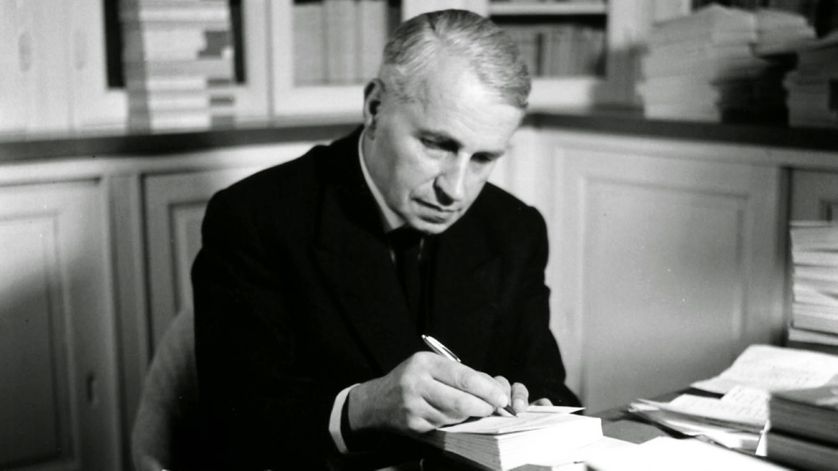
What is consistent, though, is the Cannibals Anonymous poster. That feels entirely like him — not aggressive, not performed for an audience, just a quiet, private joke pinned to a wall in a cell, amusing exactly one person. The person it was designed to amuse.


The Psychology of It

What all of these moments share is not cruelty — none of Jeffrey’s humour was cruel in the conventional sense. It was never mockery of others’ pain or weakness. It was always interior, always deflecting, always about controlling what was seen.

Psychologist and author Brian Masters noted that Jeffrey was “not good at coping with disappointment” — that the losses of his childhood had left him with a profound difficulty with vulnerability. Humour, for him, was armour. Not loud, aggressive armour but the quiet kind — the kind that keeps people at a comfortable distance while appearing to bring them close. The kind that lets you eat muffins and make small talk while carrying something impossible.

Detective Patrick Kennedy, who worked his case, put it simply: “He could be engaging, he could be bright, witty, he could make jokes. He was able to fool a lot of people.” But it wasn’t quite fooling people either — or not only that. It was also just… him. Jeffrey Dahmer, finding the small absurdity in things, keeping it to himself, letting it out in carefully measured doses to the people around him.

There is also, in all of it, a profound loneliness. The classroom stunts were performed to a room that laughed uncomfortably and kept its distance. The two-steps-back walk was performed for an audience of one — himself. The helicopter gesture was an attempt at ordinary human connection. The ha ha in the letter was a man trying, in the only way he knew, to be light. To be likeable. To be, for a moment, just a person talking to another person about nothing in particular.

He was, as those who knew him consistently noted, genuinely pleasant company. Quiet, polite, a good listener, occasionally funny in a dry and unexpected way. His grandmother loved him. The detectives who spent sixty hours with him respected him. The FBI agent who interviewed him believed him completely and found him totally cooperative.

That person — the muffin eater, the helicopter mime, the boy walking backwards to confuse the neighbour, the teenager bleating like a sheep in the middle of class — was as real as everything else. Maybe more real than anything else. Because the darkness in Jeffrey Dahmer was something he fought against, hid from, tried to outrun for years. But the dry wit, the quiet deflection, the private joke enjoyed alone — that was just him.

That was just Jeffrey.


Sources: Brian Masters, The Shrine of Jeffrey Dahmer (1993); Jason Moss, The Last Victim (1999); FBI Interview Transcript, Columbia Correctional Institution, August 13, 1992; Anonymous Inmate Memoir; Biography.com; Detective Patrick Kennedy, Channel 5 interview; Mike Costlow, Cleveland Plain Dealer interview.

The Séance at Bath Road

In the summer of 1978, Jeffrey Dahmer invited a small group of classmates to 4480 West Bath Road for a séance. He told them the house was haunted — that the spirit of a previous owner lingered there and could be called. The lights went off. Something moved in the dark. One of the girls screamed and fled into the night. Lionel Dahmer arrived home unexpectedly and broke up the gathering.

It was the last time Bridget Geiger — Jeffrey’s prom date from weeks earlier — ever saw him.

What none of them knew, and what gives this small story its terrible weight, is the timing. Steven Mark Hicks had been murdered at that house on June 18, 1978 — struck with a barbell, strangled, dismembered in the crawlspace. His remains were still on the property when Jeffrey lit those candles and told his friends the house had ghosts.

Brian Masters, in The Shrine of Jeffrey Dahmer, described this period as one of profound internal disintegration — Jeffrey drinking heavily, alone in the house most days after Joyce took David and left, waiting for a life that had already ended without his knowing it. The séance sits in that silence. A boy of eighteen, performing haunting for his friends, in a house that was already haunted — by something no one else could see.

Jeffrey never spoke of it directly. But he didn’t need to.


Source: Brian Masters, The Shrine of Jeffrey Dahmer (1993)