The House on South 57th Street: Jeffrey Dahmer’s Six Years in West Allis

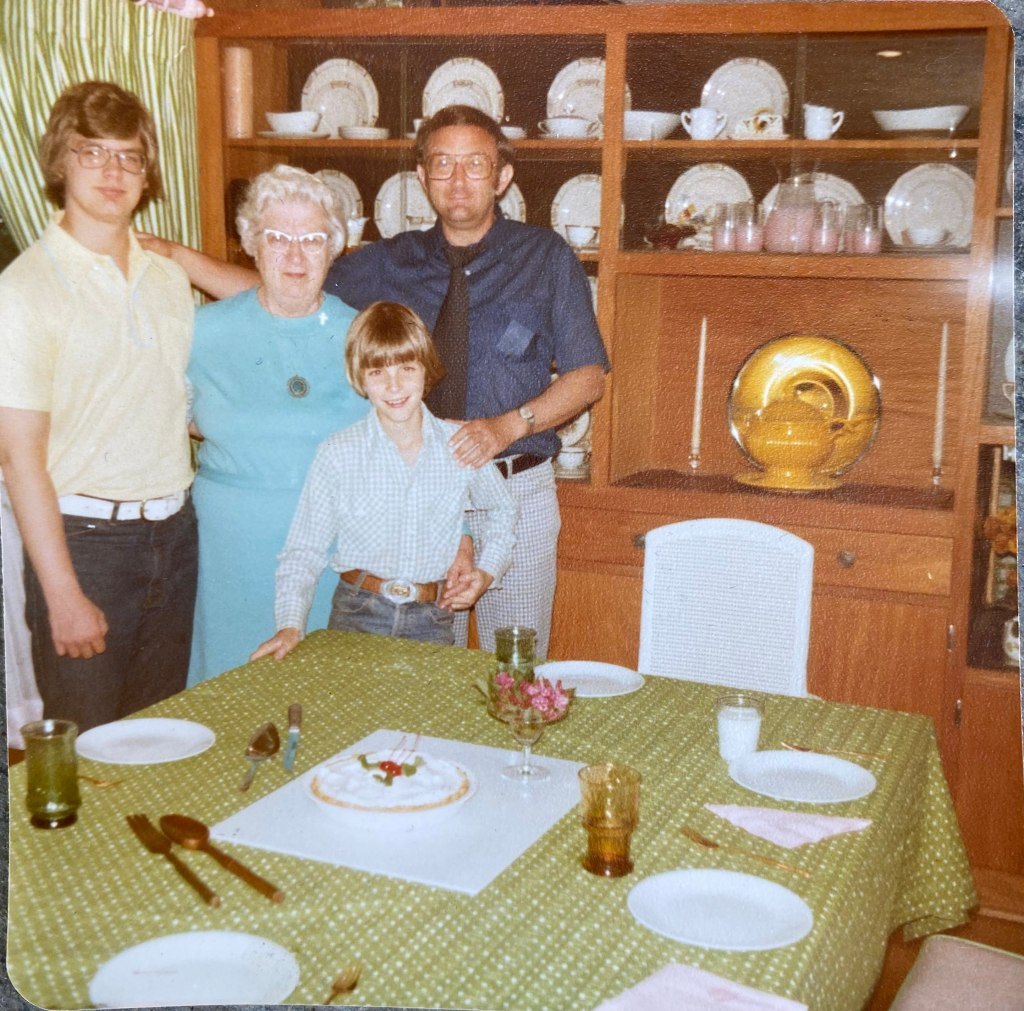
There is a stretch of Jeffrey Dahmer’s life that almost nobody writes about. It runs from December 1981 to September 1988 — nearly seven years — and it takes place in a small, tidy house at 2357 South 57th Street in West Allis, Wisconsin, a suburb of Milwaukee. It was the house Lionel Dahmer had grown up in. It belonged to his mother, Catherine.
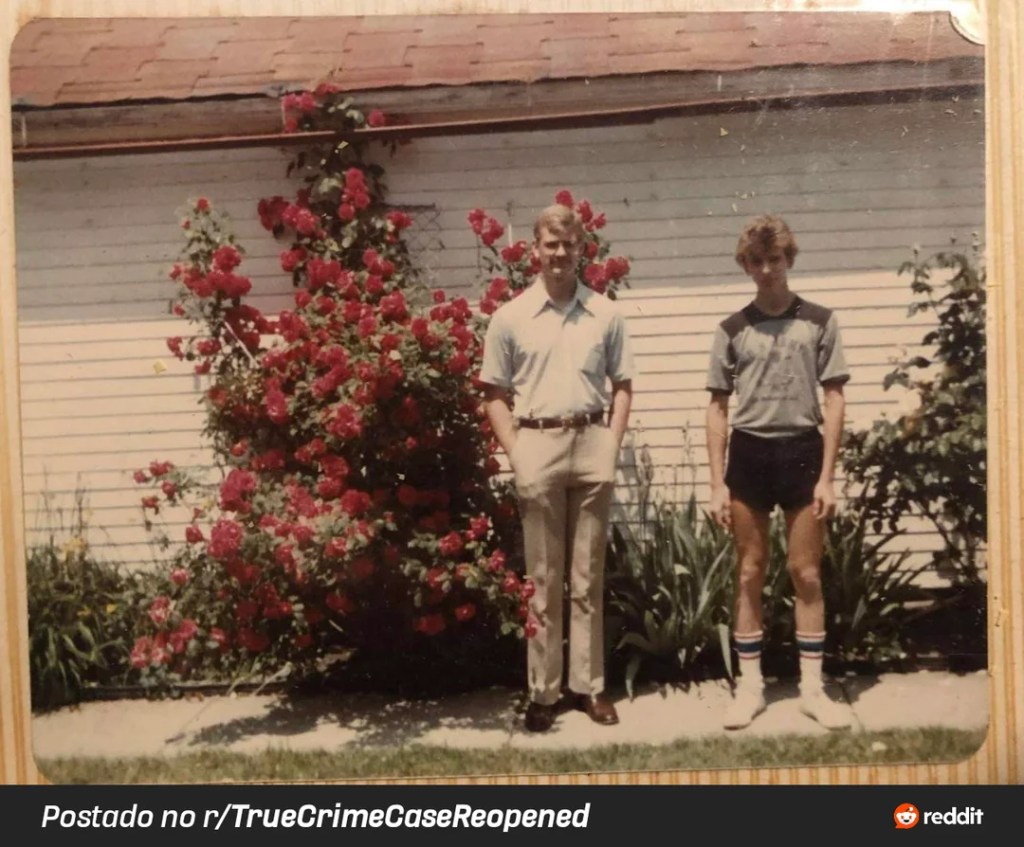
The reason it goes unexamined is easy enough to understand. Nothing about it fits the story people expect. There is no squalor here, no isolation, no absent family. There is a grandmother who cooked his meals and washed his clothes, a church on Sundays, a lawn to mow, a garden, a steady job. By any ordinary measure these were the most stable years of Jeffrey Dahmer’s adult life.

Three men were murdered in that house.

Both things are true, and the difficulty of holding them together is precisely why the period deserves attention. West Allis is where the comfortable explanations fail.

Catherine

Catherine Dahmer has been reduced, in most tellings, to a location — the grandmother’s house, the grandmother’s basement. She was a person, and the sources are unusually clear about what sort.
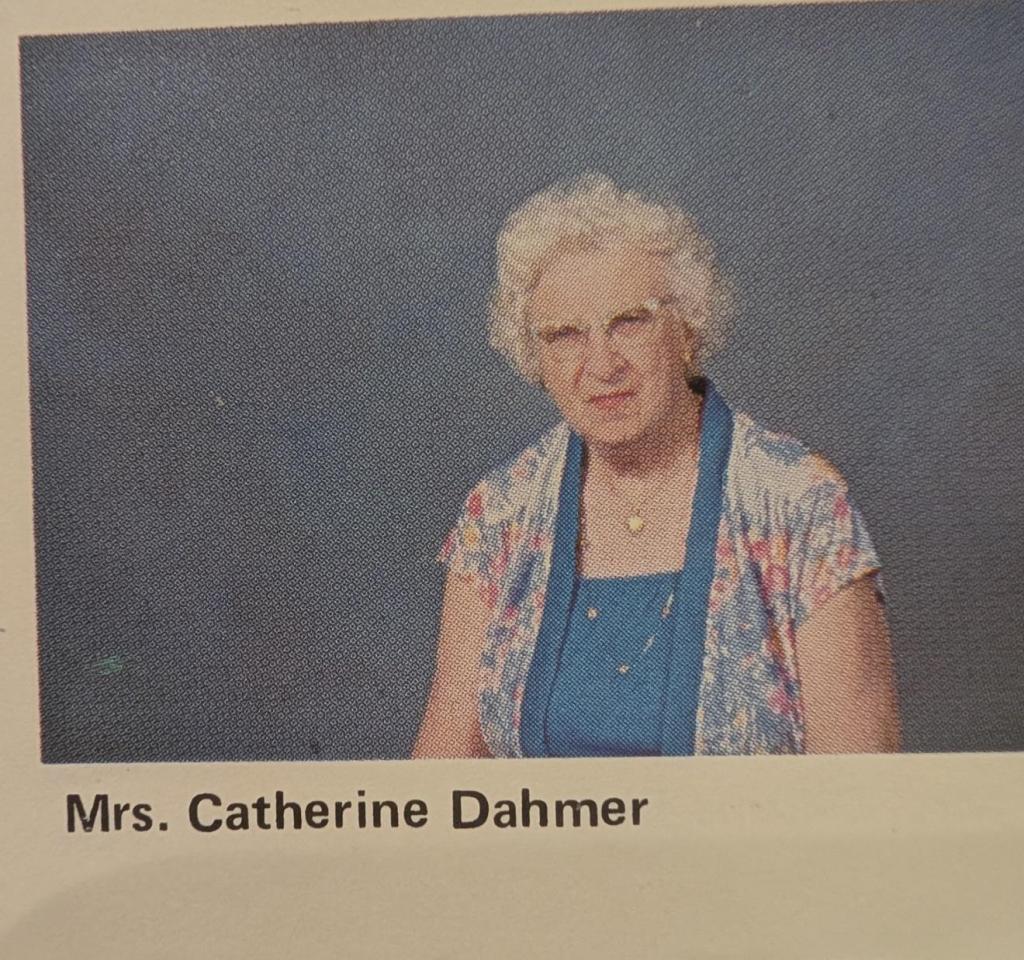
She was a lifelong Presbyterian who attended church every Sunday. Both Lionel’s memoir and Brian Masters’ account describe the same woman: kind, patient, unfailingly decent, working from the old-fashioned assumption that people will behave well if they are treated well. She was, by 1981, elderly and lonely, and the arrangement suited her as much as it suited anyone. Jeffrey would have room and board; in return he would help around the house and keep her company.

Asked directly whether he loved her, Jeffrey could not manage the word. He said instead that she had lived in that house a long time. It is a strange, sidestepping answer, and Masters reads it as an inability to make emotional contact rather than an absence of feeling — Jeffrey knew perfectly well that she was lovable and said so freely, but would not apply the verb to himself. Describing her, he had no such difficulty. He called her, in his own words, what you could call a perfect grandmother, and listed the qualities: kind, church-going, easy, supportive.

Masters makes an observation that is worth sitting with. Catherine Dahmer could have been a genuinely formative influence on her grandson, had he come to her earlier. By the time he arrived he was twenty-one, and it was too late. He could recognise her goodness. He could not absorb it.

What the house provided

He was sent there in the winter of 1981 because his father and stepmother had run out of options. He had been discharged from the army for drinking, sent to Ohio, arrested at a hotel within a fortnight for public drunkenness, and could not be trusted alone in the house or with the car. West Allis was a temporary measure. Lionel put him on a bus expecting him back within weeks.

Three months later, when Lionel and Shari drove up to visit, Jeffrey had decided he was staying. His father found him happier than he had been at any point since the army — mothered, fed, laundered for, with his days given a shape.
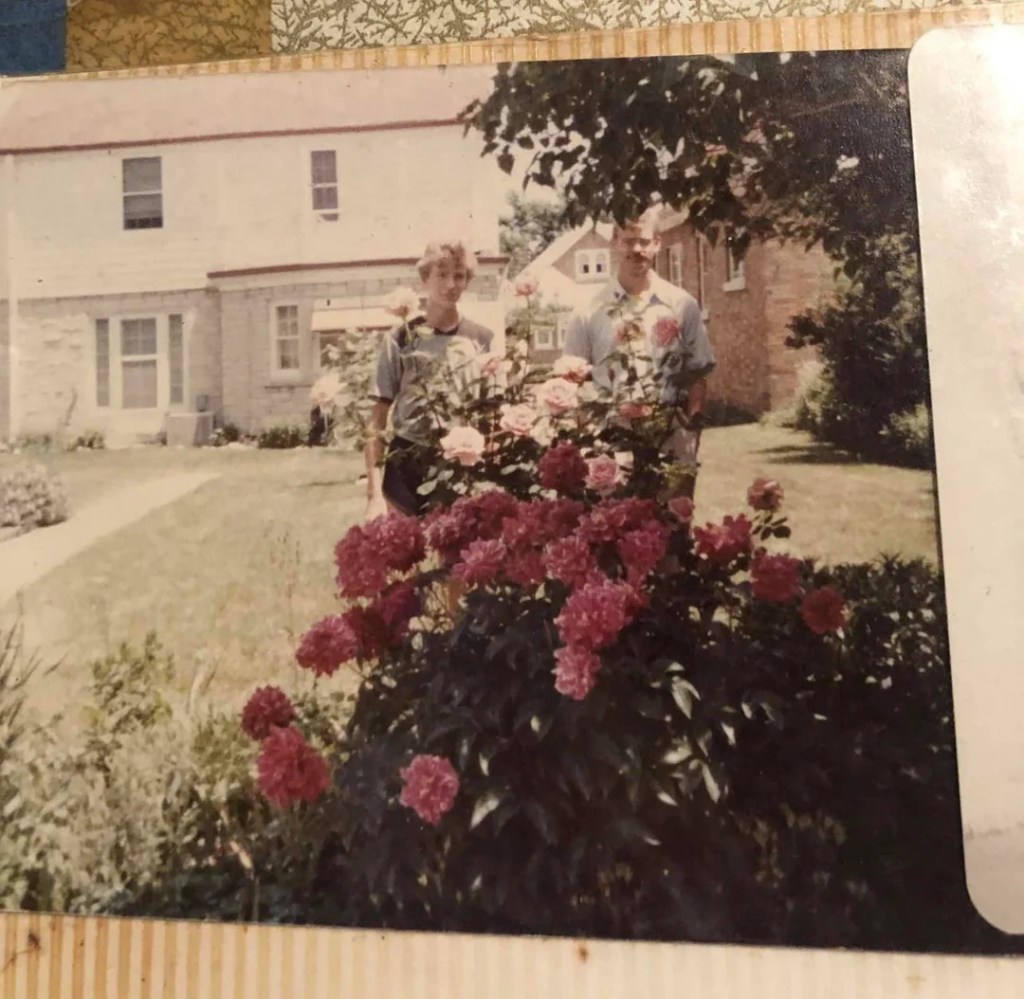
And that shape held for a while. He worked in the garden and mowed the lawn. He helped with the shopping and the cleaning. He went to church with his grandmother. He found work as a phlebotomist at the Milwaukee Blood Plasma Center, drawing blood — a skill he had learned as an army medic. He attended Alcoholics Anonymous. A young woman in the congregation took an interest in him, and his father encouraged him to call her. He never did.

After the plasma centre let him go — ten months, poor performance — there was a stretch of unemployment that ought to have been dangerous and was not. Masters describes something close to a genuine remission during 1982 and 1983: Jeffrey read the Bible alone as well as with his grandmother, gave money to street people, sent donations to missionaries. He was consciously trying to smother something in himself, and for a period it appeared to work. The memory of Steven Hicks receded. He imposed rules on his own body and kept them.

This is the part of West Allis that resists a simple reading. The conditions were exactly those that had ruined him before — no job, no structure, time on his hands — and this time they did not. What made the difference was a household: someone expecting him at meals, someone noticing when he came in, somewhere to be on a Sunday morning.

In January 1985 he was hired as a mixer at the Ambrosia Chocolate Factory, working the third shift, eleven at night until seven in the morning, six nights a week. He began paying his grandmother three hundred dollars a month in rent. His early performance reviews there were not merely adequate but warm — resourceful, congenial, neat, an asset to his department.

By every external signal available to his family, this was a young man slowly assembling a life.

What the record shows underneath

The external signals were wrong, and the documentation of how wrong is unusually complete.

On 7 August 1982, at the Wisconsin State Fair, he was arrested for exposing himself in a crowded area near the Coliseum. He was convicted twelve days later and fined. Two details are worth noting. The first is that the arresting officer’s account describes exposure rather than the urination Dahmer claimed. The second is that when asked for his address, he gave Bath, Ohio — his father’s house — rather than West Allis. Whatever else was disintegrating in him, he did not want his grandmother’s name on the charge sheet.
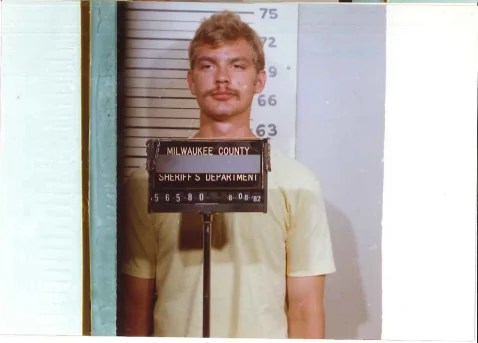
On 8 September 1986, two twelve-year-old boys reported a man masturbating by the Kinnickinnic River Parkway. Their description was accurate enough that a patrol officer stopped Dahmer nearby within the hour, and both boys identified him. He was charged with lewd and lascivious behaviour and indecent exposure, and received probation and court-ordered counselling.

Between and around these two arrests, a third thread runs. In 1985, sitting in the West Allis Public Library, a stranger dropped a note in his lap propositioning him. He did not act on it. But the sources — and Dahmer himself, repeatedly — identify that moment as the hinge. His defence counsel would later call it the critical moment of his life. What had been contained by Bible study and self-discipline began, from that point, to erode.

The court-ordered therapy after the 1986 arrest produced its own record. He kept every appointment and turned his chair away from the therapist, sitting in silence for the full fifty minutes. The one session where he spoke at any length was about the Christmas presents he had bought for his grandmother. When the therapist tried to open up the relationship, he stopped talking.

What they saw, and what they did with it

This is the most valuable material West Allis offers, because it is a record of ordinary people responding reasonably to warning signs and getting nowhere.

Catherine found a full-size male mannequin in his bedroom closet, fully dressed. She could not imagine where it had come from or why. Challenged, Jeffrey said calmly that he had stolen it from a shop on a dare, that he had liked the clothes, and that he had already thrown it away. The matter, as far as he was concerned, was closed.

She found a gun under his bed. Jeffrey described it as a target pistol; when his father came to look, it was a .357 Magnum with a two-and-a-half-inch barrel. A family conference followed. Lionel took the gun away, had a friend sell it, and gave his son the proceeds.

She noticed he was gone for whole weekends. She was stopped on her own staircase one morning and told to go back up because he was not dressed, and later saw him steering a badly drunk man toward the bus stop. She came home from Sunday service more than once to a smell in the garage she could not place and did not believe was the cat box.

Each time, Jeffrey had an answer ready. The odours were chemical cleaners. They were chicken parts he was experimenting on with bleach and acid. When Lionel flew in to investigate personally and pressed him, the answer became a dead raccoon collected from a gutter. Lionel searched the garage and the basement and found nothing but stored lamps, a projector, Christmas decorations, firewood, a washer and dryer.

The pattern in these exchanges is worth naming precisely, because it is not stupidity. Catherine identified every genuine warning sign in the house. She reported them all. Crucially, she often reported them to Shari rather than to Lionel, saying she did not want to burden him — which meant the person best placed to act received the information at one remove, filtered and softened, and always after the fact.

And Lionel accepted each explanation in turn. His memoir is unsparing about this. He describes allowing himself to believe there was a line in his son that would not be crossed, a boundary between self-destruction and harm to others. He describes conversations conducted entirely in half-sentences, both of them maintaining a wall neither would name. As he puts it: this dreadful silence we called peace.

It is the most honest sentence anyone connected to this case has written.

The murders

None of the above should be read as a portrait of domestic life with the deaths as an appendix. They happened in that house, while all of it was going on.

In September 1987, Dahmer killed Steven Tuomi at the Ambassador Hotel in Milwaukee, bought a large wheeled suitcase from a Woolworth’s at the Grand Avenue Mall, and brought the body back to West Allis by taxi while his grandmother slept. The driver helped him load the case.

On 17 January 1988, he met James Doxtator at a bus stop and brought him back to the house. Jamie had told his mother that if he ever left home he would keep in touch. He was reported missing the following day.

On 27 March 1988, he killed Richard Guerrero, aged twenty-three, in the same house. Guerrero’s father reported him missing two days later and placed notices with his son’s photograph in the local press. Nothing came of them.

On 25 March 1989 — by which time Dahmer had moved out and moved briefly back, awaiting sentencing — he met Anthony Sears outside a bar. A friend of Sears’, uneasy, drove them both to West Allis and extracted a promise that Sears would call within a couple of hours so he could collect him. Sears was killed at the house that night. His friend went back the next morning to look for him and did not know which door to knock on.

Three men died in Catherine Dahmer’s home. A fourth was carried into it in a suitcase.

Being eased out

The end came through an accumulation rather than a discovery.

In 1988 a man named Ronald Flowers was brought to the house, drugged, and survived. That incident, along with the late-night arrivals, the drinking, and the general uneasiness about his guests, prompted a family conference — Lionel, Catherine, and Lionel’s sister Eunice. Dahmer’s own description of the outcome was that he was sort of eased out. Two decisions came from that meeting: he would find his own place, and he would seek help for his drinking. Lionel took him to Family Services on West Highland Avenue that April. The alcohol programme lasted four sessions.

There was one further factor. Catherine had found objects in his room — statues of griffins, a copy of The Satanic Bible, black lights — arranged in something like an altar. For a lifelong Presbyterian this was not eccentricity but horror. Jeffrey’s account was that he was merely curious about the unknown and that none of it meant anything.

He moved out on 26 September 1988. The structure that had held him — imperfectly, incompletely, but genuinely — was gone.

On the first day in his new apartment he approached a thirteen-year-old boy, Somsack Sinthasomphone, offered him money to pose for photographs, drugged him, and assaulted him. The boy escaped, was hospitalised, and led police back to the apartment. Dahmer was arrested at the chocolate factory.

The first day.

What West Allis actually tells us

The temptation with this period is to reach for one of two easy conclusions: that the love of a good woman nearly saved him, or that it made no difference at all. Neither survives contact with the record.

The structure demonstrably worked. Employment, a household, a routine, someone waiting up — these produced the longest stretch of relative stability in his adult life, and the sources show him actively using it, reaching for religion and discipline as tools against something he knew was in him. That effort was real. It was not sufficient.

And the failure was not for want of noticing. Catherine Dahmer saw the mannequin, the gun, the absences, the drunk stranger, the smell in the garage. She reported all of it. The system around her — a father seven hours away who wanted to believe his son, a family conference that removed one pistol, four sessions of alcohol counselling, a therapist facing the back of a chair — absorbed every one of those signals and converted them into nothing.

She spent her last years in a nursing home with dementia, searching at night for a staircase that was not there. Jeffrey wanted to write to her from prison, to tell her he loved her and that he was sorry for what he had brought on her. He was not allowed a pen, in case he used it on himself.


Sources: Lionel Dahmer, A Father’s Story (1994); Brian Masters, The Shrine of Jeffrey Dahmer (1993); Milwaukee County court records; West Allis Police Department arrest reports as cited in Masters.
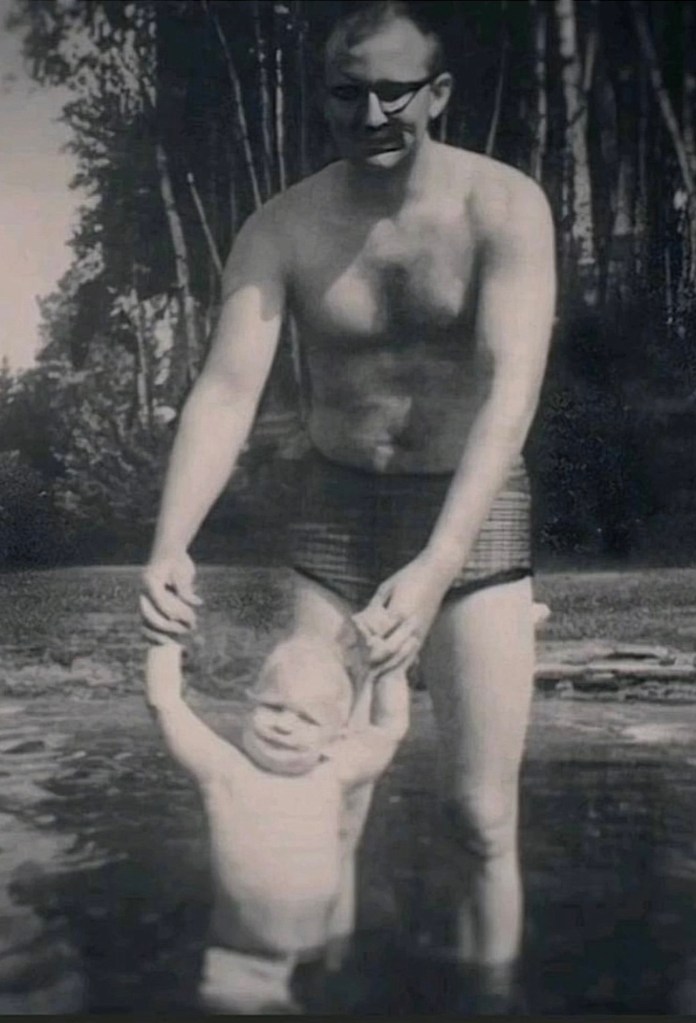
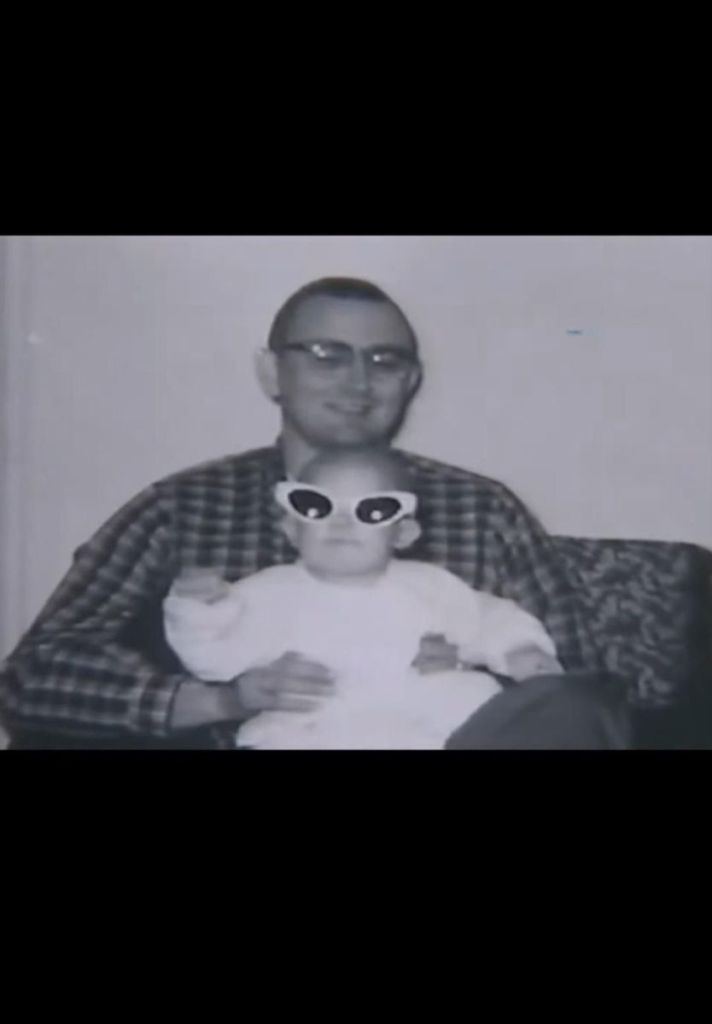
Take Care, Take Care, Take Care: Lionel Dahmer and the Son He Could Not Save

Near the end of A Father’s Story, his own memoir, Lionel Dahmer arrives at the only piece of advice he says he can offer any father who comes after him. Not a lesson, not a warning sign to watch for — just three words, repeated: “Take care, take care, take care.” It is the closest thing to a conclusion a man can reach after spending a book, and a life, unable to answer the question underneath it: what did I miss, and could I have stopped this?

This is not the story of Jeffrey’s crimes. It’s the story of the man who raised him, watched him drift further from reach with every passing year, and has spent every year since trying to understand where he failed to hold on.

A boy who looked like himself

Lionel recognized his son in a mirror before he ever recognized danger in him. Jeff was a shy, awkward child, and Lionel had been exactly that kind of child too — inordinately shy, easily disoriented by change, socially unable to read the room. When Jeff’s first-grade teacher described a boy who paced the schoolyard alone and did “nothing” at recess, Lionel absorbed it through the lens of his own childhood: a phase, an adjustment, something a person could learn to live with, the way he had.

That identification cuts through the whole first half of the book. “I saw no reason why my son could not learn to live with them, too,” he writes of Jeff’s early isolation — and admits, decades later, that he was wrong. “While I had suffered from shyness, Jeff had begun to suffer from a near total isolation. While I had known the power of an odd fascination, Jeff had begun to move into the grip of a profound perversity.” The two conditions looked identical from the outside. Lionel now believes they were never the same thing at all.

One memory recurs for him more than any other. Coming home from work, he found Jeff alone at the edge of their lawn after a rainstorm, sobbing, arms flailing, mired in mud, their dog barking wildly around him — a small boy in a full-scale panic at the feeling of being pulled down into the earth. Lionel still asks himself, all these years later, whether that was a moment he should have read differently. He never resolves the question. He simply keeps returning to it.

The house he left him in

By 1978, Jeff’s parents’ marriage had collapsed entirely. Custody went to Joyce for David, the younger son; Jeff, nearly eighteen, was old enough to be left out of the arrangement altogether — which meant, for a stretch of that year, he was effectively left alone. Lionel had moved into a motel. Joyce and David eventually left too. Jeff stayed in the family house by himself.

When Lionel’s new partner, Shari, first walked through that house, she found it in poor shape — little food, a broken refrigerator — and, on the coffee table in the family room, a pentagram drawn in chalk. Lionel didn’t understand what he was looking at until later: Jeff had been performing séances alone in the house, trying to contact the dead.

Lionel moved back in immediately once he learned Jeff was alone. But the sequence itself — a boy left in an empty house for an unspecified stretch of a collapsing marriage, filling the silence with attempts to summon spirits — sits in the record as one of the more quietly disturbing details of his adolescence, and Lionel’s own book puts it there without much comment, simply narrated as one more thing that happened.

Not long after, Lionel and Shari drove Jeff to Ohio State University, a college he’d shown no enthusiasm for and was attending, by his father’s own account, “more or less on my orders.” What Jeff packed for the trip has stayed with Lionel: no books, no clothes anyone would expect of a freshman, but a snakeskin from Boy Scout camp and two photographs of his dog.

What a father chooses not to see

The most difficult passage in A Father’s Story isn’t about a single incident. It’s Lionel’s accounting of everything he didn’t see, laid out in a single unbroken run of admissions: he hadn’t recognized Jeff’s alcoholism until Shari found him drunk in his room. He hadn’t thought his son a thief until his own mother discovered a stolen mannequin in Jeff’s closet. He hadn’t understood Jeff was gay until information surfaced after an arrest for molesting a child — despite years of no dates, of taking a “friend” to prom, of never once expressing interest in a woman. And he had used the word “crazy” about his own son more than once, he admits, always in frustration, never once considering that he might mean it literally.

“It was a level of obliviousness, or perhaps denial, that was scarcely imaginable, and yet it was real,” he writes. “It was as if I had locked my son in a soundproof booth, then drawn the curtains so that I could neither hear nor see what he had become.”

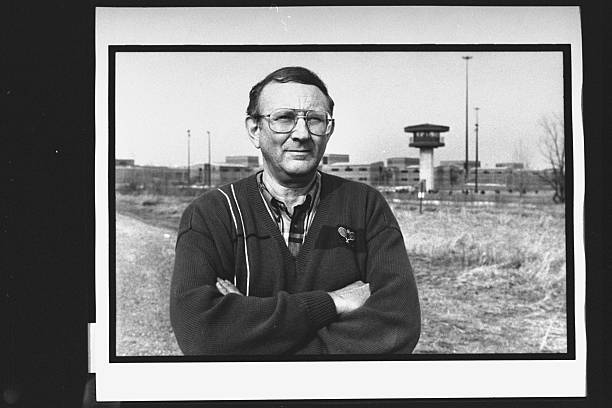
Research chemist/author Lionel Dahmer, father of confessed serial killer Jeffrey Dahmer, standing outside of Columbia Correctional Institute where his son is imprisoned. (Photo by Steve Kagan/Getty Images)

That is about as unflinching as a father’s self-assessment gets, and this memorial has no interest in softening it on his behalf. But it’s worth naming plainly what Lionel does not do in this passage: he doesn’t reach for excuses, and he doesn’t stop at diagnosing his own blindness — he goes further, into the much harder territory of asking whether he was the source of what he failed to see.

The question he cannot put down

After the arrest, in the same Inside Edition interview where Shari wept for the victims’ families, Lionel offered a theory: that Jeff’s “madness” might trace back to medication Joyce had taken during her pregnancy. He later admits the theory went essentially unexamined — a father grasping for any explanation that wasn’t simply this came from somewhere in me.

But the genetic question doesn’t stay external for long. In his own writing, Lionel turns it back on himself directly, cataloguing his own childhood fascinations — with hypnosis, with building explosive devices, with once wiring the living room couch to shock visiting cousins as a “joke” — and asks, in language he doesn’t try to make comfortable, whether “some of the compulsions that overwhelmed my son may have had their origins in me.” He wonders whether his own “need for control,” his own violent impulses arising from childhood powerlessness, might have “come to Jeff through me.” His own psychologist, he notes, eventually had to caution him against overstating any single cause — a reminder Lionel includes in his own book, seemingly aware that his rumination was in danger of becoming its own kind of compulsion.

He never reaches a conclusion. He states this outright, more than once: he will never know how much of it was genetic, how much environmental, how much simple bad luck. What he does arrive at is a kind of standing verdict on fatherhood itself — that it is, in his words, “a grave enigma,” and that the only honest thing he can pass on to any father after him is the warning to pay closer attention than he did.

What was left, once there was nothing left to do

Once Jeff was sentenced and sent to Columbia Correctional Institution, eleven hours from home, Lionel writes that his role as a father had “almost disappeared” — reduced to visits, letters, and small, non-essential provisions. What grew in that reduced space, unexpectedly, was conversation. Father and son spent visits discussing intelligent design, evolution, the origins of life — Jeff, Lionel writes, had read thirteen books on the subject and engaged with real intellectual hunger. “It felt stimulating,” Lionel writes, “and I miss Jeff’s inquiring mind.” Alongside Roy Ratcliff’s ministry and Jeff’s baptism, this period represented something Lionel describes, without irony, as his son’s humanity “restoring itself.”

That restoration makes what follows harder, not easier. In July 1994, months before the attack that killed him, Jeff was attacked with a razor by another inmate. A prison chaplain reassured Lionel afterward that Jeff would be secure. Lionel later learned that Jeff had been left unsupervised for twenty to forty minutes with a different inmate — one with a documented history of attacking others and threatening to kill white people — despite an internal report flagging a specific threat against Jeff that CCI staff concluded was “not substantive.” When the fatal attack came that November, Lionel didn’t describe it as senseless or unforeseeable. He described feeling “lulled” and “betrayed” — and guilty, for not having pushed harder on prison security after the first warning sign.

Take care, take care, take care

Lionel Dahmer’s memoir does not end in resolution, and this piece won’t manufacture one on his behalf. He remains, in his own words, “a man in constant rumination” — uncertain whether nature or negligence or sheer chance produced what his son became, certain only that he will carry the not-knowing for the rest of his life. The mud on the lawn, the pentagram on the coffee table, the snakeskin in the college bag, the razor attack nobody took seriously enough — none of it adds up to an answer. It adds up to a father who kept looking anyway, long after looking stopped being able to change anything, and who left behind three words for anyone who might be standing where he once stood, not watching closely enough.


Sources cited

  • Dahmer, Lionel. A Father’s Story.
  • Masters, Brian. The Shrine of Jeffrey Dahmer.
  • Schwartz, Anne E. Monster: The True Story of the Jeffrey Dahmer Murders.
  • Kennedy, Patrick, and Robyn Maharaj. Grilling Dahmer: The Interrogation of the Milwaukee Cannibal.

The Topaz Ring

In the summer of 1987, Jeffrey walked into Bailey, Banks & Biddle at Northridge Mall in Milwaukee and paid roughly $1,500 for a ring — a large blue topaz set in gold. Asked about it later, his explanation was almost disarmingly ordinary: he had “always had an interest in jewelry and especially rings,” and the size of the stone appealed to him.

A year later, in the summer of 1988, he pawned it. Not at a jeweler this time, but at a gold-and-silver exchange on Bluemound Road, where he bargained the clerk up to $189 for a ring he’d paid nearly eight times that for. His own stated reason was blunt: his drinking had left him short on cash.

That gap — $1,500 down to $189 — is not, on its own, remarkable. People pawn jewelry for a hundred reasons that have nothing to do with anything sinister. What makes this exchange worth examining is what came next.

The question that was actually being asked

The document containing this account is not a jewelry appraisal. It’s a police report, compiled after Jeffrey’s arrest, following a tip from the Brookfield Police Department that he had pawned a ring in their city. Investigators weren’t interested in the ring as a ring. They were asking a direct question: did this come from one of his victims?

His answer was immediate and flat — no, and he “again denied selling any of the jewelry which he obtained from any of his victims.” Then, without being pressed further on the point, he added something no one had asked for: that if there was any jewelry taken from victims, “he simply threw it out in the trash, along with body parts.”

That sentence is doing an enormous amount of work in very little space. It is, technically, a hypothetical — if there was jewelry, here’s what would have happened to it. But it’s delivered with the same flat tone as everything else in his account, sliding a detail about disposing of human remains into what started as a question about a pawn ticket.

Setting this against what trophy-taking actually looks like

Criminologists who study sexual homicide offenders have a specific term for what Jeffrey is being asked about here: trophy-taking — retaining an item connected to a victim, not for its resale value, but for what it does psychologically. The research is consistent on this point: items are kept “not for monetary reasons but to serve the offender psychologically,” allowing the offender to revisit and relive the experience privately. The most commonly documented trophies across offender studies are body parts, photographs of the crime scene, and — specifically — jewelry or clothing taken from the victim.

Jeffrey is a documented case of exactly this behavior, just not with jewelry. Skulls, Polaroid photographs, and other remains were recovered from his apartment — trophies in the fullest sense the research describes. Which makes his specific denial here worth sitting with rather than passing over. He is not claiming he kept nothing. He is drawing a very precise line: photographs, yes; skulls, yes; a victim’s ring, no — that would have gone in the trash.

Whether that line is true is not something this record can settle. It’s possible jewelry genuinely held no significance to him the way other remains did — trophy-taking research does note that offenders are selective, not indiscriminate collectors, and what becomes meaningful to one offender may hold no charge for another. It’s also possible this was simply the safer thing to say to an investigator, a way to admit to the pattern in general terms — “if there was jewelry” — while denying the one form of it that would have been easiest to trace back to a named victim through a pawn shop record, exactly as this one was traced.

A small object, honestly

There is no way to resolve that ambiguity from this document alone, and this piece isn’t going to pretend otherwise. What’s certain is narrower: a ring bought for $1,500 out of an ordinary, almost sweet fondness for jewelry, pawned a year later for a fraction of that as his drinking worsened, and finally surfacing again after his arrest as the subject of a question about whether it had ever belonged to someone he killed. An object that started as a small personal indulgence ended its documented life sitting inside an interrogation about trophies and trash.


Sources cited

  1. Police report excerpt, Brookfield Police Department tip regarding Jeffrey Dahmer pawn transaction, released records.
  2. Sage Reference, Encyclopedia of Murder and Violent Crime — “Trophy Taking.” https://sk.sagepub.com/ency/edvol/violentcrime/chpt/trophy-taking
  3. Walter, N. et al. (2024). “Trophy, souvenir, or simple theft? Taking items from the victim in sexual homicide.” Behavioral Sciences & the Law. https://onlinelibrary.wiley.com/doi/full/10.1002/bsl.2660
  4. “The collectors: Serial sexual offenders who preserve evidence of their crimes.” ResearchGate. https://www.researchgate.net/publication/259158356_The_collectors_Serial_sexual_offenders_who_preserve_evidence_of_their_crimes

Jeffrey Dahmer and the Jokes He Left Behind

Humour is not a word anyone expects to find near this story. But it is there, threaded through the record in two very different forms — the jokes a horrified public told about him, and the small, dark moments of levity that actually happened around him, inside the jail cells and interrogation rooms where his story was still unfolding in real time. Both are worth looking at honestly. Neither is comfortable.

The jokes that swept the country

Within two weeks of Jeffrey’s arrest, jokes about him were already circulating nationally. On August 6, 1991, The New York Times ran an editorial addressing the phenomenon directly, arguing that the jokes existed because “there is a need for people to distance themselves from the horror.”

That explanation is a reasonable one, and it was echoed by people who had no choice but to sit with the horror professionally. Anne Schwartz, the reporter who broke the story and covered the trial from the front row, later wrote that many of her fellow journalists told jokes throughout the proceedings specifically “in order to keep their sanity.”

But distance may not be the whole story. Within months, a publisher named Hart Fisher had turned Jeffrey’s crimes into a comic book through his company, Boneyard Press, and described the appeal to television cameras without any apparent discomfort: “It’s something you can’t get anywhere else — if you like the truth, if you like something a little bit more fresh, a little bit more bloody, we’ve got the meat.” That is not the language of someone trying to create distance. It is the language of someone selling proximity.

The joke cycle sat inside a larger pattern that scholars have since traced through the entire “serial killer” media boom of the early 1990s — the same years that gave the culture Hannibal Lecter as a sanitised, almost lovable version of the same figure. Anthony Hopkins later recalled being approached by twelve-year-old children asking him to perform Lecter’s “fava bean” line for their entertainment. Somewhere between the Times editorial and the comic book and the children asking a fictional cannibal to do a bit, the line between “processing horror” and “consuming it as entertainment” gets difficult to locate.

Jeffrey was not insulated from any of this. Letters reached him in prison keeping him “up-to-date on the latest ‘Jeffrey Dahmer’ jokes,” according to his father’s own account, and reporting from inside the jail described him as “visibly perturbed” by the jokes that followed him even among fellow inmates. Whatever function the jokes served for the public telling them, for the man they were about, they were simply one more form of the notoriety he could not escape.

The humour that actually happened around him

Separate from the joke cycle is something stranger: a handful of genuinely dark, unplanned moments of humour that occurred in the actual rooms where his case was being handled — not jokes told about him from a distance, but small human moments that happened to be, in a bleak way, funny.

The most widely cited is also the earliest. Minutes after Tracy Edwards escaped Apartment 213 and police discovered what was inside, one of the responding officers radioed dispatch: “The intoxicated Asian naked male [laughter heard in background] was returned to sober boyfriend.” A second officer, informed he’d be heading back to the station, added: “My partner’s gonna get deloused at the station” — followed by more laughter on the recording. This is gallows humour in its purest form: officers who had no idea yet what they’d just walked into, laughing at a domestic-dispute call minutes before it became one of the most notorious crime scenes in American history.

Inside the jail itself, the record shows a mix of hostility and small, incongruous moments of connection. Guards placed Jeffrey under 24-hour suicide watch — a light kept permanently on, flashlights turned on his face as he tried to sleep, three guards watching him urinate “and laughing as well,” according to Brian Masters’ account. He once sharpened his toothbrush in protest of what he considered unfair treatment, a small act of defiance that cost him a night sleeping on the concrete floor in his underwear. And yet amid the hostility, Masters records one genuinely tender moment: a guard, stepping away from his post for fifteen minutes overnight, told him simply, “Now don’t do anything stupid, Jeff.” Masters calls it “a tiny moment of connection” — and it is hard to disagree.

Jeffrey’s own complaints about jail carry a dry, almost absurd quality of their own. Asked what the days were like, he described having “nothing to do but watch the ants crawl around on the floor,” and described the bed bugs at night as something you could feel “jumping on your eyelids and nose.” A former inmate told the Milwaukee Sentinel that the guard posted outside his cell “reads him the paper, and talks to him about what he did to people and things” — offered as evidence of favourable treatment, but reading, out of context, almost like a description of an unlikely daily routine between two people stuck in a small space together.

Even the investigators had their own strange footnote. Detective Patrick Kennedy, who spent hours across the interrogation table extracting Jeffrey’s confession, moonlighted off duty as McGruff the Crime Dog, touring Milwaukee schools in a furry costume to teach children about the dangers of drugs. The man who sat with Jeffrey through some of the most disturbing testimony in American criminal history spent his weekends in a dog suit warning eight-year-olds about strangers.

Why this belongs in the record

None of this softens what happened. The jokes, the comic books, the gallows humour on a police radio — none of it changes the seventeen lives that were taken, and this memorial has never tried to weigh one against the other. But humour is also one of the most honest windows into how a society actually processes something it cannot fully absorb, and how the people closest to a case — reporters, guards, detectives — survive proximity to it day after day. The jokes told about Jeffrey say more about the country’s appetite for monsters than they do about the man himself. The small, dark moments that happened around him say something quieter: that even inside the most controlled, hostile environment imaginable, ordinary human behaviour — boredom, dry humour, a guard’s offhand kindness — kept finding its way through.


Sources cited

  1. Schwartz, Anne E. Monster: The True Story of the Jeffrey Dahmer Murders.
  2. Masters, Brian. The Shrine of Jeffrey Dahmer.
  3. Dahmer, Lionel. A Father’s Story.
  4. Kennedy, Patrick, and Robyn Maharaj. Grilling Dahmer: The Interrogation of the Milwaukee Cannibal.
  5. The New York Times, editorial on serial killer jokes, August 6, 1991.
  6. Academic discussion of the joke cycle, comic book publication, and Hannibal Lecter comparison drawn from a scholarly text on Dahmer and the construction of the serial killer figure in media.

August 24, 1993: A Crisis Report

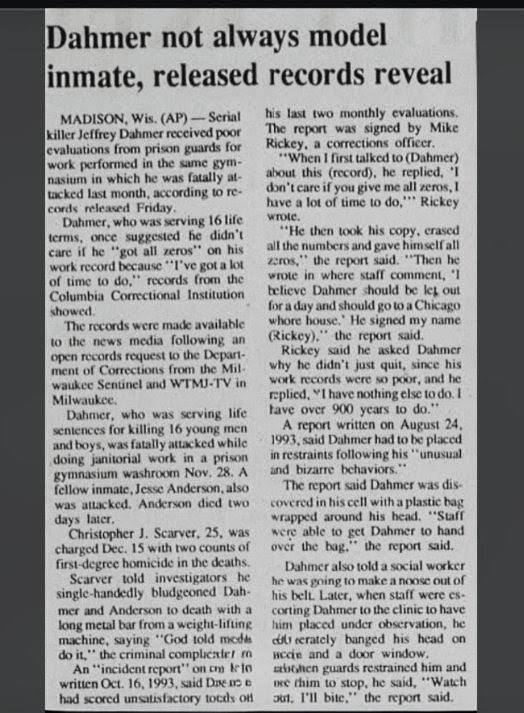
On 24 August 1993, a report was filed at the Columbia Correctional Institution describing what staff called “unusual and bizarre behaviours.” Jeffrey had been discovered in his cell with a plastic bag wrapped around his head. Staff were able to get him to hand it over. He told a social worker he intended to make a noose out of his bedsheet. Later, while being escorted to the clinic for observation, he deliberately banged his head against a door and a window; when guards moved to restrain him, he warned them, “Watch out, I’ll bite.”

He was placed in restraints.

Fourteen months later, on 28 November 1994, he was dead.

It would be easy to read the intervening year as a straight line — crisis to conclusion — but that is not what the record supports, and it is not the aim of this piece. What the record does support is a single, specific, dated moment of documented psychological crisis, described in exactly those terms by the institution itself, at a point when nobody involved could have known what would happen fourteen months later. It deserves to be examined on its own terms.

What the behaviours actually indicate

Read individually, each element of that August report corresponds to a recognised category in the clinical literature on prison suicide risk, not simply a list of “acting out.”

A plastic bag over the head is a concrete, means-based gesture — not a symbolic complaint but an act with a specific method already in motion. The statement to the social worker about a bedsheet noose is a direct verbal communication of both method and intent, the kind of disclosure that risk-assessment frameworks treat as one of the clearest available warning signs precisely because it is not ambiguous. The head-banging that followed, once he was already under observation, reads as an escalation under acute distress rather than a separate incident — three connected behaviours across a single day, not three isolated ones.

Research into near-lethal and severe self-harm among prisoners is explicit that behaviours of this kind function as genuine precursors to more serious attempts, not as manipulation to be discounted. A related finding is worth sitting with directly: in jail populations, the majority of people who go on to die by suicide were not on formal suicide watch at the time of their death. Threats, gestures, and disclosed intent — exactly the pattern documented here — are consistently under-weighted by the systems meant to catch them.

Why a person reaches this point

The literature on why incarcerated people arrive at this kind of crisis does not point primarily to individual pathology. From the inmate’s own perspective, the dominant factors identified across studies are fear of the unknown, distrust of an authoritarian environment, a felt loss of control over one’s own future, isolation from family and outside relationships, shame, and the broadly dehumanising conditions of confinement itself. Separately, research consistently links poor emotional regulation, mental health strain, and a lack of meaningful social support to inmate suicidality — and specifically ties a lack of purposeful work activity to both suicidal ideation and suicide attempts.

That last point lands with particular weight here. The same records that document this crisis also show Jeffrey’s failing work evaluations in the same period, and his own words to a corrections officer: “I don’t care if you give me all zeros, I have a lot of time to do it.” Read in isolation, that line sounds like indifference. Read against the research, and against what happened weeks later, it reads more like the flattened affect of someone already in trouble.

The isolation question

The full incident report does not survive in the released excerpt to confirm his exact housing status that day, but the sequence itself is suggestive: a bag over the head, a stated intention to fashion a noose from a bedsheet, then head-banging severe enough to require restraint — none of this plausibly happens over an extended period with a cellmate present and unremarked upon. The likelier reading is that he was alone at the time, whether by assignment, protective custody, or circumstance. We treat this as a reasoned inference rather than a documented fact, and welcome correction if the full housing record says otherwise.

If that inference holds, there is a substantial body of research worth engaging with. People in solitary confinement make up a small fraction of the total prison population but account for a dramatically disproportionate share of prison suicides. Even protective custody — isolation intended to keep someone safe — carries the same psychological costs as punitive isolation, because the mechanism of harm is the isolation itself, not the reason for it. Some of the clearest data comes from outcomes after release: people who had spent time in restrictive housing were substantially more likely to die by suicide in the year after leaving prison than those who had not, with the risk compounding for each additional stay in isolation.

The institutional response and its limits

The response to the August incident was restraint and observation. This was, by any account, a genuine safety measure in the moment. But it is worth naming plainly what it was not: it was containment, not treatment. Nothing in the record suggests a sustained clinical intervention followed — no indication of ongoing psychiatric support, no apparent reassessment of his housing or work assignment in light of what had just happened. This matches a broader, well-documented pattern in correctional mental health: the system is generally built to respond to the moment of crisis, and far less equipped to address what produced it.

Where this sits against “The Mind That Wouldn’t Stay”

This memorial has already argued, in the “Trance States” piece, that Jeffrey’s dissociative episodes were clinically significant rather than incidental. That argument was built largely from pattern — testimony, later evaluation, retrospective analysis. August 1993 offers something different: a single, dated, contemporaneously documented crisis, described as serious by the institution at the time it happened, not reconstructed afterward. It does not replace the broader argument. It anchors it.

A crisis, not a footnote

None of this reframes what Jeffrey did, or asks the reader to weigh his suffering against the suffering he caused. Those are separate facts, and this memorial has never tried to make one cancel out the other. What this record shows is narrower and, we think, still worth stating clearly: fourteen months before his death, in an institution that documented it themselves, Jeffrey Dahmer was in genuine psychological crisis — and the response he received was restraint, not care. That is true, it is documented, and it belongs in the fuller account of who he was.

By April 1992 — sixteen months before this crisis — Jeffrey was on an antidepressant, two 20mg capsules of Prozac each morning, and was being seen three times a week by a clinical psychologist who did not consider him imminently suicidal at that time. Whether that level of care was still in place by August 1993 isn’t something this report confirms — it simply isn’t mentioned. But the contrast stands on its own: a year and a half earlier, someone was checking on him several times a week. In August 1993, what survives is a crisis and a set of restraints, nothing else. If his care had quietly lapsed somewhere in that gap, this is where it becomes visible.


Primary source: Columbia Correctional Institution incident report, 24 August 1993, released under open records request.

  1. Cain, C. et al. — Jails in Crisis: Study Identifies Those at Risk of Suicide Behind Bars, Florida Atlantic University. https://www.fau.edu/newsdesk/articles/suicide-jails-study.php
  2. U.S. Department of Justice, National Institute of Corrections — jail suicide risk factors and inmate-perspective drivers (fear, distrust, isolation, shame, dehumanisation). https://www.prisonpolicy.org/scans/doj/012475.pdf
  3. Examining Risk and Protective Factors for Suicidal Behaviors: A Cross-Sectional Study Among Portuguese Male Inmates, PMC. https://pmc.ncbi.nlm.nih.gov/articles/PMC11817471/
  4. Prevention of Suicidal Behavior in Prisons: An Overview of Initiatives Based on a Systematic Review of Research on Near-Lethal Suicide Attempts, PMC. https://www.ncbi.nlm.nih.gov/pmc/articles/PMC5120691/
  5. Vera Institute of Justice — Study Links Solitary Confinement to Increased Risk of Death After Release (JAMA/North Carolina cohort study). https://www.vera.org/news/study-links-solitary-confinement-to-increased-risk-of-death-after-release
  6. Prison Policy Initiative — The research is clear: Solitary confinement causes long-lasting harm (6–8% of prison population, ~50% of prison suicides). https://www.prisonpolicy.org/blog/2020/12/08/solitary_symposium/

The Diagnosis He Never Had: Jeffrey Dahmer and the Psychopathy Question

Ask almost anyone to describe Jeffrey Dahmer in one word, and somewhere in the first three answers you will hear it: psychopath. In the popular imagination, the words “serial killer” and “psychopath” are simply synonyms — one implies the other, automatically, in both directions.

Here is what the actual record says: Jeffrey Dahmer was examined by more forensic psychiatrists and psychologists than almost any defendant of his era. He was tested, interviewed, evaluated before trial and during it, by experts for the defense, the prosecution, and the court. And across all of it, psychopathy is the diagnosis that never arrives.

This article is about that absence — what it means, what it doesn’t, and why the distinction matters more than a label should.

What Psychopathy Actually Is

Psychopathy is not, strictly speaking, a diagnosis at all. It does not appear in the DSM, psychiatry’s diagnostic manual; the nearest DSM category, antisocial personality disorder, overlaps with it but is not the same thing. Psychopathy is a research construct, given its modern shape by Robert Hare’s Psychopathy Checklist–Revised (PCL-R) — a 20-item instrument, scored 0 to 2 per item by a trained examiner, maximum 40 points, with a conventional diagnostic threshold of 30 in North America.

The traits it measures fall into two clusters. The first is interpersonal and affective: glibness and superficial charm, grandiosity, pathological lying, manipulativeness, lack of remorse, shallow emotions, callous absence of empathy. The second is behavioural: impulsivity, parasitic lifestyle, poor behavioural controls, early and versatile criminality. The classic psychopath — the Ted Bundy type — is charming, grandiose, remorseless, and lies as easily as breathing.

Hold that portrait in mind, and now look at the man in the record.

What He Was Actually Diagnosed With

The experts at Jeffrey’s 1992 trial disagreed about many things, but their diagnostic vocabulary is consistent and conspicuous. Borderline personality disorder. Schizotypal features. Paraphilia — necrophilia — as the engine of the crimes. Alcohol dependence. Anxiety and depression, treated with Prozac at Columbia Correctional, as documented in the 1992 competency evaluation the memorial published earlier this year. (See “A Mind in Pieces” for the full diagnostic history.)

What no evaluator who examined him made central — not the defense experts, not the prosecution’s Dr. Park Dietz, not the court’s appointees — was psychopathy. The forensic literature since has noticed the same thing. A scholarly analysis of media portrayals notes plainly that Dahmer does not fit the clinical criteria for psychopathy, despite decades of media reporting to the contrary. Forensic psychology teaching materials routinely use him as the standard counter-example: Bundy the textbook psychopath, Dahmer the emotionally disturbed, compulsion-driven opposite.

And in 2018, the question was put to the instrument itself. A research team led by criminologist Eric Hickey retrospectively scored five serial killers commonly assumed to be psychopaths — Dahmer, Bundy, Gacy, Kemper, and Ridgway — using trained raters and the PCL-R. Only Bundy crossed the diagnostic threshold. Jeffrey Dahmer scored 23 out of 40: elevated, certainly, but seven points below the cutoff — closer to the general prison population than to the Bundys of the world. The researchers used his case specifically to illustrate their central finding: not all serial killers are psychopaths, and the most infamous one of all wasn’t.

Trait by Trait, Against the Record

Set the checklist beside the documented man, and the mismatches are striking.

Glibness, charm, grandiosity. Jeffrey was, by every firsthand account, socially awkward, monosyllabic, and self-effacing to the point of self-erasure. His documented self-descriptions run the other direction entirely: he called his crimes “a nightmare,” himself something that should have been put to death. His one flash of wit about fame — rolling his eyes at “the price of my infamy” — is wry and deflating, the opposite of grandiose.

Pathological lying and manipulativeness. Here honesty requires precision. During the crime years, Jeffrey lied constantly and sometimes with chilling effectiveness — most catastrophically in the Konerak Sinthasomphone incident. Deception in the service of concealment was fully present. But the psychopathic trait is lying as a way of being, gratuitous and lifelong. And the moment concealment ended, something remarkable happened: he became almost pathologically truthful. Sixty hours of confession. Every victim identified, including those police could never have connected to him. Photographic tests seeded with living men to catch him lying — he never once took the bait. Detectives and psychiatrists alike remarked that they had never seen a defendant so intent on being accurately understood.

Lack of remorse, shallow affect. This is the heart of the construct, and it is where the record diverges most sharply. The man who told Roy Ratcliff, unprompted, that he believed he deserved execution — and then asked whether continuing to live was itself a sin against God — was not performing shallowness. He wept over Steven Hicks alone in a dorm room at Ohio State. He described his own emotional numbness not with indifference but with grief: he hadn’t cried in years and didn’t know if he still could. A psychopath does not mourn his missing feelings. Mourning them is precisely the thing psychopathy takes away.

And the honest counterweight. The 1992 competency evaluation contains a harder sentence: one evaluator described him as lacking sincere empathy and real remorse. That assessment exists; the memorial does not hide it. Psychopathic traits were present in Jeffrey Dahmer — a 23/40 is not a zero, and no one should mistake this article for a claim that he was empathically whole. The question is not whether he had elevated traits. It is whether “psychopath” is the accurate frame. The instrument built to answer exactly that question says no.

Why the Label Matters

Because “psychopath” is not just a word — it is a full stop. It says: born without conscience, nothing here to understand, no door that anyone could have knocked on. It converts a human catastrophe into a species difference, and in doing so it lets everyone off the hook — the family that couldn’t reach him, the systems that missed him, the society that would rather have monsters than mirrors.

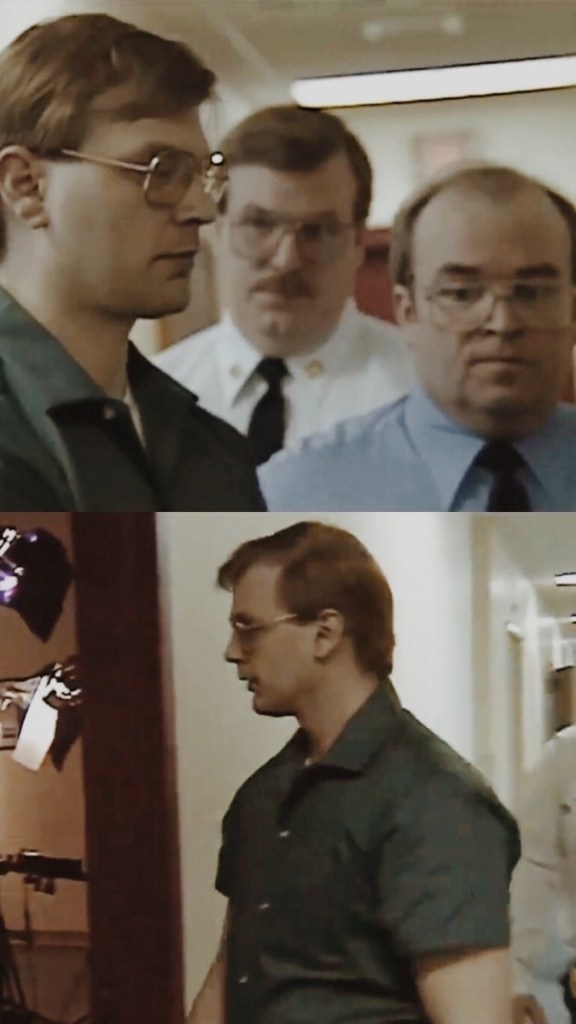
(Photo by Curt Borgwardt/Sygma via Getty Images)

The documented reality is harder to sit with. Jeffrey Dahmer appears to have had a conscience — damaged, buried under dissociation and alcohol and compulsion, but present and in pain. He knew what he was doing was monstrous; he said so, before and after arrest. The engine of his crimes was not the absence of feeling but a compulsion that overwhelmed the feeling that was there. That is not an exoneration — seventeen men and boys are dead, and elevated traits plus intact knowledge of wrong makes moral responsibility heavier, not lighter. But it is a different tragedy than the one the label tells. The psychopath story says such men must be detected and caged, because nothing else was ever possible. Jeffrey’s actual story — the lonely, drowning, help-resisting, guilt-carrying reality of it — suggests something more disturbing and more useful: that he was reachable, at least in principle, and no one reached him until a pastor with a whirlpool tub arrived twenty-two months before the end.

The memorial exists for precisely this kind of distinction. Getting the label right is not pedantry. It is the difference between a warning the world can learn from and a monster story it can only repeat.


Sources: E. Hickey et al., retrospective PCL-R assessment of serial murderers (2018), as reported in K. Ramsland, “Are All Serial Killers Psychopaths?”, Psychology Today (2025); R. Hare, Psychopathy Checklist–Revised; Jeffrey L. Dahmer, Competency Evaluation, Case No. F-912542 (April 27, 1992); Brian Masters, The Shrine of Jeffrey Dahmer (1993); Lionel Dahmer, A Father’s Story (1994); Roy Ratcliff, Dark Journey Deep Grace (2006). Related memorial articles: “A Mind in Pieces,” “The Mind That Wouldn’t Stay,” “A New Primary Source: The 1992 Competency Evaluation.”

Jeffrey And The Tin Whistle: A Small Document About Hope

Some primary sources arrive looking important. Court transcripts, psychiatric evaluations, sworn statements. And some arrive looking like this: a Wisconsin Department of Corrections property receipt, form DOC-237, the most bureaucratic piece of paper imaginable — and quietly one of the most human documents in the memorial’s collection.

Here is what it records. On May 10, 1994, a package arrived by mail at Columbia Correctional Institution for inmate 177252, Dahmer, Jeffery (the prison misspelled his first name). It came from a specialty shop called Anyone Can Whistle, in West Hurley, New York. It contained three items, listed in a staff member’s careful capitals:

1 — CLARKE TIN WHISTLE 1 — TIN WHISTLE INSTRUCTIONAL CASSETTE TAPE 1 — TIN WHISTLE INSTRUCTION BOOK

He signed for it on May 17. His signature — the same one on the Thanksgiving card he would send Roy Ratcliff six months later — sits at the bottom, next to a paragraph in which he formally agrees that none of his musical equipment exceeds $350 in value. The whistle cost a fraction of that. It is, famously, one of the cheapest real instruments in the world.

What a Tin Whistle Is

For readers who have never met one: the tin whistle — also called the penny whistle — is a small six-holed folk flute, one of the simplest instruments ever made. The Clarke company has been producing them in England since 1843, rolling a sheet of tinplate into a cone around a wooden mouthpiece block, essentially unchanged for nearly two centuries. It is the classic beginner’s instrument of Irish and Celtic folk music: cheap, light, easy to start, genuinely difficult to master.

If you don’t think you know its sound, you almost certainly do. It is the bright, airy, high voice threaded through most Celtic folk music — the sound most people today would describe, not inaccurately, as “the Lord of the Rings flute.” The Clarke in particular is known for a breathy, slightly husky tone that players call “chiff.”

It is also, in its upper octave, piercing. Gloriously, unapologetically piercing. Hold that thought.

The Date

Readers of this memorial may recognise May 10, 1994.

It is the day Jeffrey Dahmer was baptised — the day of the solar eclipse and the Gacy execution, the day Roy Ratcliff drove through a darkened afternoon to immerse him in a prison whirlpool tub, the day he came up out of the water saying “thank you.” We wrote about it at length in “The Day Jeffrey Dahmer Was Baptised.”

On that same day, in the prison mailroom, someone was logging his tin whistle.

Nobody planned this. The package simply arrived when it arrived, and a staff member stamped the date. But the coincidence is documented on both ends — Ratcliff’s memoir on one side, this DOC-237 form on the other — and it is hard not to sit with it for a moment. On the day grace entered his life through water, music entered it through the mail.

Why This Little Form Matters

Look at what he ordered. Not just the whistle — the instruction book and the instructional cassette. The full curriculum, for an instrument that costs less than a pizza.

That is not the purchase of a man passing time. That is the purchase of a man who intends to learn something — methodically, properly, from the beginning, the way he seems to have done everything. Readers of our analysis of his letters (“In His Own Hand”) will recognise the pattern instantly: this is the same person who flagged his own spelling mistakes in casual letters to penpals. Of course he ordered the book and the tape. He was going to do it right.

And there is something in that which deserves to be said plainly. In May 1994, Jeffrey Dahmer was two and a half years into a sentence of over nine hundred years. He had no prospect of release, ever. And he ordered a beginner’s instrument with a beginner’s course, which is one of the most future-oriented acts a person can perform. Nobody learns an instrument for today. Learning an instrument is a bet on tomorrow — on the version of yourself, weeks or months away, who can do something you currently cannot. It is hope, in the shape of a small tin cone.

He had six and a half months left. He didn’t know that. He was planning to get better at something.

The Lighter Part, Because It’s Real Too

And now the part that made us laugh, because humanisation includes comedy.

A Clarke tin whistle, in the hands of a beginner, in a concrete cell block, is an event. The upper octave of a tin whistle can cut through a pub full of fiddles; in a hard-surfaced prison unit it would have ricocheted off every wall like a musical fire alarm. Somewhere in Unit 6 of Columbia Correctional in the summer of 1994, the most notorious inmate in Wisconsin was working his way through a beginner’s instruction book — first the long slow notes, then the first wobbly scales, then, presumably, the first recognisable tune, played over and over the way beginners do.

We have no documentation of how his neighbours felt about this. We suspect we don’t need any.

There is something almost cinematic in the image: the man the world called a monster, sitting on his bunk with a Victorian-era folk instrument and a cassette tape, squeaking earnestly toward competence while the block goes quietly insane around him. It is ridiculous. It is endearing. It is deeply, stubbornly human. It goes on the shelf beside the taquitos, the Walter Mondale photo, and the letter about the frogs singing at night — the growing collection of small documented facts that refuse to fit the monster story.

Provenance

This document was shared with the memorial by our team member Sylli, whose contributions to the archive keep proving invaluable. It joins the letters, the Ratcliff card, and the 1992 competency evaluation in the memorial’s growing collection of primary sources — the paper trail of an actual human life, preserved one unglamorous form at a time.

Whether he ever got any good, no record says. That was never really the point. The point is that he wanted to.


Primary source: Wisconsin Department of Corrections Property Receipt/Disposition, form DOC-237, inmate 177252, dated May 10, 1994 (received) and May 17, 1994 (signed). Document courtesy of Sylli. Background on the instrument: Clarke Tinwhistle Co. (est. 1843).

In His Own Hand: What Jeffrey Dahmer’s Letters Reveal — and What They Don’t

Almost everything ever written about Jeffrey Dahmer was written by someone else. The trial transcripts, the psychiatric evaluations, the books, the documentaries — all of it filtered through other people’s frameworks and other people’s words. What has rarely been examined with any care is the small body of text he produced himself: the letters, cards, and documents in his own hand.

The memorial has gathered four such documents, spanning 1989 to 1994 — from his life before arrest to the final weeks before his death. This article looks at them through the lens of psycholinguistics: the scientific study of how language use reflects psychological states. It is, as far as we know, the first attempt to do so.

We want to be clear from the outset about what this is and is not. This is an exploratory reading of a very small sample, informed by published research — not a clinical analysis, and not a diagnosis. Where the science supports an observation, we cite it. Where we are simply describing what is on the page, we say so.

The Science, Briefly

The research foundation for this kind of reading comes largely from the work of psychologist James Pennebaker and colleagues, whose studies of “function words” — pronouns, articles, prepositions — have shown that the small, unnoticed words in a person’s writing correlate with psychological states more reliably than the dramatic ones. A few findings matter for what follows:

First-person singular pronouns. Elevated use of “I,” “me,” and “my” is one of the most replicated linguistic markers of self-focused attention, and correlates with psychological distress and depression across many studies.

Absolutist words. Research by Al-Mosaiwi and Johnstone (2018) found that words like “always,” “never,” and “completely” appear at significantly higher rates in the writing of people experiencing depression and suicidal ideation.

Politeness strategies. Linguists Brown and Levinson documented how people manage requests and social risk through “negative politeness” — hedging, apologising for imposing, softening. The degree and style of this management reflects how a writer perceives social relationships.

Concrete sensory detail. Genuine, present-focused writing tends to contain specific sensory observation; detached or dissociated writing tends toward abstraction and flatness.

With that foundation, here is what the documents show.

1989: The Letter to Judge Gardner

The earliest document is also the only one from Jeffrey’s life before the arrest — a written request to Judge William Gardner for sentence modification, following his 1988 conviction.

The surviving fragment reads: “This is why, Judge Gardner, I am requesting from you, a sentence modification. So that I may be allowed to continue my life as a productive member of our society. Respectfully Yours, Jeff Dahmer.”

Three things stand out.

First, the register. This is careful, formal, institutional English — “requesting,” “sentence modification,” “a productive member of our society.” He is writing in the language of the system he is addressing, mirroring its vocabulary back to it. This is a documented social-linguistic skill called register matching, and it shows an acute awareness of audience.

Second, the self-focus. In two sentences: “I am requesting,” “that I may be allowed,” “my life.” This is entirely natural in a plea letter — the genre demands it — but it is worth noting because of how sharply it contrasts with the last document in this collection, five years later.

Third, the handwriting itself. Unlike the later letters, this one is printed rather than cursive — deliberate, separated letterforms, the writing of someone taking visible care to be legible and correct before authority. We note this as a physical description only. Graphology — the claimed reading of personality from letter shapes — performs no better than chance in controlled studies, and the memorial will not lean on it. What we can say without pseudoscience is simply that the document is neat, effortful, and controlled, which is consistent with everything witnesses documented about his self-presentation.

There is a painful irony in this letter that needs naming: at the time he wrote these words about continuing life as a productive member of society, the worst years were still ahead. Whether the letter was cynical performance or something he believed in the moment he wrote it is unknowable. The competency evaluation we published previously documents that he resisted the therapy ordered alongside that sentence — so the record suggests, at minimum, that the words and the follow-through did not match.

April 1993: The Penpal Letter

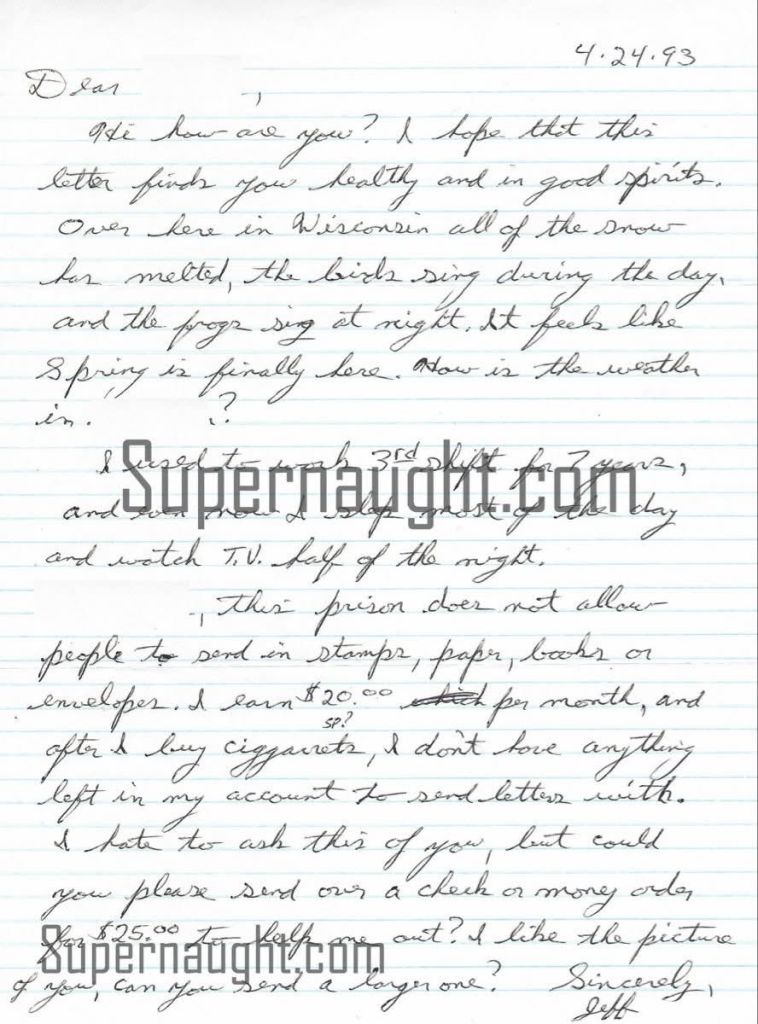
The second document is a full letter to a correspondent, dated 4-24-93, written from Columbia Correctional Institution.

It opens: “Hi how are you? I hope that this letter finds you healthy and in good spirits. Over here in Wisconsin all of the snow has melted, the birds sing during the day, and the frogs sing at night. It feels like Spring is finally here.”

For a man so often described as affectless, this passage deserves attention. It contains layered, specific, sensory observation — snow melting, birds by day, frogs by night — organised into a small, almost literary parallel structure. This is not flat writing. Whatever else was true of Jeffrey Dahmer in April 1993, he was noticing the world through a prison window and translating it into warm, conventional, socially fluent prose. Research associates this kind of concrete present-tense sensory detail with genuine engagement rather than detachment; his conversational writing, at least here, does not read as dissociated.

The letter then moves to practical matters, and here the politeness patterns are striking. Asking his correspondent for money — twenty-five dollars, in a letter that explains he earns twenty dollars a month and spends it on cigarettes — he writes: “I hate to ask this of you, but could you please send over a check or money order…” This is textbook negative politeness: acknowledging the imposition, softening the request, apologising in advance. He manages the social risk of asking with the same care he applies to his handwriting.

And then there is the smallest and perhaps most telling detail in the whole collection. Mid-letter, he misspells a word, crosses it out, and writes above it: “sp?”

He is flagging his own spelling error, in a casual letter to a penpal, with a proofreader’s annotation. This is self-monitoring — a live record of a mind checking its own output for correctness even in low-stakes writing. It is one visible data point of the carefulness that runs through everything: the neat letterforms, the managed politeness, the register control. The competency evaluation documented a man of high measured intelligence with obsessive-compulsive behavioural features; this little “sp?” is what that looks like on paper.

December 1993: The Hand

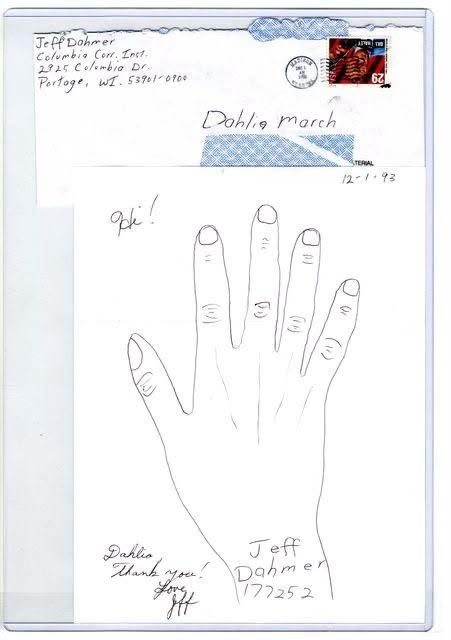
The third document is not primarily text at all. Sent to a correspondent named Dahlia in December 1993, it is a traced outline of his own hand, signed with his name and his inmate number, 177252, written on the palm.

The accompanying words are minimal — a greeting, “Thank you!”, “Love, Jeff.” There is little language to analyse here, and we will not overreach. But the artefact itself says something the letters cannot: asked to give something of himself to a stranger, he gave the outline of his own hand — the most literal self-portrait available to a man with no possessions. He labelled it with the two identifiers the world had left him: his name, and his number.

We offer no psychological claim about this. We simply note that people across every culture trace their hands as a way of saying I was here, this is me — children do it in school, prisoners have done it for as long as there have been prisons. It is among the most human gestures there is.

November 1994: The Thanksgiving Card

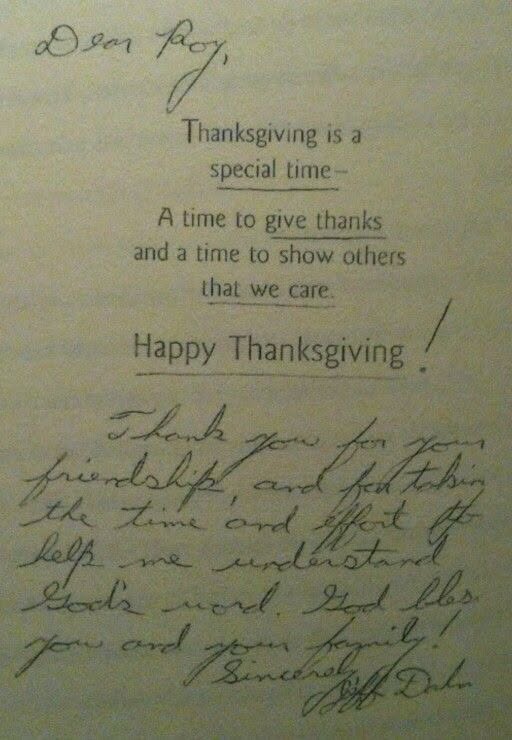
The final document is the card he sent to Roy Ratcliff, the minister who baptised him, in the last weeks of his life. Ratcliff described it in Dark Journey Deep Grace as one of his most treasured possessions.

The handwritten message reads: “Thank you for your friendship, and for taking the time and effort to help me understand God’s word. God bless you and your family! Sincerely, Jeff Dahmer.”

Set beside the 1989 Gardner letter, the shift in linguistic orientation is unmistakable. The 1989 letter is built around the self: I am requesting, that I may be allowed, my life. The 1994 card is built almost entirely around the other person: your friendship, your time and effort, you and your family. The only self-reference — “help me understand” — casts himself as a learner receiving something, not an agent demanding something.

The research on pronoun orientation is relevant here: outward-directed, other-focused language is associated with connection and gratitude; inward-directed language with distress and self-focus. On a sample of two short documents we cannot claim a measured trajectory — we want to be honest about that. But the direction of the shift matches, exactly, what every witness to his final years described: Ratcliff’s account of a man surprised that anyone would keep visiting him, the Thanksgiving card itself, the documented seriousness of the spiritual turn. The language on the page and the testimony about the man point the same way.

What This Does and Does Not Show

Read together, the four documents give us a consistent portrait in some respects and an honest limit in others.

What is consistent: carefulness. Across five years, two facilities, three genres, and audiences ranging from a judge to a penpal to a pastor, every document shows the same controlled, effortful, correctness-monitoring writer — neat letterforms, managed register, softened requests, a spelling annotation in a casual letter. The linguistic record matches the behavioural one: the politeness noted by detectives, the precision about the baptismal words, the methodical habits documented everywhere.

What is suggestive but not provable: the shift from the self-focused instrumental language of 1989 to the other-focused gratitude of 1994. It aligns with the documented biography of his final years. It is also two short texts, in different genres, and we will not pretend that is a dataset.

What is absent: the markers one might expect. In this small sample there is little of the absolutist vocabulary associated with depressive writing, no flattened affect in the conversational prose — the spring passage is the opposite of flat — and no linguistic strangeness at all. And perhaps that is the finding. The man whose inner life contained what his did wrote letters that are, linguistically, almost aggressively ordinary: polite, careful, warm within convention, worried about spelling. The gap between the interior documented in the clinical record and the surface of these pages is the same gap everyone who met him described — and here it is, preserved in ink.

This article is part of an ongoing series examining primary sources. See also: “A New Primary Source: The 1992 Competency Evaluation” and “The Mind That Wouldn’t Stay: Jeffrey Dahmer’s Dissociative Episodes and What They Tell Us.”

Documents: letter to Judge William Gardner (1989, court record); letter to a correspondent, April 24, 1993; hand tracing sent to Dahlia March, December 1, 1993; Thanksgiving card to Roy Ratcliff, November 1994 (reproduced in Ratcliff, Dark Journey Deep Grace, 2006). Research references: Pennebaker, The Secret Life of Pronouns (2011); Al-Mosaiwi & Johnstone, Clinical Psychological Science (2018); Brown & Levinson, Politeness: Some Universals in Language Usage (1987).

A New Primary Source: The 1992 Competency Evaluation

Most of what the public knows about Jeffrey Dahmer’s psychiatric history comes filtered through trial testimony, journalism, and decades of secondhand retelling. It is rare to encounter the underlying clinical paperwork itself — the actual document a forensic evaluator typed up in the weeks before his trial, before any of it had been summarised, dramatised, or simplified for a courtroom or a headline.

The memorial has obtained a copy of one such document: Jeffrey Dahmer’s competency evaluation, Case No. F-912542, dated April 27, 1992. It was prepared ahead of his trial to assess his fitness to stand trial and his sanity at the time of the offences. It is dense, clinical, and unglamorous — exactly what a real psychiatric record looks like, as opposed to how one gets portrayed on screen.

We are publishing what it contains, and being transparent about what it changed in our own previous reporting.


What the Document Shows

The evaluation is thorough. It draws on interviews, a review of police and medical examiner records, and a substantial body of testing — some of it newly administered, some of it years old.

Neurological testing. The document states plainly that Jeffrey underwent an electroencephalogram (EEG), a CAT scan of the brain, and a chromosomal analysis. All three were reported as negative for pathology. No structural abnormality. No seizure activity. No chromosomal anomaly.

Psychological testing, across years. The evaluator references a substantial battery: the Wechsler Adult Intelligence Scale (Revised), the Rorschach, and the Minnesota Multiphasic Personality Inventory. The MMPI had first been administered in 1986, then again twice in 1989, while Jeffrey was on probation — years before the murders that led to his arrest came to light. It was administered again across several dates in late 1991 and early 1992, following his arrest. The evaluator notes that the 1986 and 1989 profiles point to a personality disorder with symptoms of anxiety and depression, while the 1991 and 1992 profiles — taken after a substantial period of incarceration — show a worsening of adjustment and greater intrapsychic discomfort. The three profiles together were strongly associated, in the evaluator’s words, with acting-out behaviour and a negative therapeutic prognosis.

A documented mental health history that begins with absence. The evaluation states clearly that Jeffrey had never received treatment in a psychiatric hospital, and had not received counselling as a child or adolescent — despite a reportedly family history of emotional difficulties and substance abuse. The clinical record of his interior life, in other words, effectively begins in adulthood, after most of the damage had already been done.

Outpatient therapy he resisted. As an adult, Jeffrey was ordered by the court into outpatient therapy with a Milwaukee psychologist, Dr. Evelyn Rosen. He did not participate voluntarily, and resisted her attempts to work with him. He was also referred to the DePaul outpatient alcohol treatment programme following his discharge from a work release programme, and began seeing a Dr. William Crowley roughly one month before his arrest in July 1991 — though he later said he could not be open in that therapeutic context because of the criminal nature of the behaviour he was engaged in. He was, in effect, in treatment while still actively killing, and unable to say so.

What was happening to him at the moment of evaluation. By April 1992, Jeffrey was being seen approximately three times a week by Dr. Patricia Allen, the clinical psychologist at Columbia Correctional Institution. She reported that he was being treated for anxiety and depression, housed in a restricted unit while being oriented to the prison setting. He had been prescribed Prozac — two 20mg capsules in the morning — by his treating psychiatrist, Dr. Richard Arnesen. Dr. Allen noted he seemed to be experiencing less severe bouts of depression at that time, though she did not consider him imminently suicidal.

The document also notes that Jeffrey reported being subject to both taunting and threats from fellow prisoners during this period, and that he had become, in his own word, “paranoid” — while acknowledging there was a realistic basis for that fear.


What This Document Corrected

When we first wrote about Jeffrey’s psychiatric history on this memorial, we made a factual error. We claimed that no neurological examination — no CAT scan, no MRI, no EEG — was ever performed on him, and that the question of a biological origin for his trance states and compulsive behaviour was never seriously pursued.

That claim was wrong, and this document is why we know it.

We have gone back and corrected both articles affected by this discovery. In “A Mind in Pieces: The Psychiatric Diagnoses of Jeffrey Dahmer,” the Trance States section and the closing “Final Note” have both been revised to reflect what this document shows: that an EEG and CAT scan were in fact performed, ahead of his trial in 1992, and came back negative. We have left the original error visible rather than quietly editing it away, because the memorial believes that transparent correction is part of doing this work honestly.

This finding also bears on “The Mind That Wouldn’t Stay: Jeffrey Dahmer’s Dissociative Episodes and What They Tell Us,” which explores the trance states and dissociative patterns documented throughout his life. A negative EEG and CAT scan do not rule out every possible neurological contribution — these are blunt instruments, especially when not administered during an active episode — but they meaningfully narrow the most obvious structural explanations. The evidence points more strongly toward the psychological and developmental account that article lays out, rather than an undetected physical abnormality.


Why This Matters

A 34-year-old clinical document might seem like a small thing to build an article around. We think it matters for a specific reason: it is a piece of Jeffrey Dahmer as he actually was on paper in April 1992, not as he has been since reconstructed, dramatised, or argued over. It shows a man who had been formally tested and found neurologically unremarkable, who had a documented history of resisting help when help was offered, who was, at the exact moment of evaluation, on antidepressants, in a restricted unit, frightened of the other men around him, and being seen three times a week by a psychologist who did not think he was about to die by his own hand.

None of this changes what he did. It does change what the historical record actually says — and getting that record right, including correcting our own mistakes within it, is the whole basis on which this memorial asks to be trusted.


Primary source: Jeffrey L. Dahmer, Competency Evaluation, Case No. F-912542, April 27, 1992.

Why We Are Here: Voices from the Memorial Community

The jeffreydahmer.memorial was built on a conviction: that Jeffrey Dahmer deserves to be understood as a full human being, not reduced to the worst of what he did. Over time, a community has gathered here — researchers, writers, people with lived experience of loneliness, people with faith questions, people who simply couldn’t stop reading once they started. They come from different countries, different generations, different frameworks entirely.

We asked some of them five questions. What follows are their answers, in their own words.


How did you first hear about Jeffrey?

Some came to his story through the shock of the original news cycle. Others found him decades later, through a film, a novel, or a Netflix series watched during an ordinary evening.

Debbie, 66, found herself watching the news in 1991 by accident, immediately after serving on a jury in an unrelated murder trial — her first experience of the justice system. She came home exhausted from testimony about things she had never wanted to see, turned on the television, and heard a reporter describing body parts and drilled skulls. She lunged for the remote. For decades she kept it that way. Then, last December, recovering from a hip replacement, she flipped through Netflix and saw Dahmer: Monster. “Hey, I remember that dude,” she thought. She watched it. She started researching. “It hit me like a ton of bricks out of left field,” she says. “It’s definitely not something I was looking for or wanted. But here I am.”

Sylli, 46, heard about Jeffrey in 1991 when she was twelve years old and the story made headlines around the world. As a child, she couldn’t fully understand the complexity of what had happened. She only knew it was a story that stayed in her mind long after the news coverage faded. It wasn’t until 2022, when the Netflix series was released, that her interest was truly reignited. What started as renewed curiosity soon became something much deeper.

Gray, 22, came to Jeffrey the way many of her generation did — through the Netflix series, which led her immediately to the real case. “I found that the show does not come close to what actually happened,” she says. She went far past it.

Yarrow, 37, heard about Jeffrey in 2016 and found in his story something that would become personally significant in unexpected ways.

Eden G. encountered the name through a friend who loved film — a passing mention of My Friend Dahmer that lodged and eventually became something much more.

Lucy first came across Jeffrey through Poppy Z. Brite’s novel Exquisite Corpse, which quoted from his 1994 autopsy report. “His feet were still shackled because people were that afraid of him,” she recalls. “I found this to be weird then and even weirder now, especially considering that not only was Jeff deceased but had been rather placid in prison.” Years later, the Netflix series drew her back. She went looking for the real case.

Frisky, 40, saw him for the first time as a teenager, in a television interview. “Something inside me stirred feelings I had never experienced before,” she says. “He felt close and familiar, as if at some point in life I would come across something of his again, or get to know him more deeply.” She has never forgotten the feeling.


What called your attention to his story?

The answers to this question fall into patterns — but the patterns are wider and more varied than one might expect.

For many it was his honesty. Gray was struck by what she describes as the rarity of it: “Other serial killers, like Ted Bundy, don’t even come close to the level of self-reflection Jeffrey had done. He never once tried to lie his way out of the consequences of his actions, he knew what he had done.” She points to something he said in his confessions — that if nobody had caught him, he would have kept going — as evidence of a self-knowledge that moved her. “He knew himself and his compulsions so well that even he agreed that his getting caught was ‘better’ for everybody else and humanity in general.”

Lucy was struck by the same quality. “I think that his openness and honesty about his life and crimes makes it easier to connect with him. If he’d lied constantly or made excuses for his behaviour, this would have been difficult.”

For Sylli, it was the complexity that drew her deeper. “The more I learned, the more I realized that there were no simple answers. I became interested in understanding the person behind the headlines — the loneliness, the isolation, the psychology, and the many contradictions that existed within him. His story challenged me to look beyond black-and-white thinking.”

Frisky was drawn immediately to the human being behind the headlines. “What struck me most about his story was, quite literally, his loneliness and his complete lack of self-worth. I found myself wondering how such a handsome man could be so utterly alone. It was heartbreaking.”


How do you define your connection with him?

This is the hardest question, and the answers here are the most personal. They range widely — and that range is honest.

Gray describes a connection that is grounded in recognition. “Jeff, except of course for the gruesome killings, has a lot in common with me character-wise and mental health-wise. His coping mechanisms reminded me a lot of my own. The fact that he was heavily misunderstood and so extremely lonely that he had difficulties even forming normal human relationships also reminded me a lot of myself.” She is careful to locate the connection precisely: it is not spiritual, but human. It is the experience of seeing something of yourself in someone else’s story.

Sylli describes Jeffrey as “a quiet presence that accompanies me through my thoughts, my writing, and my creative work.” She thinks of him often in terms of nostalgia — not for the events of his life, but for a feeling she cannot easily name. “He is a source of inspiration, curiosity, and imagination.”

Lucy notes that the connection changed her social world as much as her inner one. “I have met quite a few friendly, like-minded people due to our common interest in Jeff. Being part of the online community who study and discuss Dahmer has definitely made a positive impact on my life.”

Yarrow speaks from a different framework entirely. A practicing druid, they describe Jeffrey as a constant presence and an ally — someone who, over time, has become part of their spiritual practice. For them, his story was also the beginning of a journey toward self-understanding: “Jeff having to accept himself as a gay man led me to accept myself as primarily attracted to men.”

Eden G. describes an experience that arrived unbidden and stayed. They see Jeffrey in dreams. Once, when their cat died and they were drifting toward sleep, they heard a voice they recognised as his. “I guess as a guide and a friendly soul that’s just floating around, paying attention to similar energy out and about the world.” For them, the connection is not chosen. It was received.

Frisky describes Jeffrey as her emotional anchor. She is in his presence every day — in her thoughts, in her prayers. Seeing his face, reading about him, learning something new about him lifts her spirits when she is low. She knows how that sounds. She offers it anyway, because it is true.

Debbie describes herself simply as hyperfixated, in the way her neurodivergent autistic brain hyperfixates on things. “It hit me like a ton of bricks out of left field.” She finds him handsome. She is sixty-six years old and completely unashamed. There is something refreshing in that.


Has this connection changed you?

Almost universally: yes.

Sylli describes the most unexpected transformation. Creativity had always been part of her, she says, but it remained in the background. Through her engagement with Jeffrey’s story, something dormant came back to life. She is now writing a novel. “In many ways, studying Jeffrey’s case led me back to myself. It helped me recognize abilities and creative instincts that I had overlooked for years.”

Gray found in his story a mirror for her own mental health experience, and through that mirror, a way to understand herself better. “Something about that honesty made me feel understood.”

Yarrow found self-acceptance. Through Jeffrey’s story — through the difficulty of his own reckoning with his sexuality in a time and place that offered no path forward — Yarrow was able to reckon with their own.

Eden G. says they might have gone down a different, darker path without it. They describe this as a kind of redirection, a steadying presence during difficult moments.

Frisky says simply: she is not the same person she was before. “I see everything differently now, even in my daily life. Something inside me has changed forever, but I can say with certainty that this change has been positive and empowering.”


What would you say to people who refuse to forgive or understand?

The responses to this question are the most carefully worded. All of them, in different ways, resist telling people how to feel.

Gray makes a distinction she considers essential. “Too many people treat forgiveness and forgetting as if they are the same thing, but they are not. Forgiveness does not mean excusing, justifying, or being okay with what someone has done. It means acknowledging the harm for what it is.” She adds: “Whether you choose to forgive is entirely your decision.”

Sylli takes the same position from a different angle. “I understand why many people struggle with forgiveness, and I would never tell anyone how they should feel. Understanding and excusing are two very different things. Seeking to understand someone’s psychology, struggles, or motivations does not mean approving of their actions.”

Lucy directs her response toward the specific problem of misinformation. “It does frustrate me to see people basing their opinions about the Jeffrey Dahmer case on what they’ve seen in the Netflix show when so much of it was fictionalised. I would encourage people to watch Jeff’s interviews, or footage of his father, Pat Kennedy, or Pamela Bass, to get a clearer picture of who he was as a person outside of his criminal activity.”

Frisky draws on her faith. “If the Lord is willing to forgive, then who are we as human beings to judge? In truth, no one has that right, not when compared to the immense love of our Heavenly Father.”

Eden G. is direct: “He did the crimes, and when he was alive he admitted to every single one of them. That alone is rare in serial killer cases. Not boasting — just admitting to it. That’s about as good as a criminal can do when it comes to responsibility.”


A Note from the Memorial

These seven voices represent something the memorial has always believed: that the people drawn to Jeffrey Dahmer’s story are not a monolith. They are researchers and writers, people in recovery and people in grief, people of faith and people of none, people who found self-acceptance here and people who simply couldn’t look away. They come from different countries, different decades of their lives, different ways of understanding the world.

What they share is a refusal to look away — and the conviction that looking away never helped anyone understand anything.

The memorial is grateful to everyone who shared their story here.